Mostrar 14 resultados

Descrição arquivística
14 resultados com objetos digitais Mostrar resultados com objetos digitais
LSH/1/1/5/1/105 · Part · 1937-06-07
Parte de The Ludlow & Sherriff Collection

SUMMARY:
After heavy rain and hail, the writer explored near camp, noting Primula hopeana, saxifrages, and a Primula boothii believed to match last year’s variety from the Nyuhsangha in East Bhutan, with plans to collect it on the descent. On 7th June, a halt day brought a perfect morning followed by afternoon storms, and several Primula species were recorded, including elongata, hopeana, kingii, sapphirina, and tsariensis, along with the new variety of P. boothii.

CONTENT:
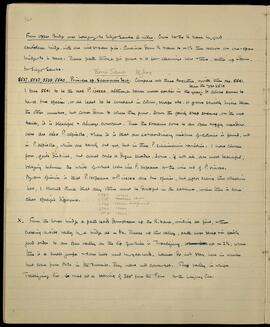
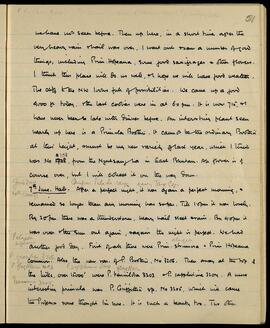
we have not seen before. Then up here, in a short time after the very heavy rain and hail was over, I went out and saw a number of good things, including Primula hopeana, some good saxifrages and other flowers. I think this place will do us well, and hope we will have good weather. The cliff to the NW looks full of possibilities. We came up a good 4000 ft today. The last coolies were in at 6.0 pm. It is now 7.15, and I have never been so late with dinner before. An interesting plant seen nearly up here is a Primula boothii. It cannot be the ordinary boothii at this height, and must be my new variety of last year, which I think was No. 1178, from the Nyuhsangha in East Bhutan. All flower is of course over, but I will collect it on the way down.

7th June. Halt. After a perfect night, it was again a perfect morning, and remained so longer than our morning has so far. Till 1.0 pm it was lovely. By 2.0 pm there was a thunderstorm, heavy hail, sleet and rain. By 4.0 pm it was over and the sun out again, and again the night is perfect. We had another good day. First of all there were Primula elongata and Primula hopeana common. Also the new variety of P. boothii, No. 3206. Then away at the top of the hills, over 15000' were P. kingii 3203 and P. sapphirina 3204. A more interesting primula was P. tsariensis No. 3205, which will cause the Professor some thought I'm sure. It is such a beauty too. Two other
Notes on Primulas in Tang Chu area
LSH/1/1/5/1/106 · Part · 1937-06-07
Parte de The Ludlow & Sherriff Collection

SUMMARY:
Notes compare Primula specimens: No. 2305, likely a variety of P. griffithii from 14,000–15,000 ft, resembling No. 21621 from Chikchar, Tsari (May 1936), with early, low, non-whorled flowering on open grassy slopes. No. 3227 is identified as P. hopeana, noted as unusually early; Cooper collected it on 20th June and 1st July, with later flowering previously observed in Tsari and in Tibet.

CONTENT:
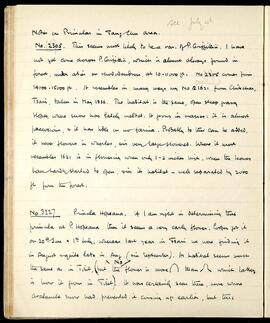
Notes on Primulas in Tang Chu area.

No. 2305. This seems most likely to be a var. of P. Griffithii. I have not yet come across P. Griffithii, which is almost always found in forest, under Abies or Rhododendron, at 10-11,000 ft. No. 2305 comes from 14,000-15,000 ft. It resembles in many ways my No. 21621 from Chikchar, Tsari, taken in May 1936. The habitat is the same, open steep grassy slopes, where snow has lately melted. It grows in masses: it is almost precocious, and it has little or no farina. Probably to this can be added, it never flowers in whorls, or very large flowered. Where it most resembles 1621 is in flowering when only 1-2 inches high, when the leaves have hardly started to open, and in its habitat - well separated by 2,000 ft from the forest.

No. 3227 Primula Hopeana. If I am right in determining this primula as P. Hopeana, then it seems a very early flower. Cooper got it on 20th June and 1st July, whereas last year in Tsari we were finding it in August and quite late in Aug (or September). Its habitat seems much the same as in Tibet, (but the flower is more [narrowly bell-shaped] than [widely bell-shaped] which latter is how it grows in Tibet). It was certainly seen there, here where avalanche snow had prevented it coming up earlier, but this

Field notes on Primula specimens Nos. 3206 and 3228
LSH/1/1/5/1/108 · Part · 1937-06-07
Parte de The Ludlow & Sherriff Collection

SUMMARY:
Notes compare Primula gracilipes var. (No. 3206) with P. Boothii and P. whitei across altitudes and relate it to a prior specimen from Nyuksam La in March 1936. Also assesses No. 3228 as P. sikkimensis (alpine form) or P. Hopeana, noting pale yellow flowers with reddish suffusion, possible hybridization, absence of P. Waltoni nearby, and a pink form seen on the Tulung La in 1934.

CONTENT:
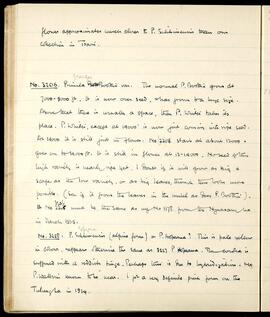
flower approximates much closer to P. sikkimensis than our collection in Tsari.

No. 3206. Primula gracilipes var. The normal P. Boothii grows at 7000-9000 ft. It is now over seed, and has grown to a huge size. Above that there is usually a space, then P. whitei takes its place. P. whitei, except at 14000' is now just coming into ripe seed. At 14000 it is still just in flower. No 3206 starts at about 12000 - goes on to 14000 ft. It is still in flower at 13-14000. No seed of this high variety is nearly ripe yet. I doubt if it will grow as big a scape as the low variety, or as big leaves, though this looks more possible. (See if it grows the leaves in the umbel as does P. Boothii). No 3206 must be the same as my No 1178 from the Nyuksam La in March 1936.

No. 3228. P. sikkimensis (alpine form) or P. Hopeana? This is pale yellow in colour, appears otherwise the same as 3227 P Hopeana. The corolla is suffused with a reddish tinge. Perhaps this is due to hybridization. No P. Waltoni known to be near. I got a very definite pink form on the Tulung La in 1934.

LSH/1/1/5/1/117 · Part · 1870-03-15
Parte de The Ludlow & Sherriff Collection

SUMMARY:
The diarist records abundant Primula species near camp between two passes on the way to Wangchelabh, noting P. stirtoniana (No. 3258), P. obliqua (3257), and others, with P. umbratilis not yet flowering and a small nivalis primula of special interest. During a halt at Tsophu and Dungchewang they experienced rain and thunder with brief views of snow mountains toward Tibet.

CONTENT:
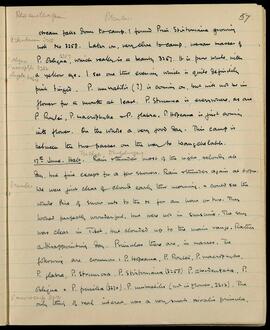
Rhododendron Primulas 57

...stream falls down to camp. I found Primula stirtoniana growing well No. 3258. Later on, very close to camp, we saw masses of P. obliqua, which really is a beauty 3257. It is pure white, with a yellow eye. I see one this evening which is quite definitely pink tinged. P. umbratilis (?) is coming on, but will not be in flower for a month at least. P. strumosa is everywhere, as are P. roylei, P. macrophylla and P. glabra. P. hopeana is just coming into flower. On the whole a very good day. This camp is between the two passes on the way to Wangchelabh.

17th June. Halt. Tsophu. Dungchewang. Rain and thunder most of the night, and cloudy all day, but fine except for a few showers. Rain and thunder again at 6:00 pm. We were just clear of clouds early this morning, and could see the white line of snow mountains to the N for an hour or two. They looked perfectly wonderful, but were not in sunshine. The sky was clear in Tibet, but clouded up to the main range. Rather a disappointing day. Primulas there are, in masses. The following are common: P. hopeana, P. roylei, P. macrophylla, P. glabra, P. strumosa, P. stirtoniana (3258), P. atrodentata, P. obliqua and P. pusilla (3270). P. umbratilis (not in flower, 3213). The only thing of real interest, was a very small nivalis primula,

Camp Changsethang: ridge flora and descent past Thampe Tso
LSH/1/1/5/1/149 · Part · 1933-07-04
Parte de The Ludlow & Sherriff Collection

SUMMARY:
The diarist records alpine plant finds along a high, windy ridge, including Diapensia, several Primula, Paraquilegia anemonoides, Rhododendron anthopogon, and a Meconopsis bella with a 56-inch taproot. On reaching Camp Changsethang, they note rain, brief sunshine, a steep drop past Thampe Tso into forest, and encountering an unfordable river.

CONTENT:
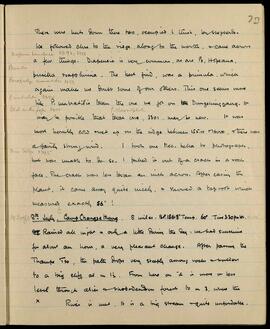
73

There were huts down there too, occupied I think, by shepherds.

We followed close to the ridge, along to the north, and came across a few things. Diapensia (Diapensia himalaica 3392, 3398) is very common, as are Primula hopeana, P. pusilla and P. sapphirina. The best find was a primula (Paraquilegia anemonoides 3399), which again makes me doubt some of our others. This one seems more like P. umbratilis (3394) than the one we got on the Dungshinggang. It (Rhododendron anthopogon 3400) may be possible that that one, P. chasmophila (3301), may be new. It was most horribly cold right up on the ridge between 15,500 and 16,000; there was a fairly strong wind. I took one Meconopsis bella (3395) to photograph, but was unable to do so. I pulled it out of a crack in a rock face. The crack was less than an inch across. After easing the plant, it came away quite nicely, and showed a taproot which measured exactly 56"!

(14,200 ft.) 8th July. Camp Changsethang. 8 miles. B.P. 186.8° Temp. 60° Time 3:30 p.m.

Rained all night and only a little during the day: we had sunshine for about an hour, a very pleasant change. After passing the Thampe Tso, the path drops very steeply among rocks and boulders to a big cliff at mile 1 1/2. From here on it is more or less level through Abies and Rhododendron forest to mile 3, where the river is met. It is a big stream and quite unfordable.

Page 157
LSH/1/1/5/1/157 · Part · 1933-07-04
Parte de The Ludlow & Sherriff Collection

CONTENT:
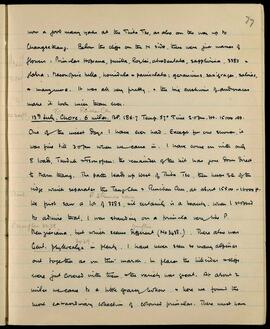
now a good many yaks at the Thiba Tso, as also on the way up to Changsethang. Below the cliffs on the N side, there were just masses of flowers: Primulas hopeana, pusilla, roylei, atrodentata, sapphirina, 3383 & glabra: Meconopsis bella, horridula & paniculata; geraniums, saxifrages, salvias, & many more. It was all very pretty, & the big cushions of Androsaces make it look nicer than ever.

13th July. Chore. 6 miles. BP. 18.67 Temp. 57° Time 2.0pm. Ht. 15000 odd.
One of the nicest days I have ever had. Except for one shower, it was fine till 3.0pm when we came in. I have come on with only 8 loads, Tenduk & Son open: the remainder of the kit has gone down direct to Ram thang. The path leads up West of Thiba Tso, then keeps SE of the ridge which separates the Tang Chu & Rinchen Chu, at about 15500 - 16000 ft. We first saw a lot of 3383, it certainly is a beauty. When I stopped to admire that, I was standing on a primula very like P. menziesiana, but which seems different (No 3438.) There also was Gent. phyllocalyx in plenty. I have never seen so many alpines out together as on this march. In places the hillsides & cliffs were just covered with them, & the variety was great. At about 2 miles we came to a little grassy hollow & here we found the most extraordinary collection of coloured primulas. There must have

LSH/1/1/6/1/59 · Part · 1936-06-26
Parte de The Ludlow & Sherriff Collection

SUMMARY:
Entries describe camps and travel around the Langong Chu Valley near Langong with rainy weather, extensive botanical observations (including Berberis, Meconopsis, and several Primula), and bird sightings such as snowcock eggs and blood pheasant. Notes mention an attempt toward the Lo La pass, information that Tsari Sama (Tsari SARPA) will not open until August, and companions Tsongpen and Chulia (the latter unwell).

CONTENT:
29

Berberis ludlowii 3851 is very common just in flower now. A fine big-flowered Berberis, 3851 is also common. The flowers are not yet close together however.

Langong Chu Valley
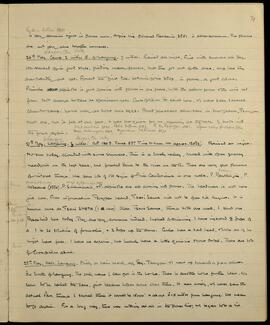
26th May. Camp 2 miles E. of Langong. 7 miles. Rained all night. Fine with showers all day. We started off in good style, finding many flowers, but then got out of the area, and here they are hardly out yet. Found the first Meconopsis betonicifolia 3869, in flower, a good colour. Primula alpicola is just coming into flower in one place, with the yellow form, otherwise red form. Not enough to take as specimens yet. Cremanthodium do exist here; I have seen several close to camp. Saw many snowcock eggs. Blood pheasant also seen in two places. Tsongpen shot one, but it fell at our feet and was too quick for us, running at the rate of knots into the forest again.
Fritillaria cirrhosa 3865, Pieris diffusa 3863, Rhododendron anthopogon 3861, Lysimachia prolifera 3860
Meconopsis betonicifolia 3859, Myricaria dahurica 3870

To Langong, Langong Chu Valley
27th May. Langong. 3 miles. B.P. 190.8. Temp. 58°. Time 11.00 am. Ht approx. 12083'. Rained at night. No sun today, clouded with some showers. This is a lovely valley, broad, with open grassy meadows on the left bank, but forested down to the river on the right. There are very few flowers of interest though. We saw lots of old signs of Primula cawdoriana in one nala. Primula pantlingii, P. hopeana (3880), P. sikkimensis, and P. alpicola are all coming into flower. The headman is not here just now. From information Tsongpen heard, Tsari Sama will not be open till August. It is known more as Tsari SARPA (= new) than Tsari Sama, though both are used. I shot one blackbird here today. They are very common indeed. Instead of skinning, I have injected 8 drops of a 1 to 20 solution of formalin, and 2 drops up the anus. Chulia has a bad head, looks as if he might have fever. I have no aspirin, but luckily have a little quinine and some Ortal. There are lots of Cremanthodium about.

28th May. Halt. Langong. Misty and rain nearly all day. Tsongpen T. went up towards a pass almost due South of Langong. The only name I can get is the Lo La. There is another Lo La further West. All seem to be called the same, just because Lopas come over them. It was misty; I never saw the actual Pass, though I should think it would be 15,000' and about 5-6 miles from Langong. We mean to go again. For a long way, there was nothing at all in the flower line; it began to be a bit...

LSH/1/1/6/1/72 · Part · 1938-06-09
Parte de The Ludlow & Sherriff Collection

SUMMARY:
The page describes the route from the Upper Bridge over the Lanjung to Sinjo Samba, including bridge crossings and path conditions through fir forest. At Tsari Sama (13 June), the author records Primula collections (Nos. 5537–5541), discussing color variation among P. sikkimensis forms and considering P. ioessa and P. Hopeana as true species. Additional route notes describe a path from the lower bridge up the right bank to Trashijing, a small gompa site used by yakherds, with reference to Tolo and the Lanjung Chu.

CONTENT:
36a

From Upper Bridge over Lanjung to Sinjo Samba 6 miles. Cross to the R bank by good cantilever bridge, with one mid stream pier. Continue down R bank to m 1 1/2 then recross on one-span bridge to L bank. Thence path through fir forest & a few clearings here & there, rather up & down, to Sinjo Samba.

Tsari Sama 13 June

5537, 5538, 5539, 5540. Primulae sp. sikkimensis Sect. Compare all these together, & with them No. 5541.
I take 5541 to be the real P. ioessa, although taken much earlier in the year than the type 2514. It alone seems to be a true species, or at least to be constant in colour, shape etc. It grows slightly higher than the other numbers, but comes down to where they grow. Down the fairly steep streams, on the wet banks, it is plentiful & always constant. Then the streams come to an open boggy meadow. Here are also P. alpicola, & here it is that an extraordinary mixture of colours is found, not in P. alpicola, which are barely out yet, but in these P. sikkimensis varieties. I have chosen four, quite distinct, but could take a dozen shades. Some, if not all, are most beautiful, varying between the white of what looks like P. Hopeana to the wine red of P. vinosa. My own opinion is that P. Hopeana & P. ioessa are true species, but after seeing this collection here, I should think that any others must be doubtful in the extreme, unless there is some clear specific difference.
5537 cocoa
5538 reddish cocoa
5539 cocoa incipient
5540 cocoa
5541 cocoa

X. From the lower bridge a path leads downstream up the R. bank, winding at first, then crossing a side valley by a bridge at m 3/4. Thence up this valley, path never steep & in fairly good order to an open valley on the lip of which is Trashijing, at m 2 1/2, where there is a small gompa & some huts used by yakherds. Lamas do not stay here in winter but come from Tolo in the summer. They have not come yet. The valley in which Trashijing lies, runs at a bearing of 340° from the Pass to the Lanjung Chu.

Langong to Chiniung La route and plant notes, 20 June 1938
LSH/1/1/6/1/80 · Part · 1938-06-20
Parte de The Ludlow & Sherriff Collection

SUMMARY:
Notes record plant collections around Chiniung La and Langong, including Primula and Pedicularis species with specimen numbers. The 4-mile route from Langong to Chiniung La over the Main Range is described, with fir forest, deep snow drifts near the pass, Lopas crossing the pass with past fatalities, and a large lake south of the pass still half iced.

CONTENT:
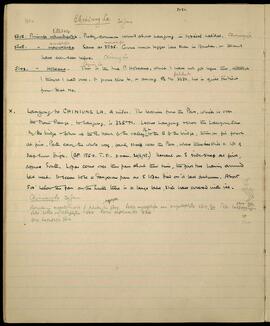
Chiniung La 20 June

  1. Primula rotundifolia. Pretty common round about Langong in typical habitat. Chiniung La

  2. Primula macrophylla. Same as 3895. Grows much bigger here than in Bhutan, or than I have ever seen before. Chiniung La

  3. Primula hopeana. This is the true P. hopeana, which I have not got before this, although I thought I had once. It grows close to, or among Pedicularis No 3932, but is quite distinct from that No. Chiniung La

X. Langong to CHINIUNG LA. 4 miles. The bearing from the Pass, which is over the Main Range, to Langong, is 325°M. Leave Langong across the Langong Chu by the bridge & follow up the R. bank of the valley 1/2 m to the E of the bridge, through fir forest at first. Path easy the whole way, fairly steep near the Pass, where there are still a lot of deep snow drifts. (BP. 185.0. T. 51. 9.0am. 20/6/38.) Descent on S side steep at first, approx South. Lopas come over this pass about this time, the first two having arrived last week. It seems to be a dangerous pass as 5 Lopas died on it last autumn. About 500' below the pass on the South there is a large lake, still half covered with ice.

Chiniung La 20 June

Pedicularis megalochila f. rhodantha 5607. Pedicularis mycophylla var. megalophylla 5613, type. Pedicularis takpoensis 5614.
Pedicularis bella var. holophylla 5615. Pedicularis siphonantha 5616.
Meconopsis horridula 5612.

Migyitun specimen list, 24 May
LSH/1/1/3/3/162 · Part · 1983-05-05
Parte de The Ludlow & Sherriff Collection

SUMMARY:
List of plant specimens with numbers recorded at Migyitun on 24 May, including several Primula species, Meconopsis simplicifolia, Cephalanthera longifolia, Pleione scopulorum, Cypripedium elegans, and Cassiope selaginoides.

CONTENT:
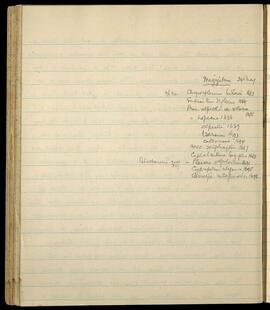
Migyitun 24th May

sp. no. Chrysosplenium ludlowii 1683
Enkianthus deflexus 1684
Primula alpicola var. violacea 1685
Primula hopeana 1686
Primula alpicola 1689
Primula tsariensis 1693
Primula calderiana 1694
Meconopsis simplicifolia 1687
Cephalanthera longifolia 1688
Phoebe's nest egg - Pleione scopulorum 1691
Cypripedium elegans 1695
Cassiope selaginoides 1696