
Mostrando 2 resultados

Descripción archivística
2 resultados con objetos digitales Muestra los resultados con objetos digitales
LSH/1/1/2/1/129 · Part · 1933-07-18
Parte de The Ludlow & Sherriff Collection

SUMMARY:
Notes abundant Delphinium grandiflorum and a large Aconite, with Plumbago absent here but expected lower down. Describes travel from the Dzong across the Nyamjang Chu, along the right bank to the Tsuk Chu and up to the customs village of Tsuk, then ascending toward the Cha La. Mentions reports on the road to Shingbe and contrasts the friendliness of Dongkar people with the rudeness in Tsuna.

CONTENT:
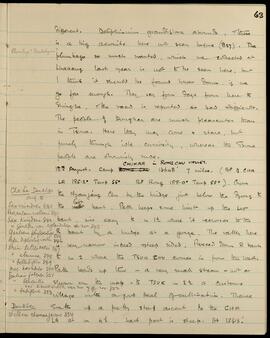
63

Different. Delphinium grandiflorum abounds, there is a big Aconite here not seen before (827). The Plumbago so much wanted, which we collected at Lhakang last year is not to be seen here, but I think it should be found lower down, if we go far enough. They say four days from here to Shingbe, the road is reported as bad & difficult. The people of Dongkar are much pleasanter than in Tsuna. Here they may come & stare, but purely through idle curiosity, whereas the Tsuna people are boorishly rude.

CHUKAR in RONG CHU VALLEY.
18th August. Camp 13648' 7 miles. (BP of CHA LA 185.2° Temp 55° BP Rong 188.0° Temp 55°). Cross the Nyamjang Chu by the bridge just below the Dzong to the left bank. Path keeps some height up the left bank, is easy to m 1 1/2 where it recrosses to the R bank by a bridge at a gorge. The valley here is very narrow indeed steep sided. Proceed down R bank to m 2 where the TSUK CHU comes in from the west. Path leads up this — a very small stream — not as shown on the map — to TSUK m 2 1/2 a customs village with a good deal of cultivation. Thence south up a pretty steep ascent to the CHA LA at
LSH/1/1/2/1/139 · Part · 1933-07-18
Parte de The Ludlow & Sherriff Collection
  • SUMMARY:
    The writer discusses limited views of the main range, suggesting Cho La is on the main range and that the area between it and the pass may belong to Bhutan; they note it is the transition zone they sought and should have visited instead of Mago, with similar zones at Shao and north of Tulung La. They record altitude preferences, expecting Plumbago lower along the Nyamjang Chu, and note Primula eburnea along the Cho La cliffs north of the Rung Chu at a lower elevation than at Narim Thang.

CONTENT:
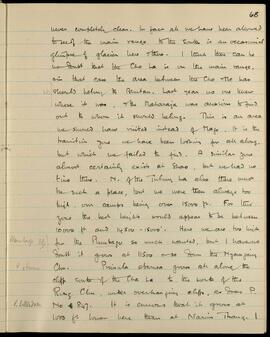
68

never completely clear. In fact all we have been allowed
to see of the main range to the south is an occasional
glimpse of glacier here and there. I think there can be
no doubt that the Cho La is on the main range,
in that case the area between the Cho and the La
should belong to Bhutan. Last year no one knew
where it was, and the Maharaja was anxious to find
out to whom it should belong. This is an area
we should have visited instead of Mago. It is the
transition zone we have been looking for all along,
but which we failed to find. A similar zone
almost certainly exists at Shao, but we had no
time there. N. of the Tulung La also there must
be such a place, but we were then always too
high, our camps being over 15000 ft. For this
zone the best heights would appear to be between
10000 ft and 14500 - 15000'. Here we are too high
Plumbago NB

  • for the Plumbago so much wanted, but I have no
    doubt it grows at 11500 or so down the Nyamjang
    P. eburnea
  • Chu. Primula eburnea grows all along the
    cliff side of the Cho La to the north of the
    Rung Chu, under overhanging cliffs, as does P.
    P. lilledale
  • No 847. It is curious that it grows at
    1000 ft lower here than at Narim Thang. I