Showing 8 results

Archival description
8 results with digital objects Show results with digital objects
LSH/1/1/8/1/33 · Part · 1946-12-23
Part of The Ludlow & Sherriff Collection

SUMMARY:
The party trekked through spruce, oak, pine, and larch forest, passed below Chunyima, obtained butter and fresh milk from herdsmen with yaks, and noted several plants including Primula atrodentata and Lilium wardii. They reached Tongkyuk Dzong after 68 days, glimpsing the Po Yigrong Range and collecting limited seed of an unidentified Rhododendron, a Gaultheria, and an evergreen Berberis.

CONTENT:
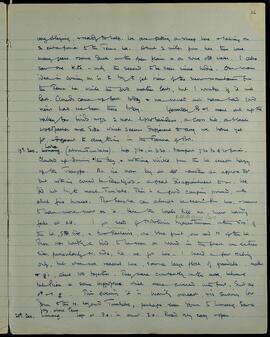
hard indeed - so much so that the kukri we used to cut out plants was broken slightly, & sparks were actually made when striking the ground! This might possibly be P. bhutanica or Whitei. Like P. atrodentata the buds were covered with dense farina. We did not see Chunyima at all, but passed below it scarcely a few miles (2?) to an open space, on the other side of the river from which is a herdsman's hut where there are two men with 50 yaks. Up behind that is a very fine snow peak (Sangdam Pu?) where the valley looks very good for flowers. We got some very dirty butter from them at 9 sangs the piece, about 1 1/2 lbs. Also most excellent fresh milk as a gift. The milk was brought in a ladle made of Rhododendron wood, holding about 1/2 gallon. Our 4 coolies caught us up today joined us here, so did 7 extra pony loads which had come on "sadsi". The path all day is through fine spruce, holly oak & latterly a little pine larch. Rhododendron in places plentiful. For the first mile or two the valley is open: thence it is a gorge, but everywhere very pretty indeed. My one only pair of shoes have given out, & am reduced to gym shoes from now on. We saw a little Mec. betonicifolia at Lunang, but no more anywhere else. I also saw one Prim. chungensis. Prim. atrodentata is everywhere & is all ready for moisture & a little warmth, to put it into flower.

22nd Dec. Tongkyuk Dzong. Home at last, after 68 days. It is worth it though, from what we can see. The march today was through conifer & rhod. forest all the way, but the forest was too thick for us to get but a glimpse of the Po Yigrong Range N. of Tongkyuk. We left at 7.30 & got in at 1.30. The road is good most of the way. In the plant line the most interesting things on the march were Lilium Wardii, common on the steep bracken covered slopes in the picea & pinus forest. A Rhododendron of which we got a little seed is one I don't recognize. We also got a Gaultheria & an evergreen Berberis, but saw no...
LSH/1/1/7/1/23 · Part · 1940-04-22
Part of The Ludlow & Sherriff Collection

SUMMARY:
The diary describes the poorly maintained Molo–Lhalung path, the heavy loads carried by local coolies, and observations of Primula species along the route, including P. Normaniana and P. latisecta with notes on their phenology. From a camp on the Chindi Chu the party climbed over the Nyug La through dense forest with Rhododendron and bamboo, noted P. tsariensis var. porrecta and P. Boothii, and obtained a view of the Lhalung valley, with P. Boothii extending its known distribution from the type locality in Bhutan.

CONTENT:
usually hanging over the river.

The people of Molo and Lhalung who use this path do not bother to keep it in any kind of repair. Only when they are unable to get over an obstacle do they do anything. Fallen trees remain where they fell. Rather than cut through them, they place notched logs over them and in some stretches one is compelled to walk more on notched logs than on path. We found it difficult enough, slippery and wet as the logs always are, and we were filled with admiration at the way the Molo coolies managed with their very heavy loads. In some cases one man chose to carry two loads, thus allowing an extra man to remain at home. These loads, with their own rations for both journeys, may have been as much as 160 lbs, but they did not seem to worry. Along the edges of the path or stream, as it often was, grew two new Primulas - P. Normaniana and P. latisecta. Both were in full bloom, and both records show an interesting extension westward. When we returned in May P. latisecta was over, and the plants had produced leaves in the axils of the pedicels. The stems then seem to fall over and act as stolons, the new leaves rooting beside the parent plant.

From our camp on the Chindi Chu we now had to climb again over a ridge which was crossed by the Nyug La. The forest is still dense, consisting of Picea (?) Rhododendron and, higher up, Bamboo. Among the Rhodos, we found R. rude, R. aureum, R. arizelum and R. uvarifolium, while magnificent clumps of P. tsariensis var porrecta were found at the edge of the Bamboo zone. P. Boothii also grows on the Nyug La, and its discovery here extends its known distribution by —— from the type locality in Bhutan.

From the top of the Nyug La, a view of the Lhalung valley is seen. The valley is broad and slopes gently to the South East. On the north side there is fairly extensive cultivation,

LSH/1/1/9/1/15 · Part · 1949-07-30
Part of The Ludlow & Sherriff Collection

SUMMARY:
Field notes from Gyechar describe an early start aided by two of H.H.'s men and an ascent to Tunk La, with observations of primulas (including P. bracteosa, P. gracilipes, and P. whitei) and changing vegetation with altitude. Weather was fine to cloudy with mist at night, elevations ranged from about 9525' to ~12900', and magpies were seen in the evening.

CONTENT:
which were not in flower. Magnolia campbellii (18648) was a very fine sight indeed, in full bloom, very common. Of primulas we found P. bracteosa (18644) almost over, another I don't think I have seen before, perhaps P. listeri (18669). It is really lovely to get away on the job again. We had a fine day with interesting flowers on the whole. Fine, clouding later, mist at night.

10th April. Gyechar. 10 miles. 195.4. 64°. 2.0 pm. 9525'. There was some rain at night, the day was cloudy with bright intervals. We were very early up & off by 5.45 which was good for our young team. Having two of H.H.'s men helps a great deal. They are good & what's more they are prepared to work. P. bracteosa was very common on the way up, & I took it again in better flower 18675. While taking it, I saw growing with it P. gracilipes 18673, which was very pretty there. P. bracteosa gives place to P. gracilipes above 11500'. Later on, further up, we came across P. whitei 18676, and was common up to the top & much further down this side. I must say I think it one of the best primulas there is. It was markedly short of the usual farina, in fact showed none of the copious farina so usual until we found some quite low down on this side. The path up & down is quite good, & the Tunk La is about 12900' (BP 189.3. 58°. 9.30 am). We made it 5 miles up & 5 down, the east side being easier on the whole. Vegetation changes rapidly. Rhododendron species predominate at the top, & give way suddenly to Tsuga, Picea & Pinus excelsa, the last of which continue down here. I saw two pairs of magpies here this evening, as I've seen them

LSH/1/1/8/1/29 · Part · 1946-12-20
Part of The Ludlow & Sherriff Collection

SUMMARY:
The diarist acquires a sheep and extra ponies to reach Temu La, aiming for views of snow mountains, and notes various birds including geese, a kite, Lophobasileus, a crossbill, a black woodpecker, a Sitta, and a large flock of Grandala. At Latsa Lunang above Tumbatse, poor visibility prevents mountain views; seeds of Notholirion hyacinthinum and two Berberis are collected, and weather and snow conditions are recorded before proceeding to Lunang.

CONTENT:
26

very obliging, ready to help. We are getting a sheep here, & taking on 2 extra ponies to the Temu La. About 2 miles from here there were many geese, some duck on the open plain & on some odd water. I also saw one kite - only the second to be seen since India. Our main idea in coming on is to try to get views of the snow mountains from the Temu La while the good weather lasts, but I wonder if it will last. Clouds came up fast today & we would not have had good views had we been there today. Yesterday B & I were out up the valley for birds & got 2 more Lophobasileus, a crossbill, a black woodpecker & a Sitta which seems different to any we have yet got, & different to anything in the Fauna of B.I.

19th Dec. Latsa Lunang (above Tumbatse). Left 7.30: in 3.30: transport 7.30 to 4.30 ponies. Clouded up during the day, & nothing visible from the La except hazy up the Tsangpo. An ice mass lay at 40° & another at approx 80°, but nothing could be identified - a great disappointment to us. We did not try to reach Tumbatse. This is a good camping ground, with about five houses. The Sancha can almost be seen from here, & seems to have more snow on it. Here the locals tell me, snow hardly falls at all. I got seed of Notholirion hyacinthinum within 500' of the La, SE side, & two Berberis, one blue fruit, one red N of the La. There was hardly a bird to be seen or heard in the forest on either side, particularly N side, till we got here - I heard a few calling only, but when we reached here, saw a large flock of Grandala, males & females, about 100 together. They were constantly on the move, between a tall Picea & some Hippophae which were covered with fruit. Shot one male or female. This evening it is heavily overcast, is snowing low down to the N beyond Tumbatse, perhaps even down to Lunang. Saw a jay, above Temo.

20th Dec. Lunang. Left at 8.0: in about 2.0. Road very easy & open.

LSH/1/1/8/1/31 · Part · 1946-12-23
Part of The Ludlow & Sherriff Collection

SUMMARY:
After a very cold night with snowfall, the party enjoyed clear weather and fine scenery with Sengdam La visible, noted a large flock of Grandala at Tumbabe, and observed various birds including geese and mallard (two of which were shot and retrieved). They marched from Lunang to Daú below Chunjima, remarked on Lunang ironwork, and collected plants including Notholirion hyacinthinum, a Codonopsis (seed), and a probable Primula sonchifolia.

CONTENT:
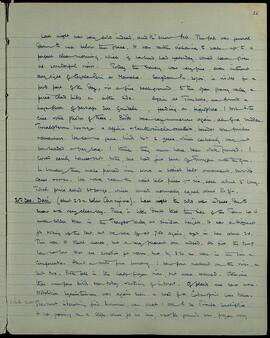
Last night was very cold indeed, and 1/2" snow fell. The fall was general down to well below this place. It was rather sickening to wake up to a perfect clear morning, which if we had had yesterday would have given us wonderful views. Today the scenery was very fine, even without any sight of Gyala Peri or Namcha. Sengdam La, 20,700', is visible for a good part of the day, in a fine background to the open grassy valley & Picea-clad hills on either side. Again at Tumbabe, we found a huge flock of perhaps 300 Grandala, feeding on Hippophae. I took both cine & still photos of these. Birds were very numerous again, all of a sudden. Trochalopteron henrici & affinis & Ianthocincla ocellata, besides rose finches & accentors. We saw no game birds but 2 geese, which certainly were not bar-headed or grey lag. I think they must have been white fronted. I could easily have shot both, but had just sent off Tsongpen with the gun. In Lunang they make pierced iron work — waist belt ornaments, swords cases & so on. We have seen the waist belt pieces — six, each about 3" long. Total price asked 20 sangs, which would normally equal about Rs 3/-.

21st Dec. Daú. (about 2-3 m. below Chunjima). Last night the cold was intense, due to snow & a very clear sky. There is little doubt that this side of the Temu La is much colder than in the Tsangpo valley at similar heights. It was a difficult job rolling up the tent, but we were off at 7.50 again, arrived here about 2.0. This was a short march, but a very pleasant one indeed. At first the temp was so low that we couldn't get warm, but by 9.30 we were in the sun & comfortable. About a mile from Lunang, I saw four mallard on the river, & shot two. Both fell in the half frozen river, but were rescued. Otherwise there were few birds seen today anything of interest. Of plants we saw more. Notholirion hyacinthinum was again seen & seed of a Codonopsis was taken.
R. Hunter 12021 The most interesting find however, was what I took to be Primula sonchifolia. It was growing on a slope which got no sun, & so the ground was frozen very

LSH/1/1/9/1/53 · Part · 1949-05-28
Part of The Ludlow & Sherriff Collection

SUMMARY:
The diarist notes magpies and quail, sends mail to H.H., Kalimpong, and Betty, and dispatches a box of dried flowers to Byakar Dz. On 20th May they march about five miles to Takhung via the Tang chu and Takhung chu, note altitude observations, collect Primula geraniifolia, and describe a well-made camp near Bumthang. The entry opens the next day's move toward Shabejetang.

CONTENT:
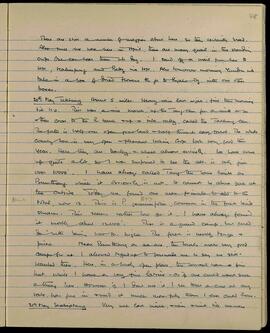
There are still a number of magpies about here, so they certainly breed. Also since we were here in April, there are many quail in the standing crops. One can hear them all day. I send off a mail from here to H.H., Kalimpong and Betty via H.H.. Also tomorrow morning Lundrup will take in a box of dried flowers to go to Byakar Dz. into our other boxes.

20th May Takhung About 5 miles. Heavy rain last night, fine this morning till 11.0. This was a nice march, up the Tang chu for a mile or so then cross to the R bank and up a side valley, called the Takhung chu. The path is half over open grassland and half through easy forest. The whole country here is very open and pleasant looking. Crops look very good this year. Here they are barley and wheat almost entirely. We have come up quite a lot, so I was surprised to see the alt. is only just over 10000'. I have always called Tang the same height as Bumthang which it obviously is not. It cannot be above 9000 at the outside. Today we found one more primula to add to the total, now 13. This is P. geraniifolia 18913, common in the forest beside streams. This seems rather low for it. I have always found it mostly above 12000'. This is a grand camp, but could do with being 1000 ft. higher. The forest is mostly tsuga and picea. Near Bumthang as we are, the locals make very good camps for us. I allowed Ngudup to persuade me to say we still wanted them. Here, in a lovely open place, the servants have a fine hut, while I have a very fine latrine - as if one could want such a thing here. However, if I don't use it, I see that a cow at any rate, has gone in and used it much more fully than I ever could have.

21st May Shabejetang Very wet last night, rain until we were

LSH/1/1/3/3/80 · Part · 1936-03-10
Part of The Ludlow & Sherriff Collection

SUMMARY:
The page is largely illegible, but right-margin notes list botanical names and abbreviations, including P. abies, P. mariana, P. glauca, Picea, Pinus, Larix, and terms like grandis and palustris. These appear to be botanical shorthand likely related to adjacent content.

CONTENT:
The image provided appears to be a page from a notebook with extremely faint, almost illegible handwriting. The main body of the page contains text that is too faded to transcribe accurately. However, there are some legible notes on the right-hand margin, which likely belong to the adjacent page. These notes appear to be botanical names or abbreviations:

P. abies
P. white
P. mariana
grandis

palustris

Rh.
Rh.

Picea

P. glauca

Pinus
Larix

LSH/1/1/8/1/38 · Part · 1946-12-31 - 1947-02-23
Part of The Ludlow & Sherriff Collection

SUMMARY:
Notes the thermograph start on 31 December 1946 at about 12,250 feet, with snowfall events at Tomjuk in early to mid-January. Describes tree composition in the Sobhe la valley and records date correspondences for Jan 28 and Feb 23 related to the thermograph.

CONTENT:
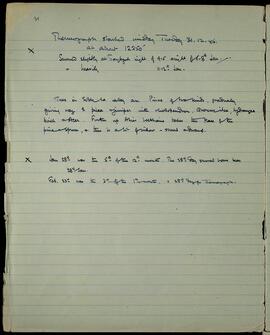
34

Thermograph started midday Tuesday 31.12.46.
at about 12,250'
Snowed slightly at Tomjuk night of 4-5, night of 6-8th Jan.
Snowed heavily 11-12th Jan.

Trees in Sobhe la valley are Pinus of two kinds, gradually
giving way to Picea and Juniper with Rhododendron, Quercus ilex, Hydrangea,
Birch and Acer. Further up Abies webbiana takes the place of the
Pine and Spruce, and there is a lot of Willow - shrub and dwarf.

Jan 28th was the 5th of the 12th month. The 28th day should have been
28th Jan.
Feb. 23rd was the 3rd of the 1st month. = 28th day for Thermograph.