Showing 4 results

Archival description
4 results with digital objects Show results with digital objects
LSH/1/1/2/1/34 · Part · 1915-05-29
Part of The Ludlow & Sherriff Collection

SUMMARY:
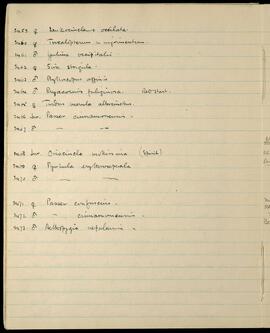
List of bird specimens numbered 2459 to 2473 with species identifications and notes on sex or age. Includes taxa such as Ianthocincla ocellata, Trochalopteron nigrimentum, Yuhina occipitalis, Phylloscopus affinis, and Rhyacornis fuliginosa (Redstart).

CONTENT:
2459 ♀ Ianthocincla ocellata.
2460 ♀ Trochalopteron n. nigrimentum.
2461 ♂ Yuhina occipitalis.
2462 ♀ Siva strigula.
2463 ♂ Phylloscopus affinis.
2464 ♂ Rhyacornis fuliginosa. Redstart.
2465 ♀ Turdus merula albocinctus.
2466 Juv. Passer cinnamomeus.
2467 ♂ — —

2468 Juv. Oreocincla mollissima (Spirit)
2469 ♀ Pyrrhula erythrocephala
2470 ♂ — —

2471 ♀ Passer confucius.
2472 ♂ — cinnamomeus.
2473 ♂ Aethopygia nepalensis.
LSH/1/1/1/1/200 · Part · 1933-09-18 - 1933-09-24
Part of The Ludlow & Sherriff Collection

SUMMARY:
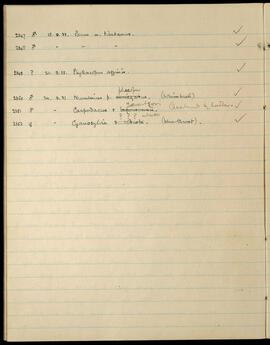
Page lists bird specimens with dates, sexes, and identifications: Parus m. tibetanus, Phylloscopus affinis, Numenius p. phaeopus (Whimbrel), Carpodacus r. severtzovi, and Cyanosylvia s. robusta (bluethroat). One identification (Carpodacus r. severtzovi) is noted as questioned by Ludlow.

CONTENT:
2347 ♂ 18. 9. 33. Parus m. tibetanus. ✓
2348 ♂ " " " ✓

2349 ? 21. 9. 33. Phylloscopus affinis. ✓

2350 ♂ 24. 9. 33. Numenius p. phaeopus. (Whimbrel) ✓
2351 ♂ " Carpodacus r. severtzovi. Questioned by Ludlow ✓
2352 ♀ " Cyanosylvia s. robusta. (bluethroat). ✓

LSH/1/1/3/3/102 · Part · 1933-04-09
Part of The Ludlow & Sherriff Collection

SUMMARY:
Notes list characteristic birds of Chayal Dzong with distribution observations across the Tsangpo and nearby regions. Locality records include sightings at Trimo (April 1936) and Keupup, Sikkim (Feb. 1938), with mentions of areas such as Subansiri, Gyamda Chu, and Tsari.

CONTENT:
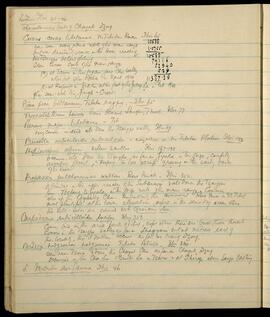
Ludlow Ibis 45-46
Characteristic birds of Chayal Dzong

Corvus corax tibetanus The Tibetan Raven - Ibis 65
Was seen everywhere north of the main range
but was decidedly scarce in the lower reaches of
the Tsangpo below Lilung.
Seen twice south of the main range
(a) at Trimo in the Nyam Jang Chu valley
at the foot of the Poda in April 1936
(b) at Keupup in Sikkim at the foot of the Jelep La in Feb. 1938
Often seen with the Jungle-Crow.

Pica pica bottanensis Tibetan Magpie. - Ibis 65

Trochalopteron henrici Prince Henri's Laughing Thrush. Ibis 77

Parus major tibetanus - Tit
Very common indeed all down the Tsangpo valley. Ibis 67

Prunella rubeculoides rubeculoides - everywhere on the Tibetan Plateau Ibis 192

Phylloscopus affinis Willow Warbler. Ibis 197-198.
Occurs all down the Tsangpo as far as Gyala in the Gorge, carefully
avoiding forest, keeping to low scrub growing on the sandy banks
of the river.

Propasser pulcherrimus waltoni Rose Finch. Ibis 352.
Abundant in the upper reaches of the Subansiri & all down the Tsangpo
from Tsetang to Gyala in the Gorge north of the main range common
also up the Gyamda Chu. Undoubtedly the commonest Rose Finch in SE Tibet
most plentiful at the lower elevations especially in the semi-dry areas where
the hill-sides are covered with Quercus ilex.

Carpodacus rubicilloides lucifer Ibis 353
Common bird in the arid parts of Tibet, especially where there are buckthorn thickets
Common in the Tsangpo Valley as far as Lhagyari but not noticed east of
this locality, though it doubtless occurs as far as Nang Dzong.

Perdix hodgsoniae hodgsoniae Tibetan Partridge. Ibis 384.
Seen near Tsong & down the Chayal Chu as far as Chayal Dzong.
Occurred on the Cha La & Bimbi La in Tsari & at Shira above Sanga Chöling

L Describe avifauna Ibis 46

LSH/1/1/2/1/122 · Part · 1933-07-18
Part of The Ludlow & Sherriff Collection

SUMMARY:
The party left Tsona for Dongkar via the Gorpo La, re-entering the Nyam Jang Chu valley in dry, sunny conditions and noting several bird records. They descended the Nyam Jang Chu, crossed the Cho La into the wetter Taree Rong Chu Valley, then on 22 Aug crossed the Me La to resume camp at Shengbe, with views over the Nyam Dzong Chu Valley from the Tibetan plateau. Notes reference related descriptions in Ludlow’s pages 89–92.

CONTENT:
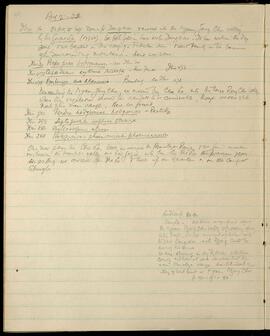
Aug 15-22

Hrs 16. On Aug 15 left Tsona for Dongkar, re-entered into the Nyam Jang Chu valley by the Gorpo La, (17,750). We both fell in love with Dongkar. It lies within the dry zone & we basked in the rays of a Tibetan sun & saw beauty in the bareness of the surrounding mountains. Here we saw
Hrs 30 Pica pica bottanensis - see Hrs 30
Hrs 473 Carpodacus erythrinus roseatus - Rose Finch Hrs 473
Hrs 478 Emberiza cia khamensis - Bunting see Hrs 478

Descending the Nyam Jang Chu, we crossed the Cho La into the Taree Rong Chu Valley, where the vegetation showed the rainfall to be considerable, though we were still north of the main range. Here we found
Hrs 501. Perdix hodgsoniae hodgsoniae - Partridge
Hrs 293 Leptopoecile sophiae obscura
Hrs 386 Phylloscopus affinis
Hrs 268 Hodgsonius phoenicuroides phoenicuroides

Our new pass, the Cho La, took us across the Himalayan Range, & we overlooked the beautiful valley we had gazed into from the Me La the previous year. On 22 Aug we crossed the Me La & took up our quarters in our old camp at Shengbe.

Ludlow p. 89-90
Sangla - we had a magnificent view of
the Nyam Dzong Chu Valley stretching away
to the North, whilst immediately below us to
the west Dongkar with Dzong could be
easily discerned.
We were standing on the Tibetan plateau
country & it was at once realized that the
main Himalayan range was to the south of us.
Story of lost bird in Nyam Dzong Chu
p. 90-91-92