Showing 11 results

Archival description
11 results with digital objects Show results with digital objects
LSH/1/1/4/1/11 · Part · 1936-07-02
Part of The Ludlow & Sherriff Collection

SUMMARY:
Notes compare Bimbi La plants with pinker flowers, report a good haul of Parnassius butterflies despite rain, and mention sightings of Babax waddelli and blackbirds. On 6 July at a camp on the north side of Drechung La (15000'), the route is described from the valley over a bridge, up a steep rhododendron-covered ascent to open hillside and along rocky slopes past yakherds; P. cawdoriana (specimen 2305) is common and fully out.

CONTENT:
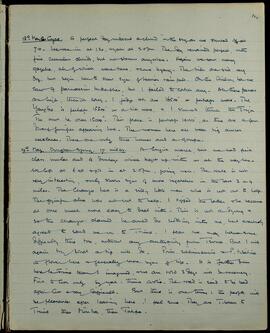
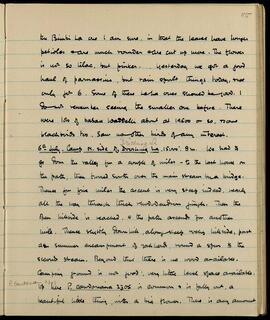
the Bimbi La ones I am sure, in that the leaves have longer petioles and are much rounder and are cut up more. The flower is not so lilac, but pinker. Yesterday we got a good haul of Parnassius, but rain spoilt things today, rose only for 6. Some of these Laha ones should be good. I do not remember seeing the smaller one before. There were lots of Babax waddelli about at 14500 or so, some blackbirds too. Saw no other birds of any interest.

6th July. Camp N. side of Drechung La. 15000'. 8m. We had to go down the valley for a couple of miles - to the last house on the path, then turned south over the main stream by a bridge. Thence for five miles the ascent is very steep indeed, nearly all the way through thick rhododendron jungle. Then the open hillside is reached, and the path ascends for another mile. Thence slightly downhill, along steep rocky hillside, past a summer encampment of yakherds, round a spur to the second stream. Beyond this there is no wood available. Camping ground is not good; very little level space available.

Up here P. cawdoriana 2305 is common and is fully out, a beautiful little thing, with a big flower. There is any amount
LSH/1/1/4/1/43 · Part · 1936-04-28
Part of The Ludlow & Sherriff Collection

SUMMARY:
Notes common primula, iris, and emerging gentians, with a few Parnassius butterflies at camp; praises local butter and mentions a local man paid in food and clothing who sells to buy an ornament for his wife. Sends for coolies to leave for Changu on the 21st; on 21 July at Drötang (11700') reports mist then sun near Karutra, parched conditions, no pheasants or larks, and shooting a rubythroat while declining to skin an aegithaliscus.

CONTENT:
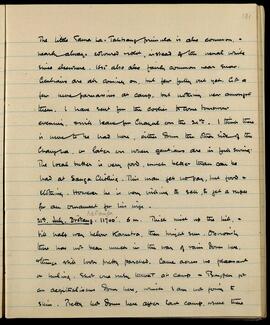
The little Tama La-Tahtsang primula is also common, nearly always coloured violet, instead of the usual white seen elsewhere. Iris also fairly common near snow. Gentians are all coming on, but few fully out yet. Got a few more parnassius at camp, but nothing new amongst them. I have sent for the coolies to come tomorrow evening, will leave for Changu on the 21st. I think there is more to be had here, either down the other side of the Chayha, or later on when gentians are in full swing. The local butter is very good, much better than can be had at Sanga Choling. This man gets no pay, but food & clothing. However he is very willing to sell, to get a rupee for an ornament for his wife.

21st. July. Drötang. 11700'. 6 m. Thick mist up the hill, till half way below Karutra, then bright sun. Obviously there has not been much in the way of rain down here, things still look pretty parched. Came across no pheasant or larking. Shot one ruby throat at camp - Bunged for an aegithaliscus down here, which I am not going to skin. Pretty hot down here after last camp, where there

LSH/1/1/5/1/131 · Part · 1933-06-21
Part of The Ludlow & Sherriff Collection

SUMMARY:
Notes record Parnassius butterflies, a woodcock nest with four eggs found on 22 June, and a list of Primula species observed. The writer describes the steep peaks of Dungshinggang, clear views toward Sikkim and beyond Chomolahri, getting soaked in a noon storm, and a 25 June entry noting rain overnight, a clear morning, and later cloud.

CONTENT:
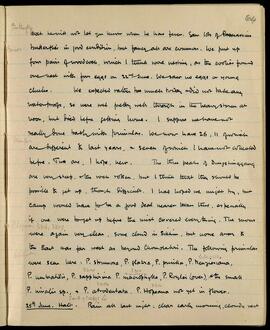
that he will not let you know when he has fever. Saw lots of Parnassius butterflies in good condition, but fancy all are common. We put up four pairs of woodcock, which I think were nesting, as the coolies found one nest with four eggs on 22nd June. We saw no eggs or young chicks.

We expected rather too much today and did not take any waterproofs, so were wet pretty well through in the heavy storm at noon, but dried before getting home. I suppose we have not really done badly with primulas. We now have 26, 11 of which are different to last year's, and seven of which I have not collected before. Two are, I hope, new.

The three peaks of Dungshinggang are very steep, the rock rotten, but I think that they should be possible to get up, though difficult. I had hoped we might try, but camp would have to be a good deal nearer than this, especially if one were to get up before the mist covered everything. The snows were again very clear, some cloud in Sikkim, but none away to the East as far west as beyond Chomolahri. The following primulas
were seen here: P. strumosa, P. glabra, P. pusilla, P. Menziesiana,
P. umbratilis, P. sapphirina, P. macrophylla, P. Roylei (over), the small
P. nivalis sp., and P. atrodentata. P. Hopeana not yet in flower.

25th June. Hall - Rain all last night, clear early morning, cloudy rest.

LSH/1/1/8/1/113 · Part · 1933-05-18 - 1933-05-19
Part of The Ludlow & Sherriff Collection

SUMMARY:
The diarist travels from Go-Cyae in perfect weather, noting tame gazelle, kyang, high passes, and sightings of parnassius butterflies, with observations on elevation, vegetation, and local attire. On 19 May they make a long march to Dongkar Dzong with mules and donkeys, encounter unhelpful local officials (Chanzo and Gyimpon) but find tipping effective, and plan to continue toward Trimo via Lior, noting Primula in flower and changing peoples along the route.

CONTENT:
18th May. Go-Cyae. A perfect day without a cloud in the sky as we started off at 7.0. We were in at 1.30, again at 2.0pm. The day remained perfect, with fine cumulus clouds, but no storms anywhere. Again we saw many gazelle, all of which were tame, and some kyang. The hills are still very dry, but begin here to show signs of heavier rainfall. On the Chidney La we saw 4 parnassius butterflies, but I failed to catch any. All these passes are high, though easy. I judge all are 16500' or perhaps more. The Yangtse is perhaps 15500' or a bit more, and I should think the Triju Tso must be over 15000'. This place is perhaps 14000', as there are a few dwarf juniper appearing here. The women here all wear big amber necklaces. There are only three houses and a Gompa.

19th May. Dongkar Dzong. 17 miles. A longish march, but we had first class mules and 4 donkeys which kept up with us all the way here. We left at 6.40 and got in at 2.0pm, going well. The route is not very interesting, only shows signs of more vegetation in the last 3 or 4 miles. The Chanzo here is a silly little man who is not one to help. The Gyimpon also was not one to help. I tipped the latter, who became at once much more easy to deal with. This is not a Dzong so the Chanzo claimed he could do nothing with me, but eventually agreed to send me on to Trimo. I fear we may have some difficulty there too, without any authority from Tsona. But I will again try what a tip will do. Prim. sikkimensis and P. tibetica in flower here and generally more signs of life. It is further from here to Trimo than I imagined, we are told 3 days will be necessary. First to Lior only by yak: thence coolies. The road is said to be bad after Lior and very difficult. But there is one thing: the people will be pleasanter after leaving here, I feel sure. They are Tibetan to Trimo then Monba, then Tahpa.

LSH/1/1/1/1/201 · Part · 1937-09-17 - 1937-09-24
Part of The Ludlow & Sherriff Collection

SUMMARY:
Diary notes describe arrival at Gyantse after storms, a visit to Tering Raja, meeting Worth and Rajput officers, and mail issues, with B.31 sent to Calcutta on 21 September 1937. Subsequent days in Gyantse included social calls on the Kengchung, a good lunch, and tennis with Worth, Henlin, and Capel, with observations of local crops and a parnassius butterfly.

CONTENT:
99
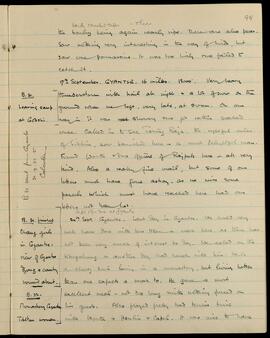
barley & mustard crops - & peas
the barley being again nearly ripe. There are also peas. Saw nothing very interesting in the way of birds, but saw one parnassius. It was too lively & we failed to catch it.

17th September. GYANTSE. 16 miles. 13000'. Very heavy
B. 31. thunderstorm with hail all night & a lot of snow on the
Leaving camp ground when we left, very late, at 9.0 am. On our
at Gobshi. way in it was showery & we got rather soaked
once. Called in to see Tering Raja, the rightful ruler
of Sikkim, now banished here - a most delightful man.
Found Worth & two officers of Rajputs here - all very
kind. Also a really fine mail, but some of our
letters must have gone astray, as we miss some
parcels which must have reached here had our
letters not been lost.

B 31 sent from Gyantse 21.9.37 to Calcutta

Sept 19 - we at Gyantse
B. 31. finished 24th Sept. Gyantse. Last day in Gyantse. We could very
Chang girls well have done with less than a week here, as there has
in Gyantse: not been very much of interest to do. We called on the
view of Gyantse Kengchung & another day had lunch with him. He is
Dzong & country a cheery soul living in a monastery, but living better
round about. than one expects a monk to. He gave a most
B. 32. excellent meal - not too long with nothing forced on
Monastery Gyantse. his guests. Also played pretty bad tennis twice
Tibetan women. with Worth & Henlin & Capel. It was nice to have

LSH/1/1/6/1/121 · Part · 1933-07-27
Part of The Ludlow & Sherriff Collection

SUMMARY:
Entries describe observations around Mira La, including Lerwa, snipe, and abundant Notholirion campanulatum, with fieldwork by the diarist alongside Tsungpen and Tendu yielding notable finds such as Meconopsis horridula var. lutea and a distinctive Saxifraga. Taylor is ill then recovers, Anna falls ill, and a Pu chu man is engaged to collect seeds for delivery to a monastery below the Dzong at Tsela Dz.; later a move north of Mira La is hampered by slow and misrouted coolies, with Chomo Dzong noted next.

CONTENT:
60

Butterflies
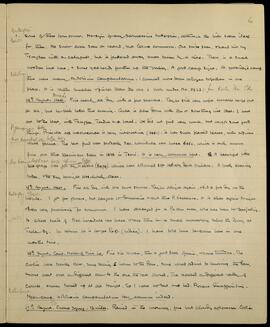
Some of these tomorrow. No sign of any Parnassius butterflies, although the hills seem ideal
Birds
for them. No snow cock seen or heard, but Lerwa common. One snipe seen, nearly hit by
Tsungpen with a catapult, but it fluttered away and was taken by a kite. There is a small
wooden hut here, and some yakherds further up the valley. A good camp site. At yesterday's camp
Notholirion
there were many Notholirion campanulatum. I counted more than a dozen together in one
place. It is rather smaller and pinker than the one I took under No. 5923: from Kulu Phu Chu.

Mira La
14th August. Halt. Fine nearly all day, with a few showers. Taylor still very unfit and unable to go out
at all, but he feels better this evening. Anna is also down with flu or something like that. I went
out to the West, with Tsungpen, Tendu and a coolie. We did not find very much, but we got some good
P. Younghusbandii 6061
things. Primula aff. macrocarpa is very interesting (6061): it has such flaccid leaves, with copious
Mec. horridula var. lutea 6062
white farina. The best find was probably Mec. horridula var. lutea 6062, which is only known
from our three specimens seen in 1936 in Tsari. It is very common here. A beautiful little
Sax. haematochroa 6070 sp. nov. type
Saxifraga was found by Tendu (6070) which was coloured soft velvety dark crimson. A lovely evening
today, the sky tonight absolutely clear.

15th August. Halt. Fine all day, with one short shower. Taylor all right again, and did a full day on the
Butterfly Birds
hillside. I got few flowers, but caught 10 Parnassius and saw three P. tischelanus. It is clear again tonight
and looks very promising for tomorrow. I have arranged for a Pu chu man, who has been to Darjeeling,
Seeds
to collect seeds of Mec. horridula var. lutea and take them to a small monastery below the Dzong at
Tsela Dz. In return he is to get Rs 5/- (Indian). I have told him to come here in one
month's time.

16th August. Camp. North of Mira La. Fine till 11.00 am, then a good deal of rain, some thunder. The
coolies were terribly slow, some taking 5 hours to the Pass. None would admit to knowing the Pass,
and some went over a different one to the one the rest crossed. They reached a different valley of
course, and never turned up at all tonight. So I have no tent and bed. Flowers disappointing.
Notholirion
Near camp, Notholirion campanulatum very common indeed.

17th August. Chomo Dzong. 12 miles. Rained in the morning, fine but cloudy afternoon. Coolies

LSH/1/1/4/1/48 · Part · 1933-07-23
Part of The Ludlow & Sherriff Collection

SUMMARY:
Notes from the pass near Nang Dzong, Kongbo record poor flowers but abundant butterflies, including Parnassius, Fritillaries, and Camberwell Beauties. The pass is wooded to the summit with larch and birch over shrubs and Rhodos, and from L. to Pero there was no conifer forest, only shrubs and bushes. Specimens listed include Didissandra kingiana, Delph. gyalanum, and Pedic. trichoglossa.

CONTENT:
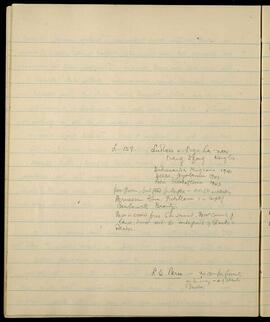
L. 159. Ludlow & Nga La - near
Nang Dzong, Kongbo.

Didissandra kingiana 1941
Delph. gyalanum 1942
Pedic. trichoglossa 1943

poor flowers, but good butterflies - over 50 including
Parnassius Blues, Fritillaries & a couple of
Camberwell Beauties.

Pass is wooded face to the summit. Forest consists of
larch, birch with an undergrowth of shrubs &
Rhodos.

L. to Pero - no conifer forest;
on the way - only shrubs
bushes.

LSH/1/1/2/1/60 · Part · 1933-07-08
Part of The Ludlow & Sherriff Collection

SUMMARY:
Near Pangong Tso, a pair of Black-necked Cranes by a hot spring were very tame, with Brahminy Ducks even tamer. Ludlow and Sherriff collected Parnassius butterflies.

CONTENT:
Ludlow. 30. Near the Pangong Tso were a pair of Black-
necked Cranes near the hot spring which were
so tame that they took no notice when I approached
within gunshot distance. A number of Brahminy
Ducks were even tamer.

Ludlow & Sherriff collected
Parnassius butterflies.

LSH/1/1/2/1/123 · Part · 1933-07-18
Part of The Ludlow & Sherriff Collection

SUMMARY:
The writer describes a difficult return to camp after gear failures, arriving after dark to Ludlow’s camp in snow and thick mist, and notes splendid views around Gorpo La and the Tibetan plateau. On 16 August they traveled to Dongkar Dzong via the Sang La, collecting gentians and butterflies and viewing the Nyamjang Chu and nearby hills toward the Cho La.

CONTENT:
60

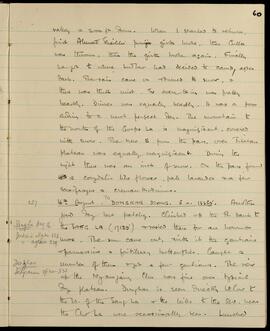
valley and 2000 ft down. When I started to return, first Ahmad Sheikh's pony's girth broke, then Culla was thrown, then the girth broke again. Finally we got to where Ludlow had decided to camp, after dark. The rain came on and turned to snow, and there was thick mist. So everything was pretty beastly. Dinner was equally beastly. It was a poor ending to a most perfect day. The mountain to the north of the Gorpo La is magnificent, covered with snow. The view E from the pass, over Tibetan plateau was equally magnificent. During the night there was an inch of snow. On the pass found a Corydalis like flower, pale lavender and a few saxifrages and cremanthodiums.

287 16th August. TO DONGKAR DZONG. 5 m. 13350'. Another
good day but patchy. Climbed up the R. bank to
Sang La Aug. 16. the SANG LA (17129') and rested there for an hour or
Gentiana algida 828. more. The sun came out, with it the gentians,
" " algida 829. parnassius and fritillary butterflies. Caught a
Donkhar number of them and got a few gentians. The view
Hedysarum sp. nov. 832 up the Nyamjang Chu was fine over typical
dry plateau. Dongkar is seen directly below to
the W. of the Sang La and the hills to the SW. near
the Cho La were occasionally seen. Lunched

LSH/1/1/2/1/117 · Part · 1933-07-18
Part of The Ludlow & Sherriff Collection

SUMMARY:
The diarist halts at Tsona, collects and packs Paraquilegia and catches Parnassius butterflies, while dealing with staff illness and asking the Dzongpen to arrange further collection and forwarding to Sahden amid rainy, snowy weather. Delays occur when yaks fail to arrive under the Tibetan 'Tao' system, with details of payments and origins from the Mago direction. The party then camps west of Gorpa La, noting barometric readings for nearby passes and Dongkar, and a route skirting Tsona hill.

CONTENT:
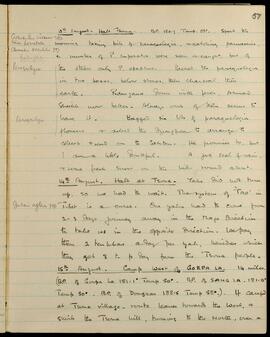
57

13th August - Halt Tsona. B.P. 186.7 Temp. 58°. Spent the morning taking bits of Paraquilegia, & catching parnassius, a number of P. imperator were seen & caught, but of the others only P. epaphus. Packed the Paraquilegia in two boxes, below stones, then charcoal, then earth. Ramzana down with fever. Ahmad Sheikh now better. Always one of them seems to have it. Bagged six lots of Paraquilegia flowers, & asked the Dzongpen to arrange to collect & send on to Sahden. He promises to, but I am a little doubtful. A good deal of rain, & some fresh snow on the hills round about.

[Marginal notes: Cyananthus incanus 794, Meconopsis horridula, Clematis orientalis 797, Butterflies, Paraquilegia]

14th August. Halt at Tsona. Yaks did not turn up, so we had to wait. The system of 'Tao' in Tibet is a curse. Our yaks had to come from 2-3 days journey away in the Mago direction to take us in the opposite direction. We pay them 2 tankas a day per yak, besides which they get 3 tankas per day from the Tsona people.

[Marginal note: Gentiana aglaia 798]

15th August. Camp West of GORPA LA. 14 miles. (B.P. of Gorpa La 181.1" Temp 50°. B.P. of SANG LA. 181.9" Temp 50°. B.P. of Dongkar 188.5 Temp 58°.). If camped at Tsona village, route leaves towards the West, & skirts the Tsona hill, turning to the North, over a