Showing 7 results

Archival description
7 results with digital objects Show results with digital objects
LSH/1/1/5/1/149 · Part · 1933-07-04
Part of The Ludlow & Sherriff Collection

SUMMARY:
The diarist records alpine plant finds along a high, windy ridge, including Diapensia, several Primula, Paraquilegia anemonoides, Rhododendron anthopogon, and a Meconopsis bella with a 56-inch taproot. On reaching Camp Changsethang, they note rain, brief sunshine, a steep drop past Thampe Tso into forest, and encountering an unfordable river.

CONTENT:
73

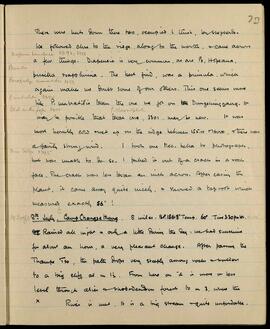
There were huts down there too, occupied I think, by shepherds.

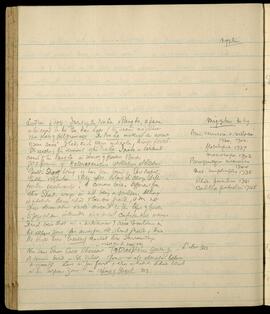
We followed close to the ridge, along to the north, and came across a few things. Diapensia (Diapensia himalaica 3392, 3398) is very common, as are Primula hopeana, P. pusilla and P. sapphirina. The best find was a primula (Paraquilegia anemonoides 3399), which again makes me doubt some of our others. This one seems more like P. umbratilis (3394) than the one we got on the Dungshinggang. It (Rhododendron anthopogon 3400) may be possible that that one, P. chasmophila (3301), may be new. It was most horribly cold right up on the ridge between 15,500 and 16,000; there was a fairly strong wind. I took one Meconopsis bella (3395) to photograph, but was unable to do so. I pulled it out of a crack in a rock face. The crack was less than an inch across. After easing the plant, it came away quite nicely, and showed a taproot which measured exactly 56"!

(14,200 ft.) 8th July. Camp Changsethang. 8 miles. B.P. 186.8° Temp. 60° Time 3:30 p.m.

Rained all night and only a little during the day: we had sunshine for about an hour, a very pleasant change. After passing the Thampe Tso, the path drops very steeply among rocks and boulders to a big cliff at mile 1 1/2. From here on it is more or less level through Abies and Rhododendron forest to mile 3, where the river is met. It is a big stream and quite unfordable.

LSH/1/1/3/3/156 · Part · 1983-05-05
Part of The Ludlow & Sherriff Collection

SUMMARY:
The route descends through jungle fir forest toward Podzo Sumdo, where a large valley leads to the Bimbi La. The page lists plant specimens collected, including Berberis, Rhododendron, Viburnum, Paraquilegia, Meconopsis, Cypripedium, and Podophyllum with collection numbers.

CONTENT:
L. 96. track leads gradually
downwards through jungle fir forest
until within a mile of Podzo Sumdo
when it falls more quickly. Large valley
comes in at Podzo Sumdo which
leads to the Bimbi La.

Conrosgongkhana - Podzo Sumdo.
21 May.
sp. nov? Berberis leidiari 1626
sp. nov. Rhod. miniatum 1627
" campylocarpum 1628
sp. nov. " erosum 1629
" pumilum 1634
sp. nov. " tsariense 1636
Viburnum cordifolium 1631
Paraquilegia anemonoides 1632
Meconopsis simplicifolia 1637
Cypripedium tibeticum 1638
Podophyllum sikkimense 1640

LSH/1/1/6/1/57 · Part · 1936-06-26
Part of The Ludlow & Sherriff Collection

SUMMARY:
Diary records travel from Lo La and Singo Samba to Molo, where Taylor arrives, followed by several halt days to reorganise. The party then moves to camps on the Langong Chu and above Singo Samba while Ludlow and Taylor explore down the Lilung Chu; mail and future rendezvous plans are noted. Botanical collecting is mentioned throughout, though limited by logistics and weather.

CONTENT:
Lo La
May 16. R. forrestii var. repens 3783, Primula 3784, Calostrotum 3785.
Singo Samba, Loda Chu near Molo. May 16. R. chaetomallum var. chamaephytum 3786. R. ponderosum 3792. 78.
P. calderiana 3788, locosa 3789. Paraquilegia anemonoides 3790. Lloydia tibetica 3791. R. laudum var. lucidum 3793.

masses, just coming into flower now. There is still a lot of snow on this side; Ludlow's Primula elizabethae has still a covering of 3ft over it. But I saw it on the south of the pass in masses yesterday on a small patch clear of snow. It was 1-1 1/2" up, so it won't be very long in coming away now. We hear here that there is no news of Taylor yet in Molo. They know of our coming. However, no news is good news, as had he had to turn back, I think our mail would have arrived with news of Taylor's return. We all crossed this fine bridge in style; Ludlow had no great difficulty this time. He could not have turned whether he wanted to or not.

Taylor arrives
17th May. To Molo. 10 miles. Fine road. Arrived in Molo 1:30 pm. Taylor walked in at about 3:00, before our kit had arrived. A wonderfully well-timed meeting, seeing he was last talked to by either of us in London by phone on 12th Feb.

Molo - Halt, reorganise kit and loads, buying bags of flour, developing photographs, planning future.
18, 19, 20, 21, 22 and 23rd May. Halt Molo. Dry sunny weather on the whole. Taylor is collecting masses of things, thoroughly happy. I have been too busy to get very much collecting done. Coolies were difficult. We should have been off on the 23rd, but no one turned up at all.

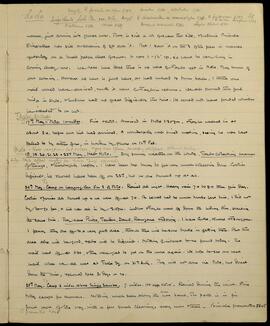
24th May. To Camp on Langong Chu, 5 miles south of Molo. Rained all night. Heavy rain 7:00 to 9:00 then a fine day. Coolies and ponies all turned up and we were off at 7:00. As we had had so much trouble last time, I did not try to go far, and kit was all in by 2:00 pm. Ludlow and Taylor went off down the Lilung Chu, starting at the same time. They have Pinso, Tenduk, Dawd, Ramzana and Tsering. I have Cutha, Kusho and Tsourpon. I fancy they are off to a very good area, though there will be some trouble in getting there. But this area also will be good, and also will be difficult. Nothing of interest to me was found today. The mail went off at 6:30, and then we were glad to get on the move again. We hope to see our next mail when we all meet at Tsala Dz. on 31st July. They will not come via Molo, but direct down the river, and should take 21 days or so.

25th May. To Camp 3 miles above Singo Samba. 7 miles. Height approx. 11,500'. Rained during the night. Fine today except for showers. Nothing much seen along the river bank. The path is in fine forest most of the way, with a few small clearings every now and then. Primula prenantha 3848.

LSH/1/1/3/3/170 · Part · 1983-05-05
Part of The Ludlow & Sherriff Collection

SUMMARY:
The diarist ascended the Na La through forest and traversed to the Pang La while traveling toward Tso Kar, searching for flowers and birds. Notes include observations of Heteroxenicus stellatus breeding among alpine rocks and a sighting of Snow Cock Pheasant (Tetraophasis szechenyii) across a wide elevational range.

CONTENT:
Migyitun

Ludlow page 104. Went up the Na La and Pang La, 2 passes Migyitun 30 August
on the road to the Tso Kar (Lake of the sacred one) which
is a place of pilgrimage. The Na La involved an ascent Primula verrucosa var. violacea
of some 3000 feet and led, as its name indicates, through forest. 1734, 1742.
On reaching the summit of the Na La I made a circuit flabellifera 1737
round to the Pang La in search of flowers and birds. macrocarpa 1743
Got 3 specimens of Heteroxenicus stellatus stellatus Paraquilegia anemonoides
Gould's Short-wing which has been found in East Nepal, 1744
Sikkim and Bhutan. This species extends its range still Meconopsis simplicifolia 1735
further eastwards. A common bird. Different from Rhododendron pumilum 1741
other Short-wings in not being a skulker. Although Caltha palustris 1745
it inhabits dense rhododendron and bamboo growth, it does not
shun observation and will ascend to the tops of bushes
to gaze at an intruder in a most confidential manner.
The 2 were shot in - wherever there are rocks and boulders in
the alpine zone, far away from all shrub growth. And
the birds were breeding amidst these surroundings.
--- shot on the next day ---
Also saw Snow Cock Pheasant Tetraophasis szechenyii - Ludlow 383
A common bird in Southeast Tibet. Found at all elevations between
11-15000 feet. Lives in fir forest and also inhabits Rhododendron scrub
in the alpine zone. - Specimen of Szechenyii 383.

LSH/1/1/3/3/159 · Part · 1983-05-05
Part of The Ludlow & Sherriff Collection

SUMMARY:
A wet halt at Pang-Sunda where the diarist scouted the valley while Danang and Tsung-pen explored rocky slopes, collecting multiple Primula taxa and noting promising sites. Notes mention Rhododendron campylocarpum, Viburnum cordifolium, and Paraquilegia anemonoides. The next day they moved to Migitun via steep paths through mixed forest, recording conditions and elevations.

CONTENT:
77

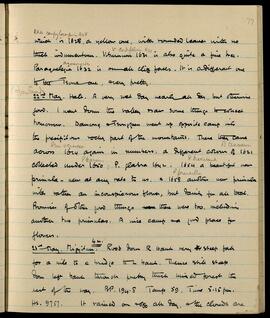
Rhod. campylocarpum 1628, which is 1628, a yellow one, with rounded leaves with no thick indumentum. Viburnum (V. cordifolium) 1631 is also quite a fine tree. Paraquilegia (anemonoides) 1632 is on all cliff faces. It is a different one to the Tsang one, very pretty.

Pang-Sunda
22nd May. Halt. A very wet day nearly all day, but otherwise good. I went down the valley and saw some things to collect tomorrow. Danang and Tsung-pen went up opposite camp into the precipitous rocky part of the mountains. There they came across 1614 (Prim. vernicosa) again in numbers: a different colour of 1621 (P. tsariensis) collected under 1650 (P. barnesii); P. glabra 1642 (P. dickieana). 1654 a beautiful new primula - new at any rate to us. And 1658 (P. prenantha) another new primula with rather an inconspicuous flower, but dainty for all that. Promises of other good things there were too, including another two primulas. A nice camp and a good place for flowers.

23rd May. Migitun. 4 m. Road down right bank, very steep path for a mile to a bridge to left bank. Thence still steep down left bank through pretty thick mixed forest the rest of the way. BP. 194.8 Temp 59. Time 5.15 pm. Ht. 9757. It rained on and off all day, and the clouds are

LSH/1/1/5/1/107 · Part · 1937-06-07
Part of The Ludlow & Sherriff Collection

SUMMARY:
Notes from the Tang Chu area record collections of primulas, saxifrages, rhododendrons, and Paraquilegia, observations from a ridge around 15,000 ft with barometric and temperature readings, and a storm that soaked the party. A halt on 8th June is noted with fine weather until late afternoon and three days of work remaining.

CONTENT:
Saxifraga 3210 - see 7th Aug.
P. umbratilis var. alba 3212
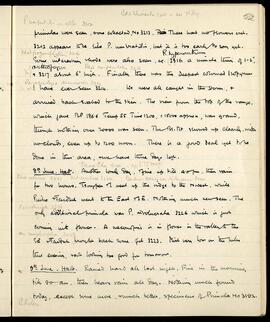
primulas were seen, some collected, No 3213. These had no flowers out.
3213 appears to be like P. umbratilis, but it is too early to say yet.
Rhod. pogonophyllum 3216 R. hypenanthum
Some interesting rhods were also seen, e.g. 3216 a minute thing of 1-2",
anthopogon Rhod. campanulatum 3218
& 3217 about 6" high. Finally there was the deepest coloured Isopyrum
Paraquilegia anemonoides 3214
I have ever seen 3214. We were all caught in the storm, &
arrived back soaked to the skin. The view from the top of the range,
which gave BP 18.6 Temp 55 Time 1200, = 15000 approx, was grand,
though nothing over 20000 was seen. The Br. Mt showed up clearly, with
no clouds, even up to 1200 noon. There is a good deal yet to be
done in this area, we have three days left.
Tang Chu area - up to 15000f
8th June. Halt. Another lovely day, fine up till 4.

LSH/1/1/2/1/61 · Part · 1933-07-08
Part of The Ludlow & Sherriff Collection

SUMMARY:
The diarist describes finding Paraquilegia like the Kashmir flower, coping with inquisitive locals while praising Ahmad Sheikh’s patience, and taking flower photographs with notes on shutter speeds; a coolie is noted for not stealing a cash box. On 17th July at Tsong, the Dzongpens requested portraits and four colour photographs were taken and copies sent.

CONTENT:
Paraquilegia anemonoides 678

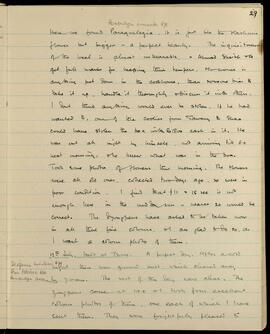
Here we found Paraquilegia. It is just like the Kashmir flower but bigger - a perfect beauty. The inquisitiveness of the local is almost unbearable, and Ahmad Sheikh etc. get full marks for keeping their tempers. No sooner is anything put down in the cookhouse, than someone tries to take it up, handle it thoroughly and discuss it with others. I don't think anything would ever be stolen. If he had wanted to, one of the coolies from Tawang to Shao could have stolen the box with Rs 1800 cash in it. He was out all night by himself, not arriving till 6:00 next morning, and he knew what was in the box. Took some photos of flowers this morning. The flowers were all old ones, collected two days ago, so were in poor condition. I find that 1/10 and 1/15 sec is not enough here in the midday sun - nearer 1/20 would be correct. The Dzongpens have asked to be taken now in all their fine colours, and I am glad to do so, as I want a colour photo of them.

17th July. Halt at Tsong. A perfect day. After a cold night, there was ground mist, which cleared away by 7:00 am. The rest of the day was clear. The Dzongpens came at 10:00 and I took four excellent colour photos of them, one each of which I have sent them. They were frightfully pleased to

Diapensia himalaica 679
Prim tibetica 680
Paraquilegia anemonoides