Showing 8 results

Archival description
8 results with digital objects Show results with digital objects
LSH/1/1/5/1/109 · Part · 1937-06-07
Part of The Ludlow & Sherriff Collection

SUMMARY:
Observations include mass flowering of Primula whitei around 14,000 ft and a pale yellow Sikkimensis-type primula likely from hybridisation. On 10 June the party halted, marked several Primula populations, recorded Primula vernicosa as a notable westward occurrence, kept busy drying specimens, and planned to return to Phobjikha via the Pele La Range towards Chendebi while collecting a few Rhododendron variants.

CONTENT:
P. flagellaris 3231.
Lloydia serotina 3232 Cypripedium tibeticum 3233

It has up to 4 flowers on a scape of 3" on pedicels of 3/4". At about 14000 or a little over P. whitei was in flower in masses still, & the flowers were on the whole bigger than low altitude, early ones. Among a mass of P. Hopeana 3227, I saw a few plants of a Sikkimensis primula coloured pale yellow, tinged with pink 3228. This presumably is the result of hybridisation. We have so far seen no P. sikkimensis, nor of P. Waltoni.

10th June. Halt. - Rained most of the night, but fine & overcast nearly all today. I have marked with 12 stakes the new little petiolaris primula 3192, & today marked the var. of P. Griffithii 3205 & P. umbratilis 3213. We came across P. vernicosa today, No 3240.

As far as I know this has never been recorded from nearly so far west as this; in fact I don't think it is recorded as occurring outside SE Tibet. It is no beauty, but interesting. We all took it easy today after a climb to the top of the ridge. We got back by 11.30 & stayed in camp. Tsongpen has little rest though, as flowers will not dry in this humid atmosphere, & he has about 200 still being changed. A few variations in Rhododendron completed the bag. We now move on back to Phobjikha, but will go a new route over the Pele La Range towards Chendebi.

Rhod. fulgens 3239. R. campanulatum 3243, R. campan. var. aeruginosum 3244

LSH/1/1/6/1/65 · Part · 1937-06-05
Part of The Ludlow & Sherriff Collection

SUMMARY:
From Chianang the diarist reports illness among companions, a reconnaissance with Kunio toward Chubumbu La with notable rhododendrons and Nomocharis, persistent rain, and route details. Plans to attempt the Chubumbu La despite local advice are noted, along with Brahminy Ducks near Lanyong; subsequent halts include botanical collecting and bird observations, before proceeding up-valley toward a pass.

CONTENT:
Chianang.

...vomiting everything he tried to swallow. He has no strength today at all. I went with Kunio towards Chubumbu La, which is about 6 miles from here, and has not too much snow on it to be crossed. There was nothing to be seen till we reached the head of the valley, then rhododendrons in profusion, P. pauliana all over the place, Nomocharis souliei the best of all, masses of Rhod. aff. repens, in full flower.

3rd June. CAMP CHIANANG. 5 miles. B.P. 189.0° Temp. 50° Time 11:30 am. Ht. approx. 12929'.
Rained most of the night and all today without a stop. Path follows the left bank for 2 miles, then crosses by a foot bridge to right bank. At mile 3 a side valley from the Chubumbu La is reached and crossed. The Chubumbu La lies at a bearing of 162° Magnetic and from here is about 4 miles distant. Follow up this valley left bank for ½ mile, then turn up a side valley. Ascent fairly steep for 1½ miles to a plateau, where there are 3-4 houses, where yaks are grazed in summer. Very swampy ground. We saw nothing at all today, as Lin was not yet too fit and Tsungpen only just able to come up, we did nothing today, but sat in camp and changed flowers. I'm afraid this valley is not as good as I had hoped: we are still too early. So I remain only two days and then go to the Chubumbu La for a day, to see if I can get across. It does not look impossible, though the locals say it is, and will remain so for another 2 months or more, when the Lhopas will come over. There are Brahminy Duck near Lanyong, and I saw they have their young one now and quite big.

4th June. Halt. Chianang. Fine intervals with a little sun up till 12:00 noon, then rain all day. Went up to the South, and had a fairly good day. Rhod. repens is abundant, but not above 14000'. With it were P. harrisii, and P. valentiniana 3953. This must cover the hillside, but is hardly in flower yet. Just as at Tsari Chikchar, it comes just after P. harrisii. First one gets a blue violet hillside, which is then turned into a deep velvety crimson one. P. vernicosa 3951, is here about half blue and half white. Saw a good many Grandala coelicolor above, some rubythroats; the latter is not the Yunnan bird.
Diapensia himalaica 3949, Potentilla leucanota 3950 - Bell common, Pot. stenophylla 3956, Pot. microphylla 3957 & 41, Pedicularis formis 3959.

5th June. Halt Chianang. Rain early at night, but a fine day till 2:00 pm, then thunder and rain and snow on the hills. Cleared 2 hours later. Went up the valley, past two more yak grazing grounds to a pass,

LSH/1/1/7/1/21 · Part · 1940-04-22
Part of The Ludlow & Sherriff Collection

SUMMARY:
After a snowfall delay, the party crossed the Lo La on April 24 and descended the steep south side into the Rhododendron–Abies forest. Along the Chudi Chu they observed numerous Rhododendron and Primula species, including the new Primula P. chionogenes and another unnamed Primula on an inaccessible cliff.

CONTENT:
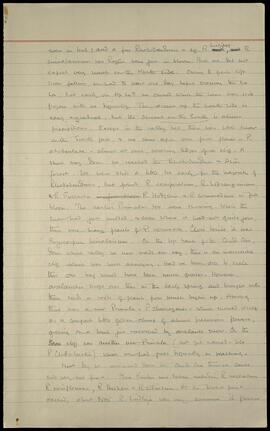
were in bud, and a few Rhododendrons - e.g. R. hirtipes, and R. cinnabarinum var. roylei were just in bloom. But we did not expect very much on the North side. Owing to fresh soft snow falling, we had to wait one day before crossing the Lo La, but early on April 24th we crossed while the snow was still frozen with no difficulty. The ascent up the North side is easy and gradual, but the descent on the South is almost precipitous. Except in the valley bed, there was little snow on the South face, and we came upon our first flower - P. atrodentata - almost at once, covering ledges of a cliff. A short way down we reached the Rhododendron - Abies forest. We were still a little too early for the majority of Rhododendrons, but found R. exasperatum, R. lopsangianum, R. forrestii, R. hodgsonii, and R. commodum in full bloom. The earlier Primulas too were showing. Where the snow had just melted, and even where it had not quite gone, there were many plants of P. vernicosa. Close beside it was Bryocarpum himalaicum. On the left bank of the Chudi Chu, down which valley we now made our way, there is an inaccessible cliff which was most annoying. Had we been able to scale this our bag would have been much greater. However, avalanches swept over this in the early spring and brought with them seeds or roots of plants from much higher up. Among these was a new Primula - P. chionogenes - which showed itself as a compact little golden clump of almost precocious flowers, growing on a bank just uncovered by avalanche snow. On the cliff was another new Primula (not yet named - like P. clutterbuckii) which we had great difficulty in reaching.

Next day we continued down the Chudi Chu through dense and very wet forest. More Rhodos were taken, including R. uvariifolium, R. neriiflorum, R. hookeri and R. ciliatum. At the lowest point reached, about 8500', R. lindleyi was very common in flower.

LSH/1/1/7/1/1 · Part · 1940-05-24
Part of The Ludlow & Sherriff Collection

SUMMARY:
The expedition splits, with Ludlow and Taylor heading to passes east of Tsela Dzong while Sherriff works the Lanyong area and passes between Roro and Bela Dzong, departing Roro on 24 May. The page describes the Lanyong Chu valley, its isolated inhabitants and seasonal conditions, and notes early-season floral observations on high slopes, including Rhododendron repens and Primula species.

CONTENT:
1940.

Sherriff - May - July -

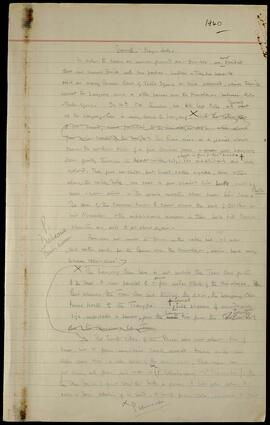
In order to cover as much ground as possible, we now decided that we should divide into two parties. Ludlow and Taylor were to visit as many passes East of Tsela Dzong as time allowed, while Sherriff worked the Lanyong area and other passes over the Himalayas between Roro and Bela Dzong. On 24th May therefore we all left Roro, and Sherriff went up the Lanyong Chu in easy stages to Lanyong.

The Lanyong Chu here is not unlike the Tsari Chu further to the West. It runs parallel to and about four miles North of the Himalayas. But whereas the Tsari Chu cuts through the axis, the Lanyong Chu turns North to the Tsangpo. Several side streams of considerable size, unfordable in summer, join the Lanyong from the South.

The valley, which is from 300-600 yards wide, flows gently through the valley bed. The inhabitants are very isolated. They grow no crops, but breed cattle and yaks. Here and there along the valley bed, one sees a few chalet-like huts, used by men and yaks alone in the winter months when snow lies deep. The rain of the summer turns to snow about the end of October or mid-November, and the inhabitants remain in their huts till March when they are able to get about again.

There was not much in flower in the valley bed, as it was still rather early for the passes over the Himalayas, which here vary between 13,500 - 15,000'.

The South sides of the passes were now almost free of snow, but North faces were still deeply covered. However on the open slopes about 14,000' a little North of the main axis, Rhododendron repens was just coming into flower, and with it (P. valentinianum and P. franchetii). On the same day as I first saw the latter in flower, I was also able to make a large collection of its seed. A north facing slope on which it grew P. vernicosa.

LSH/1/1/5/1/215 · Part · 1937-07-31
Part of The Ludlow & Sherriff Collection

SUMMARY:
Checklist of Primula species collected in 1937, with notes on prior collection status and several specimen numbers. Localities mentioned include Chendebi and Tang Chu.

CONTENT:
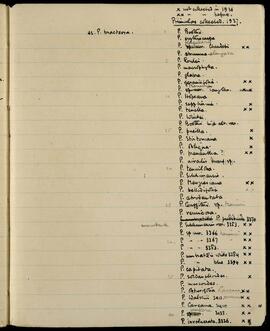
x not collected in 1936
xx " " " before.
Primulas collected. 1937.

  1. P. bracteosa.

1 P. Boothii.
P. erythrocarpa
P. flagellaris
P. sp. nov. Chendebi xx
5 P. strumosa elongata
P. Roylei.
P. macrophylla.
P. glabra.
P. geraniifolia xx
10 P. sp. nov. Tang Chu. xx
P. Hopeana
P. sapphirina x
P. tenella. xx
P. Winteri.
15 P. Boothii high alt. var.
P. pusilla. x
P. Stirtoniana x
P. obliqua. x
P. prenantha? xx
20 P. nivalis dwarf sp.
P. tenuiloba.
P. sikkimensis.
P. Menziesiana xx
P. bellidifolia xx
25 P. atrodentata
P. Griffithii sp. hancini
P. vernicosa.
P. pudibunda 3370
P. sikkimensis var. 3353. xx
30 P. sp. nov. 3366 hancini xx
P. " " 3367 xx
P. " " 3383. xx
P. umbratilis white 3384 xx
P. " blue 3394 xx
35 P. capitata.
P. soldanelloides. x
P. muscoides.
P. obtusifolia Caveana xx
P. Walshii 3413 concinna xx
40 P. Caveana 3410 xx
P. uniflora 3438. x
P. involucrata 3226. x

LSH/1/1/6/1/146 · Part · 1936-10-02
Part of The Ludlow & Sherriff Collection

SUMMARY:
Entries for 13 and 14 October describe wet, misty conditions around Trashidzung and Langong, limited success collecting rhododendron seed, and a pressing of P. chamaethauma, with coolies assisting and seeds dried for packing. News from Ludlow reports delays and rerouting due to the Lilung bridge collapse, with casualties and mail issues, and mentions movements via Lhacha, Tsela Dzong, and toward Kyindong/Sangachöling.

CONTENT:
74a
Oct. 13 Tsari Sama
seeds of P. chamaethauma 6603, P. morsheadiana 6604,
P. sikkimensis 6606, P. vernicosa 6607,
Swertia kantelu 6605.

far as from Trashidzung here: & that the third stage is much the same. He gives two names as on the preceding page. He also says that the path never enters Loque, but it must go very close to it.

Tsari Sama
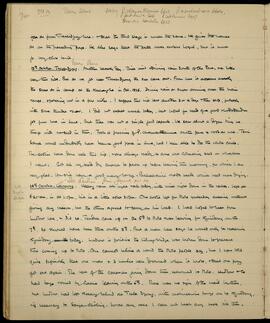
13th October. Trashidzung. Another beastly day. Thick mist & driving rain south of the Pass, & little on this side. But as we got near Trashidzung the sun came out. From here it appears exactly the same as in camp at the Kashong La in Oct. 1936. Driving rain or snow coming over the main range, petering out in a few miles. I suppose this will last another 3 or 4 days then stop, probably with some thunder snow. I did not expect much today, but hoped for seed of a good rhododendron got from here in June. But there was not a single good capsule. We saw about a dozen tiny wee things with no seed in them. Took a pressing of P. chamaethauma on the pass & root as well. Tsari Sama would undoubtedly have been a good place in June, had I been able to do the whole circle. The coolies have done well this trip, & are always ready to come out collecting seed or whatever I want. Got all my seeds dry enough to pack up before leaving this morning, for which I am very glad. We still have a good many Lo-La - Pachakshiri rhodo seeds which need more drying.
See Ludlow's diary - Kew Journal XII 14.

14th October. Langong. Heavy rain all night & all today, with mist right down in the valley. Left at 8.30 am, in at 1.0 pm, kit in a little after 3.0 pm. One coolie left for Molo yesterday evening without giving any reason, but the others agreed to carry on his load. I had hoped to hear from Ludlow here, & did so. Tendup came up on the 5th to Molo & was leaving for Kyindong on the 7th, so should have been there on the 9th. But a man here says he would only be reaching Kyindong today. Ludlow is positive the Lilung bridge was broken down to prevent their coming up to Molo. One cannot believe a word the Molo people say, but I was told quite definitely that one man & 3 mules were drowned when it broke, & that one pony got out again. The rest of the caravan going down then, returned to Molo. Ludlow & Co had to go round by Lhacha leaving on the 5th. There was no sign of the mail between, but Ludlow had left Kesang behind at Tsela Dzong, with instructions to go on to Kyindong, if necessary to Sangachöling. So at any rate I can not hear any more till then.

LSH/1/1/6/1/93 · Part · 1938-07-08
Part of The Ludlow & Sherriff Collection

SUMMARY:
The diarist travels through swampy valleys near Tum La in persistent rain, noting mallard and snipe, yakherd huts, and that the pass is very low. Botanical work records several Primula species mostly past flowering; an attempt to explore the ridge in thick mist results in getting lost and retracing the route with help from a local.

CONTENT:
Tum La

the whole valley bed is a huge swamp, which made walking here an extremely wet job. But these lakes contain water lilies in profusion. Up here I came across about 30 mallard, this evening I hear many snipe flying round and calling. Occasionally one of them drums. Brahmins are also here in considerable numbers. The mixture of Tibetan and Lopa coolies I have all seem quite cheerful. They are an infinitely nicer lot here than round about Molo and Langong. This pass must be one of the lowest, if not the lowest along the whole Range. I would guess its height at little over 12000 ft from here, but we will see tomorrow or the next day. We are still far too far away from the Pass to make camp for our three days, so must go on tomorrow.

7th July. Camp. 1 m N of Tum La. 4 miles. Rain at night, then rain all day today except for an hour or two at midday. We came on through a swamp the whole way here, past a few huts with yakherds. Camp is at the foot of the steep ascent to the Tum La. I am too late here. This pass is very low indeed, and although there are some good things on it, it is not high enough for many primulas. P. Elizabethae is still just in flower and there are some others over, one like P. Boothii, another with leaves like P. Roylei, P. prenantha and one which is perhaps P. alpicola violacea (3770) or like it, with deep velvety purple flowers. Rhododendrons are over. We went down the S side of the pass for ½ mile, but there was nothing much to be seen. Rain very heavy indeed today. The main valley continues beyond this - in fact the Nyam Chu is a very large river still - quite unfordable I should say. It comes in from 285° M.

8th July. Halt. Tum La. Rained hard all night and all today except from 4.0 to 6.0 am. I went up to the Tum La, (B.P. 190.4. Temp. 55° T. 7.0 am. Ht approx. 12243') then turned East, keeping roughly along the ridge. But the mist was very thick and we could see nothing of the country. In fact it was so bad, that we were completely lost for over an hour on our way back: this in spite of having a local with us who had often been up that way. We luckily recognized one place we had passed, and the Lopa was able to track our footsteps in the grass, till we knew where we were. It was a disappointing day though, on the whole. There are P. vernicosa (in seed). P. Roylei (seed) P. Elizabethae, nearly over, P. aff. alpicola (5770) P. prenantha, P. barbatula No 5791 a primula I have never seen before, but unfortunately the flowers

LSH/1/1/6/1/103 · Part · 1933-07-05
Part of The Ludlow & Sherriff Collection

SUMMARY:
At W. Tsanangho, the diarist reports heavy rain and poor visibility, explores the Tsanangha valley, and notes scarce primulas overall but finds two primulas new to them (No. 5865 of the Dryadifolia section and No. 5872, a nivalid close to P. sino-purpurea). Logistics are disrupted due to Kushu’s arrangements, reducing planned time on the Kuchaha; Kesang and a local accompany the outing, with observations of musk deer and local attire from Kongbo.

CONTENT:
And we found Cassiope wardii for the first time 5846. Primulas are more remarkable for their absence than anything else. We only saw P. Paulingii, P. prenantha, P. Dryadifolia & P. doshongensis (or is it P. Kongboensis?). No new ones, none of the old favorites like P. baileyensis, P. valentiniana or even P. Rockii, nor is there any sign here of P. Elizabethae. Thanks to Kushu's bad arrangements—it is his fault rather than the coolies—I can only stop here 1 day, owing to shortage of coolies' rations. And instead of 6 days on the Kuchaha, I will have but 2.

W. Tsanangho
18th July. Halt. A very wet night, & pouring rain all day. I would like to have seen this place on a clear day, with its glaciers & towering cliffs. It should be a fine sight, but there seems no hope in the monsoon, this year at any rate. We went straight up the main valley today to the Tsanangha. I certainly don't think laden coolies could manage it now, but why did they not say that was their reason.

We found the hillside very bare at first, on the whole there is remarkably little in this valley, good as it appears to be in the distance. However it had some good things. P. Valentiniana is profuse over a wide area, P. prenantha also, & P. Paulingii & P. vernicosa. P. Rockii is over, but common—a rather small form. P. Jonarduni too is common above 14000 ft. But we at last managed to find two new primulas—new to us anyway—after I had almost given up hope. One is I think another of the Dryadifolia section, or so it would appear from the roots & leaves & general habit. But it also has a marked pompom of hairs at the throat, which I thought was peculiar to the Bella section. It is a pretty little primula (5865) & oddly enough, grows close to P. Jonarduni. But the best found was No 5872, a Nivalid which appears to be close to P. sino-purpurea. Except for the colour, rich purple—it gives one an idea of P. obliqua, with the adaxial lobes reflexed in exactly the same way. I think it must take pride of place this year with P. Elizabethae, another nivalid. Musk deer seem to be pretty common here, as we walked on to two. Lerwa also common, & a lot of Coelicolor above.

Kesang & a local came with me today. The local wore a vampire hat, peculiar to the wet districts of Kongbo, made of coarse felt, with a wide undulating brim, very useful in this rain. Very cold indeed today, with a strong wind on the hilltops from the SW, driving what was then almost sleet. Fresh snow again on the highest peaks.