Showing 23 results

Archival description
23 results with digital objects Show results with digital objects
LSH/1/1/5/1/109 · Part · 1937-06-07
Part of The Ludlow & Sherriff Collection

SUMMARY:
Observations include mass flowering of Primula whitei around 14,000 ft and a pale yellow Sikkimensis-type primula likely from hybridisation. On 10 June the party halted, marked several Primula populations, recorded Primula vernicosa as a notable westward occurrence, kept busy drying specimens, and planned to return to Phobjikha via the Pele La Range towards Chendebi while collecting a few Rhododendron variants.

CONTENT:
P. flagellaris 3231.
Lloydia serotina 3232 Cypripedium tibeticum 3233

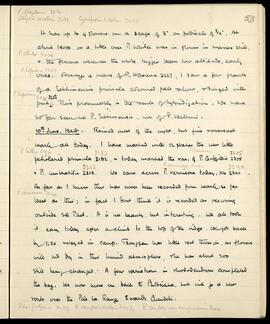
It has up to 4 flowers on a scape of 3" on pedicels of 3/4". At about 14000 or a little over P. whitei was in flower in masses still, & the flowers were on the whole bigger than low altitude, early ones. Among a mass of P. Hopeana 3227, I saw a few plants of a Sikkimensis primula coloured pale yellow, tinged with pink 3228. This presumably is the result of hybridisation. We have so far seen no P. sikkimensis, nor of P. Waltoni.

10th June. Halt. - Rained most of the night, but fine & overcast nearly all today. I have marked with 12 stakes the new little petiolaris primula 3192, & today marked the var. of P. Griffithii 3205 & P. umbratilis 3213. We came across P. vernicosa today, No 3240.

As far as I know this has never been recorded from nearly so far west as this; in fact I don't think it is recorded as occurring outside SE Tibet. It is no beauty, but interesting. We all took it easy today after a climb to the top of the ridge. We got back by 11.30 & stayed in camp. Tsongpen has little rest though, as flowers will not dry in this humid atmosphere, & he has about 200 still being changed. A few variations in Rhododendron completed the bag. We now move on back to Phobjikha, but will go a new route over the Pele La Range towards Chendebi.

Rhod. fulgens 3239. R. campanulatum 3243, R. campan. var. aeruginosum 3244
LSH/1/1/5/1/179 · Part · 1933-07-21
Part of The Ludlow & Sherriff Collection

SUMMARY:
Travel from Maruthang (Reinchen Chu) to Chichukang (Tang Chu) amid heavy rain, with notable plant collecting including a new gentian, Delphinium muscosum, and primulas from Thita Tso. Tendup redirected a visitor to Rihang, and Tsongpen was sent to Thita Tso and later reported a herd of burhel near the primula site.

CONTENT:
88

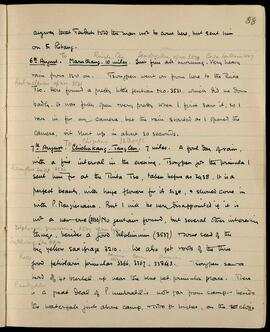
anyway that Tendup told the man not to come here, but sent him on to Rihang.

6th August. To Maruthang (Reinchen Chu). 10 miles. Just fine all morning (Saxifraga sp. nov. 3528). Very heavy rain from 12.0 on (Corda. bealhamii 3527). Tsongpen went on from here to the Thita Tso. Here found a pretty little gentian No. 3531 (Gent. melensis sp. nov. 3531), which did me down badly. It was fully open and very pretty when I first saw it, so I ran in for my camera, but the rain started as I opened the camera, and it shut up in about 20 seconds.

7th August. To Chichukang (Tang Chu). 7 miles (12,200 ft). A foul day of rain, with a fine interval in the evening. Tsongpen for the primula I sent him for at the Thita Tso, taken before as 3438 (P. uniflora 3438, 3536). It is a perfect beauty, with huge flowers for its size, and should come in with P. Menziesiana. But I will be very disappointed if it is not a new one (3536). No gentians found, but several other interesting things, besides a good Delphinium (3537) (Delphinium muscosum 3537 sp. nov. Lyon), some seed of the big yellow saxifrage 3210 (Saxifraga sp. 3210). We also got roots of the three good petiolaris primulas 3366, 3367, 33843 (Roots: Barnardi alba, Chamaethauma, strumosa). Tsongpen saw a herd of 40 burhel up near the blue pet. primula place. There is a great deal of P. umbratilis not far from camp beside the waterfall just above camp, 12,500 ft higher, on the talus slopes.

LSH/1/1/5/1/125 · Part · 1933-06-21
Part of The Ludlow & Sherriff Collection

SUMMARY:
Notes on unsuccessful searches for bird eggs near Black mountain, observations of Primula involucrata, and receipt of fresh vegetables from HM at Bumthang with a return letter mentioning Bumthang forests and George. On 23rd June at camp on Dungshinggang south of Nabzi La, fine weather accompanied a long collecting day with Tenduk, yielding few flowers but adding a primula (No. 3301), likely P. umbratilis, which was difficult to photograph.

CONTENT:
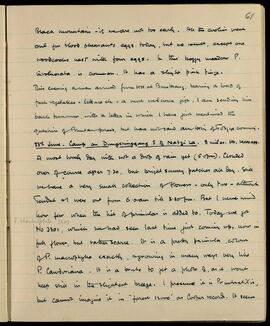
Black mountain - if we are not too early. All the coolies went out for blood pheasant's eggs today, but no result, except one woodcock's nest with four eggs. In this boggy meadow P. involucrata is common. It has a slight pink tinge. This evening a man arrived from HM at Bumthang, bearing a load of fresh vegetables - lettuce etc - a most welcome gift. I am sending him back tomorrow with a letter in which I have just mentioned the question of Bumthang forests, but have not said anything of George coming.

23rd June. Camp on Dungshinggang S of Nabzi La. 8 miles. Ht. 14000 app.
A most lovely day with not a drop of rain yet (5.0 pm). Clouded over of course after 7.30, but bright sunny patches all day. Still we have a very small collection of flowers - only two - although Tenduk and I were out from 6.0 am till 3.30 pm. But I never mind how few when the list of primulas is added to. Today we got No 3301, which we had seen last time just coming up, now in full flower, but rather scarce. It is a pretty primula, colour of P. macrophylla exactly, and growing in many ways very like P. Cawdoriana. It is a brute to get a photo of, as it won't keep still in the slightest breeze. I presume it is P. umbratilis, but

LSH/1/1/9/1/107 · Part · 1949-07-12
Part of The Ludlow & Sherriff Collection

SUMMARY:
The writer reports finding a new lily and abundant Notholirion macrophyllum, and receives mail from Kalimpong with news that Branklyn is for sale and may be acquired. A letter from Taylor confirms P. umbratilis roots arrived safely and began to show growth after soaking. On 23rd July they marched to Dhur, noting an uninteresting, damp route where two rivers join.

CONTENT:
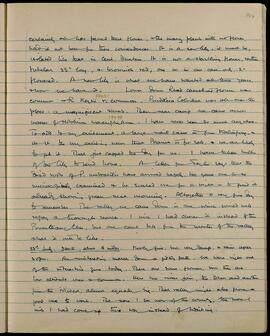
certainly all has passed their flower, the many plants with no flower, had it not been for these coincidences. It is a new lily: it must be, isolated like that in Cent. Bhutan. It is not a startling flower, rather tubular 2 1/2" long, a brownish red, one or in one case only, 2-flowered. A new lily is what we have wanted all these years, now we have it. Lower down Rhododendron camelliiflorum was common. R. keysii v. common. Buddleja colvilei was all over the place - a magnificent shrub. Then near camp we came across masses of Notholirion macrophyllum. I have never seen so much anywhere. To add to my excitement, a large mail came in from Kalimpong, & in it, the very exciting news that Branklyn is for sale, & we are likely to get it. That just capped the day for us. I have taken bulbs of the lily to send home. A letter from Taylor says that the dried roots of P. umbratilis have arrived safely. He gave one to be microscopically examined & he soaked one for a night - to find it already showing green next morning. Altogether a very fine day to remember. The valley we came down is one which would well repay a thorough search. I wish I had chosen it instead of the Bumthang Chu, but one can't tell from the mouth of the valley what it will be like.

23rd July. DHUR, about 4 miles. Mostly fine, but very damp, & rain after 2.0pm. An uninteresting march down a filthy path. We were right out of the interesting zone today. There are some flowers, but they are low altitude ones & common. Here two rivers join, the Dhur and another from the N-West, almost equal size. That valley might also prove a good one to work. The more I see now of the country, the more I wish I had come up this way instead of waiting.

LSH/1/1/5/1/131 · Part · 1933-06-21
Part of The Ludlow & Sherriff Collection

SUMMARY:
Notes record Parnassius butterflies, a woodcock nest with four eggs found on 22 June, and a list of Primula species observed. The writer describes the steep peaks of Dungshinggang, clear views toward Sikkim and beyond Chomolahri, getting soaked in a noon storm, and a 25 June entry noting rain overnight, a clear morning, and later cloud.

CONTENT:
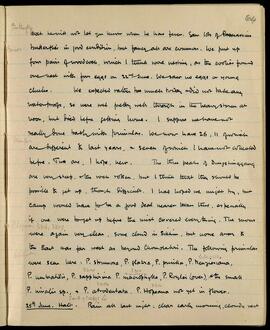
that he will not let you know when he has fever. Saw lots of Parnassius butterflies in good condition, but fancy all are common. We put up four pairs of woodcock, which I think were nesting, as the coolies found one nest with four eggs on 22nd June. We saw no eggs or young chicks.

We expected rather too much today and did not take any waterproofs, so were wet pretty well through in the heavy storm at noon, but dried before getting home. I suppose we have not really done badly with primulas. We now have 26, 11 of which are different to last year's, and seven of which I have not collected before. Two are, I hope, new.

The three peaks of Dungshinggang are very steep, the rock rotten, but I think that they should be possible to get up, though difficult. I had hoped we might try, but camp would have to be a good deal nearer than this, especially if one were to get up before the mist covered everything. The snows were again very clear, some cloud in Sikkim, but none away to the East as far west as beyond Chomolahri. The following primulas
were seen here: P. strumosa, P. glabra, P. pusilla, P. Menziesiana,
P. umbratilis, P. sapphirina, P. macrophylla, P. Roylei (over), the small
P. nivalis sp., and P. atrodentata. P. Hopeana not yet in flower.

25th June. Hall - Rain all last night, clear early morning, cloudy rest.

LSH/1/1/5/1/121 · Part · 1933-06-19 - 1933-06-21
Part of The Ludlow & Sherriff Collection

SUMMARY:
Diary entries from Dungshinggang record rest days with fine mornings and heavy afternoon hail and rain, photo developing difficulties, and limited plant finds including Primula species. A message arrives from Phobshikha that Purbo had been ill for a day but is now much better.

CONTENT:
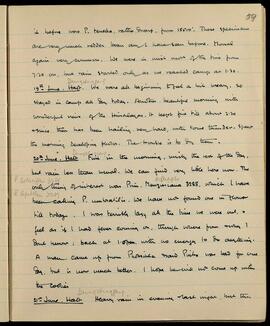
it before was P. tenella, rather dwarf, from 15,500'. These specimens are very much redder than any I have seen before. Monal again very common. We were in mist most of the time from 7.30 on, but rain started only as we reached camp at 1.30.

[Dungshinggang]
19th June. Halt. We were all beginning to feel a bit weary, so stayed in camp all day today. Another beautiful morning with wonderful views of the Himalayas. It kept fine till about 2.30 & since then has been hailing very hard, with some thunder. Spent the morning developing photos. The trouble is to dry them.

[Dungshinggang]
20th June. Halt. Fine in the morning, misty the rest of the day, but rain less than usual. We can find very little here now. The [P. bellidifolia 3288] only thing of interest was Prim. Menziesiana 3288, which I have [P. capitata 3289] been calling P. umbratilis. We have not found one in flower till today. I was terribly lazy all the time we were out, & feel as if I had fever coming on, though where from anyway I don't know: back at 1.0 pm. with no energy to do anything. A man came up from Phobshikha said Purbo was bad for one day, but is now much better. I hope he will not come up with the coolies.

[Dungshinggang]
21st June. Halt. Heavy rain in evening & last night, but this

LSH/1/1/9/1/93 · Part · 1933-07-03
Part of The Ludlow & Sherriff Collection

SUMMARY:
The diarist describes plant collecting on cliffs and sand slopes, with Pasang separately gathering notable specimens, and notes wildlife sightings, weather, and plans to camp higher and visit Marlung. Letters were sent to Betty and Asha Wangmoo. On 4 July, amid active trade movement, Pasang and Yundun collected more plants near the Sekpen's huts, and plans are considered for a September trip to the Tibdey La after returning from Bumthang.

CONTENT:
1 June
Went to a big cliff straight ahead. This was covered at the foot with almost white P. umbratilis (19332), and with a lot of the yellow Sax I saw 2 days ago, glabricaulis (19306). Then again to the right, then found P. waddellii and one or two other good things, including a high altitude Delphinium muscosum (19328) and a Sax bergianoides (19329) and a nice dwarf plant which I don't remember seeing before (19327), which grows in sand slopes below cliffs. Pasang was separate, and he got one fine big Gentian, G. phyllocalyx (19322), and also a very pretty little white Potentilla coriandrifolia (19324), which I'd like to get seed of, but unfortunately he only saw enough for the press.

Pasang saw many bharal, I saw one. I must take out the gun and have a go at one one day. We were lucky today, as it was almost fine the whole day until 5 minutes after we returned, when there was a deluge of rain. Really we should camp now at 14,500' to get the best of the alpines. They all seem to be high, and camping here at 12,000' is far too low: it makes a long walk to reach 15,000'. Tomorrow we have an off day, then go up to Marlung, at about 13,500'. Perhaps from there I will send the lads off for a couple of nights to one of the yakherds' shelters, which now mostly seem to be about 14,500'. Sent off a letter to Betty and one to Asha Wangmoo this morning.

4th July. Halt. More fine than wet. Great moving of trade up and down today, mostly Bhutanese, but also Tibetans. I stayed in camp, but Pasang and Yundun preferred to go out. They went up the valley behind the Sekpen's huts, then over the ridge to the north, and they collected 10 quite good plants, including one fine Prim. soldanelloides (19346), which was growing on a cliff, which I think unusual. I've always seen it just on steep open grassy hillside. Ngudup seemed surprised when I told him we would return here after Bumthang, for seed. I've been wondering whether it might not be good to go to the Tibdey La for Sept 1-12th or 15th.

LSH/1/1/10/1/18 · Part · 1933-10-01
Part of The Ludlow & Sherriff Collection

SUMMARY:
The diarist reports severe infestation of P. umbratilis seed capsules by caterpillars, difficulty finding other seeds, snow melted up to about 15,500 ft, and the drogpas leaving the high pastures. On 2nd October at Ha-chu, after clear frosty weather, they observed a large herd of burhel, finished work in the Tsampa area (Bumthang Chu watershed), planned to cross to the Dhur Chu to meet Pasang and Yundon, and reflected on concluding Himalayan trips first planned with Ludlow in 1929 at Kashgar.

CONTENT:
From among the seeds of P. umbratilis which I collected today, I extracted 67 caterpillars, which shows the difficulty with seed. Practically every capsule I take now has worms or caterpillars. I can't find any seed of a big Swertia. All capsules have 3-4 red worms in them. None of the aconites were ready yet, and I have had to take roots of some. Snow is not now lying here. It has all melted up to 15500' or so. The drogpas have all gone down from these high grazing grounds, I am surprised to see. They come in the 5th month (July) and leave in the 7th or 8th (Sept). It is a very short season. I sympathize with them going down now, but I think they should come up much earlier, when the grass is good.

2nd October. Ha-chu. This is the best day we have had. There was rain and some snow last night, but it cleared up to a beautiful morning and there was hard frost. Up till midday today there was lovely bright sun, and then huge clouds collected, but it has not snowed, and I should think we will now have several similar days. I got a little more of the same seed today, but nothing special. We walked onto a huge herd of 58 burhel on our way back. And now we have finished with the area called Tsampa, which includes the watershed of the Bumthang Chu, but not the Dhur Chu. Tomorrow we cross to the head of the Dhur Chu, and there meet Pasang and Yundon. It is difficult now to think that we have practically finished our work this year, and that there are now but 5 more days left. In a month I will be in Sikkim. And this is the last of our Himalayan trips, which Ludlow and I started planning in 1929, sitting in front of the fire in the drawing room of the Consulate General in Kashgar.

LSH/1/1/9/1/79 · Part · 1933-06-18 - 1933-06-19
Part of The Ludlow & Sherriff Collection

SUMMARY:
From Ha-li on 18 June, the party explored the Dirupnang valley toward a pass to Geormotangka, finding notable Primula and Cassiope on wet cliff ledges in mist and rain. On 19 June they remained in camp at Ha-li, planning for the Rhularkarchung Pass, and were awakened at night by a rockfall that came toward the camp, with Lhakpa alerting the party.

CONTENT:
a thing before. Unfortunately he got little seed, but says there is more, not in flower yet. I must be careful to get roots of it later on. The other side I feel sure is very much better, but it is a pity there is no bridge here. We thought of making one, but it would be too much of a business over the main river.

18th June. Ha-li. Mostly misty & rain, with some fine intervals. We went up the valley called Dirupnang which leads over a pass to Geormotangka. On the first cliff there were masses of P. umbratilis (19183), much finer than the first lot I got. Then we had a very bare day until we had gone as far as I could manage. I decided to try to come down a difficult waterfall, & was repaid by finding then the fine P. macrophylla v. macrocarpa (19189). It tucks itself under cliff ledges, on sheer rock cliffs, but where it gets the constant splash of water. I always feel that that is one of the varieties that should be a species. It has more difference from its species than many species have. A good deal of Cassiope also, of bellidifolia (19190) too. A very wet evening, & it is cold too up here when so wet.

19th June Ha-li. Had a day in camp, & it was a fine day with some sun. I have been waiting for a fine day to go to the Rhularkarchung Pass, but I think they are unlikely to come now, so we must go tomorrow. At about 3.0 am last night we were all awakened by the noise of huge rocks coming down the hill behind camp, & coming as it sounded — as I see it actually was this morning — straight for camp. They made a rather fearful noise crashing among boulders at first, & then a worse noise of tearing rhododendron bushes to bits as they crashed through them. I almost got up, then didn't, then when Lhakpa shouted I did get up & ran off to one side. But the nearest boulder,

LSH/1/1/5/1/159 · Part · 1937-07-14
Part of The Ludlow & Sherriff Collection

SUMMARY:
Notes intermixing among primulas near camp below a cliff, with white P. umbratilis out of reach. On 14th July the party traveled to Maruthang via ridges west of the Nam Chu, collecting P. umbratilis (No. 3444) near Chora and observing extensive blue petiolarid primula above 16,000 ft amid intermittent heavy rain.

CONTENT:
been the most awful intermarriage going on. There was P. Roylei, quite true and apart. Then there were all shades of colours from mixtures of 3366, 3367, and 3383. I counted seven variations in colour, and all were mixed together. We came on to camp under a huge sheer cliff, which has many flowers at the bottom, and halfway up a fair amount of the beautiful white umbratilis No. 3384. I tried to reach it from both top and bottom, but could not get near. It is a pity: I should like some more of it. However, we have a fair number of new flowers today, and it has all been great fun.

14th July. To Maruthang. 6 miles. 12,200'. Heavy rain from 3:00 pm and all through last night. Fine in the morning, no rain till 1:30. Rain rest of day. Coolies came more or less direct down to the Nam Chu, while we kept along the ridge west of the valley, crossing it once and recrossing shortly after, at about 16,000 ft. Just this side of Chora there are some very fine cliffs and in these were many fine clumps of the white P. umbratilis, taken before under No. 3384. I took another collection (No. 3444) and left a fine lot for seed collection. Just beyond this we came across the petiolarid primula, blue var., collected as No. 3367. For the next mile—on the west side of the ridge, above 16,000 ft—this primula was covering the ground. Snow lies late up