Showing 15 results

Archival description
15 results with digital objects Show results with digital objects
LSH/1/1/5/1/111 · Part · 1937-06-07
Part of The Ludlow & Sherriff Collection

SUMMARY:
Mail from Sarshang reports mixed results with new Meconopsis seed: Hay and Sandeman failed while Anderson succeeded; Taylor comments on germination methods. The diarist moves from Camp Kangchukka on the Pele La range with detailed route notes, persistent rain, and remarks on Primula no. 3249 possibly being P. stirtoniana. Camps, meadows, and forest routes are described en route toward Rukubzhi and Longte Chu.

CONTENT:
11th June. Camp Kangchukka, on Pele La range. 10 miles. Ht. approx 12000' (To 12000 ft.)

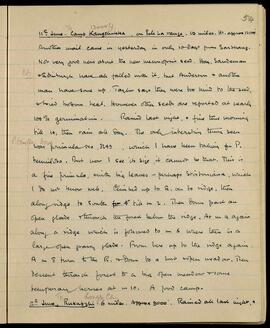
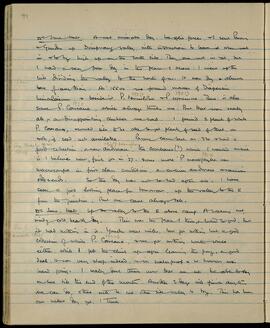
Another mail came in yesterday in only 10 days from Sarshang. Not very good news about the new Meconopsis seed. Hay, Sandeman & Edinburgh have all failed with it, but Anderson & another man have some up. Taylor says they were too kind to the seed, & tried bottom heat. However other seeds are reported at nearly 100% germination. Rained last night, & fine this morning till 10, then rain all day. The only interesting thing seen was Primula no. 3249, which I have been taking for P. tenuiloba. But now I see its size, it cannot be that. This is a fine Primula, with big leaves - perhaps Stirtoniana, which I do not know well. Climbed up to E. on to ridge, then along ridge to South till m 2. Then down past an open glade through the forest below the ridge. At m 4 again along a ridge which is followed to m 6 where there is a large open grassy glade. From here up to the ridge again. At m 8 turn to the R. & down to a lush open meadow. Then descent through forest to a big open meadow & some temporary houses at m 10. A good camp.

12th June. Rukubzhi (To Longte Chu) 6 miles. Approx 9000'. Rained all last night, &
LSH/1/1/9/1/82 · Part · 1937-06-22 - 1937-06-23
Part of The Ludlow & Sherriff Collection

SUMMARY:
In wet conditions the party split up: the diarist had a poor day on a dry hill while Pasang returned with a strong collection including a new Androsace, a suspected new Cochlearia, and P. macrophylla var. macrocarpa, alongside notes on Diapensia himalaica and several Primula including white P. caveana. The following day they worked up the valley east of camp in soaking weather; Gunden went far and gathered white P. caveana, but little else was found, prompting thoughts of leaving the area within a few days.

CONTENT:
22nd June Haer. A wet miserable day. We split forces, I sent Pasang and Gunden up Dimpuang valley with instructions to leave it when well in, and to try high up on the south side. They are not in yet, but I had a very poor day in the place I chose. I went up the hill dividing the valley to the north of us. It was dry and almost bare of anything. At 15,500 we found masses of Diapensia himalaica, and beside it P. tenuiloba and P. concinna. There is also some P. caveana, which always tricks me. But that was really all—a disappointing chukker we had. I found two plants of white P. caveana; would like to be able to get plenty of seed of that, or roots, if seed not available. Pasang came back at 3:30 and had a good collection: a new Androsace, the Cochlearia(?) which I wanted and which is, I believe, new, first for us in '37; some more P. macrophylla var. macrocarpa in first-class condition, a cushion Androsace, and various odds and ends. So the day was not so bad after all. I have seen a good-looking place for tomorrow, up the valley to the east from the junction. But one can never tell.

23rd June - Hall. Up the valley to the east above camp. A soaking wet, windy, cold, beastly day. This was the place I thought looked so good, but it had nothing in it. Gunden went miles, but for nothing but a good collection of white P. caveana, and we got nothing worthwhile either, while I felt the climb up after leaving the pony a good deal. It was very steep indeed, and in waterproof and waterproof trousers was hard going. I really don't think now that we will be able to stay on here till the end of the month. Another three days will finish all that we can do, and there will be no other side valleys to try. This has been our wettest day yet, I think.

LSH/1/1/9/1/145 · Part · 1933-09-01
Part of The Ludlow & Sherriff Collection

SUMMARY:
Notes record altitudinal occurrences and absence of hybrids, with blue flowers flowering later than white, and observations on farina and scent. Mentions that the Bumthang Chu-Trongsa Chu Divide may separate blue and white forms, and that pedicellation is not diagnostic for P. dryadifolia, with comparisons to cliffs in SE Tibet.

CONTENT:
137

occurs. That is 13500'. Where the specimen was taken is 5 miles up the valley at 15000'. There are no Calderiana there are no hybrids.
Waihau there are no strumosa. In between are the mixtures. Note that strumosa has the same bad smell exactly as Calderiana.

farina on calyx, pedicels & back of leaves.

from among thousands of the true colour.

Other. The blue flowers are definitely later than the white ones.

tenuiloba. This is pink to deep pink. P. tenuiloba is blue to deep blue-violet.
are practically white. It looks as if the Bumthang Chu-Trongsa Chu Divide may be the divide of the blue & white forms.
explanation.

found before.
on cliffs as in SE Tibet. Many are distinctly pedicelled, this should not be a diagnostic character for P. dryadifolia.

mixtures.

LSH/1/1/9/1/101 · Part · 1949-07-12
Part of The Ludlow & Sherriff Collection

SUMMARY:
At Haer, the diarist reports persistent rains and mist, a strenuous climb through gullies yielding no new finds but abundant Primula (including P. macrophylla var. macrocarpa, P. soldanelloides, P. sapphirina, P. tenuiloba, and P. caveana), and intentions to cross toward the Trongsa valley. With the monsoon returning, the diarist remains in camp doing photos while Pasang and Tundru explore a nearby nala; Ngudup’s reports of heavy rains and Tundru’s sore feet are noted.

CONTENT:
One more fine day, before the break comes again. There was lots of rain in the night, and has been since the fine days came. Long may it continue thus. Ngudup always gives such awful accounts of the rain from about now on for a month, that I can hardly expect much more clear weather. Tundru's feet don't improve much. We will miss him, as he always was a good boy, and always for some good things. And he had learnt to press flowers well, though not to change them well.

13th July. Haer. Thick mist in the morning up till 10:00 am, by which time we had climbed one of the awful gullies just below and behind camp. What a climb, and there was nothing new at all. What was there, in greater numbers than I've ever seen, was P. macrophylla v macrocarpa - in the hundred. We looked over the other side, but it was all too misty to see anything. We came down one gully this side of the one we went up, equally steep, and almost as hard work among all the boulders with very unsteady rocks. Again nothing new, but we marked a place where roots of P. soldanelloides could be taken. There were very few in flower, but a number of plants. Beside it grows P. sapphirina, and close to, also P. tenuiloba and P. caveana. The P. caveana up there was remarkably behind time, still in perfect flower. All these days now are disappointing, and I'll be glad to get over the pass to the Trongsa valley. Perhaps it won't be any better, but it will have many new places for us to try in any way.

14th July. Haer. The monsoon is back in all its fierceness again today, with thick mist and heavy rain all day, and last night. But we have had a really good break since the 8th, and can't complain. I again stayed in camp today, did photos, while Pasang and Tundru went out and up the nala on the right bank some distance up, but not too farther up, which leads...

LSH/1/1/5/1/110 · Part · 1937-06-07
Part of The Ludlow & Sherriff Collection

SUMMARY:
The author clarifies the locality as Kangchukka in the Langte Chu (flowing to Langte), noting an earlier field note name of Tang Chu and adding Kangchukka on specimen 3249. Detailed observations compare Primula specimens (including P. tenella) from 3203, 3249, and Chundebi 3052, discussing size, leaf and scape differences, elevation (8000 ft for the latter), and their apparent merging.

CONTENT:
580

The name of this place is Kangchukka, really in the Langte Chu, flowing down to Langte. I have named it Tang Chu on field notes, but added Kangchukka on 3249, the primula.

No 3249. P. tenella. I have taken this to be P. tenuiloba when collected at the last camp 3203 flagellaris. If this one is the same, it is very much bigger, the leaves are not like those of a minutissima: nor is the flower which is as big as that of P. Roylei, sometimes bigger. No 3203, 3249 & the Chundebi 3052 flagellaris primula I called new, all seem to merge into one another, though the latter was collected at 8000 which seems to separate it from the others. And the size of leaf & scape too, seem to put this one away from 3203 flagellaris. It is a most beautiful primula.

LSH/1/1/4/1/27 · Part · 1936-07-02
Part of The Ludlow & Sherriff Collection

SUMMARY:
Notes describe mixed sunshine and heavy rain near camp, with collections of primulas, gentians, and saxifrages, and sightings of Crossoptilon and snowcock; most coolies returned but no mail arrived. On 14 July at Kashong La, the morning was fair before turning to heavy rain.

CONTENT:
miles to the N of camp, and was in bright sunshine and
pretty heavy rain for an hour or two, both going on
together. Still this place is drier than I had expected,
though it looks as if it must be pretty wet on the
whole. There is another primula here - a rotundifolia
section - No 2349 (P. littledalei 2349) - different to both the Bimbi La one
and the Lela one. Tendu also found four flowers only
of another new minutissimae one 2350 (P. barbatula sp. nov. 2350). We could find
no more (P. tenuiloba 2354). Two gentians (Gent. coerulea aglaia 2353) - one I think G. prostrata,
and two saxifrages (Sax. hispidula 2348). But very little of everything
we found ("wardii" 2357) but the primula 2349. Crossoptilon and snow
cock are almost together on the hillside just below
here. Blackbirds numerous beside camp. All coolies
returned except two. They have done me very well
indeed. No sign of the mail.

14th July Halt. Kashong La. A good morning till about 9.0 am. After
that gradually becoming fouler and fouler. This evening it
is just coming down in streams. Otherwise a day
full of

LSH/1/1/5/1/57 · Part · 1933-05-09
Part of The Ludlow & Sherriff Collection

SUMMARY:
The party travels through dense fir and rhododendron to reach the Lamse La around 1200, then descends the west side into a broad cultivated valley with several closely set villages, good grazing, and wheat and buckwheat fields, noting bearings and distances. Soon after leaving Chandebi they discover a small Primula resembling P. tenuiloba at about 8000 ft on steep mossy slopes (No. 3052), and Purba speaks with the locals.

CONTENT:
before getting into fir forest. The last two miles is through pretty dense fir & rhododendron forest. The Lamse La is reached at m 6. B.P. 190.5° Temp. 60° Time 1200. Descent on West side steep at first, gradually easing off. First houses met at m 8. This place consists of the broad open valley, with excellent open spaces on the hills round about for grazing. There are several villages in the valley, all close together, a good deal of cultivation of wheat & buckwheat. Bearing from the Lamse La to the main village in the valley is 235° M. This really is a grand looking valley, better than either Mera or Sakden. Our first thrill this morning came very soon after leaving Chandebi, within a mile of the village. On the R hand side of the path there is a cliff, & just short of that, on the very steep hillside, we found a new primula - new to me at any rate. It is a small one, rather like P. tenuiloba at first sight, but not so blue as that, & having a good deal of farina on the leaves. It was growing only at 8000 ft, & that is the only place we saw it in. There was a lot there too, growing mostly in large clumps, from 6" to 1 1/2 ft across, in moss on very steep slopes & cliff faces. No. 3052. Purba informed the locals that I was

LSH/1/1/3/3/195 · Part · 1996-06-18
Part of The Ludlow & Sherriff Collection
  • SUMMARY:
    Notes a small patch of Primula tenuiloba on steep rocky cliffs, followed by observations of a Lerwa nest with five eggs and an Anthus nest with three eggs. At Mipa, records abundant primulas on hillsides, with Tenduk bringing specimens from Lhapu and a blue primula (2173) and another from Natrampa, and lists several Primula specimens (2137, 2173–2178).

CONTENT:
Ludlow

  • P. alpestris 1831, 1833, Incarvillea lutea 1827 Prim. erosa 1832, = Ludlow at Kyimdong Dzong June 18th 96

P. tenuiloba 2172
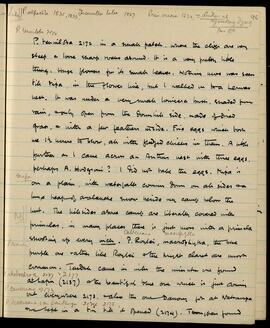
P. tenuiloba 2172 in a small patch, where the cliffs are very steep & loose sharp rocks abound. It is a very pretty little thing. Huge flowers for its small leaves. Nothing more was seen till Mipa, in the flower line, but I walked on to a Lerwa's nest. It was under a very small Lonicera bush, shaded from rain, & only open from the downhill side, made of dried grass, & with a few feathers inside. Five eggs which took me 1 1/2 hours to blow, all with fledged chicks in them. A little further on I came across an Anthus nest with three eggs, perhaps A. hodgsoni? I did not take the eggs.

Mipa
Mipa is on a plain, with waterfalls coming down on all sides & a large heap of avalanche snow beside my camp below the hut. The hillsides above camp are liberally covered with primulas, in many places there is just moss with a primula shooting up every inch. P. Roylei (Calderiana), macrophylla, the blue purple one rather like Roylei & the bright claret are most common. Tenduk came in with the minute one found at Lhapu (2137) & the beautiful blue one which is just coming out everywhere 2173, & also the one Danu found at Natrampa. Two kept in a tin till it opened (2174). Tenduk found

P. rhodochroa 2137, 2177
P. Cawdoriana 2173
P. dickieana var. pantlingii 2174, 2178

LSH/1/1/2/1/43 · Part · 1933-07-08
Part of The Ludlow & Sherriff Collection

SUMMARY:
Dawong and the diarist found a new Meconopsis, primulas, a Corydalis, and an Androsace on the Orka La, took photographs, and hurried back before rain, while many people came for medicine including 37.5 over proof rum for tummy aches. The page ends with an entry heading for Muktur, 12 miles, dated 11th July.

CONTENT:
Orka La. P. bellidifolia 636, P. tenuiloba 637, P. sikkimensis 640, P. gambeliana 641, P. macrophylla 642. Rhod. anthopogon 638, Mec. horridula 639, Mec. latifolia 'aurora' 643, Androsace adenophora 643. Corydalis cashmeriana 644.

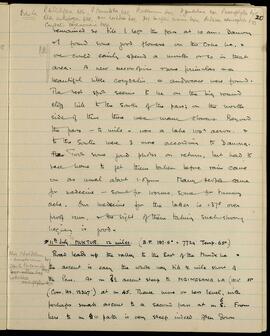
remained so till I left the pass at 10 am. Dawong & I found some good flowers on the Orka La, & one could easily spend a month or so in that area. A new Meconopsis & some primulas & a beautiful little Corydalis & Androsace were found. The best spot seems to be on the big round cliff like to the South of the pass; on the north side of this there were many flowers. Beyond the pass - 1/4 mile - was a lake 100 yds across. & to the South were 3 more according to Dawong. Took some good photos on return, but had to race home to get them taken before rain came on as usual about 1.0 pm. Many people came for medicine - some for worms, some for tummy ache. Our medicine for the latter is 37.5 over proof rum, & the sight of them taking such strong liquor is good.

11th July. MUKTUR. 12 miles. (B.

LSH/1/1/9/1/78 · Part · 1933-06-17
Part of The Ludlow & Sherriff Collection

SUMMARY:
Page records photographic notes using Dufaycolor and Kodachrome films for subjects including Primula caveana, P. umbratilis, Cassiope, Rhododendron setosum, and Meconopsis simplicifolia. Locations mentioned include Menla-harchu La and areas above it, including a lake. Entries are dated through mid to late June.

CONTENT:
73

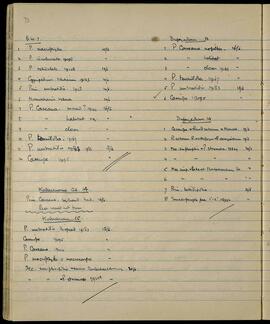
B.W. 7. Dufaycolor 13
1 P. macrophylla 10/6 1 P. Caveana no filter 16/6
2 P. involucrata 19090 10/6 2 P. Caveana habitat 16/6
3 P. reticulata 19108 13/6 3 P. Caveana closer 19144 16/6
4 Cypripedium tibeticum 19123 14/6 4 P. tenuiloba 19167 16/6
5 Prim. umbratilis 19128 14/6. 5 P. umbratilis 19183 18/6
6 Nomocharis nana 14/6 6 Cassiope 19095 18/6
7 P. Caveana. moved? 19144 16/6
8 P. Caveana habitat v.g. 16/6 Dufaycolor 14
9 P. Caveana closer 16/6 1 Cassiope & Rhod. setosum & Nomocharis 19/6
10 P. tenuiloba 19167 16/6 2 R. setosum. R. anthopogon & R. aeruginosum 19/6
11 P. umbratilis 19183 18/6 3 Mec. simplicifolia or P. strumosa 19204 20/6
12 Cassiope 19095 18/6 4 Mec. simplicifolia or P. strumosa 19204 20/6
5 Mec. simp. Lake at Menla-harchu La 20/6
Kodachrome CS. 14. 6 Mec. simp. Lake at Menla-harchu La 20/6
Prim. Caveana. behind. bad. 16/6. 7 Prim. bellidifolia 21/6
Rest would not turn. 8 Small purple pea 1"-2" 18992 21/6

Kodachrome 15.
P. umbratilis 1/2 speed 19183 18/6.
Cassiope 19095 18/6
P. Caveana 19144 18/6
P. macrophylla v macrocarpa -
Mec. simplicifolia above Menla-harchu 20/6.
Mec. simplicifolia or P. strumosa 19204 20/6