Showing 24 results

Archival description
24 results with digital objects Show results with digital objects
LSH/1/1/5/1/109 · Part · 1937-06-07
Part of The Ludlow & Sherriff Collection

SUMMARY:
Observations include mass flowering of Primula whitei around 14,000 ft and a pale yellow Sikkimensis-type primula likely from hybridisation. On 10 June the party halted, marked several Primula populations, recorded Primula vernicosa as a notable westward occurrence, kept busy drying specimens, and planned to return to Phobjikha via the Pele La Range towards Chendebi while collecting a few Rhododendron variants.

CONTENT:
P. flagellaris 3231.
Lloydia serotina 3232 Cypripedium tibeticum 3233

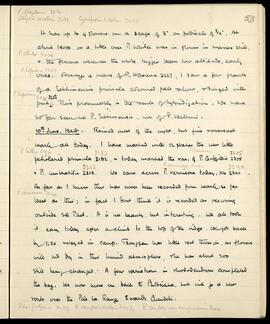
It has up to 4 flowers on a scape of 3" on pedicels of 3/4". At about 14000 or a little over P. whitei was in flower in masses still, & the flowers were on the whole bigger than low altitude, early ones. Among a mass of P. Hopeana 3227, I saw a few plants of a Sikkimensis primula coloured pale yellow, tinged with pink 3228. This presumably is the result of hybridisation. We have so far seen no P. sikkimensis, nor of P. Waltoni.

10th June. Halt. - Rained most of the night, but fine & overcast nearly all today. I have marked with 12 stakes the new little petiolaris primula 3192, & today marked the var. of P. Griffithii 3205 & P. umbratilis 3213. We came across P. vernicosa today, No 3240.

As far as I know this has never been recorded from nearly so far west as this; in fact I don't think it is recorded as occurring outside SE Tibet. It is no beauty, but interesting. We all took it easy today after a climb to the top of the ridge. We got back by 11.30 & stayed in camp. Tsongpen has little rest though, as flowers will not dry in this humid atmosphere, & he has about 200 still being changed. A few variations in Rhododendron completed the bag. We now move on back to Phobjikha, but will go a new route over the Pele La Range towards Chendebi.

Rhod. fulgens 3239. R. campanulatum 3243, R. campan. var. aeruginosum 3244
LSH/1/1/1/1/107 · Part · 1933-07-26
Part of The Ludlow & Sherriff Collection

SUMMARY:
Notes on fleas and lice among the party, with Ludlow inspected daily and Ramzana attributing lice to sweat; temporary huts built and a comfortable halt at Donga Pini with fine weather, bird shooting, and photo developing. On 27th July the party proceeds to SANA, climbing from about 8000' to 9600' along the ridge via the DONGA LA, with plants such as Primula xanthopa, P. sikkimensis, and Oxalis acetosella recorded.

CONTENT:
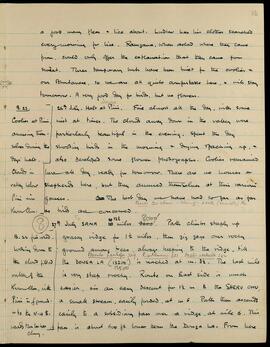
a good many fleas & lice about. Ludlow has his clothes searched every morning for lice. Ramzana, when asked where they came from, could only offer the explanation that they came from sweat. Three temporary huts have been built for the coolies & our Cookhouse, so we are all quite comfortable here, & will stay tomorrow. A very good day for birds, but no flowers.

B. 22. 26th July. Halt at Donga Pini. Fine almost all the day, with some
Coolies at Pini mist at times. The clouds away down in the valley were
amusing them- particularly beautiful in the evening. Spent the day
selves during the shooting birds in the morning & drying & packing up, &
day's halt. also developed some flower photographs. Coolies remained
Clouds in here all day, ready for tomorrow. There are no houses or
valley below shepherds here, but they amused themselves at their various
Pini in games.
Kurn Chu.

8 27th July To SANA 12 1/2 miles. 8000' 9600'. Path climbs steeply up
B. 22 finished. grassy ridge for 1 1/2 miles, then zig zags over rocky
Looking down to ground among trees, always keeping to the ridge, till
the cloud filled Primula xanthopa 329. P. sikkimensis 331, Oxalis acetosella 332
valley of the the DONGA LA

LSH/1/1/5/1/124 · Part · 1933-06-21
Part of The Ludlow & Sherriff Collection

SUMMARY:
The page distinguishes P. sikkimensis from P. Hopeana by calyx features and notes that P. Hopeana here has a pinkish to red tube, possibly approaching P. Waltoni. It also mentions chasmophila and references P. umbratilis? with number 33014.

CONTENT:
Here P. sikkimensis No , is very much mixed up with
P. Hopeana. But they are distinct, as can be seen from the calyx.
P. Hopeana here shows a pinkish tube, sometimes quite red, which
I suppose goes nearer to P. Waltoni. But I have seen no P. Hopeana
here, where the corolla is red tinted.

chasmophila
P. umbratilis? 33014 See opposite.

LSH/1/1/4/1/53 · Part · 1933-07-23
Part of The Ludlow & Sherriff Collection

SUMMARY:
Notes on flowering stages of Cyananthus and Primula, with some seeds of P. atrodentata collected. The party met a Bhutanese man with his family returning from Pemako, who spoke with Tenduk and described harsh conditions there. Entry made at Charme after a rainy night that cleared in the morning.

CONTENT:
taken before. Cyananthus will soon be fully out. At present it is just coming out here and there. P. sikkimensis is in masses half way up from here. I counted on one head 76 flowers. Mah Tsongpen here, who had no trouble on the way, but did not find very much either. The summer flowers are mostly getting over now, and the autumn ones are not yet out. Seeds are not ripe either, except P. atrodentata, of which I have taken some more.

We passed today a man and his wife and 4 children. He was a Bhutanese from Tjong who had gone to Pemako some years ago - with 2 children. He was frightfully glad to see his own countryman Tenduk, and had a long talk with him. Pemako he describes as pretty awful, rain and snow, and terrible passes, usually closed by snow. However the rain did not worry him much. He said he could easily stop that - "it is quite simple to stop rain or bring it on," he said. He is returning to his own land, and I hope he will be happy there; a nice man he was, with a very cheerful open face, with a nice looking wife and kids.

28th July. Charme. 10300' 7 miles. Rained all night but was just fine in the morning and the sun is shining here. I made up

LSH/1/1/1/1/65 · Part · 1933-06-21
Part of The Ludlow & Sherriff Collection

SUMMARY:
Revisited Cheli La and collected flowers including Primula sikkimensis, Kashmir corydalis, and Bergenia ligulata; left Ha with Ludlow, ascended through rhododendron scrub to the pass with views of Chomolhari. Transport was by ponies, mules, and porters; spent the night at Chang na na amid a heavy thunderstorm and troublesome flies.

CONTENT:
30

B. 11. contd. not been able to do much either, birds being hard to find. On
Chomolhari the Cheli La again we found some more flowers, P. sikkimensis
massif from top (? P. obliqua 129), the Kashmir corydalis (Coryd. cash. 131) &
of Cheli La (Ha- a big red saxifrage (Bergenia ligulata 130). On 21st we
Paro). Views near left Ha, Ludlow & I fairly early, going straight up to the
Chang na na, Cheli La through the forest. The hill to the S. of the pass,
starting off in at the top, is densely covered with rhododendron scrub.
the morning: This seems to be a good flower place. We had a fair
the party on the view of Chomolhari from the top, a much more
road to Paro. impressive sight from the South than from the Natu La.
Transport consisted of ponies, mules & men & women. The
women seem to manage 80 lb loads as easily as the
men almost. Spent the night at Chang na na. A
B. 12. heavy thunder storm broke about 2.0 pm & nearly washed the
Paro dancers camp away. There are some awful flies here, which we
meet us near

LSH/1/1/5/1/169 · Part · 1933-07-21
Part of The Ludlow & Sherriff Collection

SUMMARY:
Notes on Codonopsis subsimplex and several Primula species, correcting earlier identifications to P. bracteosa, with collecting of P. Boothii seed and roots and observations on leech altitude. Messages arrived from Domkhar and Bumthang, and the party proceeded 5 miles to Dhomkhar where they received an army reception with bands.

CONTENT:
88

Codonopsis subsimplex 3469
ridge to the north to a hill called on the map Kampojohn 13800'.

P. bhutanica 3468
Close to the pass there is lots of P. Boothii 3468, & I took some seed, & roots. I now see that I was mistaken in thinking the Mara Chu one & the Lamse La one P. Boothii. They must both be P. bracteosa. Further on, we came across a great deal

P. obliqua 3470
of P. obliqua, the yellow form, & also of really magnificent

P. sikkimensis 3471
P. sikkimensis, with very fine flowers, well over 40 in a head. Barring these, there was nothing of much interest. Leeches, I am sorry to say, go up to 13500 in this area, but there were very few.

22nd July. A lovely day, with a strong E wind & big cumulus clouds gradually coming up. We were rather lazy, & only collected & packed roots of P. Boothii today. More people came
presents
up with presents & messages from Domkhar & Bumthang.

To
23rd July. Dhomkhar. 5 miles. BP. 204.8° Temp. 64° Time 5.0pm. Ht. 4000ft
Picea likiangensis 3473
A fine day, with only a little rain in the evening. We started off late, about 6.30 & walked down the first 2 miles, where we were met by a pony & tea. Then on till we were met by the
reception
Army, all dressed up in very smart khaki drill. They played us in with their three bands, a pipe band, fifes & bugles. All were

LSH/1/1/5/1/123 · Part · 1933-06-21
Part of The Ludlow & Sherriff Collection

SUMMARY:
The diarist reports fever and painful throat affecting both himself and Tsongpen, while Pinto has recovered. They move from Dungshuggang to a camp 2 miles beyond Wangchelah at about 12,500 ft, finding few new plants but noting abundant rhododendrons and several Primula species.

CONTENT:
Sherriff 60

Morning was perfect, even over the plains of Assam there were no clouds for a while. I have got some kind of fever, which makes me feel pretty queer every week; also a throat which feels completely raw and most painful. So I only stayed out for 3 or 4 hours this morning. We found nothing. I have thought Tsongpen was a little past work too, this evening he has just come in to say he also has fever, got it the same time as I did, but he says he thought his inability to climb was just due to staleness and nothing else. The coolies are all up and Pinto too; he is much better, and says he is quite alright. I think at any rate he has no fever left. No mail has come.

Dungshuggang
22nd June. Camp 2 miles beyond Wangchelah 5 miles. Ht. 12500' approx.
Another perfect morning, with the hills looking better than ever. But Tsongpen and I are not better than ever, and both feel pretty rotten. The fever is not very bad as they go, but our necks are very painful, and to swallow is difficult. On both sides under the lower jaw is swollen. Rhododendrons, P. sikkimensis, P. Hopeana and P. strumosa are plentiful — it is the first time we have seen sikkimensis. Otherwise there is very little that we have not already collected. But I have hopes of tomorrow's place up the

LSH/1/1/9/1/85 · Part · 1949-06-30
Part of The Ludlow & Sherriff Collection

SUMMARY:
The writer reports that meat set aside by Lhahpa was stolen overnight, likely by a dog, while Lhahpa suspects passing Tibetans. A letter from Rani Chuni relays that H.H. says the Maharajkumar may go to England with them for several months, prompting logistical concerns; on 27 June they halt, deem the area poor after working all surrounding valleys, plan to leave tomorrow, and note certain plants absent here but present at the Mela.

CONTENT:
I had rather looked forward to some fried liver this morning, but something - presumably a dog - took away the whole liver, kidneys & some fat which Lhahpa had put aside in a dekchi, during the night. Yundru was sleeping within a yard, so I don't think it could have been a man - unless Yundru himself! Lhahpa suspects Tibetans as many are passing down just now, but I don't think that is likely.

There is a slight sign of a let up in the rain this evening. The most startling news in the mail yesterday was in a letter from Rani Chuni, who says 'we are so glad to hear from H.H. that the Maharajkumar is going to England with you for 5 or 6 months'. Now we have heard nothing of this at all as yet, which seems a bit odd. Presumably H.H. will ask us in August what he wants. He has probably only said what he would like to happen. In any case we must tell him it will be alright. If we have a house, then there is no real difficulty. But if we have to wander about looking for a house, & at the same time look after M.K., then it won't be at all easy.

27th June Halt. We all think we have finished this area, & I don't consider it a good one at all. We've worked every valley round about & leave tomorrow. Notable as not occurring here, & occurring at the Mela are P. sikkimensis, dich

LSH/1/1/3/3/151 · Part · 1983-05-05
Part of The Ludlow & Sherriff Collection

SUMMARY:
From Jarep on a clear day after a hard frost, the party descended a broad valley, passing Totsen, with wet but easy paths and extensive views of sharp, snow-covered peaks to the south; locals use the name Takpa Shiri for peaks within the Kingkor. Few flowers were seen, though Primula roylei was abundant; plants noted include Rhododendron lanatum v. luciferum and Clematis cirrhosa, with comparison to Primula sikkimensis near Mago.

CONTENT:
Jarep, May 18th.
Rhododendron lanatum v. luciferum 1610.
P. puderosum 1612 of nov.
Clematis cirrhosa 1611.

As perfect a day as I can remember. It froze pretty hard at night, we awoke to a blue sky with not a cloud to be seen. We had to wait some time for the sun to thaw the frost off our tents, then came on down the valley. Most of the way the valley is broad and open, with the path keeping to the left-hand side. Totsen is passed at about m 3, consists of 2 or 3 houses and a paddock where mules and horses are bred. The hills to the south were always visible, and the whole range was seen as we came down, by looking up side-valleys coming in from the south. They form a fine range of snow-covered peaks, nearly all very sharp-pointed. The locals do not appear to call any one peak Takpa Shiri, but refer to those enclosed by the Kingkor as that. Path is rather wet and stony but otherwise easy, and descent very gradual. The view down the valley too is almost equally fine, snow-covered peaks are to be seen as far as one can see. Of flowers there were very few. But Primula roylei as a sight made up for a lot. I have never seen more of any primula except of P. sikkimensis, when going down towards Mago. In places

LSH/1/1/2/1/53 · Part · 1933-07-08
Part of The Ludlow & Sherriff Collection

SUMMARY:
The party descends north from Milakatong La, follows a lake and river, and reaches Tsukang (Shao) around mile 16, noting scant barley and rhododendron fuel. They express relief at leaving rain-soaked Tawang, criticize incompetent local officials, and describe a route transitioning from dense jungle to bamboo, rhododendron, and finally grass with dwarf rhododendron, alongside a list of collected plants.

CONTENT:
July 14.
Milakatong La

P. sikkimensis 652=667
" obliqua 655
" Calderiana (Roylei) 658
" macrophylla 657
" sikkimensis 662
" alpicola 663
" pusilla 665
" sapphirina 666
Meconopsis villosa 649
Notholirion macrophyllum 650
Corydalis trifoliata 651
Swertia hookeri 654
Meconopsis horridula 659
Rhododendron hypenanthum 660
Campanula aristata 664

North of the pass, the descent is easy over open rocky hillside. A lake is seen to the N. West and the river met at m 14. From this lake followed down to the East to TSUKANG or SHAO at m 16. Here there is rhododendron wood fuel. A very little barley is grown, but probably does not ripen. Shao consists of about a dozen stone built houses. We were thoroughly glad to be shut of that miserable place Tawang. It rained all the time we were there, and we were for nearly the whole time in the mist.

The acting body for the Jongpen were an acute sodden womanising lot of poops. When our coolies were once off the mark, they went well enough: the trouble was simply that the officials were incapable of giving an order. Half the coolies started yesterday, the others with our bedding etc came on today. It rained from start to finish, and was miserably cold the whole time. The ground we covered was most interesting from a flower point of view. First we were in pretty dense jungle: this gave way to bamboo jungle, then to rhododendron jungle, till finally nothing was left but grass and dwarf rhododendron with the typical Tibetan dry zone potentilla. It was not a dry zone for us though. The hills are covered with a very dwarf pink rhododendron which makes them look like moors in

Rhododendron hypenanthum 661