
Showing 2 results

Archival description
2 results with digital objects Show results with digital objects
LSH/1/1/3/3/195 · Part · 1996-06-18
Part of The Ludlow & Sherriff Collection
  • SUMMARY:
    Notes a small patch of Primula tenuiloba on steep rocky cliffs, followed by observations of a Lerwa nest with five eggs and an Anthus nest with three eggs. At Mipa, records abundant primulas on hillsides, with Tenduk bringing specimens from Lhapu and a blue primula (2173) and another from Natrampa, and lists several Primula specimens (2137, 2173–2178).

CONTENT:
Ludlow

  • P. alpestris 1831, 1833, Incarvillea lutea 1827 Prim. erosa 1832, = Ludlow at Kyimdong Dzong June 18th 96

P. tenuiloba 2172
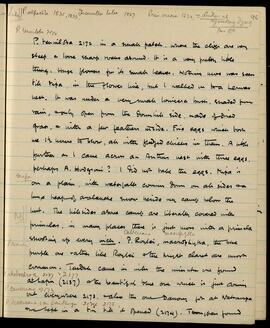
P. tenuiloba 2172 in a small patch, where the cliffs are very steep & loose sharp rocks abound. It is a very pretty little thing. Huge flowers for its small leaves. Nothing more was seen till Mipa, in the flower line, but I walked on to a Lerwa's nest. It was under a very small Lonicera bush, shaded from rain, & only open from the downhill side, made of dried grass, & with a few feathers inside. Five eggs which took me 1 1/2 hours to blow, all with fledged chicks in them. A little further on I came across an Anthus nest with three eggs, perhaps A. hodgsoni? I did not take the eggs.

Mipa
Mipa is on a plain, with waterfalls coming down on all sides & a large heap of avalanche snow beside my camp below the hut. The hillsides above camp are liberally covered with primulas, in many places there is just moss with a primula shooting up every inch. P. Roylei (Calderiana), macrophylla, the blue purple one rather like Roylei & the bright claret are most common. Tenduk came in with the minute one found at Lhapu (2137) & the beautiful blue one which is just coming out everywhere 2173, & also the one Danu found at Natrampa. Two kept in a tin till it opened (2174). Tenduk found

P. rhodochroa 2137, 2177
P. Cawdoriana 2173
P. dickieana var. pantlingii 2174, 2178
LSH/1/1/5/1/158 · Part · 1937-07-14
Part of The Ludlow & Sherriff Collection

SUMMARY:
Notes on Primula populations, including suspected Strumosa × Calderiana hybrids (nos. 3432–3436) and the true yellow form 3383 (strumosa nana), with observations on color variation and density. Records additional collections 3445–3446 of a Primula sp. nov. (tsariensis and tsariensis alba), detailing habitat differences between blue-purple plants on west-facing scree and white forms on sunny grassy slopes.

CONTENT:
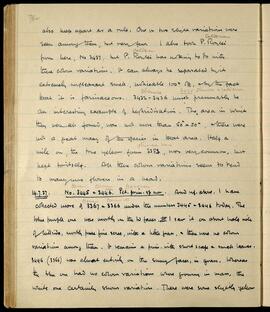
also keep apart as a rule. One or two slight variations were seen among them, but very few. I also took P. Roylei (Calderiana) from here, No 3437, but P. Roylei (Calderiana) has nothing to do with these colour variations. It can always be separated by its extremely unpleasant smell, noticeable 100 yards off, by the fact that it is farinaceous. 3432-3436 (Strumosa x Calderiana) must presumably be an interesting example of hybridisation. The area in which they were all found, was not more than 50 yards x 50 yards, there were not a great many of the species in that area. Half a mile on, the true yellow form 3383 (strumosa nana), was very common, but kept to itself. All these colour variations seem to tend to many more flowers in a head.

14.7.37. No. 3445 & 3446. Pet. primula sp. nov. (tsariensis) And ref. above. I have collected more of 3367 & 3366 (tsariensis alba) under the numbers 3445 - 3446 today. The blue purple one was mostly on the W faces. I saw it on about half a mile of hillside, mostly pure fine scree, with a little grass, & there were no colour variations among them. It remains a primula with short scape & small leaves. 3446 (3366) was almost entirely on the sunny faces, in grass. Whereas the blue one had no colour variations where growing in mass, the white one certainly shows variation. There were some slightly yellow