Showing 11 results

Archival description
11 results with digital objects Show results with digital objects
LSH/1/1/3/3/137 · Part · 1983-05-05
Part of The Ludlow & Sherriff Collection

SUMMARY:
Notes describe a valley with contrasting north and south faces, a bout of fever for Gulia, and halts on 9th and 10th May to explore and collect plants. Finds include rhododendrons, abundant P. bellidifolia (not yet out), and P. roylei and macrophylla in bloom near a terminal moraine; each member shot one crossoptilon.

CONTENT:
66

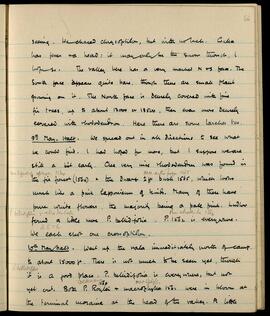
seeing. We chased crossoptilon, but with no luck. Gulia has fever on head: it may only be the snow thrush, I hope so. The valley here has a very marked N & S face. The South face appears quite bare, though there are small plants growing on it. The North face is densely covered with fine fir trees, up to about 13000 or 13500, then even more densely covered with rhododendron. Here there are some larches too.

9th May. Halt. We spread out in all directions to see what we could find. I had hoped for more, but I suppose we are still a bit early. One very nice rhododendron was found in the fir forest (1564) - the dwarf 2 ft bush 1565, which looks much like a pink lapponicum of kinds. Many of these have pure white flowers, the majority being a pale pink. Ludlow found a little more P. bellidifolia, P. 1562 is everywhere. We each shot one crossoptilon.

10th May. Halt. Went up the nala immediately north of camp to about 15000 ft. There is not much to be seen yet, though it is a good place. P. bellidifolia is everywhere, but not yet out. Both P. Roylei & macrophylla 1561 were in bloom at the terminal moraine at the head of the valley. A little
LSH/1/1/6/1/39 · Part · 1933-05-17
Part of The Ludlow & Sherriff Collection

SUMMARY:
The party moved up the valley with coolies burdened by heavy loads and delays at Molo, noted weather changes, and observed several rhododendrons and primulas. On 22 April at a camp above Singo Samba, a hazardous bridge crossing led Ramzana to cross while Ludlow forded downstream with Tseringpen. On 23 April, despite fresh snow and the coolies’ refusal to move, Ludlow, Tseringpen, and the diarist scouted and broke a path to the Lo La pass, checking known plant sites now under snow.

CONTENT:
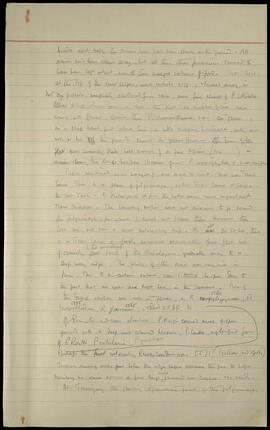
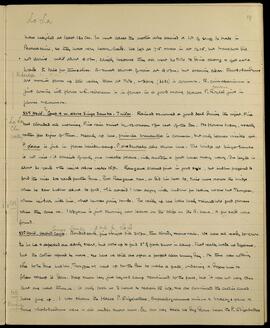
have weighed at least 130 lbs. In most cases the coolies also carried a lot of stuff to trade in Pachakshiri, so they have very heavy loads. We left at 7:15 and were in at 12:15, but transport did not arrive until about 4:00 pm, chiefly because they all went to Molo to drink chang and get extra loads to take for themselves. A small shower of rain at 4:00 pm, but evening clear. Rhododendrons are more in flower up this valley than at Molo, R. 3624 (3631) is common. R. cinnabarinum is just coming into flower and R. vellereum is in flower in a good many places. P. Roylei just in flower common.

22nd April. Camp 4 m. above Singo Samba. 7 miles. Rained and snowed a good deal during the night. Fine but clouded all morning. Fine rain and mist by 12:00 noon and for rest of the day. No flowers today, and really rather few signs of them. Nearly up here, Primula prenantha is common, but only leaves visible yet. P. glabra is just in flower beside camp. P. atrodentata also shown here. The bridge at Singo Samba is not nice - it consists of only one usable plank, with another a foot lower and very wavy. The length is about 30 yards and the height above water 15 ft. Ramzana crossed first in good style, but Ludlow preferred to ford the river 200 yards further down. Poor Ramzana ran, or did his best to, twice more across the bridge when he saw Ludlow about to ford. I'm afraid I was angry with Ludlow for telling no-one but Tseringpen, whom he took with him, what he was going to do. The valley up here looks lovely and should hold good flowers when they come on. Isopyrum is just showing new leaves on the cliffs on the R. bank. A few seed were found.

23rd April, Halted Camp. Clouded early, fine and bright till 2:00 pm, then cloudy and some rain. We were all ready to cross the Lo La and expected an early start, but woke up to find 2" of fresh snow in camp. That really made no difference, but the coolies refused to move, so here we still are after a perfect clear sunny day. As there was nothing else to be done Ludlow, Tseringpen and I went up to the Pass to make a path, ordering a dozen men to follow and stamp it down. Deep snow lay just beyond camp and continued to the pass, but it was not very often that one went through. It only took us 3 hours to reach the top, and we are convinced the coolies could have gone up. I was shown the places P. Elizabethae, Omphalogramma minus and brachysiphon and some rhododendrons were - all under snow now. On our way back we dug down near the P. Elizabethae

LSH/1/1/5/1/131 · Part · 1933-06-21
Part of The Ludlow & Sherriff Collection

SUMMARY:
Notes record Parnassius butterflies, a woodcock nest with four eggs found on 22 June, and a list of Primula species observed. The writer describes the steep peaks of Dungshinggang, clear views toward Sikkim and beyond Chomolahri, getting soaked in a noon storm, and a 25 June entry noting rain overnight, a clear morning, and later cloud.

CONTENT:
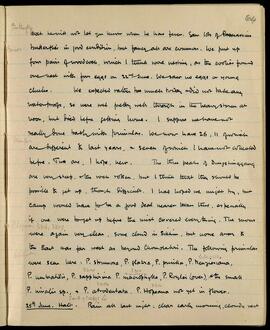
that he will not let you know when he has fever. Saw lots of Parnassius butterflies in good condition, but fancy all are common. We put up four pairs of woodcock, which I think were nesting, as the coolies found one nest with four eggs on 22nd June. We saw no eggs or young chicks.

We expected rather too much today and did not take any waterproofs, so were wet pretty well through in the heavy storm at noon, but dried before getting home. I suppose we have not really done badly with primulas. We now have 26, 11 of which are different to last year's, and seven of which I have not collected before. Two are, I hope, new.

The three peaks of Dungshinggang are very steep, the rock rotten, but I think that they should be possible to get up, though difficult. I had hoped we might try, but camp would have to be a good deal nearer than this, especially if one were to get up before the mist covered everything. The snows were again very clear, some cloud in Sikkim, but none away to the East as far west as beyond Chomolahri. The following primulas
were seen here: P. strumosa, P. glabra, P. pusilla, P. Menziesiana,
P. umbratilis, P. sapphirina, P. macrophylla, P. Roylei (over), the small
P. nivalis sp., and P. atrodentata. P. Hopeana not yet in flower.

25th June. Hall - Rain all last night, clear early morning, cloudy rest.

LSH/1/1/5/1/110 · Part · 1937-06-07
Part of The Ludlow & Sherriff Collection

SUMMARY:
The author clarifies the locality as Kangchukka in the Langte Chu (flowing to Langte), noting an earlier field note name of Tang Chu and adding Kangchukka on specimen 3249. Detailed observations compare Primula specimens (including P. tenella) from 3203, 3249, and Chundebi 3052, discussing size, leaf and scape differences, elevation (8000 ft for the latter), and their apparent merging.

CONTENT:
580

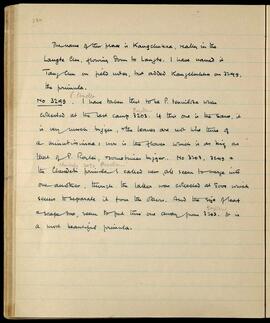
The name of this place is Kangchukka, really in the Langte Chu, flowing down to Langte. I have named it Tang Chu on field notes, but added Kangchukka on 3249, the primula.

No 3249. P. tenella. I have taken this to be P. tenuiloba when collected at the last camp 3203 flagellaris. If this one is the same, it is very much bigger, the leaves are not like those of a minutissima: nor is the flower which is as big as that of P. Roylei, sometimes bigger. No 3203, 3249 & the Chundebi 3052 flagellaris primula I called new, all seem to merge into one another, though the latter was collected at 8000 which seems to separate it from the others. And the size of leaf & scape too, seem to put this one away from 3203 flagellaris. It is a most beautiful primula.

LSH/1/1/6/1/60 · Part · 1938-05-28 - 1938-05-29
Part of The Ludlow & Sherriff Collection

SUMMARY:
Field notes from Langong list multiple Primula specimens with observations on flowering, variation, and a possible hybrid, and note nearby passes (Lo La/Shethang La and Chubumbu La) used in July–August. Bird nesting records for Crossoptilon harmani and Blood Pheasant at about 12,000 ft are dated 28–29 May 1938.

CONTENT:
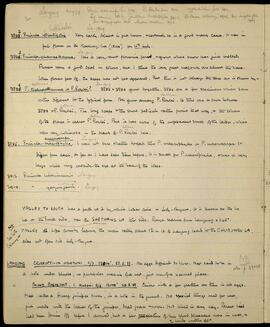
Langong - May 38. Primula macrocephala 3889, R. laudandum 3900, agglutinatum form 3902, Lil. nanum 3903, Gaultheria trichophylla 3905, Androsace delavayi 3906, Mec. integrifolia 3909, Trichophragma 3910, Lloydia serotina 3915.

30a Littledalei Langong

  1. Primula rotundifolia. Very early. Almost in full bloom, certainly so in a good many cases. It was in full flower on the Kashong La (15000') on 15th July.

  2. Primula chamaethauma. Has a very short flowering period, and grows where snow has just melted.
    Flowers vary a good deal in colour, but I think the very great majority are almost the same.
    When flowers fall off, the scape has not yet appeared. But this is not always the case as is shown by —

3894 P. chamaethauma x P. Roylei? 3893 and 3894 grow together. 3894 are a few specimens which seem rather different to the typical form. Both grow among P. Roylei. Is this one a cross between 3893 and P. Roylei? The long scape and the short pedicels rather point that way, and the colour of the flower is nearer P. Roylei. But it has none of the unpleasant smell of the latter, which was very noticeable in the plants of P. Roylei here.

  1. Primula macrophylla. I was not sure whether to call this P. macrophylla or P. macrocarpa. It differs from each, as far as I have seen them before. It is small for P. macrophylla, and has a very large white ring outside the eye at the base of the lobes.

  2. Primula sikkimensis. Langong.

  3. Primula yargonjensis. Langong.

VALLEY TO SOUTH has a path up it by which Lopas come in July - August. It is known as the Lo La on the South side, and the SHETHANG LA this side. Rough bearing from Langong = 145°.

VALLEY to Lopa country leaving the main valley about 1 1/2 m W. of Langong leads to the CHUBUMBU LA, also not open till July - August.

LANGONG CROSSOPTILON HARMANI. c/7. 12000'. 28.5.38. All eggs difficult to blow. Nest said to be in a hole under shrubs, no particular making of a nest, just use of a natural place.

BLOOD PHEASANT. I. kuseri. c/6 12000' 29.5.38. Chicks with a few feathers on them in all eggs. Nest under a dwarf juniper bush, in a hole in the ground. No special things used for nest, just made with the leaves of the juniper, dead grass and moss. Not lined in any way. Parent bird had been driven off before I arrived, but a few feathers of her blood pheasant were in nest, and 2 birds within 40 yds.

LSH/1/1/5/1/159 · Part · 1937-07-14
Part of The Ludlow & Sherriff Collection

SUMMARY:
Notes intermixing among primulas near camp below a cliff, with white P. umbratilis out of reach. On 14th July the party traveled to Maruthang via ridges west of the Nam Chu, collecting P. umbratilis (No. 3444) near Chora and observing extensive blue petiolarid primula above 16,000 ft amid intermittent heavy rain.

CONTENT:
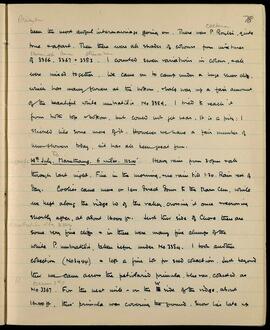
been the most awful intermarriage going on. There was P. Roylei, quite true and apart. Then there were all shades of colours from mixtures of 3366, 3367, and 3383. I counted seven variations in colour, and all were mixed together. We came on to camp under a huge sheer cliff, which has many flowers at the bottom, and halfway up a fair amount of the beautiful white umbratilis No. 3384. I tried to reach it from both top and bottom, but could not get near. It is a pity: I should like some more of it. However, we have a fair number of new flowers today, and it has all been great fun.

14th July. To Maruthang. 6 miles. 12,200'. Heavy rain from 3:00 pm and all through last night. Fine in the morning, no rain till 1:30. Rain rest of day. Coolies came more or less direct down to the Nam Chu, while we kept along the ridge west of the valley, crossing it once and recrossing shortly after, at about 16,000 ft. Just this side of Chora there are some very fine cliffs and in these were many fine clumps of the white P. umbratilis, taken before under No. 3384. I took another collection (No. 3444) and left a fine lot for seed collection. Just beyond this we came across the petiolarid primula, blue var., collected as No. 3367. For the next mile—on the west side of the ridge, above 16,000 ft—this primula was covering the ground. Snow lies late up

LSH/1/1/5/1/215 · Part · 1937-07-31
Part of The Ludlow & Sherriff Collection

SUMMARY:
Checklist of Primula species collected in 1937, with notes on prior collection status and several specimen numbers. Localities mentioned include Chendebi and Tang Chu.

CONTENT:
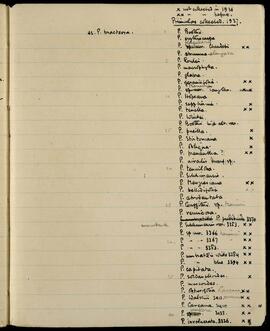
x not collected in 1936
xx " " " before.
Primulas collected. 1937.

  1. P. bracteosa.

1 P. Boothii.
P. erythrocarpa
P. flagellaris
P. sp. nov. Chendebi xx
5 P. strumosa elongata
P. Roylei.
P. macrophylla.
P. glabra.
P. geraniifolia xx
10 P. sp. nov. Tang Chu. xx
P. Hopeana
P. sapphirina x
P. tenella. xx
P. Winteri.
15 P. Boothii high alt. var.
P. pusilla. x
P. Stirtoniana x
P. obliqua. x
P. prenantha? xx
20 P. nivalis dwarf sp.
P. tenuiloba.
P. sikkimensis.
P. Menziesiana xx
P. bellidifolia xx
25 P. atrodentata
P. Griffithii sp. hancini
P. vernicosa.
P. pudibunda 3370
P. sikkimensis var. 3353. xx
30 P. sp. nov. 3366 hancini xx
P. " " 3367 xx
P. " " 3383. xx
P. umbratilis white 3384 xx
P. " blue 3394 xx
35 P. capitata.
P. soldanelloides. x
P. muscoides.
P. obtusifolia Caveana xx
P. Walshii 3413 concinna xx
40 P. Caveana 3410 xx
P. uniflora 3438. x
P. involucrata 3226. x

LSH/1/1/3/3/185 · Part · 1983-05-05
Part of The Ludlow & Sherriff Collection

SUMMARY:
The party revisited their old valley south of Chichchar, documenting nine Primula species in flower across avalanche-swept slopes and cliffs, with several specimens noted (e.g., 1614, 2141, 2153, 2154) and P. macrophylla around 15,500 feet. Tsongpen left at 6:00 am and returned at 3:00 pm, and one member is convalescing with a knee injury.

CONTENT:
convalescing, with his knee, which is doing well. Tsongpen at
left at 6.0 am and came back at 3.0 pm. We went up our old
valley south of Chichchar. It is a beautiful valley, and good for
flowers too. Above the snow avalanche we found many
primulas in flower. P. roylei still holds on, but the most
numerous was the beautiful blue-purple one first collected
here last time. It is in masses, the whole hillside, where
bare, being covered with it. P. atrodentata is also
there, but over now. The little white primula 1614, where
the snow melts, comes into flower for its short season.
P. macrophylla at about 15,500 is fairly common, and the
lovely little blue primula 2154 was found in full flower on
the cliff on the right of the avalanche. It is a beauty, with
such minute leaves and huge flower. 2141, a white sikkimensis
is common, but the pick of the white lot is a new one to
us, No. 2153, which is a bright claret colour and is common
on the bare slopes from which the avalanche sweeps every
year. The ordinary sikkimensis too is fairly common.
There are therefore 9 primulas all flowering in this one
quite small valley. We are still a little early for

LSH/1/1/2/1/55 · Part · 1933-07-08
Part of The Ludlow & Sherriff Collection

SUMMARY:
The writer describes abundant primulas and meconopsis around Shao, including a new white meconopsis and vast fields of yellowish white primulas, while noting Ludlow’s flea-infested lodging. The party proceeds toward Tsona, following the Shao Chu and a northern side valley to Kachen Tso and over Kachen La, with an easy descent past small lakes.

CONTENT:
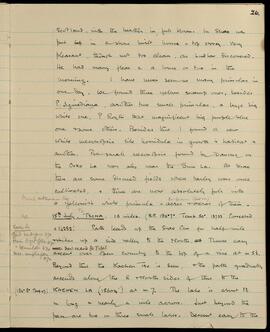
Scotland, with the heather in full bloom. In Shao we put up in a stone built house - top storey. Very pleasant, though not too clean, as Ludlow discovered. He had many fleas and a louse or two in the morning. I have never seen so many primulas in one day. We found three yellow swamp ones, besides P. sikkimensis, another two small primulas, a huge big white one, P. Roylei that magnificent big purple blue one and some others. Besides this I found a new white meconopsis like horridula in growth and habitat and another. The small meconopsis found by Dawa on the Orka La was also near the Bum La. At Shao there are some disused fields where barley was once cultivated, and these are now absolutely full with a yellowish white primula - acres and acres of them.

15th July. TO TSONA. 16 miles. (B.P. 186.7° Temp. 50°. 13733' Corrected = 14282'). Path leads up the Shao Chu for half mile, strikes up a side valley to the North. Thence easy ascent over open country to the top of a rise at m 5 1/2. Beyond this the Kachen Tso is seen, and the path gradually ascends along the E and North sides of this to the KACHEN LA (15604') at m 7. The lake is about 1 1/2 m long and nearly a mile across. Just beyond the pass are two or three small lakes. Descent easy to the

LSH/1/1/7/1/7 · Part · 1940-05-24
Part of The Ludlow & Sherriff Collection

SUMMARY:
The diarist notes bodies with bows left beside them and observes alpine flora on nearby snow slopes and streambeds. Accompanied by Langong coolies, they visit the Tsari Sama (Sarpa) pilgrimage area, finding it rich in Primula, Rhododendron, and a new white-flowered Daphne near the pass to Lopa territory. Trashiyang is mentioned as the starting and finishing point of the pilgrimage.

CONTENT:
Beside each body, the owner's bow had been stuck in the ground. All arrows had been taken away, but all their other possessions seemed to have been left intact, even to their meagre rations of food. Near here, at the top of the snow slopes, were vertical cliffs. Tucked away in dust-dry pockets, completely sheltered from rain, were fine clumps of P. littledalei.

A little lower down, at 14,000', the first Meconopsis simplicifolia were coming into flower. Beside this, P. chamaethauma was in flower, and on a steep bank just above this, a little creeping Lonicera, only an inch or two off the ground, showed its yellow flowers. Some of the open swampy flats held masses of a fine Allium (No. ). On stony beds beside streams grow P. macrophylla v. macrocarpa.

There remained, near Langong, one area to visit, that was Tsari Sama. This is a place of pilgrimage, called Tsari Sama or Sarpa—the new Tsari—to distinguish it from the better-known, more important Tsari Chikchar. The Langong coolies were not anxious to go round the pilgrimage, for which I could not blame them. However, they took me, and it was a most interesting trip. As at the Lo La, there is in Tsari Sama a fairly extensive, reasonably open flat bit of country, just north of the immediate Himalayas, gradually rising to a steep rocky ridge. The whole of this area was very rich in flora. This, to a certain extent, can, I think, be put down to the fact that no yaks are kept here in the summer. None of the dwarf rhodos were now in flower, and R. campylogynum (5560), R. trichocladum (5555), R. glaucum (5565). Also 5568.

A Primula not seen elsewhere, P. Kingii covered acres of open ground with its deep wine-coloured blooms, P. laeta, a glorified form of P. Roylei. Primula, P. gracilipes.

Perhaps the most interesting Rhododendron was 5571 (yellow, red spots). Growing among rocks just below the ridge before reaching the pass to Lopa territory, we came across a fine large, white-flowered new Daphne. No seeds.

At Trashiyang, the starting and finishing point of the pilgrimage,