
Showing 3 results

Archival description
LSH/1/1/4/1/91 · Part · 1933-08-15
Part of The Ludlow & Sherriff Collection

SUMMARY:
The author considers Meconopsis 2531 to be Bailey's var. argemonantha and marks plants for seed collection. From 2–5 September, they halt near Nga La and Pang La, receive news of a dak from Tsona, recover and butcher a lost sheep, and record further hunting by Tsongpen, Dawang, and Tenduk; they then move via Migyitun to Bimbi La, photograph three lamas, and note coolie difficulties.

CONTENT:
L.P. 177. I think the white poppy we found the day before yesterday (2531) must be Bailey's var. argemonantha of which only the flowers and leaves are preserved. 155

The Meconopsis 2531 we think may be Bailey's var. argemonantha. I have marked a dozen plants for seeds.

2nd Sept. Halt. Camp above Nga La.
Pang La.
P. macrophylla 2538
P. rhodochroa 2539
G. prolata 2540
Last night was perfect, and today was again fine with no rain, but clouds coming up fast in the evening. Tsongpen shot two kuling females. Collected a few seeds, but found nothing of much interest. News came to Migyitun of a dak having been sent from Tsona. The lost sheep was found, brought up here, and within 5 minutes was in 4 pieces — one for Pintso and Co, 1 for the Kashmiris and one for us, with some odds.

3rd Sept. Halt. Nga La Camp. Mist all day and some rain. Dawang and Tenduk went out with the gun and got one more kuling, in good condition.

4th September. Migyitun. 9500' 5 miles. Rain in the hills all morning, mostly fine in the Migyitun valley. Dak said to be in S. Chöling, but nothing more known about it.

5th September. Bimbi La Camp. 11 m. 12500'. A fine morning, and hardly any rain all day. Three lamas turned up and wanted to pose for their photographs, so I took them in colour. Coolies are getting a bit difficult, and poor Pintso has a hard time.
LSH/1/1/3/3/195 · Part · 1996-06-18
Part of The Ludlow & Sherriff Collection
  • SUMMARY:
    Notes a small patch of Primula tenuiloba on steep rocky cliffs, followed by observations of a Lerwa nest with five eggs and an Anthus nest with three eggs. At Mipa, records abundant primulas on hillsides, with Tenduk bringing specimens from Lhapu and a blue primula (2173) and another from Natrampa, and lists several Primula specimens (2137, 2173–2178).

CONTENT:
Ludlow

  • P. alpestris 1831, 1833, Incarvillea lutea 1827 Prim. erosa 1832, = Ludlow at Kyimdong Dzong June 18th 96

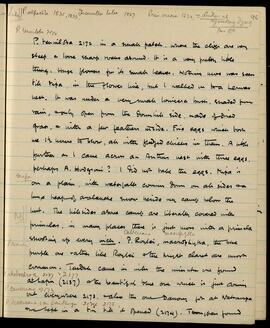
P. tenuiloba 2172
P. tenuiloba 2172 in a small patch, where the cliffs are very steep & loose sharp rocks abound. It is a very pretty little thing. Huge flowers for its small leaves. Nothing more was seen till Mipa, in the flower line, but I walked on to a Lerwa's nest. It was under a very small Lonicera bush, shaded from rain, & only open from the downhill side, made of dried grass, & with a few feathers inside. Five eggs which took me 1 1/2 hours to blow, all with fledged chicks in them. A little further on I came across an Anthus nest with three eggs, perhaps A. hodgsoni? I did not take the eggs.

Mipa
Mipa is on a plain, with waterfalls coming down on all sides & a large heap of avalanche snow beside my camp below the hut. The hillsides above camp are liberally covered with primulas, in many places there is just moss with a primula shooting up every inch. P. Roylei (Calderiana), macrophylla, the blue purple one rather like Roylei & the bright claret are most common. Tenduk came in with the minute one found at Lhapu (2137) & the beautiful blue one which is just coming out everywhere 2173, & also the one Danu found at Natrampa. Two kept in a tin till it opened (2174). Tenduk found

P. rhodochroa 2137, 2177
P. Cawdoriana 2173
P. dickieana var. pantlingii 2174, 2178

LSH/1/1/3/3/197 · Part · 1996-06-18
Part of The Ludlow & Sherriff Collection

SUMMARY:
At Mipa Taktsa the party halted, noting fine weather early before mist and rain, and surveyed the valley northwest of camp with extensive rock ridges and a broad plain. Primulas were abundant, with mentions of a yellow form and P. rhodochroa (specimen 2137), and earlier P. jucunda (2175). There was trouble with insufficient coolies, leading to rations being left behind, and a plan to visit a large plain west of camp.

CONTENT:
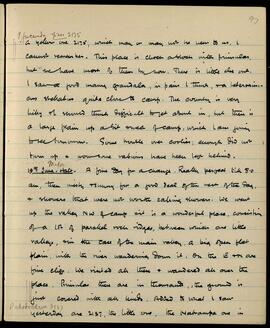
P. jucunda 2175
A yellow one 2175, which may or may not be new to us, I cannot remember. This place is chock-a-block with primulas, but we have most of them by now. There is little else out. I saw a good many glandula, in pairs I think, or heterotrichous stellatus quite close to camp. The country is very hilly and I should think difficult to get about in, but there is a large plain up a bit west of camp, which I am going to see tomorrow. Some trouble over coolies; enough did not turn up and now some rations have been left behind.

Mipa Taktsa
19th June. Halt. A fine day for a change. Really perfect till 8.0 am, then misty and rainy for a good deal of the rest of the day, and showers that were not worth calling showers. We went up the valley NW of camp and it is a wonderful place, consisting of a lot of parallel rock ridges, between which are little valleys, in the case of the main valley, a big open flat plain, with the river wandering down it. On the East side are fine cliffs. We visited all these and wandered all over the place. Primulas there are in thousands, the ground is just covered with all kinds. Added to what I saw yesterday are 2137, the little one, the Nabrampa one in
P. rhodochroa 2137