Showing 7 results

Archival description
7 results with digital objects Show results with digital objects
LSH/1/1/1/1/65 · Part · 1933-06-21
Part of The Ludlow & Sherriff Collection

SUMMARY:
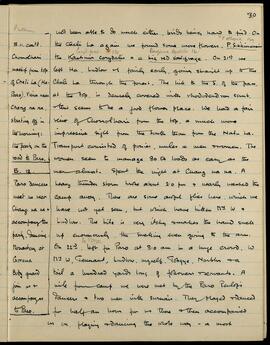
Revisited Cheli La and collected flowers including Primula sikkimensis, Kashmir corydalis, and Bergenia ligulata; left Ha with Ludlow, ascended through rhododendron scrub to the pass with views of Chomolhari. Transport was by ponies, mules, and porters; spent the night at Chang na na amid a heavy thunderstorm and troublesome flies.

CONTENT:
30

B. 11. contd. not been able to do much either, birds being hard to find. On
Chomolhari the Cheli La again we found some more flowers, P. sikkimensis
massif from top (? P. obliqua 129), the Kashmir corydalis (Coryd. cash. 131) &
of Cheli La (Ha- a big red saxifrage (Bergenia ligulata 130). On 21st we
Paro). Views near left Ha, Ludlow & I fairly early, going straight up to the
Chang na na, Cheli La through the forest. The hill to the S. of the pass,
starting off in at the top, is densely covered with rhododendron scrub.
the morning: This seems to be a good flower place. We had a fair
the party on the view of Chomolhari from the top, a much more
road to Paro. impressive sight from the South than from the Natu La.
Transport consisted of ponies, mules & men & women. The
women seem to manage 80 lb loads as easily as the
men almost. Spent the night at Chang na na. A
B. 12. heavy thunder storm broke about 2.0 pm & nearly washed the
Paro dancers camp away. There are some awful flies here, which we
meet us near

LSH/1/1/5/1/169 · Part · 1933-07-21
Part of The Ludlow & Sherriff Collection

SUMMARY:
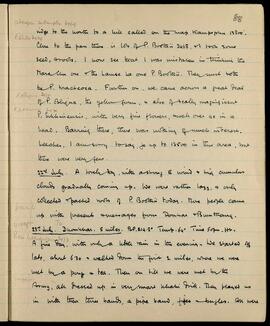
Notes on Codonopsis subsimplex and several Primula species, correcting earlier identifications to P. bracteosa, with collecting of P. Boothii seed and roots and observations on leech altitude. Messages arrived from Domkhar and Bumthang, and the party proceeded 5 miles to Dhomkhar where they received an army reception with bands.

CONTENT:
88

Codonopsis subsimplex 3469
ridge to the north to a hill called on the map Kampojohn 13800'.

P. bhutanica 3468
Close to the pass there is lots of P. Boothii 3468, & I took some seed, & roots. I now see that I was mistaken in thinking the Mara Chu one & the Lamse La one P. Boothii. They must both be P. bracteosa. Further on, we came across a great deal

P. obliqua 3470
of P. obliqua, the yellow form, & also of really magnificent

P. sikkimensis 3471
P. sikkimensis, with very fine flowers, well over 40 in a head. Barring these, there was nothing of much interest. Leeches, I am sorry to say, go up to 13500 in this area, but there were very few.

22nd July. A lovely day, with a strong E wind & big cumulus clouds gradually coming up. We were rather lazy, & only collected & packed roots of P. Boothii today. More people came
presents
up with presents & messages from Domkhar & Bumthang.

To
23rd July. Dhomkhar. 5 miles. BP. 204.8° Temp. 64° Time 5.0pm. Ht. 4000ft
Picea likiangensis 3473
A fine day, with only a little rain in the evening. We started off late, about 6.30 & walked down the first 2 miles, where we were met by a pony & tea. Then on till we were met by the
reception
Army, all dressed up in very smart khaki drill. They played us in with their three bands, a pipe band, fifes & bugles. All were

LSH/1/1/2/1/53 · Part · 1933-07-08
Part of The Ludlow & Sherriff Collection

SUMMARY:
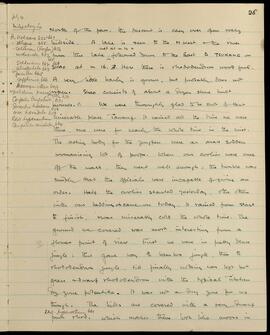
The party descends north from Milakatong La, follows a lake and river, and reaches Tsukang (Shao) around mile 16, noting scant barley and rhododendron fuel. They express relief at leaving rain-soaked Tawang, criticize incompetent local officials, and describe a route transitioning from dense jungle to bamboo, rhododendron, and finally grass with dwarf rhododendron, alongside a list of collected plants.

CONTENT:
July 14.
Milakatong La

P. sikkimensis 652=667
" obliqua 655
" Calderiana (Roylei) 658
" macrophylla 657
" sikkimensis 662
" alpicola 663
" pusilla 665
" sapphirina 666
Meconopsis villosa 649
Notholirion macrophyllum 650
Corydalis trifoliata 651
Swertia hookeri 654
Meconopsis horridula 659
Rhododendron hypenanthum 660
Campanula aristata 664

North of the pass, the descent is easy over open rocky hillside. A lake is seen to the N. West and the river met at m 14. From this lake followed down to the East to TSUKANG or SHAO at m 16. Here there is rhododendron wood fuel. A very little barley is grown, but probably does not ripen. Shao consists of about a dozen stone built houses. We were thoroughly glad to be shut of that miserable place Tawang. It rained all the time we were there, and we were for nearly the whole time in the mist.

The acting body for the Jongpen were an acute sodden womanising lot of poops. When our coolies were once off the mark, they went well enough: the trouble was simply that the officials were incapable of giving an order. Half the coolies started yesterday, the others with our bedding etc came on today. It rained from start to finish, and was miserably cold the whole time. The ground we covered was most interesting from a flower point of view. First we were in pretty dense jungle: this gave way to bamboo jungle, then to rhododendron jungle, till finally nothing was left but grass and dwarf rhododendron with the typical Tibetan dry zone potentilla. It was not a dry zone for us though. The hills are covered with a very dwarf pink rhododendron which makes them look like moors in

Rhododendron hypenanthum 661

LSH/1/1/5/1/215 · Part · 1937-07-31
Part of The Ludlow & Sherriff Collection

SUMMARY:
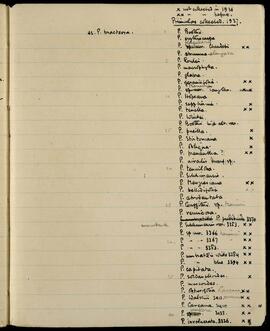
Checklist of Primula species collected in 1937, with notes on prior collection status and several specimen numbers. Localities mentioned include Chendebi and Tang Chu.

CONTENT:
x not collected in 1936
xx " " " before.
Primulas collected. 1937.

  1. P. bracteosa.

1 P. Boothii.
P. erythrocarpa
P. flagellaris
P. sp. nov. Chendebi xx
5 P. strumosa elongata
P. Roylei.
P. macrophylla.
P. glabra.
P. geraniifolia xx
10 P. sp. nov. Tang Chu. xx
P. Hopeana
P. sapphirina x
P. tenella. xx
P. Winteri.
15 P. Boothii high alt. var.
P. pusilla. x
P. Stirtoniana x
P. obliqua. x
P. prenantha? xx
20 P. nivalis dwarf sp.
P. tenuiloba.
P. sikkimensis.
P. Menziesiana xx
P. bellidifolia xx
25 P. atrodentata
P. Griffithii sp. hancini
P. vernicosa.
P. pudibunda 3370
P. sikkimensis var. 3353. xx
30 P. sp. nov. 3366 hancini xx
P. " " 3367 xx
P. " " 3383. xx
P. umbratilis white 3384 xx
P. " blue 3394 xx
35 P. capitata.
P. soldanelloides. x
P. muscoides.
P. obtusifolia Caveana xx
P. Walshii 3413 concinna xx
40 P. Caveana 3410 xx
P. uniflora 3438. x
P. involucrata 3226. x

LSH/1/1/3/3/87 · Part · 1933-04-09
Part of The Ludlow & Sherriff Collection

SUMMARY:
Notes local customs of refusing meat and sending honey to the Dzongpon. Describes a 12-mile march to Tsona over a snowy pass around 14,500 ft with clear but windy conditions, and records observations of Primula species and flocks of grandala.

CONTENT:
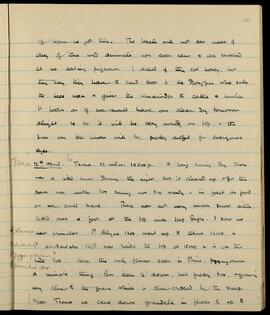
The locals will not eat meat of any of these wild animals, nor even hens, and are shocked at us eating pigeons. I asked if they eat honey, but they say they have to send that to the Dzongpon, who sells the beeswax and gives the remainder to cattle and mules. It looks as if we should have our clear day tomorrow all right. If so it will be very windy on top, and the sun on the snow will be pretty awful for everyone's eyes.

Tsona 12th April. To Tsona. 12 miles. 14500 ft. A long tiring day. There was a little snow during the night, but it cleared up and for the pass was neither too sunny nor too windy - in fact as good as we could have. There was not very much snow either, little over a foot at the top with deep drifts. I saw no new primulas. P. obliqua 1300 went up to about 14000, and P. atrodentata 1278 was beside the top at 15000 and is on this side too. Here the only flower seen is Prim. pygmaeorum, a minute thing less than 1/2 inch across, but pretty too, and growing very close to the grass which is close cropped by the sheep. Near Tsona we came across grandala in flocks of up to

LSH/1/1/2/1/235 · Part · 1969-04-29
Part of The Ludlow & Sherriff Collection

SUMMARY:
Clear views were obtained toward the Dongkar range and passes including Gorpo La, Pun Sum La, and Warha La, with a local belief noted about the 'Thief' near Orka La at Sakden. Danang returned from Bum La beyond Tawang with seed collections, though some desired plants were missing or eaten, and further collecting and short stays are planned.

CONTENT:
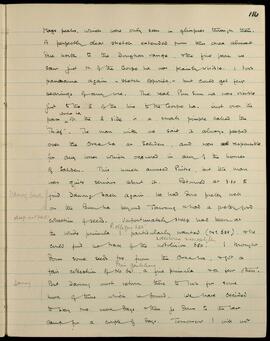
Mago peaks, which were only seen in glimpses through them.
A perfectly clear stretch extended from this area almost
due north to the Dongkar range, and the fine peak we
saw just N. of the Gorpo La was plainly visible. I took
panorama again - sketch opposite - but could get few
bearings of any use. The real Pun Sum La was visible
just to the E of the line to the Gorpo La. Just over the
pass (Warha La) on the E side is a small pimple called the
"Thief". The man with us said it always peeped
over the Orka La at Sakden, and was responsible
for any losses which occurred in any of the houses
of Sakden. This much amused Purbo, but the man
was quite serious about it. Returned at 3.30 to

find Danang back again. He had done pretty well
on the Bum La beyond Tawang and had a pretty good
collection of seeds. Unfortunately sheep had been at
the white primula I particularly wanted (No: 655, P. obliqua), and he
could find no trace of the Notholirion macrophyllum (650). I brought
down some seeds too from the Orka La, and got a
fair collection of No 641 (Prim. gambeliana), a fine primula and a few others.

But Danang must return there to look for some
more of these which he found. We have decided
to stay two more days and then go down to the last
camp for a couple of days. Tomorrow I will not

LSH/1/1/6/1/103 · Part · 1933-07-05
Part of The Ludlow & Sherriff Collection

SUMMARY:
At W. Tsanangho, the diarist reports heavy rain and poor visibility, explores the Tsanangha valley, and notes scarce primulas overall but finds two primulas new to them (No. 5865 of the Dryadifolia section and No. 5872, a nivalid close to P. sino-purpurea). Logistics are disrupted due to Kushu’s arrangements, reducing planned time on the Kuchaha; Kesang and a local accompany the outing, with observations of musk deer and local attire from Kongbo.

CONTENT:
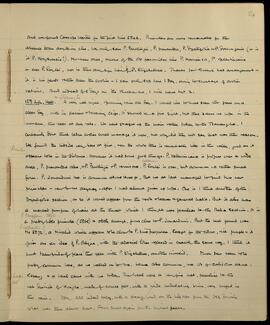
And we found Cassiope wardii for the first time 5846. Primulas are more remarkable for their absence than anything else. We only saw P. Paulingii, P. prenantha, P. Dryadifolia & P. doshongensis (or is it P. Kongboensis?). No new ones, none of the old favorites like P. baileyensis, P. valentiniana or even P. Rockii, nor is there any sign here of P. Elizabethae. Thanks to Kushu's bad arrangements—it is his fault rather than the coolies—I can only stop here 1 day, owing to shortage of coolies' rations. And instead of 6 days on the Kuchaha, I will have but 2.

W. Tsanangho
18th July. Halt. A very wet night, & pouring rain all day. I would like to have seen this place on a clear day, with its glaciers & towering cliffs. It should be a fine sight, but there seems no hope in the monsoon, this year at any rate. We went straight up the main valley today to the Tsanangha. I certainly don't think laden coolies could manage it now, but why did they not say that was their reason.

We found the hillside very bare at first, on the whole there is remarkably little in this valley, good as it appears to be in the distance. However it had some good things. P. Valentiniana is profuse over a wide area, P. prenantha also, & P. Paulingii & P. vernicosa. P. Rockii is over, but common—a rather small form. P. Jonarduni too is common above 14000 ft. But we at last managed to find two new primulas—new to us anyway—after I had almost given up hope. One is I think another of the Dryadifolia section, or so it would appear from the roots & leaves & general habit. But it also has a marked pompom of hairs at the throat, which I thought was peculiar to the Bella section. It is a pretty little primula (5865) & oddly enough, grows close to P. Jonarduni. But the best found was No 5872, a Nivalid which appears to be close to P. sino-purpurea. Except for the colour, rich purple—it gives one an idea of P. obliqua, with the adaxial lobes reflexed in exactly the same way. I think it must take pride of place this year with P. Elizabethae, another nivalid. Musk deer seem to be pretty common here, as we walked on to two. Lerwa also common, & a lot of Coelicolor above.

Kesang & a local came with me today. The local wore a vampire hat, peculiar to the wet districts of Kongbo, made of coarse felt, with a wide undulating brim, very useful in this rain. Very cold indeed today, with a strong wind on the hilltops from the SW, driving what was then almost sleet. Fresh snow again on the highest peaks.