Showing 6 results

Archival description
6 results with digital objects Show results with digital objects
LSH/1/1/5/1/131 · Part · 1933-06-21
Part of The Ludlow & Sherriff Collection

SUMMARY:
Notes record Parnassius butterflies, a woodcock nest with four eggs found on 22 June, and a list of Primula species observed. The writer describes the steep peaks of Dungshinggang, clear views toward Sikkim and beyond Chomolahri, getting soaked in a noon storm, and a 25 June entry noting rain overnight, a clear morning, and later cloud.

CONTENT:
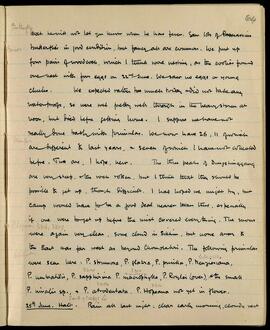
that he will not let you know when he has fever. Saw lots of Parnassius butterflies in good condition, but fancy all are common. We put up four pairs of woodcock, which I think were nesting, as the coolies found one nest with four eggs on 22nd June. We saw no eggs or young chicks.

We expected rather too much today and did not take any waterproofs, so were wet pretty well through in the heavy storm at noon, but dried before getting home. I suppose we have not really done badly with primulas. We now have 26, 11 of which are different to last year's, and seven of which I have not collected before. Two are, I hope, new.

The three peaks of Dungshinggang are very steep, the rock rotten, but I think that they should be possible to get up, though difficult. I had hoped we might try, but camp would have to be a good deal nearer than this, especially if one were to get up before the mist covered everything. The snows were again very clear, some cloud in Sikkim, but none away to the East as far west as beyond Chomolahri. The following primulas
were seen here: P. strumosa, P. glabra, P. pusilla, P. Menziesiana,
P. umbratilis, P. sapphirina, P. macrophylla, P. Roylei (over), the small
P. nivalis sp., and P. atrodentata. P. Hopeana not yet in flower.

25th June. Hall - Rain all last night, clear early morning, cloudy rest.

LSH/1/1/5/1/152 · Part · 1933-07-04
Part of The Ludlow & Sherriff Collection

SUMMARY:
Reassessment identifies specimen No. 2409 as Prim. Bellidifolia (atricapilla?), after earlier misassignments to P. umbratilis and P. Menziesiana. Notes that P. Menziesiana is No. 3301, P. umbratilis corresponds to Nos. 3384 (white) and 3394 (blue), and No. 2409 lacks farina on the leaves, differing from No. 3288.

CONTENT:
780
P. 2409. Prim. Bellidifolia (atricapilla?). I had foolishly
taken this to be P. umbratilis first, then P. Menziesiana.
The latter must be No. 3301, and P. umbratilis is 3384 (white)
and 3394 (blue). No. 2409 has no farina at all on the
leaves, and differs in this way from others I have seen, and I think,
from the specimens I took under 3288.

Page 157
LSH/1/1/5/1/157 · Part · 1933-07-04
Part of The Ludlow & Sherriff Collection

CONTENT:
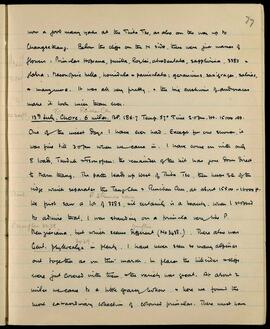
now a good many yaks at the Thiba Tso, as also on the way up to Changsethang. Below the cliffs on the N side, there were just masses of flowers: Primulas hopeana, pusilla, roylei, atrodentata, sapphirina, 3383 & glabra: Meconopsis bella, horridula & paniculata; geraniums, saxifrages, salvias, & many more. It was all very pretty, & the big cushions of Androsaces make it look nicer than ever.

13th July. Chore. 6 miles. BP. 18.67 Temp. 57° Time 2.0pm. Ht. 15000 odd.
One of the nicest days I have ever had. Except for one shower, it was fine till 3.0pm when we came in. I have come on with only 8 loads, Tenduk & Son open: the remainder of the kit has gone down direct to Ram thang. The path leads up West of Thiba Tso, then keeps SE of the ridge which separates the Tang Chu & Rinchen Chu, at about 15500 - 16000 ft. We first saw a lot of 3383, it certainly is a beauty. When I stopped to admire that, I was standing on a primula very like P. menziesiana, but which seems different (No 3438.) There also was Gent. phyllocalyx in plenty. I have never seen so many alpines out together as on this march. In places the hillsides & cliffs were just covered with them, & the variety was great. At about 2 miles we came to a little grassy hollow & here we found the most extraordinary collection of coloured primulas. There must have

LSH/1/1/5/1/215 · Part · 1937-07-31
Part of The Ludlow & Sherriff Collection

SUMMARY:
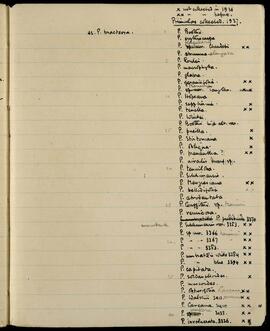
Checklist of Primula species collected in 1937, with notes on prior collection status and several specimen numbers. Localities mentioned include Chendebi and Tang Chu.

CONTENT:
x not collected in 1936
xx " " " before.
Primulas collected. 1937.

  1. P. bracteosa.

1 P. Boothii.
P. erythrocarpa
P. flagellaris
P. sp. nov. Chendebi xx
5 P. strumosa elongata
P. Roylei.
P. macrophylla.
P. glabra.
P. geraniifolia xx
10 P. sp. nov. Tang Chu. xx
P. Hopeana
P. sapphirina x
P. tenella. xx
P. Winteri.
15 P. Boothii high alt. var.
P. pusilla. x
P. Stirtoniana x
P. obliqua. x
P. prenantha? xx
20 P. nivalis dwarf sp.
P. tenuiloba.
P. sikkimensis.
P. Menziesiana xx
P. bellidifolia xx
25 P. atrodentata
P. Griffithii sp. hancini
P. vernicosa.
P. pudibunda 3370
P. sikkimensis var. 3353. xx
30 P. sp. nov. 3366 hancini xx
P. " " 3367 xx
P. " " 3383. xx
P. umbratilis white 3384 xx
P. " blue 3394 xx
35 P. capitata.
P. soldanelloides. x
P. muscoides.
P. obtusifolia Caveana xx
P. Walshii 3413 concinna xx
40 P. Caveana 3410 xx
P. uniflora 3438. x
P. involucrata 3226. x

LSH/1/1/5/1/153 · Part · 1933-07-04
Part of The Ludlow & Sherriff Collection

SUMMARY:
Notes confirm several Primula identifications from Dungshinggang and describe the scented P. obtusifolia under boulders. At about 15,500 feet the diarist found and photographed a grandala nest with nearly fledged young and a fragment of eggshell. A halt day is noted with intermittent fine weather and heavy rain before heading up a valley.

CONTENT:
unforgivable. P. menziesiana is the primula we got on the Dungshinggang 3301. I don't think there can be any doubt of that now. 3374 - 3384 are P. umbratilis, I have already taken P. bellidifolia, or a subspecies on Dungshinggang, 3288. P. obtusifolia is a most beautiful flower, with a strong scent, and looks particularly nice under the huge boulders where it grows, where the pale colour of the flower is thrown up by the black background.

At about 15,500' today I heard grandala, and when the mist cleared, saw a pair, each with a mouthful of food. They were a little worried obviously waiting for us to go. Eventually the male flew into the rocks, and gave the site of the nest away. It was built on a very small ledge on a rock face. This time I could with difficulty get to 3 ft away and saw the nest clearly, with two nearly fully fledged young. I took a few photos, then waited in between two huge boulders for the female to come, which she did, and I got a photo of her feeding the chicks. Away below, lying on some snow, I found about half an egg shell, enough to give a rough idea of what the egg is like.

10th July. Halt. Rained all night: fine part of the morning and one hour's sun this afternoon, then very heavy rain. We went up a valley to

LSH/1/1/5/1/156 · Part · 1933-07-04
Part of The Ludlow & Sherriff Collection

SUMMARY:
Notes describe a probable new Primula (No. 3438, P. uniflora) not in full flower, compared with 3301 (chasmophila/P. menziesiana), including calyx color, presence of white farina, habitat on open grassy slopes, and small leaves. Additional remarks cover color variation and presumed hybridization among Primula specimens Nos. 3432–3436 and references to 3366, 3367, 3358, and 3383; altitude recorded at 13,600 ft and temperature 58° at 2.0 pm.

CONTENT:
77a

570
26

3420
1140

14820

Alt. 13600' Temp 58° 2.0 pm.

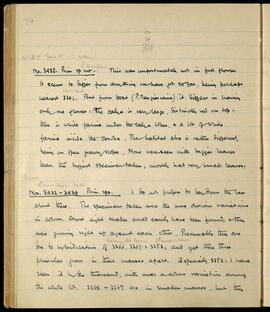
No. 3438. Primula sp. nov. (P. uniflora) This was unfortunately not in full flower.

It seems to differ from anything we have got so far, being perhaps nearest 3301 (chasmophila). But from that (P. Menziesiana) it differs in having only one flower. The calyx is very large, distinctly red on top: there is white farina under the calyx lobes, & a lot of white farina inside the corolla. The habitat also is rather different, being on open grassy slopes. None were seen with bigger leaves than the biggest specimen taken; mostly had very small leaves.

Nos. 3432 - 3436 Primula spp. I do not profess to lay down the law about these. The specimens taken were the more obvious variations in colour. About eight shades could easily have been found, often were growing right up against each other. Presumably they are due to hybridisation of 3366, 3367 & 3358 (tsariensis, alb. tsariensis, strenua v. nov.), and yet these three primulas grow in their masses apart. Especially 3383: I have seen it by the thousand, with never a colour variation among the whole lot. 3366 & 3367 are in smaller masses, but they...