Showing 5 results

Archival description
5 results with digital objects Show results with digital objects
LSH/1/1/9/1/79 · Part · 1933-06-18 - 1933-06-19
Part of The Ludlow & Sherriff Collection

SUMMARY:
From Ha-li on 18 June, the party explored the Dirupnang valley toward a pass to Geormotangka, finding notable Primula and Cassiope on wet cliff ledges in mist and rain. On 19 June they remained in camp at Ha-li, planning for the Rhularkarchung Pass, and were awakened at night by a rockfall that came toward the camp, with Lhakpa alerting the party.

CONTENT:
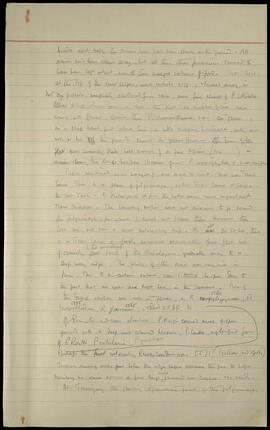
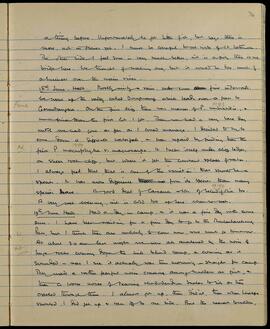
a thing before. Unfortunately he got little seed, but says there is more, not in flower yet. I must be careful to get roots of it later on. The other side I feel sure is very much better, but it is a pity there is no bridge here. We thought of making one, but it would be too much of a business over the main river.

18th June. Ha-li. Mostly misty & rain, with some fine intervals. We went up the valley called Dirupnang which leads over a pass to Geormotangka. On the first cliff there were masses of P. umbratilis (19183), much finer than the first lot I got. Then we had a very bare day until we had gone as far as I could manage. I decided to try to come down a difficult waterfall, & was repaid by finding then the fine P. macrophylla v. macrocarpa (19189). It tucks itself under cliff ledges, on sheer rock cliffs, but where it gets the constant splash of water. I always feel that that is one of the varieties that should be a species. It has more difference from its species than many species have. A good deal of Cassiope also, of bellidifolia (19190) too. A very wet evening, & it is cold too up here when so wet.

19th June Ha-li. Had a day in camp, & it was a fine day with some sun. I have been waiting for a fine day to go to the Rhularkarchung Pass, but I think they are unlikely to come now, so we must go tomorrow. At about 3.0 am last night we were all awakened by the noise of huge rocks coming down the hill behind camp, & coming as it sounded — as I see it actually was this morning — straight for camp. They made a rather fearful noise crashing among boulders at first, & then a worse noise of tearing rhododendron bushes to bits as they crashed through them. I almost got up, then didn't, then when Lhakpa shouted I did get up & ran off to one side. But the nearest boulder,
LSH/1/1/9/1/144 · Part · 1933-09-01
Part of The Ludlow & Sherriff Collection

SUMMARY:
Page lists Primula specimens with notes on morphology, flower colors, abundance, and growth habits, including forms such as P. caveana, P. muscoides, P. glabra, and P. waddellii. Mentions comparison with earlier collections at Waitang and a reference to a specimen from 1938.

CONTENT:
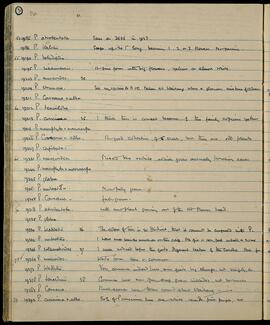
(3) 136 33.

  1. 19185 P. atrodentata Same as 3636 in 1938.
    19186 P. walshii Scape up to 1" long bearing 1, 2 or 3 flowers. No farina.
  2. 19190 P. bellidifolia.
    19195 P. sikkimensis. A fine form with big flowers, yellow or almost white.
    19203 P. muscoides. 34.
    19204 P. strumosa. See my 19000 A B or C taken at Waitang where a glorious mixture of colours
    19211 P. caveana v. alba
  3. 19212 P. tenuiloba
    19213 P. concinna 35. I think this is correct because of the fairly copious yellow
    19216 P. macrophylla v. macrocarpa
    19226 P. caveana v. alba. A good collection of 5 sheets, but they are odd plants
    19227 P. capitata.
  4. 19231 P. muscoides. Mixed blue and white, which grow actually touching each
    19244 P. macrophylla v. macrocarpa
    19245 P. glabra
    19251 P. umbratilis. Not fully grown.
    19255 P. caveana - full grown.
  5. 19318 P. atrodentata. With new plants growing out from old flower head.
    19325 P. glabra.
    19330 P. waddellii 36. The colour of this is so distinct, that it cannot be confused with P.
    19332 P. umbratilis. I have never seen so much as on this cliff. All of it is very pale indeed, or some
    19346 P. soldanelloides 37 I never noticed before the quite different texture of the corolla. Ask for
  6. 19364 P. muscoides. White form. Here v. common.
    19373 P. waddellii. Very common indeed here, in quite big clumps, not singly, as
    19378 P. jonardunii. 38 Common here, on open steep grass hillsides, not so much
    19383 P. caveana. Much scarcer here than round about Waitang.
  7. 19392 P. concinna v. alba. 80% of P. concinna here are white, remainder pink purple, no
LSH/1/1/9/1/146 · Part · 1933-09-01
Part of The Ludlow & Sherriff Collection

SUMMARY:
Page lists Primula taxa with collection numbers and notes on abundance, habitat, flowering/fruiting status, and seed or root collections. Mentions very late flowering in some cases and specific quantities. One entry records a collection at Chendebi Sovo.

CONTENT:
4 138

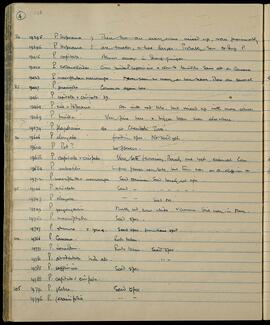
80 19395 P. Hopeana } These two are everywhere mixed up, one presumably
19396 P. Hopeana } are smaller, & here larger. Probably best to drop P.
19416 P. capitata. Almost always in dwarf juniper.
19420 P. soldanelloides Grows beside P. sapphirina & close to tenuiloba. Same alt. as Caveana
19423 P. macrophylla v. macrocarpa. Never seen so many as here before. There are several
85 19447 P. geraniifolia Common again here.
19461 P. capitata v crispata. 39.
19464 P. sin. v Hopeana. An with red tube, but mixed up with more which
19469 P. pusilla. Very fine here & bigger than seen elsewhere.
19574 P. flagellaris 40 at Chendebi Sovo.
90 19606 P. elongata fruiting spec. No seed yet.
19610 P. Pet? No flowers.
19656 P. capitata v crispata Very late flowering. Barely one yet, even at low
19684 P. umbratilis. In full flower very late, but this was on a cliff in a
19712 P. macrophylla v. macrocarpa. Seed specimen. Seed barely yet ripe.
95 19746 P. reticulata Seed - - - - - - -
19747 P. elongata. Seed ok.
19749 P. yargongensis. Mostly red, some white. Common. Still many in flower.
19750 P. macrophylla Seed spec.
19757 P. strumosa = 19204. Seed spec. from same spot.

  1. 19766 P. Caveana. Roots taken.
    19777 P. Jonarduni. Roots taken. Seed spec.
    19781 P. atrodentata high alt. " "
    19785 P. sapphirina Seed spec.
    19788 P. capitata v crispata.
    105 19791 P. flaccida. Seed spec.
    19796 P. geraniifolia " "
LSH/1/1/9/1/86 · Part · 1949-06-30
Part of The Ludlow & Sherriff Collection

SUMMARY:
Seed collections are listed with specimen numbers and brief locality notes around camp, river, lake, and cliffs, including several Primula species, anemones, Rheum, and Androsace. Notes record seed sent to Taylor and to G.T.

CONTENT:
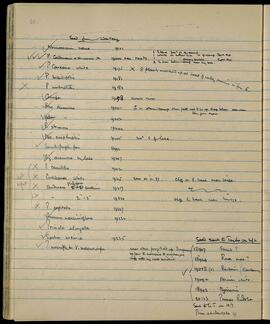
Seed from Waitang

Nomocharis nana 19121 1 ½ blue 300' N of camp.
P. calderiana x strumosa 19000 ABC roots. 1 white in bottom ½ m N of camp. Dark eye.
1 " " " among shrubs. light eye.
2 ½ blue below camp near big rock.
P. caveana white 19175 X 8 plants marked up at head of valley, river in from E.
P. bellidifolia 19181
P. muscarioides 19183
Conifer 19198 across river
Blue anemone 19201 ½ m above camp where path used to go up. Keep below near where they join again.
Yellow " 19202
P. strumosa 19204
Rheum spiciforme 19205 200' S of lake.
Small purple pea 18992
Big anemone by lake 19207
P. tenuifolia 19212
Cochlearia white 19215 some as in 37. Cliff on L. bank near bridge. (not ripe)
Androsace globifera cushion 19217 (not ripe)
" " 2" - 3" 19220 cliff L. bank near bridge.
P. capitata 19227
Anemone narcissiflora 19232
Primula elongata
Sorbus ursina 19235
P. macrophylla v. macrocarpa near where pony tied up Dumpra. up past R moraine to overhanging cliff with big rock beside it.

Seed sent to Taylor on 30/6
18907 Surus?
18924 Rosa mac?
19058 (2) Berberis (Kautam)
19092 Allium white.
18943 Myricaria.
20123 Prunus Rudolpha
Sent to G.T. on 10/7.
Prim. atrodentata 19

LSH/1/1/7/1/7 · Part · 1940-05-24
Part of The Ludlow & Sherriff Collection

SUMMARY:
The diarist notes bodies with bows left beside them and observes alpine flora on nearby snow slopes and streambeds. Accompanied by Langong coolies, they visit the Tsari Sama (Sarpa) pilgrimage area, finding it rich in Primula, Rhododendron, and a new white-flowered Daphne near the pass to Lopa territory. Trashiyang is mentioned as the starting and finishing point of the pilgrimage.

CONTENT:
Beside each body, the owner's bow had been stuck in the ground. All arrows had been taken away, but all their other possessions seemed to have been left intact, even to their meagre rations of food. Near here, at the top of the snow slopes, were vertical cliffs. Tucked away in dust-dry pockets, completely sheltered from rain, were fine clumps of P. littledalei.

A little lower down, at 14,000', the first Meconopsis simplicifolia were coming into flower. Beside this, P. chamaethauma was in flower, and on a steep bank just above this, a little creeping Lonicera, only an inch or two off the ground, showed its yellow flowers. Some of the open swampy flats held masses of a fine Allium (No. ). On stony beds beside streams grow P. macrophylla v. macrocarpa.

There remained, near Langong, one area to visit, that was Tsari Sama. This is a place of pilgrimage, called Tsari Sama or Sarpa—the new Tsari—to distinguish it from the better-known, more important Tsari Chikchar. The Langong coolies were not anxious to go round the pilgrimage, for which I could not blame them. However, they took me, and it was a most interesting trip. As at the Lo La, there is in Tsari Sama a fairly extensive, reasonably open flat bit of country, just north of the immediate Himalayas, gradually rising to a steep rocky ridge. The whole of this area was very rich in flora. This, to a certain extent, can, I think, be put down to the fact that no yaks are kept here in the summer. None of the dwarf rhodos were now in flower, and R. campylogynum (5560), R. trichocladum (5555), R. glaucum (5565). Also 5568.

A Primula not seen elsewhere, P. Kingii covered acres of open ground with its deep wine-coloured blooms, P. laeta, a glorified form of P. Roylei. Primula, P. gracilipes.

Perhaps the most interesting Rhododendron was 5571 (yellow, red spots). Growing among rocks just below the ridge before reaching the pass to Lopa territory, we came across a fine large, white-flowered new Daphne. No seeds.

At Trashiyang, the starting and finishing point of the pilgrimage,