
Showing 3 results

Archival description
3 results with digital objects Show results with digital objects
LSH/1/1/3/3/177 · Part · 1983-05-05
Part of The Ludlow & Sherriff Collection

SUMMARY:
Notes record primulas found near a rocky nala and two Blood Pheasants shot at high elevations. During two halt days, letters were written and mail sent; the mail runner was dismissed and replaced by a 'tapion'. Dawong and Tsompen collected new primulas west of the Bimbi La while the author surveyed the hillside near camp.

CONTENT:
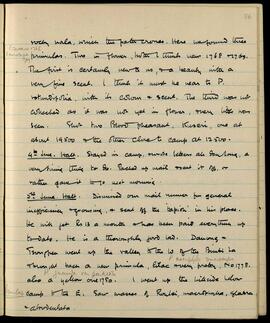
rocky nala, which the path crosses. Here we found three (P. caveana 1768, P. macrocarpa 1769) primulas. Two in flower, both I think new 1768 and 1769. The first is certainly new to us, and a beauty with a very fine scent. I think it must be near to P. rotundifolia, with its colour and scent. The third was not collected as it was not yet in flower, and very little was seen. Shot two Blood pheasant, Kuseri, one at about 14500 and the other close to camp at 12500.

4th June. Halt. Stayed in camp, wrote letters all day long, a very tiring thing to do. Packed up mail and sent it off, or rather gave it to go next morning.

5th June. Halt. Dismissed our mail runner for general inefficiency and grousing, and sent off the 'tapion' in his place. He will get Rs 13 a month and has been paid everything up to date. He is a thoroughly good lad. Dawong and Tsompen went up the valley to the W of the Bimbi La and brought back a new primula (P. macrophylla macrocarpa), lilac and very pretty, No 1778. Also a yellow one 1780 (P. jucunda var ponticola). I went up the hillside below camp to the E. Saw masses of Roylei, macrophylla, glabra and atrodentata.
LSH/1/1/6/1/60 · Part · 1938-05-28 - 1938-05-29
Part of The Ludlow & Sherriff Collection

SUMMARY:
Field notes from Langong list multiple Primula specimens with observations on flowering, variation, and a possible hybrid, and note nearby passes (Lo La/Shethang La and Chubumbu La) used in July–August. Bird nesting records for Crossoptilon harmani and Blood Pheasant at about 12,000 ft are dated 28–29 May 1938.

CONTENT:
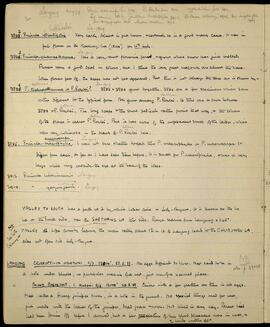
Langong - May 38. Primula macrocephala 3889, R. laudandum 3900, agglutinatum form 3902, Lil. nanum 3903, Gaultheria trichophylla 3905, Androsace delavayi 3906, Mec. integrifolia 3909, Trichophragma 3910, Lloydia serotina 3915.

30a Littledalei Langong

  1. Primula rotundifolia. Very early. Almost in full bloom, certainly so in a good many cases. It was in full flower on the Kashong La (15000') on 15th July.

  2. Primula chamaethauma. Has a very short flowering period, and grows where snow has just melted.
    Flowers vary a good deal in colour, but I think the very great majority are almost the same.
    When flowers fall off, the scape has not yet appeared. But this is not always the case as is shown by —

3894 P. chamaethauma x P. Roylei? 3893 and 3894 grow together. 3894 are a few specimens which seem rather different to the typical form. Both grow among P. Roylei. Is this one a cross between 3893 and P. Roylei? The long scape and the short pedicels rather point that way, and the colour of the flower is nearer P. Roylei. But it has none of the unpleasant smell of the latter, which was very noticeable in the plants of P. Roylei here.

  1. Primula macrophylla. I was not sure whether to call this P. macrophylla or P. macrocarpa. It differs from each, as far as I have seen them before. It is small for P. macrophylla, and has a very large white ring outside the eye at the base of the lobes.

  2. Primula sikkimensis. Langong.

  3. Primula yargonjensis. Langong.

VALLEY TO SOUTH has a path up it by which Lopas come in July - August. It is known as the Lo La on the South side, and the SHETHANG LA this side. Rough bearing from Langong = 145°.

VALLEY to Lopa country leaving the main valley about 1 1/2 m W. of Langong leads to the CHUBUMBU LA, also not open till July - August.

LANGONG CROSSOPTILON HARMANI. c/7. 12000'. 28.5.38. All eggs difficult to blow. Nest said to be in a hole under shrubs, no particular making of a nest, just use of a natural place.

BLOOD PHEASANT. I. kuseri. c/6 12000' 29.5.38. Chicks with a few feathers on them in all eggs. Nest under a dwarf juniper bush, in a hole in the ground. No special things used for nest, just made with the leaves of the juniper, dead grass and moss. Not lined in any way. Parent bird had been driven off before I arrived, but a few feathers of her blood pheasant were in nest, and 2 birds within 40 yds.

LSH/1/1/5/1/145 · Part · 1933-07-04
Part of The Ludlow & Sherriff Collection

SUMMARY:
Travel past yakherd huts at Sezi to Omta Tso, where a camp could be made. Despite foul rain and wind making photography difficult, primulas were collected and photographed, with abundant plants near Thita Tso and difficult cliff-face specimens that even Tenduk struggled to reach; P. hopeana was massed at camp.

CONTENT:
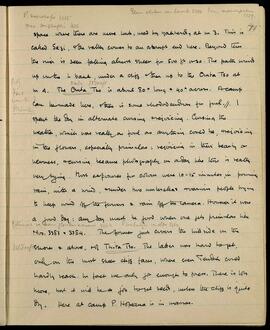
P. macrocarpa 3385
Mec integrifolia 3386
Lilium elatum var humile 3388 Prim macropetalum 3389.

space where there are some huts, used by yakherds, at m. 3. This is
called Sezi, the valley comes to an abrupt end here. Beyond this
the river is seen falling almost sheer for 500 ft. or so. The path winds
up on the left bank, under a cliff and then up to the Omta Tso at
m. 4. The Omta Tso is about 80x long and 40x across. A camp
can be made here, and there is some rhododendron for fuel. // I
spent the day in alternate cursing and rejoicing. Cursing the
weather, which was really as foul as anything could be, and rejoicing
in the flowers, especially primulas: rejoicing in their beauty or
newness, and cursing because photography on a day like this is really
very trying. Most exposures for colour were 10-15 minutes, in pouring
rain, with a wind, and under two umbrellas and various people trying
to keep wind off the flowers and rain off the camera. However it was
a good day: any day must be good when one gets primulas like
Nos. 3383 and 3384. The former just covers the hillside on the
shores and above, of Thita Tso. The latter was hard to get,
only on the most sheer cliff faces, where even Tenduk could
hardly reach. In fact we only got enough to press. There is lots
more, but it will be a job to get seed, unless the cliff is quite
dry. Here at camp P. hopeana is in masses.