
Showing 3 results

Archival description
3 results with digital objects Show results with digital objects
LSH/1/1/6/1/155 · Part · 1938-10-22
Part of The Ludlow & Sherriff Collection

SUMMARY:
At Migyitun the diarist reports rain and snow, finds a note from Ludlow sent from Chitsam about transport from Tume, collects limited seeds, and pays off Langong coolies. The next day, despite heavy snow, the diarist and Tsangpen search south for primulas, securing some seed and purchasing a sheep, with yak transport promised. On the 25th they march 15 miles to Chikchar, obtaining a letter from Ludlow at Podzo Sumdo en route.

CONTENT:
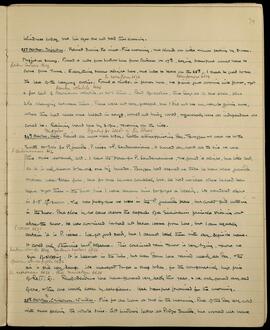
79

blindness today, but his eyes are not bad this evening.

23rd October. Migyitun. Rained during the night. Fine morning, but clouds on hills and snow falling by 8.00 am.

Migyitun sunny. Found a note from Ludlow here from Chitsam on 17th, saying transport would have to come from Tume [Berberis ludlowii 6623]. Everything seems alright here, and we hope to leave on the 25th. I shall be glad to see the last of the Langong coolies. Found a rhodo. [R. neriiflorum 6626] in flower here, and a Pieris [Pieris formosa 6627] just coming into flower, and got a few seed of Aconitum volubile [Aconitum volubile 6628], or so I think. Paid off coolies, three days at 12 sho each, plus 3 Rs. changing between them. They were not very grateful, but I did not see any point in giving more, when they had never once helped in camp, would not bring wood, and generally were as independent as could be. Raining hard here by 3.00 pm, snowing on the hills. [Migyitun: Hunting for seeds in the snow.]

24th October. Halt. Rained all night and all today. Rather a disappointing day. Tsangpen and I went up to the south to look for P. jucunda, P. ioessa and P. sandemaniana [P. sandemaniana 6630]. It snowed very hard all the time we were there and was extremely cold. I knew the place for P. sandemaniana, and we found it alright, but little seed, as it is only known to be one big breeder. Tsangpen had assured me that he knew where jucunda and ioessa were taken from, but for once he was completely lost. He had no idea where he had been before and got them—the first time I have known him to forget a locality. We wandered about in 6-8" of snow, and he was pretty sure we were in the P. jucunda place, but could find nothing in the snow. But close by we came across the capsules of a Sikkimensis primula sticking out above the snow. He was convinced he had not taken ioessa from here, but I am equally certain it is P. ioessa [P. ioessa 6631]. We got good seed, but I cannot label them with any definite name. It could only otherwise be P. hopeana [Berberis sheriffii 6634, Berberis hookeri 6636]. This continued rain and snow is very trying, and shows no sign of stopping. It is heaviest in the hills, but even down here rained nearly all day, and the air is still very damp [Quercus semecarpifolia 6632]. We managed to get a sheep today, for the comparatively huge price of Rs. (T) 5/-. Rhododendrons here have flowered very badly this year, and we only found any seed of one, and they are mostly eaten by caterpillars [Rh. microneres 6633, Rhod. neriiflorum 6638]. Yak transport promised for the morning.

25th October. Chikchar. 15 miles. Fine for an hour or two in the morning. Rest of the day very cold with snow falling the whole time. Got Ludlow's letter at Podzo Sumdo, but would not have
LSH/1/1/6/1/152 · Part · 1938-10-22
Part of The Ludlow & Sherriff Collection

SUMMARY:
Field notes list several Primula species with localities, habitat and elevation details, flowering or seed status, and comparisons to collections made in 1936. There is uncertainty about the exact P. ioessa type locality near Lo Migyitun due to mist and deep snow, and sites such as KHERI GOMPA at Chungkar are referenced.

CONTENT:
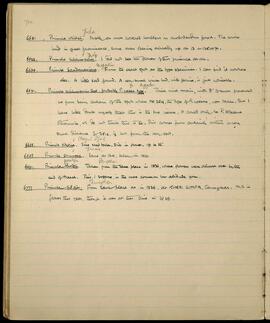
78a

  1. Primula winteri. Yuda. Mostly on moss covered boulders in Rhododendron forest. The winter bud in great prominence, some even opening already up at 13 or 13,500 ft.

  2. Primula sikkimensis. Yuda. I did not see the flowers of this primula at all.

  3. Primula Sandemaniana. Migyitun. From the exact spot as the type specimen. I can find it nowhere else. A little seed found. A very small winter bud, with farina, is just noticeable.

  4. Primula sikkimensis Sect. probably P. ioessa type. Lo Migyitun. Thick mist rain, with 8" of snow prevented us from being certain of the spot where No 2514, the type of P. ioessa, was taken. But I have little doubt myself that this is the true ioessa. It could only be P. Hopeana otherwise, and I do not think this is so. This comes from certainly within a very short distance of 2514, if not from the very spot.

  5. Primula tibetica. Chayul Dzong. Some seed taken. Still in flower. Up to 3½".

  6. Primula strumosa. Tremo. Same as 1300, taken in 1936.

  7. Primula Boothii (gracilipes). Pangchen. Taken from the same place in 1936, where flowers were almost over by the end of March. This, I suppose, is the more common low altitude form.

  8. Primula filipes. Chungkar. From same place as in 1936, at KHERI GOMPA, Chungkar. Not in flower this year, though it was at this time in 1936.

LSH/1/1/6/1/143 · Part · 1936-10-02
Part of The Ludlow & Sherriff Collection

SUMMARY:
The diarist reports from Singo Samba and then Trashidzong/Tsari Sama, noting misty and rainy weather, limited finds of rhododendrons and primulas, and heavy grazing by yaks that destroyed desired Meconopsis and Primula stands. Plans are made to leave kit with one man and proceed lightly with eight coolies around Tsari Sama, while noting Ludlow and Taylor’s move from Kyimdong toward the Bimbi La to target several Meconopsis species; the pilgrim season at Sacha Peso appears over.

CONTENT:
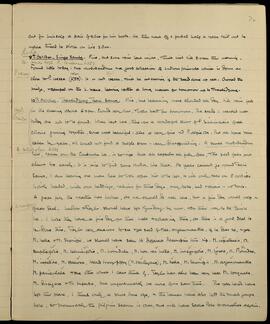
cut for himself a pair of soles for his boots. He then went off & pulled half a yak's tail out to make thread to stitch on his soles.

9th October. Singo Samba. Fine, but some rain last night, thick mist till 8.00am this morning. Found little today: two rhododendrons & a good collection of Ludlow's primula which is down as close to P. ioessa (3789). It is not ioessa, will be interesting if the seed come up well. Crossed the ridge, recamped on the L. bank, leaving rather a long march for tomorrow up to Trashidzong.

10th October. Trashidzong, Tsari Sama. Fine, but becoming more clouded all day, till rain fell in the evening about 5.0pm. Clouds very low, looks bad for tomorrow. The seeds I wanted most today are not to be found. When last here, there was a wonderful show of P. sikkimensis of all colours growing together, some most beautiful: also a very fine red P. alpicola. But all have been eaten by yaks, or dried up - not find a single stem - very disappointing. A small rhododendron here, taken on the Chumbumbu La, is so ripe that all capsules are fully open, the seed falls out almost too easily. It is nice to find some rhodos. like that. As yaks cannot go round Tsari Sama, I am leaving one man here to look after kit to be left, & will only take on 8 coolies lightly loaded, with our beddings, rations for three days, camp table, bed & chair - no tents.

A great pity the weather has broken, as we should do well here, but a fine day would help a great deal. Ludlow & Taylor should have left Kyimdong by now, for their way to the Bimbi La. I hope they have a fine day for their halt & collecting there, as there is a good deal to be done there. Taylor very anxious to see & get seed of Meconopsis argemonantha. If he does so, & gets M. bella & M. sherriffii, we should have seen 16 different Meconopsis this trip. M. nepalensis, M. simplicifolia, M. betonicifolia, M. horridula, M. hor. var lutea, M. integrifolia, M. lyrata, M. florindae, M. impedita, M. speciosa, Ward's ivory poppy (M. harleyana), M. bella, M. sherriffii, M. argemonantha, M. paniculata & one other which I can't think of. Taylor has also been very near M. torquata, M. discigera & M. superba, but unfortunately we none of us saw them. The yak herds have left this place, I think only a short time ago, & the lamas have also left the small gompa here, so presumably the pilgrim season is over, & we will have Sacha Peso to ourselves again.