Showing 5 results

Archival description
5 results with digital objects Show results with digital objects
LSH/1/1/6/1/91 · Part · 1938-07-08
Part of The Ludlow & Sherriff Collection

SUMMARY:
The diarist leaves the Tsangpo valley toward Nayü La, noting views of Gyala Tsutum and a local legend linking its summit to Samye via Yüsum. On 5th July at Nayü Chu, progress is delayed by lack of coolies despite assurances from Kusho and the gyimpon; on 6th July, after heavy rain, the party camps north of Nayü La and records notable plants including Lilium giganteum, a white water lily, and Smilacina.

CONTENT:
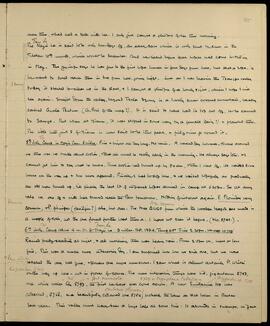
...were there, and had a talk with her. I only just caught a glimpse of her this morning.

The Nayü La is said to be only two days off, an easy pass which is only shut by snow in the Tibetan 10th month, which would be December. And we heard before that Lopas had come to Tsela in May. The gyimpon says he has gone to the first Lopa houses in four days from here, but that a Lopa, if he wants to could reach them in two from here, going light. Just as I was leaving the Tsangpo valley today it started to clear up in the East, and I caught a glimpse of a lovely scene, which I hope I will see again. Straight down the valley, beyond Tsela Dzong is a lovely snow covered mountain, locally called Gyala Tsutum (G. Peri of the map?). It is said to have had its top cut off, to be carried to Samye. But when at Yüsum, it was stopped in some way by a female deity (?) and planted there. The little hill just S of Yüsum is now said to be this peak, and pilgrims go round it.

5th July. Camp in Nayü Chu. 5 miles. Fine and bright all day long. No rain. A wasted day however. Kusho assured us there was no trouble about coolies, that all would be ready early in the morning. He always says this, and cannot get him to say what he knows. Three coolies had turned up by 8.0 am, then I went off. We waited some hours on the way up and two more appeared. Finally had to stop here, and we waited hopefully as gradually an odd man turned up, till finally the last lot of impressed Lopas arrived in camp at 6.30 pm. So at any rate we are off and with luck should reach the Pass tomorrow. Nothing of interest again. P. Florindae very common, and P. firmipes (flexilipes?) also, but over. The tree GIUGO from which the wooden teapots are made is a maple of sorts, not the one found further west though. I have not seen it before. (No. 5740.).

6th July. Camp about 4 m. N. of Nayü La. 9 miles. BP. 193.4. Temp 65° Time 2.30 pm. Ht app. 10700'
Rained pretty steadily at night, and all morning there was heavy rain. From 2.0 pm on, more or less fine. This was a much more interesting day. I am surprised how low we still are, but we have reached the very wet zone, and flowers are more numerous. I saw what is almost certainly P. Whitei on the way up here - not in flower of course. The most interesting things were Lil. giganteum 5743, and a white water lily 5759, the first we have ever come across. A new Smilacina too was collected, 5756, and a beautifully coloured one 5754, probably the same as that taken in Bhutan last year. This valley must have been a huge lake at some time. It abounds in swamps, in fact...
LSH/1/1/3/3/161 · Part · 1983-05-05
Part of The Ludlow & Sherriff Collection

SUMMARY:
Monsoon rains begin, pleasing local Lopas and Tibetans, and the party notes cultivation of wheat, potatoes, and turnips while offering seeds for sowing. Ramzana finds a new primula (1662, Primula yargongensis) by a hill stream and another primula (1663, P. florindae) in meadows; headmen bring provisions as the party arranges for paid services and medical help.

CONTENT:
Polygonatum cirrhifolium 1668. Calanthe tricarinata 1669. Rhod. megeratum 1666, Rhod. triflorum 1675.
Rhod. neriiflorum 1676, 1677. Trillium tschonoskii 1670.

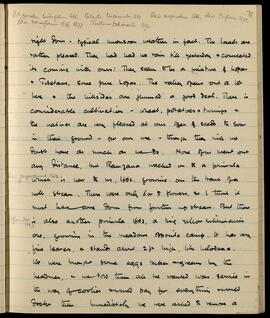
right down - typical monsoon weather in fact. The locals are rather pleased. They had had no rain till yesterday and connected its coming with ours. They seem to be a mixture of Lopas and Tibetans, some pure Lopas. The valley opens out a lot here and the hillsides are 'jhummed' a good deal. There is considerable cultivation - wheat, potatoes and turnips and the natives are very pleased at our offer of seeds to sow in their ground - for our use - though they will no doubt have as much as we do. None of us went out any distance, but Ramzana walked on to a primula which is new to us, 1662 (Prim. yargongensis), growing on the bank of a hill stream. There were only 6 or 8 flowers, so I think it must have come down from further up stream. But there is also another primula 1663 (P. florindae), a big yellow sikkimensis one, growing in the meadows opposite camp. It has very fine leaves, and stands about 2 ft high, like helodoxa. We were brought some eggs, butter and greens by the headmen, and we told them all we wanted was service in the way of coolies and would pay for everything and would doctor them. Immediately we were asked to remove a

LSH/1/1/5/1/160 · Part · 1937-07-14
Part of The Ludlow & Sherriff Collection

SUMMARY:
Notes on Primula populations with yellow, blue-purple, and white forms; whites show some variation, and all remain short and small-leaved as in specimens 3432–3436. Specimens 3449 and 3370 (alpicola luna) are compared, with 3449 resembling P. florindae or P. microdonta, P. sikkimensis present, and distributions between about 12,000–14,000 ft, with 3449 taking over at lower elevations than 3370.

CONTENT:
79a
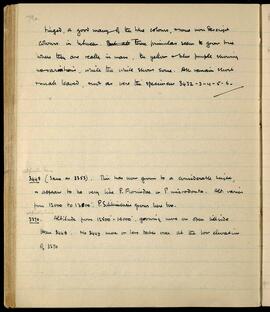
tinged, a good many of the blue colours, and some nondescript
colours in between. But all these primulas seem to grow true
where they are really in mass, the yellow and blue purple showing
no variations, while the white shows some. All remain short
small leaved, just as were the specimens 3432-3-4-5-6.

alpicola luna
3449 (Same as 3353). This has now grown to a considerable height,
and appears to be very like P. florindae or P. microdonta. Alt. varies
from 12,000 to 13,000'. P. sikkimensis grows here too.

alpicola luna

  1. Altitude from 12,500' - 14,000', growing more on open hillside
    than 3449. No. 3449 more or less takes over at the low elevation
    of 3370.
LSH/1/1/8/1/12 · Part · 1946-11-14
Part of The Ludlow & Sherriff Collection

SUMMARY:
Notes transport rates for donkeys, ponies, and coolies on the route Tsetang–Rong–Lhagyari–Lhapso–Lenda–Tromda. Records seeds collected on Potrang La with several taxa and an elevation noted.

CONTENT:
9

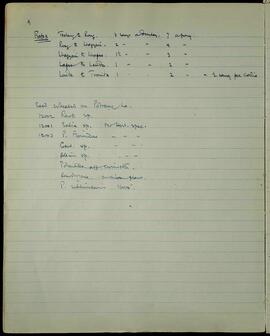
Rates
Tsetang to Rong. 3 sangs a donkey. 7 a pony.
Rong to Lhagyari. 2 " " 4 "
Lhagyari to Lhapso. 1 1/2 " " 3 "
Lhapso to Lenda. 1 " " 2 "
Lenda to Tromda 1 " " 2 " & 1/2 sang per coolie

Seed collected on Potrang La.
12002 Rhod sp.
12001 Salix sp. No Herb. spec.
12003 P. florindae - - -
Gent. sp. - - -
Allium sp. - - -
Potentilla aff curviseta.
Androsace cushion plant.
P. sikkimensis 16000'.

LSH/1/1/6/1/105 · Part · 1933-07-19 - 1933-07-21
Part of The Ludlow & Sherriff Collection

SUMMARY:
Amid continuous rain and cold, the party at Tsanang Gompa finds their bridge washed away, fords the river via a natural crossing, and gathers mixed reports about the steepness of Kucha La. Reaching Kongshong, they pay off reluctant coolies, send Kusho to recruit more with nine days’ rations, and prepare for the pass. On a halt day, despite illness and heavy morning rain, the diarist makes a strenuous 4,000 ft climb as the weather clears at the top.

CONTENT:
Tsanang La 19 July. P. florindae 5877 G. phyllocalyx 5878
20 July. R. xanthocodon 5883.

19th July. Tsanang Gompa. 6 miles. Very heavy rain all night and today. We did not get off till 8.30, as the coolies had to come up from 2 miles down the valley. A filthy morning even, cold. New snow lying pretty thick on the hills above 14,000'. Our bridge, made on the 17th, had been washed away, but we found another natural one further up over half the river, the other half being fordable. Rain pours down steadily without a stop, and I am surprised how cold it has become. News about the Kucha La is still difficult to get. It is said to be as steep as the Tsanang La, but I can hardly credit that, as Lopas do use it, and it would be very difficult to cross the Tsanang La loaded as Lopas always are. The only way to find out is to go and see. The gompa here is said to be very old, about 350 years or so. There is a newer one too about 100 years old, now much smaller than it used to be. The old monastery contains some very fine old tankas. It is said to be under the Lhalu family; the only lama here complains that nowadays they get no allowance, no rations or anything, all of which they used to have. News from local people about the Kucha La is rather more hopeful. They say three days are enough to reach it from Kongshong. I hope so.

20th July. Kongshong. 6 miles. Rain all day. The coolies, going homewards, found no difficulty in getting here in two days, and would have gone on to Pana with the greatest ease. One of them did tell Tsungpen that they were unwilling to go to the Tsanang La; that is why they kept back the whole time. Phutso would have got them on alright though. The river is much lower than when we went up, but why I don't know. Paid off coolies and sent Kusho in to get another lot, with nine days' rations, to allow for three up, three at the Pass, and three down. In the meantime we must spend two very dull days here, waiting for coolies to collect rations.

21st July. Halt. This was really a red-letter day. All last night it poured and all today up till 12.0 noon it poured. I had decided to go up a hill to the North of the valley—a climb of 4000 ft fully. This morning though, I was not feeling fit, very weak and with a bit of fever. The rain was almost too much for me, and for a while we hesitated. However, I felt I must go and left at 5.30 am in pouring rain to start the climb, which proved much further and much steeper than I had expected. I could only go slowly, and we did not reach the top till nearly midday, but we got there alright. Then the weather suddenly cleared up, and we had a