Showing 7 results

Archival description
7 results with digital objects Show results with digital objects
LSH/1/1/3/3/221 · Part · 1996-06-18
Part of The Ludlow & Sherriff Collection

SUMMARY:
Notes prolific flowering and collections including a new primula (P. jaffreyana 2257), an iris (2251), Incarvillea lutea (2252), and Thalictrum chelidonii. Reports shortage of drying paper, and mail issues: the runner found no mail at Tsona but had a chit from the Dzongpen; outgoing mail was forwarded by the Dzongpen and more is to be sent via Chayul.

CONTENT:
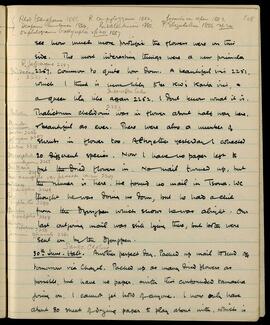
Rhod. sanguineum 1881, R. campylogynum 1882, forrestii var. repens 1883.
Diapensia himalaica 1884, Prim. valentiana 1885. P. Elizabethae 1886 sp. nov.
Omphalogramma bathysepala sp. nov. 1887

...see how much more prolific the flowers were on this side. The most interesting things were a new primula P. jaffreyana 2257. Common to quite low down. A beautiful iris 2251, which I think is near the K.W.'s Karta iris, a queer lily-like affair 2252 (Incarvillea lutea), I don't know what it is.

Thalictrum chelidonii was in flower about halfway here, beautiful as ever. There were also a number of shrubs in flower too. Altogether yesterday I collected 20 different species. Now I have no paper left to put the dried flowers in. No mail turned up, but the runner is there. He found no mail in Tsona. We thought he was doing us down, but he had a chit from the Dzongpen which shows he was alright. Our last outgoing mail was still lying there, but both were sent on by the Dzongpen.

30th June. Halt. Sanga Choling. Another perfect day. Packed up mail to send off tomorrow via Chayul. Packed up as many dried flowers as possible, but have no paper; with this confounded tamasha going on, I cannot get hold of anyone. I now only have about 80 sheets of drying paper to play about with, which is...

[Marginal Notes:]
P. jaffreyana 2257
Iris decora 2251
Thalictrum 2253
Meconopsis 2256
Jeffreyana 2257
Tibetica 2258
Dracocephalum 2255
Primula 2255
Rosa macrophylla var. farreri 2259
Gentiana 2249
Cryptantha 2250
Clematis 2254
Gentiana tibetica 2258
Jasminum officinale 2261
LSH/1/1/6/1/39 · Part · 1933-05-17
Part of The Ludlow & Sherriff Collection

SUMMARY:
The party moved up the valley with coolies burdened by heavy loads and delays at Molo, noted weather changes, and observed several rhododendrons and primulas. On 22 April at a camp above Singo Samba, a hazardous bridge crossing led Ramzana to cross while Ludlow forded downstream with Tseringpen. On 23 April, despite fresh snow and the coolies’ refusal to move, Ludlow, Tseringpen, and the diarist scouted and broke a path to the Lo La pass, checking known plant sites now under snow.

CONTENT:
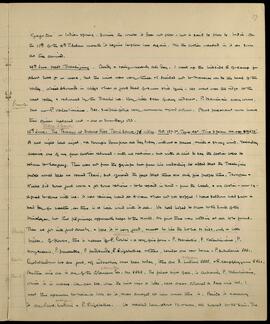
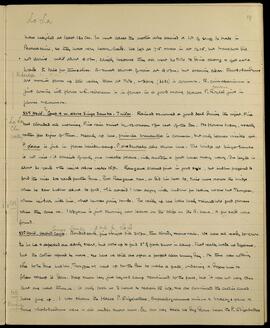
have weighed at least 130 lbs. In most cases the coolies also carried a lot of stuff to trade in Pachakshiri, so they have very heavy loads. We left at 7:15 and were in at 12:15, but transport did not arrive until about 4:00 pm, chiefly because they all went to Molo to drink chang and get extra loads to take for themselves. A small shower of rain at 4:00 pm, but evening clear. Rhododendrons are more in flower up this valley than at Molo, R. 3624 (3631) is common. R. cinnabarinum is just coming into flower and R. vellereum is in flower in a good many places. P. Roylei just in flower common.

22nd April. Camp 4 m. above Singo Samba. 7 miles. Rained and snowed a good deal during the night. Fine but clouded all morning. Fine rain and mist by 12:00 noon and for rest of the day. No flowers today, and really rather few signs of them. Nearly up here, Primula prenantha is common, but only leaves visible yet. P. glabra is just in flower beside camp. P. atrodentata also shown here. The bridge at Singo Samba is not nice - it consists of only one usable plank, with another a foot lower and very wavy. The length is about 30 yards and the height above water 15 ft. Ramzana crossed first in good style, but Ludlow preferred to ford the river 200 yards further down. Poor Ramzana ran, or did his best to, twice more across the bridge when he saw Ludlow about to ford. I'm afraid I was angry with Ludlow for telling no-one but Tseringpen, whom he took with him, what he was going to do. The valley up here looks lovely and should hold good flowers when they come on. Isopyrum is just showing new leaves on the cliffs on the R. bank. A few seed were found.

23rd April, Halted Camp. Clouded early, fine and bright till 2:00 pm, then cloudy and some rain. We were all ready to cross the Lo La and expected an early start, but woke up to find 2" of fresh snow in camp. That really made no difference, but the coolies refused to move, so here we still are after a perfect clear sunny day. As there was nothing else to be done Ludlow, Tseringpen and I went up to the Pass to make a path, ordering a dozen men to follow and stamp it down. Deep snow lay just beyond camp and continued to the pass, but it was not very often that one went through. It only took us 3 hours to reach the top, and we are convinced the coolies could have gone up. I was shown the places P. Elizabethae, Omphalogramma minus and brachysiphon and some rhododendrons were - all under snow now. On our way back we dug down near the P. Elizabethae

LSH/1/1/7/1/10 · Part · 1940-05-24
Part of The Ludlow & Sherriff Collection

SUMMARY:
Notes indicate the western extremity for Mec. florindae and where P. caliantha begins, with P. elizabethae meeting it at this point and not occurring eastward. The writer first found these further west in Bari Tana or Umkumbala.

CONTENT:
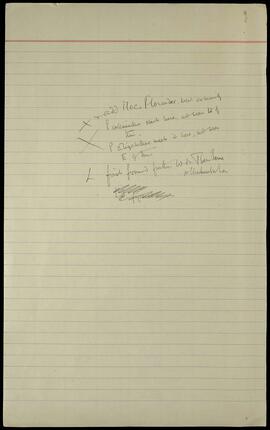
add Mec. florindae, west extremity
P. caliantha starts here, not seen W of
this.
P. elizabethae meets it here, not seen
E of this
I first found further W in Bari Tana
or Umkumbala

LSH/1/1/6/1/75 · Part · 1938-06-15
Part of The Ludlow & Sherriff Collection

SUMMARY:
Notes on the Kyag Chu spring’s seasonal flow, a halt at Trashiying with poor weather, and a wet march to the Tsokang at Shacho Pebo in Tsari Sama. The diarist describes logistical issues with coolies and rations, and records abundant Primula and Rhododendron, including vast masses of P. valentiniana; blood pheasant chicks are noted.

CONTENT:
'Kyag Chu' or Indian spring. During the winter it does not flow - but is said to flow to India. On the 10th of the 4th Tibetan month it begins to flow here again. All the coolies washed in it as soon as they arrived.

14th June. Halt. Trashiying. Cloudy & rainy nearly all day. I went up the hillside E of camp for about 2000 ft or more, but the mist was very thick & decided not to traverse on to the head of the valley, which abounds in cliffs & has a good deal of snow still lying. We went over the ridge to the next valley & returned by the Trashi La. Very little seen of any interest. P. tsariensis everywhere, but no P. valentiniana. Mec. simplicifolia very common & good colour. Blood pheasant now have their chicks hatched out - one or two days old.

15th June. The Tsokang at Shacho Pebo, Tsari Sama. 7 1/2 miles. BP. 187.7°. Temp. 46°. Time 3.30 pm. Ht. app. 13576'.
A wet night last night, & a terrific downpour all day today, without a pause, with a strong wind. Yesterday evening one of my four coolies returned - with no rations - but with a chit to say the coolies were to return to Langong. This was not from the gyunpa but from his underling. He added that the Trashiying people would take me round Tsari, but ignored the fact that there are only five people there. Tsoupon-Kusho did some good work & for some rations - to be repaid in kind - from the locals, & my coolies - now 14 - agreed to come with me. It was raining hard at 4 am & has not yet stopped. I have seldom had such a bad day for weather, as there is a high wind with it all. We had hoped to cross to the South of the Himalayas, but this pilgrimage apparently keeps to the North. At first there was nothing at all to be found. Then we got into good country, & here it is very good, must be like the Lo La N. side, only a little higher. Of flowers, there is masses of P. Roylei (calcareum) - a very fine form - P. tsariensis, P. valentiniana, P. kongboensis, P. prenantha, P. pudibunda, P. elizabethae & others, besides one new to me - P. subularia 5561. Rhododendrons too are good, very interesting ones seen today, there are R. ludlowii 5555, & R. campylogynum (mekongense) 5560. Another nice one is one of the Glaucum Ser. (charitopes) No. 5565. The finest sight of all, is certainly P. valentiniana, which is in masses. We can see, when the mist rises a little, vast areas, coloured a deep wine red. I went this afternoon to have a look at it, & was amazed at how much there is. Beside it & among it are Rhodo. ludlowii (mekongense) & P. elizabethae. We reached here about 12 noon, all soaked to the skin. The

LSH/1/1/7/1/11 · Part · 1940-05-24
Part of The Ludlow & Sherriff Collection

SUMMARY:
The author describes the low Tum La pass and nearby areas, noting limited finds there but abundant primulas and a notable prostrate yellow-flowered rhododendron. After wet weather they returned toward Nagu, collected aquatic and tree specimens, noted Magnolia globosa and Lilium giganteum in the Nagu Chu valley, and then proceeded toward Paka to visit the Tsanang La and Kuchala passes, observing that Tsanang La is steep and little used but botanically promising.

CONTENT:
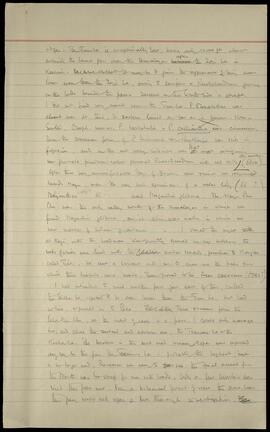
ridge. The Tum La is exceptionally low, being only 12,000 ft, almost certainly the lowest pass over the Himalayas after the Zoji La in Kashmir. It gives the appearance of being even lower even than the Zoji La, owing to conifers & Rhododendrons growing on the hills beside the pass. Descent on the south side is abrupt. I did not find very much near the Tum La. P. Elizabethae was almost over at this, its eastern limit as far as is known. Nom-Soulei, Omph. minus, P. barbata & P. calliantha were common. Here the common form of P. Dickieana var. Pantlingii was still in profusion, and on the wet rocky hillside was that most intriguing new prostrate primrose yellow flowered Rhododendron, with red spots (6600).

After three very uncomfortable days of driving rain & mist we returned towards Nagu, & on the way took specimens of a water lily (66?) Menyanthes trifoliata 66-- and Magnolia globosa. The Nagu Chu was the only valley north of the Himalayas in which we found Magnolia globosa, & it also was in which we saw masses of Lilium giganteum. I stayed the night at Nagu with the headman who proudly showed me his kitchen the walls of which were lined with wooden teapots, peculiar to Kongbo, called Tisti. He sent a servant with me to show me the trees from which these teapots were made. These proved to be Acer caesium (5740?).

I had intended to visit another pass just east of this, called the Shoka La, reputed to be even lower than the Tum La, but had no time, & pushed on to Paka. Three streams form the Paka Chu Chu, at the head of each is a pass. I could only manage two, and chose the central and eastern one, the Tsanang La & the Kuchala. The western is the most used & many Lopas were expected any day by this pass. The Tsanang La is probably the highest, but is no longer used. The reason was easy to see. The final ascent from the North was too steep for men with loads. Only a few hunters ever visit this pass now. From a botanical point of view the area near this pass, would well repay a more thorough investigation.

LSH/1/1/6/1/93 · Part · 1938-07-08
Part of The Ludlow & Sherriff Collection

SUMMARY:
The diarist travels through swampy valleys near Tum La in persistent rain, noting mallard and snipe, yakherd huts, and that the pass is very low. Botanical work records several Primula species mostly past flowering; an attempt to explore the ridge in thick mist results in getting lost and retracing the route with help from a local.

CONTENT:
Tum La

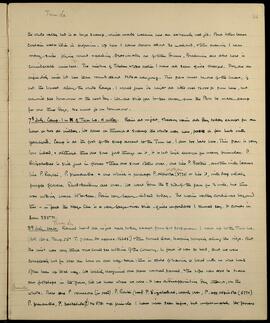
the whole valley bed is a huge swamp, which made walking here an extremely wet job. But these lakes contain water lilies in profusion. Up here I came across about 30 mallard, this evening I hear many snipe flying round and calling. Occasionally one of them drums. Brahmins are also here in considerable numbers. The mixture of Tibetan and Lopa coolies I have all seem quite cheerful. They are an infinitely nicer lot here than round about Molo and Langong. This pass must be one of the lowest, if not the lowest along the whole Range. I would guess its height at little over 12000 ft from here, but we will see tomorrow or the next day. We are still far too far away from the Pass to make camp for our three days, so must go on tomorrow.

7th July. Camp. 1 m N of Tum La. 4 miles. Rain at night, then rain all day today except for an hour or two at midday. We came on through a swamp the whole way here, past a few huts with yakherds. Camp is at the foot of the steep ascent to the Tum La. I am too late here. This pass is very low indeed, and although there are some good things on it, it is not high enough for many primulas. P. Elizabethae is still just in flower and there are some others over, one like P. Boothii, another with leaves like P. Roylei, P. prenantha and one which is perhaps P. alpicola violacea (3770) or like it, with deep velvety purple flowers. Rhododendrons are over. We went down the S side of the pass for ½ mile, but there was nothing much to be seen. Rain very heavy indeed today. The main valley continues beyond this - in fact the Nyam Chu is a very large river still - quite unfordable I should say. It comes in from 285° M.

8th July. Halt. Tum La. Rained hard all night and all today except from 4.0 to 6.0 am. I went up to the Tum La, (B.P. 190.4. Temp. 55° T. 7.0 am. Ht approx. 12243') then turned East, keeping roughly along the ridge. But the mist was very thick and we could see nothing of the country. In fact it was so bad, that we were completely lost for over an hour on our way back: this in spite of having a local with us who had often been up that way. We luckily recognized one place we had passed, and the Lopa was able to track our footsteps in the grass, till we knew where we were. It was a disappointing day though, on the whole. There are P. vernicosa (in seed). P. Roylei (seed) P. Elizabethae, nearly over, P. aff. alpicola (5770) P. prenantha, P. barbatula No 5791 a primula I have never seen before, but unfortunately the flowers

LSH/1/1/6/1/103 · Part · 1933-07-05
Part of The Ludlow & Sherriff Collection

SUMMARY:
At W. Tsanangho, the diarist reports heavy rain and poor visibility, explores the Tsanangha valley, and notes scarce primulas overall but finds two primulas new to them (No. 5865 of the Dryadifolia section and No. 5872, a nivalid close to P. sino-purpurea). Logistics are disrupted due to Kushu’s arrangements, reducing planned time on the Kuchaha; Kesang and a local accompany the outing, with observations of musk deer and local attire from Kongbo.

CONTENT:
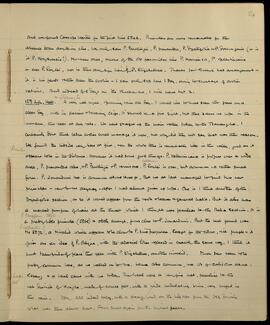
And we found Cassiope wardii for the first time 5846. Primulas are more remarkable for their absence than anything else. We only saw P. Paulingii, P. prenantha, P. Dryadifolia & P. doshongensis (or is it P. Kongboensis?). No new ones, none of the old favorites like P. baileyensis, P. valentiniana or even P. Rockii, nor is there any sign here of P. Elizabethae. Thanks to Kushu's bad arrangements—it is his fault rather than the coolies—I can only stop here 1 day, owing to shortage of coolies' rations. And instead of 6 days on the Kuchaha, I will have but 2.

W. Tsanangho
18th July. Halt. A very wet night, & pouring rain all day. I would like to have seen this place on a clear day, with its glaciers & towering cliffs. It should be a fine sight, but there seems no hope in the monsoon, this year at any rate. We went straight up the main valley today to the Tsanangha. I certainly don't think laden coolies could manage it now, but why did they not say that was their reason.

We found the hillside very bare at first, on the whole there is remarkably little in this valley, good as it appears to be in the distance. However it had some good things. P. Valentiniana is profuse over a wide area, P. prenantha also, & P. Paulingii & P. vernicosa. P. Rockii is over, but common—a rather small form. P. Jonarduni too is common above 14000 ft. But we at last managed to find two new primulas—new to us anyway—after I had almost given up hope. One is I think another of the Dryadifolia section, or so it would appear from the roots & leaves & general habit. But it also has a marked pompom of hairs at the throat, which I thought was peculiar to the Bella section. It is a pretty little primula (5865) & oddly enough, grows close to P. Jonarduni. But the best found was No 5872, a Nivalid which appears to be close to P. sino-purpurea. Except for the colour, rich purple—it gives one an idea of P. obliqua, with the adaxial lobes reflexed in exactly the same way. I think it must take pride of place this year with P. Elizabethae, another nivalid. Musk deer seem to be pretty common here, as we walked on to two. Lerwa also common, & a lot of Coelicolor above.

Kesang & a local came with me today. The local wore a vampire hat, peculiar to the wet districts of Kongbo, made of coarse felt, with a wide undulating brim, very useful in this rain. Very cold indeed today, with a strong wind on the hilltops from the SW, driving what was then almost sleet. Fresh snow again on the highest peaks.