
Showing 2 results

Archival description
2 results with digital objects Show results with digital objects
LSH/1/1/3/3/195 · Part · 1996-06-18
Part of The Ludlow & Sherriff Collection
  • SUMMARY:
    Notes a small patch of Primula tenuiloba on steep rocky cliffs, followed by observations of a Lerwa nest with five eggs and an Anthus nest with three eggs. At Mipa, records abundant primulas on hillsides, with Tenduk bringing specimens from Lhapu and a blue primula (2173) and another from Natrampa, and lists several Primula specimens (2137, 2173–2178).

CONTENT:
Ludlow

  • P. alpestris 1831, 1833, Incarvillea lutea 1827 Prim. erosa 1832, = Ludlow at Kyimdong Dzong June 18th 96

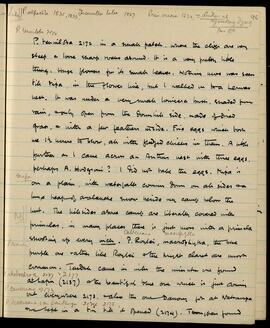
P. tenuiloba 2172
P. tenuiloba 2172 in a small patch, where the cliffs are very steep & loose sharp rocks abound. It is a very pretty little thing. Huge flowers for its small leaves. Nothing more was seen till Mipa, in the flower line, but I walked on to a Lerwa's nest. It was under a very small Lonicera bush, shaded from rain, & only open from the downhill side, made of dried grass, & with a few feathers inside. Five eggs which took me 1 1/2 hours to blow, all with fledged chicks in them. A little further on I came across an Anthus nest with three eggs, perhaps A. hodgsoni? I did not take the eggs.

Mipa
Mipa is on a plain, with waterfalls coming down on all sides & a large heap of avalanche snow beside my camp below the hut. The hillsides above camp are liberally covered with primulas, in many places there is just moss with a primula shooting up every inch. P. Roylei (Calderiana), macrophylla, the blue purple one rather like Roylei & the bright claret are most common. Tenduk came in with the minute one found at Lhapu (2137) & the beautiful blue one which is just coming out everywhere 2173, & also the one Danu found at Natrampa. Two kept in a tin till it opened (2174). Tenduk found

P. rhodochroa 2137, 2177
P. Cawdoriana 2173
P. dickieana var. pantlingii 2174, 2178
LSH/1/1/7/1/11 · Part · 1940-05-24
Part of The Ludlow & Sherriff Collection

SUMMARY:
The author describes the low Tum La pass and nearby areas, noting limited finds there but abundant primulas and a notable prostrate yellow-flowered rhododendron. After wet weather they returned toward Nagu, collected aquatic and tree specimens, noted Magnolia globosa and Lilium giganteum in the Nagu Chu valley, and then proceeded toward Paka to visit the Tsanang La and Kuchala passes, observing that Tsanang La is steep and little used but botanically promising.

CONTENT:
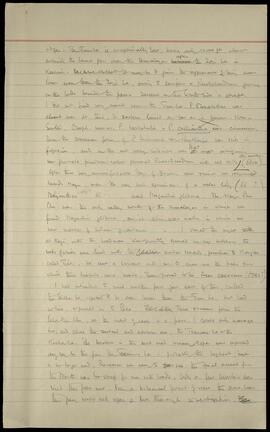
ridge. The Tum La is exceptionally low, being only 12,000 ft, almost certainly the lowest pass over the Himalayas after the Zoji La in Kashmir. It gives the appearance of being even lower even than the Zoji La, owing to conifers & Rhododendrons growing on the hills beside the pass. Descent on the south side is abrupt. I did not find very much near the Tum La. P. Elizabethae was almost over at this, its eastern limit as far as is known. Nom-Soulei, Omph. minus, P. barbata & P. calliantha were common. Here the common form of P. Dickieana var. Pantlingii was still in profusion, and on the wet rocky hillside was that most intriguing new prostrate primrose yellow flowered Rhododendron, with red spots (6600).

After three very uncomfortable days of driving rain & mist we returned towards Nagu, & on the way took specimens of a water lily (66?) Menyanthes trifoliata 66-- and Magnolia globosa. The Nagu Chu was the only valley north of the Himalayas in which we found Magnolia globosa, & it also was in which we saw masses of Lilium giganteum. I stayed the night at Nagu with the headman who proudly showed me his kitchen the walls of which were lined with wooden teapots, peculiar to Kongbo, called Tisti. He sent a servant with me to show me the trees from which these teapots were made. These proved to be Acer caesium (5740?).

I had intended to visit another pass just east of this, called the Shoka La, reputed to be even lower than the Tum La, but had no time, & pushed on to Paka. Three streams form the Paka Chu Chu, at the head of each is a pass. I could only manage two, and chose the central and eastern one, the Tsanang La & the Kuchala. The western is the most used & many Lopas were expected any day by this pass. The Tsanang La is probably the highest, but is no longer used. The reason was easy to see. The final ascent from the North was too steep for men with loads. Only a few hunters ever visit this pass now. From a botanical point of view the area near this pass, would well repay a more thorough investigation.