Showing 14 results

Archival description
14 results with digital objects Show results with digital objects
LSH/1/1/10/1/9 · Part · 1949-09-14
Part of The Ludlow & Sherriff Collection

SUMMARY:
The diarist notes many migratory birds from Tibet and poor seed results except likely from Marlung or passes to the west. On 21 Sept., they remain in camp while Yundon and Pasang collect Primula caveana and a fine woolly Phandra from Tamagorra Nala, returning late and exhausted, with Yundon suffering a bad headache. On 22 Sept., amid cold wind and intermittent rain and sun, letters arrive from H.H. and mail from Hicks and Ludlow, but none from Betty.

CONTENT:
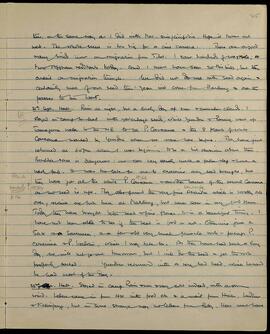
This, in the same way as I did with Mec. simplicifolia. Hope it turns out well. The whole scene is too big for a cine-camera. There are a good many birds now on migration from Tibet. I saw hundreds of wagtails and two Afghan redstarts today. And I must have seen 20 Ibisbills, but they aren't on migration though. We did not do well with seed again, and certainly most of our seed this year will come from Marlung or over the passes to the West.

21st Sept. Halt. Rain at night, but a lovely day of sun and cumulus clouds. I stayed in camp to deal with yesterday's seeds, while Yundon and Pasang went up Tamagorra Nala to the NE to get P. caveana and the 8 plants of white caveana marked by Yundon when we were here before. They have just returned at 6:00 pm when I was beginning to be a bit anxious about them. Boulder scree is dangerous: one can very easily make a false step and have a nasty fall. It was too late for me to examine any seed brought, but they have got all the white P. caveana, and another basket of the usual caveana as no seed is ripe. They also found the very fine Phandra which is woolly all over, and which we took twice at Marlung, but never saw in very good flower. Today they have brought both seed and fine flower. It is a beautiful thing. I have not been able to see if the seed is good or not. Otherwise just a Sax or a Saussurea, and a few odd very small primula roots - perhaps P. cervicina or P. walshii, which I may take too. As they have had such a long day, we will not go out tomorrow, but I will do the seed and get the roots properly packed. Yundon returned with a very bad head, which he said he had most of the day.

22nd Sept. Halt. Stayed in camp. Rain and sun very cold indeed, with a strong wind. Letters came in from H.H. with food etc and a mail from Hicks, Ludlow and Kalimpong, but in some strange way no letters from Betty. Hers must have
LSH/1/1/9/1/64 · Part · 1949-06-01
Part of The Ludlow & Sherriff Collection

SUMMARY:
The party contoured the hillside from the fir forest up to Lussing La, then entered the Panggetangka valley toward the Rufo Zam, finding only three small plant specimens and considering a stay due to transport being requisitioned. The writer rode a yak cautiously. A letter from Betty reports two primulas that Tsangpo does not remember, and Ludlow mentions a curious Petiolarid.

CONTENT:
But it was a sad day in every way. We should have seen things, I expected, as our route lay up through the fir forest to the rhod. & open hillside above, & then from above. 6.30 am till 11.0 we contoured the hillside about 500' above the firs, keeping south, & finally up to the Lussing La, which is a pass over a ridge only. Beyond that we were in the valley called on the map Panggetangka, which runs down to the Rufo Zam. The whole day we got 3 plants, only small bits of these three, & saw nothing of interest. Now we may have to stay here 5 days, which seems a pity, but the Druk Locha needs all transport in tow, & there it is. I rode a yak today, & had to be very careful getting on & off, & in allowing anyone close behind. But we had no accidents.

This place doesn't really look good. It is too much scrub & too much yak-eaten for my liking. I don't think we will get much. A mail came in yesterday after all - but not for 4 hours after I had sent off my mail. With this one was a letter from Betty. She is not happy I fear, & it worries me that she should be there with Hicks, & not enjoying it. And there is still a good long while to go, before she will start coming my way - 2 months from now. Not much news in my mail, but Betty tells me she has two good primulas, which Tsangpo doesn't remember. I should think one might be P. tsariensis & one P. caveana, but how much earlier they must be than we are here. Ludlow also talks of a queer Petiolarid which I have no ideas about. It should be interesting.

LSH/1/1/9/1/77 · Part · 1933-06-16 - 1933-06-17
Part of The Ludlow & Sherriff Collection

SUMMARY:
The diarist worked high above the Sokpon's huts near Haeth on 16 June, collecting several Primula species and observing many Grandala. On 17 June at Waitang, after a mishap with a shying pony that broke the diarist's glasses, Lundrup found a white variety of Primula caveana near the junction of two rivers.

CONTENT:
happen honestly. Whether it is Ngudup or Lhakpa who is doing it, I don't know. Either is capable, but Ngudup would think it quite usual.

16th June. Haeth. Half wet half fine, mostly misty up the hills. We went up the valley above the Sokpon's huts, and on the whole had a good day. Got Primula capitata (one only), P. tenuifolia, P. walshii (very few) and saw the finest lot of P. caveana I have ever seen. It is common as dirt here. Lots of P. bellidifolia beside the caveana in places. There were many Grandala flying about, but I saw no nests. All this was of course high up, and I'm very tired tonight, although I rode to 14,000' most of the way. The walking beyond was steep and there was a longish walk back. A good day. Obviously we are into things now all of a sudden really.

17th June Waitang. Height 13,400'. Fine at times, mostly misty, raining and cold. The day was notable for two things - the miserable pony I had, who shied at everything and a new white variety of P. caveana. After several shies, the pony in some way loosened the girth and the saddle slipped round, and me with it. Luckily we were on no dangerous part above the river, and I only fell among smooth boulders which did no damage to me at all, but smashed my reading glasses. Luckily I have another pair. We are camped almost at the junction of the two rivers, but it is not very convenient because to cross the main river we must go down 2 miles or up 3, and the best side is the other side. I wandered about a little, but saw nothing of interest. The lads went out separately, and came back very depressed, but Lundrup had found a white variety of P. caveana, or that is what I take it to be. It cannot be anything else, but I have never heard of such

LSH/1/1/9/1/82 · Part · 1937-06-22 - 1937-06-23
Part of The Ludlow & Sherriff Collection

SUMMARY:
In wet conditions the party split up: the diarist had a poor day on a dry hill while Pasang returned with a strong collection including a new Androsace, a suspected new Cochlearia, and P. macrophylla var. macrocarpa, alongside notes on Diapensia himalaica and several Primula including white P. caveana. The following day they worked up the valley east of camp in soaking weather; Gunden went far and gathered white P. caveana, but little else was found, prompting thoughts of leaving the area within a few days.

CONTENT:
22nd June Haer. A wet miserable day. We split forces, I sent Pasang and Gunden up Dimpuang valley with instructions to leave it when well in, and to try high up on the south side. They are not in yet, but I had a very poor day in the place I chose. I went up the hill dividing the valley to the north of us. It was dry and almost bare of anything. At 15,500 we found masses of Diapensia himalaica, and beside it P. tenuiloba and P. concinna. There is also some P. caveana, which always tricks me. But that was really all—a disappointing chukker we had. I found two plants of white P. caveana; would like to be able to get plenty of seed of that, or roots, if seed not available. Pasang came back at 3:30 and had a good collection: a new Androsace, the Cochlearia(?) which I wanted and which is, I believe, new, first for us in '37; some more P. macrophylla var. macrocarpa in first-class condition, a cushion Androsace, and various odds and ends. So the day was not so bad after all. I have seen a good-looking place for tomorrow, up the valley to the east from the junction. But one can never tell.

23rd June - Hall. Up the valley to the east above camp. A soaking wet, windy, cold, beastly day. This was the place I thought looked so good, but it had nothing in it. Gunden went miles, but for nothing but a good collection of white P. caveana, and we got nothing worthwhile either, while I felt the climb up after leaving the pony a good deal. It was very steep indeed, and in waterproof and waterproof trousers was hard going. I really don't think now that we will be able to stay on here till the end of the month. Another three days will finish all that we can do, and there will be no other side valleys to try. This has been our wettest day yet, I think.

LSH/1/1/9/1/101 · Part · 1949-07-12
Part of The Ludlow & Sherriff Collection

SUMMARY:
At Haer, the diarist reports persistent rains and mist, a strenuous climb through gullies yielding no new finds but abundant Primula (including P. macrophylla var. macrocarpa, P. soldanelloides, P. sapphirina, P. tenuiloba, and P. caveana), and intentions to cross toward the Trongsa valley. With the monsoon returning, the diarist remains in camp doing photos while Pasang and Tundru explore a nearby nala; Ngudup’s reports of heavy rains and Tundru’s sore feet are noted.

CONTENT:
One more fine day, before the break comes again. There was lots of rain in the night, and has been since the fine days came. Long may it continue thus. Ngudup always gives such awful accounts of the rain from about now on for a month, that I can hardly expect much more clear weather. Tundru's feet don't improve much. We will miss him, as he always was a good boy, and always for some good things. And he had learnt to press flowers well, though not to change them well.

13th July. Haer. Thick mist in the morning up till 10:00 am, by which time we had climbed one of the awful gullies just below and behind camp. What a climb, and there was nothing new at all. What was there, in greater numbers than I've ever seen, was P. macrophylla v macrocarpa - in the hundred. We looked over the other side, but it was all too misty to see anything. We came down one gully this side of the one we went up, equally steep, and almost as hard work among all the boulders with very unsteady rocks. Again nothing new, but we marked a place where roots of P. soldanelloides could be taken. There were very few in flower, but a number of plants. Beside it grows P. sapphirina, and close to, also P. tenuiloba and P. caveana. The P. caveana up there was remarkably behind time, still in perfect flower. All these days now are disappointing, and I'll be glad to get over the pass to the Trongsa valley. Perhaps it won't be any better, but it will have many new places for us to try in any way.

14th July. Haer. The monsoon is back in all its fierceness again today, with thick mist and heavy rain all day, and last night. But we have had a really good break since the 8th, and can't complain. I again stayed in camp today, did photos, while Pasang and Tundru went out and up the nala on the right bank some distance up, but not too farther up, which leads...

LSH/1/1/3/3/177 · Part · 1983-05-05
Part of The Ludlow & Sherriff Collection

SUMMARY:
Notes record primulas found near a rocky nala and two Blood Pheasants shot at high elevations. During two halt days, letters were written and mail sent; the mail runner was dismissed and replaced by a 'tapion'. Dawong and Tsompen collected new primulas west of the Bimbi La while the author surveyed the hillside near camp.

CONTENT:
rocky nala, which the path crosses. Here we found three (P. caveana 1768, P. macrocarpa 1769) primulas. Two in flower, both I think new 1768 and 1769. The first is certainly new to us, and a beauty with a very fine scent. I think it must be near to P. rotundifolia, with its colour and scent. The third was not collected as it was not yet in flower, and very little was seen. Shot two Blood pheasant, Kuseri, one at about 14500 and the other close to camp at 12500.

4th June. Halt. Stayed in camp, wrote letters all day long, a very tiring thing to do. Packed up mail and sent it off, or rather gave it to go next morning.

5th June. Halt. Dismissed our mail runner for general inefficiency and grousing, and sent off the 'tapion' in his place. He will get Rs 13 a month and has been paid everything up to date. He is a thoroughly good lad. Dawong and Tsompen went up the valley to the W of the Bimbi La and brought back a new primula (P. macrophylla macrocarpa), lilac and very pretty, No 1778. Also a yellow one 1780 (P. jucunda var ponticola). I went up the hillside below camp to the E. Saw masses of Roylei, macrophylla, glabra and atrodentata.

LSH/1/1/9/1/76 · Part · 1949-06-15
Part of The Ludlow & Sherriff Collection

SUMMARY:
The writer reports finding P. caveana and, with Tundup’s collections, totals 27 gatherings, then receives mail including two lots from Kalimpong and letters from Betty, who has found P. jigmediana again. They comment on Hicks’ limited results with the camera, news that Bhutan’s treaty matters seem settled, car delivery news from Chris, and concern over the Paro Penlop’s worsening condition as H.H. cannot visit. On 15th June they halt in camp, send mail to Betty, Kalimpong, and H.H., note heavy showers, and remark on large butter consumption.

CONTENT:
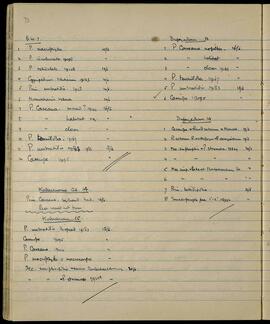
Primula farinosa 19149
Primula sapphirina 19147
Meconopsis horridula 19136
Cremanthodium decaisnei 19148
Cypripedium himalaicum 19131
Cypripedium elegans 19134
Orchis chusua 19129
19144

valley to the east and found P. caveana in full flower, and with a few things collected by Tundup, we are 27 gatherings in all. I was busy writing these up when the mail arrived, and a good mail too, with two lots from Kalimpong, and two letters of 23rd - 28th from Betty. She has done pretty well I think, and has found P. jigmediana for the second time only. They also have P. caveana I suppose most of what I have otherwise. She seemed more cheerful too, but Hicks is not a great success I fear. He wrote to me in a cheerful enough way, and realized he was not as good as he might be. I fear he hasn't done much with the camera, whether the camera's or his fault I don't know. There was no special news in the mail I think except that Bhutan now seems to have all points of their Treaty settled at last, not badly either, if India keeps the bargain. Chris tells me the car I ordered at home on "18 months delivery" in Nov. last, will be delivered in June - now. That is rather unfair to him I feel, but it's very nice to know I won't have to take our car home. Paro Penlop is apparently worse, and H.H. very sorry he cannot manage to go and see him which he feels he certainly ought to do. I suppose it is cancer without doubt now. As there was such a lot to do, I decided to send off a mail tomorrow and not go out after flowers.

15th June Halt. Stayed in camp and sent off a mail to Betty and to Kalimpong and to H.H. Fine with some heavy showers. Nothing to report. I find we have disposed of over a maund of butter in 3 weeks, and cannot think how that could possibly

LSH/1/1/9/1/78 · Part · 1933-06-17
Part of The Ludlow & Sherriff Collection

SUMMARY:
Page records photographic notes using Dufaycolor and Kodachrome films for subjects including Primula caveana, P. umbratilis, Cassiope, Rhododendron setosum, and Meconopsis simplicifolia. Locations mentioned include Menla-harchu La and areas above it, including a lake. Entries are dated through mid to late June.

CONTENT:
73

B.W. 7. Dufaycolor 13
1 P. macrophylla 10/6 1 P. Caveana no filter 16/6
2 P. involucrata 19090 10/6 2 P. Caveana habitat 16/6
3 P. reticulata 19108 13/6 3 P. Caveana closer 19144 16/6
4 Cypripedium tibeticum 19123 14/6 4 P. tenuiloba 19167 16/6
5 Prim. umbratilis 19128 14/6. 5 P. umbratilis 19183 18/6
6 Nomocharis nana 14/6 6 Cassiope 19095 18/6
7 P. Caveana. moved? 19144 16/6
8 P. Caveana habitat v.g. 16/6 Dufaycolor 14
9 P. Caveana closer 16/6 1 Cassiope & Rhod. setosum & Nomocharis 19/6
10 P. tenuiloba 19167 16/6 2 R. setosum. R. anthopogon & R. aeruginosum 19/6
11 P. umbratilis 19183 18/6 3 Mec. simplicifolia or P. strumosa 19204 20/6
12 Cassiope 19095 18/6 4 Mec. simplicifolia or P. strumosa 19204 20/6
5 Mec. simp. Lake at Menla-harchu La 20/6
Kodachrome CS. 14. 6 Mec. simp. Lake at Menla-harchu La 20/6
Prim. Caveana. behind. bad. 16/6. 7 Prim. bellidifolia 21/6
Rest would not turn. 8 Small purple pea 1"-2" 18992 21/6

Kodachrome 15.
P. umbratilis 1/2 speed 19183 18/6.
Cassiope 19095 18/6
P. Caveana 19144 18/6
P. macrophylla v macrocarpa -
Mec. simplicifolia above Menla-harchu 20/6.
Mec. simplicifolia or P. strumosa 19204 20/6

LSH/1/1/9/1/144 · Part · 1933-09-01
Part of The Ludlow & Sherriff Collection

SUMMARY:
Page lists Primula specimens with notes on morphology, flower colors, abundance, and growth habits, including forms such as P. caveana, P. muscoides, P. glabra, and P. waddellii. Mentions comparison with earlier collections at Waitang and a reference to a specimen from 1938.

CONTENT:
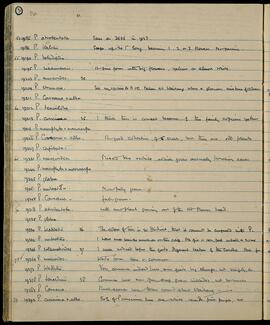
(3) 136 33.

  1. 19185 P. atrodentata Same as 3636 in 1938.
    19186 P. walshii Scape up to 1" long bearing 1, 2 or 3 flowers. No farina.
  2. 19190 P. bellidifolia.
    19195 P. sikkimensis. A fine form with big flowers, yellow or almost white.
    19203 P. muscoides. 34.
    19204 P. strumosa. See my 19000 A B or C taken at Waitang where a glorious mixture of colours
    19211 P. caveana v. alba
  3. 19212 P. tenuiloba
    19213 P. concinna 35. I think this is correct because of the fairly copious yellow
    19216 P. macrophylla v. macrocarpa
    19226 P. caveana v. alba. A good collection of 5 sheets, but they are odd plants
    19227 P. capitata.
  4. 19231 P. muscoides. Mixed blue and white, which grow actually touching each
    19244 P. macrophylla v. macrocarpa
    19245 P. glabra
    19251 P. umbratilis. Not fully grown.
    19255 P. caveana - full grown.
  5. 19318 P. atrodentata. With new plants growing out from old flower head.
    19325 P. glabra.
    19330 P. waddellii 36. The colour of this is so distinct, that it cannot be confused with P.
    19332 P. umbratilis. I have never seen so much as on this cliff. All of it is very pale indeed, or some
    19346 P. soldanelloides 37 I never noticed before the quite different texture of the corolla. Ask for
  6. 19364 P. muscoides. White form. Here v. common.
    19373 P. waddellii. Very common indeed here, in quite big clumps, not singly, as
    19378 P. jonardunii. 38 Common here, on open steep grass hillsides, not so much
    19383 P. caveana. Much scarcer here than round about Waitang.
  7. 19392 P. concinna v. alba. 80% of P. concinna here are white, remainder pink purple, no
LSH/1/1/5/1/215 · Part · 1937-07-31
Part of The Ludlow & Sherriff Collection

SUMMARY:
Checklist of Primula species collected in 1937, with notes on prior collection status and several specimen numbers. Localities mentioned include Chendebi and Tang Chu.

CONTENT:
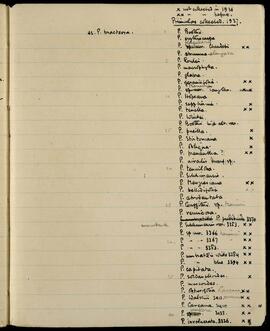
x not collected in 1936
xx " " " before.
Primulas collected. 1937.

  1. P. bracteosa.

1 P. Boothii.
P. erythrocarpa
P. flagellaris
P. sp. nov. Chendebi xx
5 P. strumosa elongata
P. Roylei.
P. macrophylla.
P. glabra.
P. geraniifolia xx
10 P. sp. nov. Tang Chu. xx
P. Hopeana
P. sapphirina x
P. tenella. xx
P. Winteri.
15 P. Boothii high alt. var.
P. pusilla. x
P. Stirtoniana x
P. obliqua. x
P. prenantha? xx
20 P. nivalis dwarf sp.
P. tenuiloba.
P. sikkimensis.
P. Menziesiana xx
P. bellidifolia xx
25 P. atrodentata
P. Griffithii sp. hancini
P. vernicosa.
P. pudibunda 3370
P. sikkimensis var. 3353. xx
30 P. sp. nov. 3366 hancini xx
P. " " 3367 xx
P. " " 3383. xx
P. umbratilis white 3384 xx
P. " blue 3394 xx
35 P. capitata.
P. soldanelloides. x
P. muscoides.
P. obtusifolia Caveana xx
P. Walshii 3413 concinna xx
40 P. Caveana 3410 xx
P. uniflora 3438. x
P. involucrata 3226. x