Showing 11 results

Archival description
11 results with digital objects Show results with digital objects
LSH/1/1/9/1/80 · Part · 1933-06-19
Part of The Ludlow & Sherriff Collection

SUMMARY:
A halt day with damp conditions; the diarist photographed and tended drying flowers, and noted Tibetans trading salt, wool, and cloth at Pangstang with rice sent to Towa Dzong. On 20th June they crossed the river to inspect west-side cliffs, where few plants were in flower; Pasang collected P. muscoides, and P. strumosa was confirmed with notes on its hybridization with P. calderiana.

CONTENT:
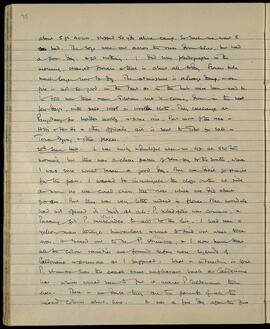
about 5 feet across, stopped 50 yards above camp. So back we went to bed. The boys were out across the river down below, but had a poor day, got nothing. I did some photographs in the morning, changed flowers and that is about all today. Flowers take much longer now to dry. The atmosphere is always damp, and our fire is not so good in the tent as in the huts we've been used to. I'm told now that many Tibetans will be coming down in the next few days, with salt, wool and woollen cloth. They exchange at Pangstang for madder mostly, and some rice. But more of the rice is H.H.'s and Her H.'s and other officials, all is sent to Tibet for sale in Towa Dzong and other places.

20th June Halt. It was misty and doubtful when we got up at 5:30 this morning, but there was a clear patch of blue sky to the south, which I was sure would mean a good day. But we didn't go straight for the pass. I wanted to investigate the cliffs on the West side as soon as we could cross the river which we did about 9:00 a.m. But there was very little indeed in flower. Mec. horridula had not opened its buds at all. P. bellidifolia was common, and Pasang got P. muscoides (19303) to add to the list. I had seen a yellow mass through binoculars and went to find out what that was. It turned out to be P. strumosa (19304), and I now know that all the colour varieties we found before were hybrids of Calderiana and strumosa as I supposed. What is interesting is that P. strumosa has the exact same unpleasant smell as Calderiana has, which would seem to put it nearer P. Calderiana than ever. There is no doubt they are the parents of all the mixed colours around here... It was a fine day after the first
LSH/1/1/9/1/61 · Part · 1949-06-01
Part of The Ludlow & Sherriff Collection

SUMMARY:
After an early start the party reached Weitang, noting Primula bellidifolia in bud, P. crispata, and particularly P. calderiana in white, yellow, and hybrid forms, while other expected species were absent, possibly due to heavy yak grazing. News arrived that the Druk Locha (Bumthang Representative) from Lhasa is en route to Bumthang and expected shortly; the diarist recalls meeting him previously in Lhasa with Betty.

CONTENT:
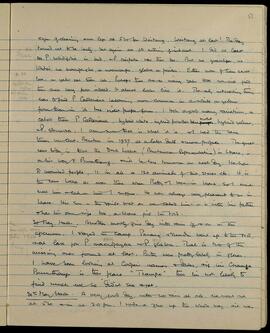
Signs of clearing and we left at 5:30 for Weitang. Weitang at last! The day turned out to be lovely, but again we saw nothing of interest. I did at last see P. bellidifolia in bud, and P. crispata was there too. But no gracilipes, no whitei, no macrophylla, or macrocarpa, glabra or puella. Either none of them exist here, or yaks eat them all. Perhaps there are so many yaks that we will find this area very poor indeed. It almost looks like it. The only interesting thing was to find P. Calderiana becoming more common in a white or yellow form than in its true violet purple form. I took a good many variations, and called them P. Calderiana, hybrid white, hybrid powder blue violet, hybrid yellow, and P. strumosa. I am sure that is what it is, and had the same times in central Bhutan in 1937 at a later date and more profuse. The great news today is that the Druk Locha (Bumthang Representative) in Lhasa, is on his way to Bumthang, will be here tomorrow or next day. He has 8 mounted people, 11 in all and 120 animals of kit, stores etc. It is the same Locha as was there when Betty and I were in Lhasa, so I must meet him and talk to him I suppose. He was always very pleasant to us in Lhasa. His son—the spoilt brat as we called

LSH/1/1/3/3/174 · Part · 1983-05-05
Part of The Ludlow & Sherriff Collection

SUMMARY:
Brief description of the Bembi La valley’s wooded sides and steep left-bank cliffs, with plant collections recorded at Bembi La and Migyitun on 2 and 3 June. Numerous taxa and specimen numbers are listed, including Rhododendron, Primula, Cassiope, Androsace, Polygonatum, Berberis, and Meconopsis.

CONTENT:
188.9
190.0 11872 Bembi La
54 1.0438 Migyitun 2 June
L.p. 107. The Bembi La valley is a pretty one. 11872 Rho. micromeres 1751
Both sides are wooded. The cliffs on the 47488 (4100)
left bank tower almost vertically upwards. 93966 Bembi La 2 June
On the right bank not so steep. 12440.85 P. calderiana 1754
Bembi La 3 June
Rho. calostrotum 1757
aganniphum 1760
agglutinatum 1761
Sp no. lanatum v. luciferum 1762
Prim. sikkimensis 1758
caveana 1768
macrocarpa 1769
Cassiope fastigiata 1759
Androsace adenocephala var. 1765
Polygonatum hookeri 1764
Berberis tsariensis
Mec. horridula

LSH/1/1/9/1/52 · Part · 1949-05-17 - 1949-05-28
Part of The Ludlow & Sherriff Collection

SUMMARY:
Notes of Kodachrome, Dufaycolour and B.W. photographs of Primula, Rhododendron, Enkianthus, Clematis, Saxifraga, and landscape subjects across late May 1949. Mentions sending Dufay films 5 and 6 from Tang on 19/05/1949 and includes scenes such as an old man at Ngang Lhakang, rain on rose leaves, a river below Pang Sang, and a view towards Kankar Punsum from Pangotang.

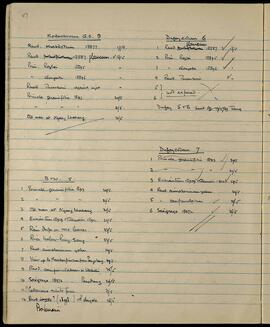
CONTENT: Kodachrome G.S. 9 Dufaycolour 6
Rhod. rhabdotum 18877. 17/5. 1 Rhod. glaucum 18887 18/5.
Rhod. glaucum 18887 18/5. 2 Prim. Roylei 18895 18/5.
Prim. Roylei 18895 18/5. 3 Prim. elongata 18896 18/5.
Prim. elongata 18896 18/5. 4 Rhod. Thomsonii 18/5.
Rhod. Thomsonii against light 18/5. 5 } not exposed.
Primula geraniifolia 18913 20/5. 6 }
Primula geraniifolia 18913 21/5. Dufay 5 & 6 sent off 19/5/49 Tang
Old man at Ngang Lhakang. 21/5.

Dufaycolour 7
1 Primula geraniifolia 18913 20/5.
2 Primula geraniifolia 18913 21/5. B.W. 5. 3 Enkianthus 18909 & Clematis 18912 22/5.
1 Primula geraniifolia 18913 20/5. 4 Rhod. cinnabarinum yellow. 24/5.
2 Primula geraniifolia 18913 21/5. 5 Rhod. campanulatum 25/5.
3 Old man at Ngang Lhakang 21/5. 6 Saxifraga 18972 26/5.
4 Enkianthus 18909 & Clematis 18912 22/5.
5 Rain drops on rose leaves. 23/5.
6 River below Pang Sang. 25/5.
7 Rhod. cinnabarinum yellow. 24/5.
8 View up to Kankar Punsum from Pangotang. 24/5.
9 Rhod. campanulatum or Wallichii 25/5.
10 Saxifraga 18972 Pangotang 26/5.
11 P. Calderiana white form. 27/5.
12 Rhod. Wightii? (18998) & elongata 28/5.
Batemanii

LSH/1/1/6/1/57 · Part · 1936-06-26
Part of The Ludlow & Sherriff Collection

SUMMARY:
Diary records travel from Lo La and Singo Samba to Molo, where Taylor arrives, followed by several halt days to reorganise. The party then moves to camps on the Langong Chu and above Singo Samba while Ludlow and Taylor explore down the Lilung Chu; mail and future rendezvous plans are noted. Botanical collecting is mentioned throughout, though limited by logistics and weather.

CONTENT:
Lo La
May 16. R. forrestii var. repens 3783, Primula 3784, Calostrotum 3785.
Singo Samba, Loda Chu near Molo. May 16. R. chaetomallum var. chamaephytum 3786. R. ponderosum 3792. 78.
P. calderiana 3788, locosa 3789. Paraquilegia anemonoides 3790. Lloydia tibetica 3791. R. laudum var. lucidum 3793.

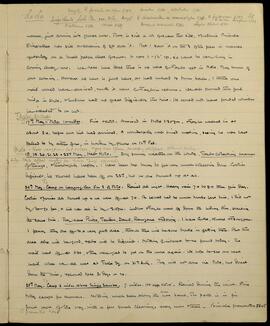
masses, just coming into flower now. There is still a lot of snow on this side; Ludlow's Primula elizabethae has still a covering of 3ft over it. But I saw it on the south of the pass in masses yesterday on a small patch clear of snow. It was 1-1 1/2" up, so it won't be very long in coming away now. We hear here that there is no news of Taylor yet in Molo. They know of our coming. However, no news is good news, as had he had to turn back, I think our mail would have arrived with news of Taylor's return. We all crossed this fine bridge in style; Ludlow had no great difficulty this time. He could not have turned whether he wanted to or not.

Taylor arrives
17th May. To Molo. 10 miles. Fine road. Arrived in Molo 1:30 pm. Taylor walked in at about 3:00, before our kit had arrived. A wonderfully well-timed meeting, seeing he was last talked to by either of us in London by phone on 12th Feb.

Molo - Halt, reorganise kit and loads, buying bags of flour, developing photographs, planning future.
18, 19, 20, 21, 22 and 23rd May. Halt Molo. Dry sunny weather on the whole. Taylor is collecting masses of things, thoroughly happy. I have been too busy to get very much collecting done. Coolies were difficult. We should have been off on the 23rd, but no one turned up at all.

24th May. To Camp on Langong Chu, 5 miles south of Molo. Rained all night. Heavy rain 7:00 to 9:00 then a fine day. Coolies and ponies all turned up and we were off at 7:00. As we had had so much trouble last time, I did not try to go far, and kit was all in by 2:00 pm. Ludlow and Taylor went off down the Lilung Chu, starting at the same time. They have Pinso, Tenduk, Dawd, Ramzana and Tsering. I have Cutha, Kusho and Tsourpon. I fancy they are off to a very good area, though there will be some trouble in getting there. But this area also will be good, and also will be difficult. Nothing of interest to me was found today. The mail went off at 6:30, and then we were glad to get on the move again. We hope to see our next mail when we all meet at Tsala Dz. on 31st July. They will not come via Molo, but direct down the river, and should take 21 days or so.

25th May. To Camp 3 miles above Singo Samba. 7 miles. Height approx. 11,500'. Rained during the night. Fine today except for showers. Nothing much seen along the river bank. The path is in fine forest most of the way, with a few small clearings every now and then. Primula prenantha 3848.

LSH/1/1/6/1/141 · Part · 1936-10-02
Part of The Ludlow & Sherriff Collection

SUMMARY:
At Lo La, the diarist collected Primula and Rhododendron specimens around a small lake amid frost, snow, and sun, noting Jill’s reluctance to collect seeds and the coolies’ hardiness. On October 8 a halt was made; a circuit to the southwest of the lakes yielded a few bulbs, and Tsongpen arrived reporting difficulties obtaining ripe seed, fears of Lhopas on the route, and a theft problem with a dismissed man.

CONTENT:
Lo La. Oct 7. P. chamaethauma 6551, P. calderiana 6552, P. subularia 6553, tsangpoensis 6554.
Oct 8. Gent. hamberxii f. caulibaccans 6555, Rh. pumilum 6556, R. concatenans 6560.
Rh. lopsangianum 6561, 6567 R. lindleyi 6562, R. xeriflorum 6563, R. haysii 6565.
R. elatum 6568, R. brachyanthum v. hypolepidotum 6576, R. sulphureum 6580.
abrivale 6558, normaniana 6574.
laccata 6575, Omph. minor 6585.

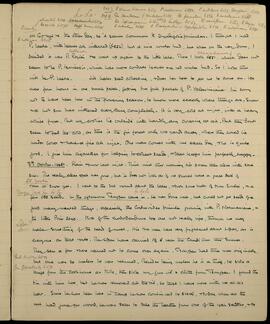
On Gonyi-re the other day, so it seems common to Omphalifolia primulas. I thought I had P. laeta, with leaves all withered (6552), but a nice winter bud, but when on the way down, I decided it was P. calderiana so went up again to the little lake. There I took 6551, which does not seem to be P. tsariensis, which has more cordate leaves & a red winter bud. So I hope this will be P. laeta. Jill hates seed collecting, & does her best to get me to come on. We were four hours in one small patch, getting two full packets of P. valentiniana. I'm sorry not to have been here in the flowering season, to know more exactly where things are. Snow & a hot sun has withered everything completely. It is very cold at night, with a heavy white frost. But my coolies lie outside with hardly any covering at all. But they don't seem to feel the cold, as there is the fir forest only 100 yards away, where they could lie under cover & have a fire all night. One man comes into me each day, this is quite good. I give him cigarettes for helping to collect seeds, & that keeps him perfectly happy.

8th October. Halt. Rain & snow last night. Thick mist this morning till 9.00 am then clear with some sun. The really clear spell has gone, but it does not look as if we should have a great deal of rain or snow yet. I went to the SW round about the lakes, & took some bulbs of Nom. souliei, & a few odd seeds. In the afternoon Tsongpen came in. He has done well, but could not get seeds of a good many wanted things, especially the Cortusoides primula growing with P. normaniana, & the little Prim 3640. Most of the rhododendrons too are not really ripe, though we may make something of the seeds of most. His two men were very frightened about Lhopas, as is everyone on that route. The Lhopas have carried off 5 near the Chudi-Cun this summer. They saw a few & were warned not to come over again. Tsongpen had three men originally, but one was so useless he was returned. Besides being useless he is a thief. He stole a knife from the cookhouse at Molo, then stole my gun oil & cloth from Tsongpen. I found the tin with him here, but he has removed all the oil, so that I have none with me at all now. Since he has been here in camp he has continued to steal, & today when all the rest had gone for wood, he was seen to take the leather from one of the yak saddles, & to...

LSH/1/1/9/1/21 · Part · 1949-04-21
Part of The Ludlow & Sherriff Collection

SUMMARY:
The page describes conifer- and rhododendron-dominated terrain and extensive cultivation in the Tang valley, contrasting land use practices with those near Kalimpong. On 15th April, the party traveled from Pimi over the RUDO LA in persistent snow, observed few flowers, and received wine and food sent by Asha Wangmoo at the pass.

CONTENT:
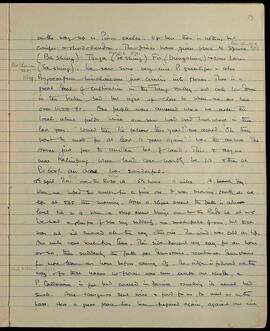
On the way up is Pinus excelsa. Up here there is nothing but conifers & rhododendron. The pines have given place to Spruce (Picea spinulosa 18702) (Bashing), Tsuga (dumosa 18701) (Seshing), Fir (Dungshing) & some Larix (Sasuing) (Rhod. thomsonii 18697). We saw some very nice P. gracilipes — also (15699) Bryocarpum himalaicum just coming into flower. There is a great deal of cultivation in the Tang valley, not only low down in the valley bed, but right up close to where we are here, over 11,000 ft. Our people were amused when we asked the locals about fields which we saw had had buckwheat in them last year. "Would they lie fallow this year?" we asked. "Oh they won't be used for at least 12 years again!" was the answer. The owner just goes to another bit of land. This to anyone near Kalimpong, where land can hardly be got, often at Rs 600/- an acre, was wonderful.

15th April. PIMI. over the RUDO LA (9690, 12600). 5 1/2 hours, 11 miles. A beastly day when we hoped so much for a fine one. It was snowing gently as we left at 5:45 this morning. After a slight ascent, the path is almost level till 4 when a steep ascent brings one to the Rudo La at 11:30. We had a glimpse of blue sky suddenly, & a small patch of sun, but that was all, it snowed all the way otherwise. The wind was cold on top. Our mules were back from there. This side descent very easy for an hour or so, then suddenly the path goes downstairs, & continues downstairs for more than an hour before easing off. The ridge is followed all the way, & for that reason no flowers were seen, except one Rhod. (Rhod. arboreum 18703), & P. Calderiana in fat bud, covered in farina, smelling its usual bad smell. Asha Wangmoo sent wine & food for us to meet us on the pass. Here a great place has been prepared again, against our visit.

LSH/1/1/9/1/140 · Part · 1933-09-01
Part of The Ludlow & Sherriff Collection

SUMMARY:
List of Primula specimens with collection numbers and notes on abundance, elevation, and localities across Bhutan in 1949. Mentions collectors identified by initials (B.S, J.H., G.S.) and notes presence or absence around passes and places such as Rip La, Shambling, Tomtom, Sergung La, Takhung, Rudu La, Chenbi Rongang, Dunkhar-Nashima, and Tsampa; notes that some species were not previously collected by L+S.

CONTENT:
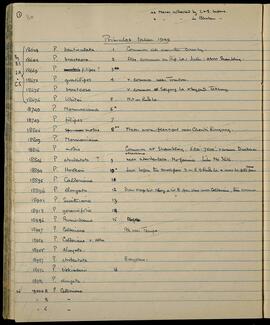
xx Never collected by L+S. before.

  • .. .. .. in Bhutan ..

Primulas taken 1949

By 18614 P. denticulata. 1 Common all over the country.
B.S 18644 P. bracteosa. 2 Also common on Rip La: Julu: above Shambling:
J.H. 18669 P. filipes? 3xx
G.S. 18673 P. gracilipes 4 v. common near Tomtom.
18675 P. bracteosa v. common at Sergung La beyond Takhung.
18676 P. whitei 5 Not on Rudu La.
18740 P. Normaniana 6
18749 P. filipes 7
18806 P. sp. non mollis 8xx Much more plentiful near Chenbi Rongang.
18809 P. Normaniana
18816 P. mollis Common at Shambling. 6500'-7500'. v. common Dunkhar-Nashima.
18846 P. atrodentata? 9 near atrodentata. No farina. Like No 3636.
18894 P. Hookeri 10
Just before the small pass 2 m E of Rudu La & more W. of the same pass.
18895 P. Calderiana 11
18896 P. elongata. 12 Down steep bit. Along a bit to open where much Calderiana, then common.
18901 P. Smithiana 13
18913 P. geraniifolia 14
18946 P. Barnardoana 15
18947 P. Calderiana All over Tsampa.
18954 P. Calderiana v. alba
18955 P. elongata.
18957 P. atrodentata Everywhere.
18976 P. sikkimensis 16
18981 P. elongata.
19000 A. P. Calderiana
B "
C "

LSH/1/1/9/1/143 · Part · 1933-09-01
Part of The Ludlow & Sherriff Collection

SUMMARY:
Notes reconsidering identifications of Primula specimens, suggesting 1937 L+S mixtures (3433–3437) are P. strumosa × P. calderiana hybrids rather than tsariensis, and discussing affinities among P. Barnardoana, elongata, involucrata, and alpicola. Mentions observations at Lussing La and references comments by Fletcher and a possible need to await Prof. Brown.

CONTENT:
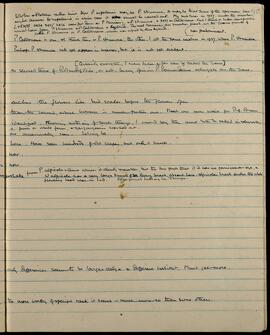
Words of Fletcher rather hint that P. nepalensis may be P. strumosa. It may be that some of the specimens here which answer to nepalensis, in which case it should be washed out. My mixtures in 1937, under the numbers L+S 3433, 3434, 3435, 3436 were put down as P. tsariensis, & P. strumosa, & 3437 as Calderiana. But I think a better identification would have been P. strumosa & P. Calderiana hybrids. The real tsariensis are smaller plants, and the coarse growth of either P. strumosa or P. Calderiana, which was copied in these hybrids, was predominant. P. Calderiana is one, I think this is P. strumosa, the other. I got the same mixture in 1937, where P. strumosa
Perhaps P. strumosa will yet appear in masses, but it is not yet evident.

[Certainly everything I have taken so far can be called the same]
as showed those of Rotundifoliae, or not. In my opinion P. Barnardoana & elongata are the same.

enclose the flowers like bud scales before the flowers open.
than the second, which however is much further on. Must one now wait for Prof. Brown
identified. Knowing nothing of such things, I would say they must both be called involucrata,
a pink or white form, or any orangeing washed out.
are occasionally seen. Lussing La.

here. Have seen hundreds of old scapes, but only 1 bunch.
now.
now.

unshakable from P. alpicola v. luna which it closely resembles, but the two facts that i) it has no farinaceous eye, &
ii) alpicola has a very large bunch of leafy bracts, absent here. alpicola bracts enclose the whole
flowering head when in bud. Also found Lussing La. Tsampa.

only differences seem to be larger calyx & different habitat. Must get more.

the more worthy of specific rank it seems - much more so than some others.

LSH/1/1/9/1/141 · Part · 1933-09-01
Part of The Ludlow & Sherriff Collection

SUMMARY:
Notes on Primulas from Karponang grown at 4500', highlighting unusual rose coloration, leaf variation, and difficulty matching key characters; possible identification as elongata is questioned. Field observations report local abundance up to about 8500' near Sergong La, and above 12500' white forms of P. calderiana and natural hybrids become more common than the deep violet true P. calderiana.

CONTENT:
133

Primulas from Karponang in our garden at 4500' have grown leaves like bracteosa. Due to low altitude?
Never seen the rich rose colour before.

Locally quite common.

Eventually found very common, highest altitude about 8500' near Sergong La.

This does not answer the key 'tube 3 times as long as calyx'. It is nothing like it.

Might be elongata, but leaves are pretty rotund.

Not common.
This seemed to be the same as 18946, but leaf varies. Probably both are the same thing.

A gathering with very few old capsules even some old seed.
These three are all natural hybrids. As one gets above 12500', so white forms of P. Calderiana become more & more common until at 13000 & a little above - just at the top edge of the abies zone - these hybrids become much more common than the true P. Calderiana, which here is deep violet. What are the parents?
P.T.O.