Showing 20 results

Archival description
20 results with digital objects Show results with digital objects
LSH/1/1/9/1/80 · Part · 1933-06-19
Part of The Ludlow & Sherriff Collection

SUMMARY:
A halt day with damp conditions; the diarist photographed and tended drying flowers, and noted Tibetans trading salt, wool, and cloth at Pangstang with rice sent to Towa Dzong. On 20th June they crossed the river to inspect west-side cliffs, where few plants were in flower; Pasang collected P. muscoides, and P. strumosa was confirmed with notes on its hybridization with P. calderiana.

CONTENT:
about 5 feet across, stopped 50 yards above camp. So back we went to bed. The boys were out across the river down below, but had a poor day, got nothing. I did some photographs in the morning, changed flowers and that is about all today. Flowers take much longer now to dry. The atmosphere is always damp, and our fire is not so good in the tent as in the huts we've been used to. I'm told now that many Tibetans will be coming down in the next few days, with salt, wool and woollen cloth. They exchange at Pangstang for madder mostly, and some rice. But more of the rice is H.H.'s and Her H.'s and other officials, all is sent to Tibet for sale in Towa Dzong and other places.

20th June Halt. It was misty and doubtful when we got up at 5:30 this morning, but there was a clear patch of blue sky to the south, which I was sure would mean a good day. But we didn't go straight for the pass. I wanted to investigate the cliffs on the West side as soon as we could cross the river which we did about 9:00 a.m. But there was very little indeed in flower. Mec. horridula had not opened its buds at all. P. bellidifolia was common, and Pasang got P. muscoides (19303) to add to the list. I had seen a yellow mass through binoculars and went to find out what that was. It turned out to be P. strumosa (19304), and I now know that all the colour varieties we found before were hybrids of Calderiana and strumosa as I supposed. What is interesting is that P. strumosa has the exact same unpleasant smell as Calderiana has, which would seem to put it nearer P. Calderiana than ever. There is no doubt they are the parents of all the mixed colours around here... It was a fine day after the first
LSH/1/1/3/3/137 · Part · 1983-05-05
Part of The Ludlow & Sherriff Collection

SUMMARY:
Notes describe a valley with contrasting north and south faces, a bout of fever for Gulia, and halts on 9th and 10th May to explore and collect plants. Finds include rhododendrons, abundant P. bellidifolia (not yet out), and P. roylei and macrophylla in bloom near a terminal moraine; each member shot one crossoptilon.

CONTENT:
66

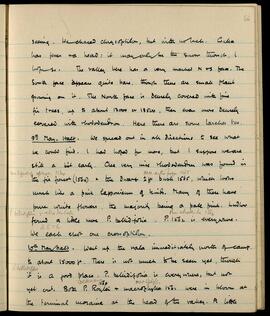
seeing. We chased crossoptilon, but with no luck. Gulia has fever on head: it may only be the snow thrush, I hope so. The valley here has a very marked N & S face. The South face appears quite bare, though there are small plants growing on it. The North face is densely covered with fine fir trees, up to about 13000 or 13500, then even more densely covered with rhododendron. Here there are some larches too.

9th May. Halt. We spread out in all directions to see what we could find. I had hoped for more, but I suppose we are still a bit early. One very nice rhododendron was found in the fir forest (1564) - the dwarf 2 ft bush 1565, which looks much like a pink lapponicum of kinds. Many of these have pure white flowers, the majority being a pale pink. Ludlow found a little more P. bellidifolia, P. 1562 is everywhere. We each shot one crossoptilon.

10th May. Halt. Went up the nala immediately north of camp to about 15000 ft. There is not much to be seen yet, though it is a good place. P. bellidifolia is everywhere, but not yet out. Both P. Roylei & macrophylla 1561 were in bloom at the terminal moraine at the head of the valley. A little

LSH/1/1/9/1/61 · Part · 1949-06-01
Part of The Ludlow & Sherriff Collection

SUMMARY:
After an early start the party reached Weitang, noting Primula bellidifolia in bud, P. crispata, and particularly P. calderiana in white, yellow, and hybrid forms, while other expected species were absent, possibly due to heavy yak grazing. News arrived that the Druk Locha (Bumthang Representative) from Lhasa is en route to Bumthang and expected shortly; the diarist recalls meeting him previously in Lhasa with Betty.

CONTENT:
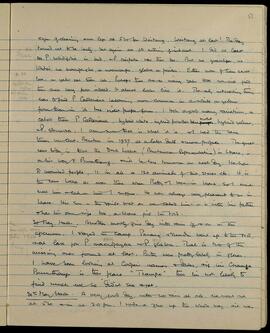
Signs of clearing and we left at 5:30 for Weitang. Weitang at last! The day turned out to be lovely, but again we saw nothing of interest. I did at last see P. bellidifolia in bud, and P. crispata was there too. But no gracilipes, no whitei, no macrophylla, or macrocarpa, glabra or puella. Either none of them exist here, or yaks eat them all. Perhaps there are so many yaks that we will find this area very poor indeed. It almost looks like it. The only interesting thing was to find P. Calderiana becoming more common in a white or yellow form than in its true violet purple form. I took a good many variations, and called them P. Calderiana, hybrid white, hybrid powder blue violet, hybrid yellow, and P. strumosa. I am sure that is what it is, and had the same times in central Bhutan in 1937 at a later date and more profuse. The great news today is that the Druk Locha (Bumthang Representative) in Lhasa, is on his way to Bumthang, will be here tomorrow or next day. He has 8 mounted people, 11 in all and 120 animals of kit, stores etc. It is the same Locha as was there when Betty and I were in Lhasa, so I must meet him and talk to him I suppose. He was always very pleasant to us in Lhasa. His son—the spoilt brat as we called

LSH/1/1/4/1/15 · Part · 1936-07-02
Part of The Ludlow & Sherriff Collection

SUMMARY:
Notes several primulas and an iris, with P. bellidifolia plentiful and Primula minutissima seen on the route from Tama La toward Tahtsang. The Chanut Dzongpen provided help and supplies; a thank-you letter and scarf were sent. Plans are made to go to Lung and then Karuha or the Kashong La, with comments on wet weather beyond Nabampa and Lopa traders crossing by the Lha La.

CONTENT:
P. muscoides 2311

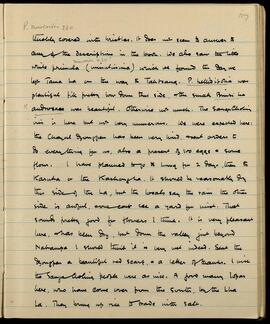
thickly covered with bristles. It does not seem to answer to any of the descriptions in the book. We also saw the little white primula (minutissima) which we found the day we left Tama La on the way to Tahtsang. P. bellidifolia was plentiful till pretty low down this side, the small Primula androsace was beautiful. Otherwise not much. The Sanga Choling iris is here but not very numerous. We were expected here: the Chanut Dzongpen has been very kind, sent orders to do everything for us, also a present of 100 eggs & some flour. I have planned to go to Lung for 2 days, then to Karuha or the Kashong La. It should be reasonably dry this side of the La, but the locals say the rain the other side is awful, one can't see a yard for mist. That sounds pretty good for flowers I think. It is very pleasant here, & has been dry, but down the valley just beyond Nabampa I should think it is very wet indeed. Sent the Dzongpen a beautiful red scarf, & a letter of thanks. I wish the Sanga Choling people were as nice. A good many Lopas here, who have come over from the south, by the Lha La. They bring up rice to trade with salt.

LSH/1/1/3/3/183 · Part · 1983-05-05
Part of The Ludlow & Sherriff Collection

SUMMARY:
At Chichechar, the party searched in the evening for new game birds; Ludlow heard them and later saw one, while Pintso also saw one, yielding two skins for identification. Danong returned from Thijijitum with flowering magnolia, a rhododendron, and Meconopsis but no primula. The group then split, with Ludlow and Sherriff joining M. over the Bimbi La while the writer proceeded to do the Kingkor.

CONTENT:
Chichechar 12th June
Pr. prenanthoides 2126. P. alpina violacea 2128, Pedicularis corydaloides 2127, Lonicera cyanocarpa var. porphyrantha 2129. 89

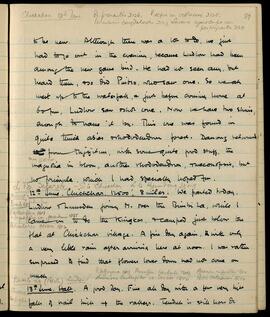
to be new. Although there was a lot to do, we just had to go out in the evening, because Ludlow had been among the new game birds. He had not seen any, but heard them, as did Pintso, who saw one. So we all went up to the waterfall, and just before coming home at 6 p.m., Ludlow saw another one. Now we have two skins, enough to name it by. This one was found in quite thick Abies rhododendron forest. Danong returned from Thijijitum, with some quite good stuff, the magnolia in bloom, another rhododendron, Meconopsis, but no primula, which I had specially hoped for.

L. & S. Separate - S. to Chichechar - L. to Kyimdong Dzong.
Sieru
Bimbi La
P. bellidifolia 1801
P. bryophila var. jerdoniana 1895
Pedicularis oederi 1802

12th June. Chichechar. 12500', 8 miles. We parted today, Ludlow and Sherriff joining M. over the Bimbi La, while I came on to do the Kingkor,

LSH/1/1/9/1/77 · Part · 1933-06-16 - 1933-06-17
Part of The Ludlow & Sherriff Collection

SUMMARY:
The diarist worked high above the Sokpon's huts near Haeth on 16 June, collecting several Primula species and observing many Grandala. On 17 June at Waitang, after a mishap with a shying pony that broke the diarist's glasses, Lundrup found a white variety of Primula caveana near the junction of two rivers.

CONTENT:
happen honestly. Whether it is Ngudup or Lhakpa who is doing it, I don't know. Either is capable, but Ngudup would think it quite usual.

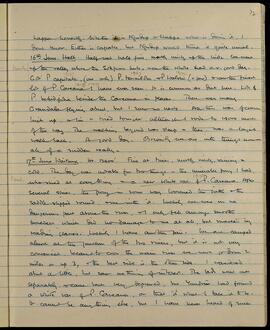
16th June. Haeth. Half wet half fine, mostly misty up the hills. We went up the valley above the Sokpon's huts, and on the whole had a good day. Got Primula capitata (one only), P. tenuifolia, P. walshii (very few) and saw the finest lot of P. caveana I have ever seen. It is common as dirt here. Lots of P. bellidifolia beside the caveana in places. There were many Grandala flying about, but I saw no nests. All this was of course high up, and I'm very tired tonight, although I rode to 14,000' most of the way. The walking beyond was steep and there was a longish walk back. A good day. Obviously we are into things now all of a sudden really.

17th June Waitang. Height 13,400'. Fine at times, mostly misty, raining and cold. The day was notable for two things - the miserable pony I had, who shied at everything and a new white variety of P. caveana. After several shies, the pony in some way loosened the girth and the saddle slipped round, and me with it. Luckily we were on no dangerous part above the river, and I only fell among smooth boulders which did no damage to me at all, but smashed my reading glasses. Luckily I have another pair. We are camped almost at the junction of the two rivers, but it is not very convenient because to cross the main river we must go down 2 miles or up 3, and the best side is the other side. I wandered about a little, but saw nothing of interest. The lads went out separately, and came back very depressed, but Lundrup had found a white variety of P. caveana, or that is what I take it to be. It cannot be anything else, but I have never heard of such

LSH/1/1/5/1/121 · Part · 1933-06-19 - 1933-06-21
Part of The Ludlow & Sherriff Collection

SUMMARY:
Diary entries from Dungshinggang record rest days with fine mornings and heavy afternoon hail and rain, photo developing difficulties, and limited plant finds including Primula species. A message arrives from Phobshikha that Purbo had been ill for a day but is now much better.

CONTENT:
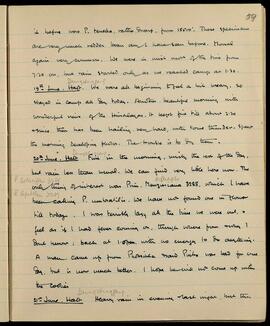
it before was P. tenella, rather dwarf, from 15,500'. These specimens are very much redder than any I have seen before. Monal again very common. We were in mist most of the time from 7.30 on, but rain started only as we reached camp at 1.30.

[Dungshinggang]
19th June. Halt. We were all beginning to feel a bit weary, so stayed in camp all day today. Another beautiful morning with wonderful views of the Himalayas. It kept fine till about 2.30 & since then has been hailing very hard, with some thunder. Spent the morning developing photos. The trouble is to dry them.

[Dungshinggang]
20th June. Halt. Fine in the morning, misty the rest of the day, but rain less than usual. We can find very little here now. The [P. bellidifolia 3288] only thing of interest was Prim. Menziesiana 3288, which I have [P. capitata 3289] been calling P. umbratilis. We have not found one in flower till today. I was terribly lazy all the time we were out, & feel as if I had fever coming on, though where from anyway I don't know: back at 1.0 pm. with no energy to do anything. A man came up from Phobshikha said Purbo was bad for one day, but is now much better. I hope he will not come up with the coolies.

[Dungshinggang]
21st June. Halt. Heavy rain in evening & last night, but this

LSH/1/1/8/1/5 · Part · 1946-10-14
Part of The Ludlow & Sherriff Collection

SUMMARY:
Travel from Gyantse to Dochen via Phari and Tuna with notes on weather, flowering plants, and limited seed collecting. Transport disputes with local headmen lead to a bribe; Pangdatshang intervenes, the party meets Dorje Tsering, exchanges currency, attempts wildfowl hunting, and receives letters of introduction from Tsarong.

CONTENT:
21st October. Gyantse. Very fine day after three days of heavy rain. We are not taking any specimens yet, but only a few seeds here & there. Today there were several fine clumps of Gentiana amoena in full bloom. Besides these there are many of a sp. of small blue Swertia, some Asters, Cyananthus lobatus, the usual odd blooms of Rhod. cinnabarinum which always appear in October. The Headmen of Yatung lived up to their reputation. They will not supply transport at the rates laid down. We have transport from Kalimpong to Gyantse, & yesterday the headmen tried to stop it going beyond Yatung. However Pangdatshang ordered them to let us go without hindrance.

22 October. Phari. Very cold in the morning, with thin clouds. Cleared up later and was lovely. Met by Dorje Tsering this time. Exchanged rupees at 3.35 sangs per rupee. The only seeds collected were P. bellidifolia. I could not find P. tenella under the snow.

23rd October. Tuna. A clear but very cold day indeed until we reached Shabra Shubra, about 12.15. As usual we could not get off to time, even though we had our own through transport. Last night the Phari headmen demanded a bribe. We could take our own transport if we liked, they said: if we did then they would of course not supply any other sahibs. Rs 20 bribe paid that night. Saw no gazelle or game of any kind.

24 October. Dochen. Fine still. Went after duck & geese in the afternoon. Have seen but we could get near nothing. Got a large letter from Tsarong enclosing several letters to people on our way. These should be very useful later on. All are in Tibetan, so we have not been able to see yet who they are addressed to.

LSH/1/1/6/1/135 · Part · 1933-09-07
Part of The Ludlow & Sherriff Collection

SUMMARY:
Diary entries at Kula Phu Chu describe persistent rain and wind, difficulties drying collected seeds, and concern for Tsongpen traveling to the Tsanang La amid snow. Seeds of several species were gathered, and after a brief illness, Jill recovered by the 22nd; a sunny 23rd allowed successful drying and collection including Nomocharis souliei.

CONTENT:
ripe: some of the beautiful spotted saxifrage and a few other things of less importance. In the Primula marsh I failed to find any Prim. micropetala, and of all the capsules of Prim. littledalei I found, only 5 had any seed in them - fairly ripe. It is raining again this evening, but does not look too bad. Locals say a great many Lopas came over the passes this year. They also say that when the Lopas come, they bring the rain with them - true enough this year anyway. Tsongpen has gone up to the Tsanang La, where he will have a very cold and wet time I'm afraid, he has no tent. We are not used to this very strong wind which has been common for the last few nights. One would think it would drive off the rain, but it does not seem to.

Kula Phu Chu
21st September. Kulu Lungma. Rained at night, and all today lightly. The hilltops were all covered with snow this morning, I fear Tsongpen will have a bad time on the Tsanang La. I got a few seeds today, but everything is soaking wet, and I can't think how they are to be dried. There was no sun at all today, and all seeds remain very wet indeed. Jill was her usual bright and lively self all day till after she had her dinner at 2:30 pm. Then she suddenly became ill, and seems pretty bad this evening. She can still wag a tail a little, but is lying without a movement under a blanket with a hot water bottle. I wonder if she has distemper, or whether she got a cold yesterday on Go nyi re. This is the first time I have ever seen her the least bit sick or sorry for herself.

Kula Phu Chu
22nd September. Halt. Rained all night and all day. I went up the valley to get seed of a white P. alpicola, and a small lactuca, both of which I found. Besides a Berberis, there was nothing of interest. Opposite camp I got seed of a good coloured Mec. betonicifolia (Mec. betonica 6520). There is very little seed in P. Dickieana capsules, the masses I saw here in July have all been eaten by yaks and ponies. Rather a disappointing day, the rain continues so steadily, that drying these soaked seeds is a very great problem. Jill has completely recovered, her trouble seems to have been no more than a very bad tummy ache.

Kula Phu Chu
23rd September. Halt. A fine sunny day thank goodness. All or nearly all of the seeds were dried in the sun. We got very good Nomocharis souliei seed, and some enormous bulbs, the biggest I have ever seen. There was a good deal more snow again last night.

(N. souliei seeds 6518. I collected seeds 6517, P. bellidifolia 6515, Prim. calliantha flower 6524.)

LSH/1/1/2/1/43 · Part · 1933-07-08
Part of The Ludlow & Sherriff Collection

SUMMARY:
Dawong and the diarist found a new Meconopsis, primulas, a Corydalis, and an Androsace on the Orka La, took photographs, and hurried back before rain, while many people came for medicine including 37.5 over proof rum for tummy aches. The page ends with an entry heading for Muktur, 12 miles, dated 11th July.

CONTENT:
Orka La. P. bellidifolia 636, P. tenuiloba 637, P. sikkimensis 640, P. gambeliana 641, P. macrophylla 642. Rhod. anthopogon 638, Mec. horridula 639, Mec. latifolia 'aurora' 643, Androsace adenophora 643. Corydalis cashmeriana 644.

remained so till I left the pass at 10 am. Dawong & I found some good flowers on the Orka La, & one could easily spend a month or so in that area. A new Meconopsis & some primulas & a beautiful little Corydalis & Androsace were found. The best spot seems to be on the big round cliff like to the South of the pass; on the north side of this there were many flowers. Beyond the pass - 1/4 mile - was a lake 100 yds across. & to the South were 3 more according to Dawong. Took some good photos on return, but had to race home to get them taken before rain came on as usual about 1.0 pm. Many people came for medicine - some for worms, some for tummy ache. Our medicine for the latter is 37.5 over proof rum, & the sight of them taking such strong liquor is good.

11th July. MUKTUR. 12 miles. (B.