SUMMARY:
Page records bird specimens and observations from the dry Mo Chu valley near Wangdi Potrang, with notes on habitat and characteristic species. Mentions goral abundance and an isolated takin colony north of Punaka, and distribution notes including the Gamri Chu valley and major valleys of Bhutan.
CONTENT:
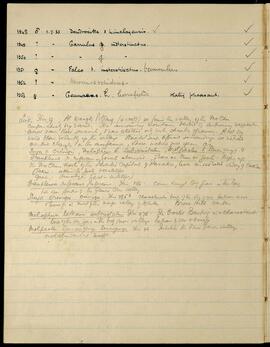
1948 ♂ 1.7.33 Dendrocitta s. himalayensis. ✓ ✓
1949 ? - Garrulus g. interstinctus. ✓
1950 ? - " " g " " ✓
1951 ♀ - Falco t. interstinctus - tinnunculus ✓
1952 ? - Abroscopus schisticeps ✓
1953 ♀ - Gennaeus h. horsfieldi Kalij pheasant. ✓
Lud. His. 9. At Wangdi Potrang (4500ft) we found the valley of the Mo Chu
comparatively dry & arid. The surrounding mountains devoid of arboreous vegetation
except near their summits, were clothed only with shrubs & grasses. A hot dry
wind blew violently up the valley. Amidst such different surroundings we noticed
marked changes in the avifauna, which included such species as
Suya c. crinigera, Melophus l. subcristatus, Molpastes l. leucogenys &
Franklinia r. rufescens & Goral abounded there as thick as goats. Higher up
the Mo Chu, north of the deserted capital of Punaka, lives an isolated colony of takin
(Takin - allied to goats & antelopes
Goral - Himalayan Goat-antelope)
Franklinia rufescens rufescens. His 285. Common amongst long grass in the low,
hot open portions of the Gamri Chu valley.
Suya crinigera crinigera. His 292-3 Characteristic bird of the dry zone between 4000
& 6000ft in most of the major valleys of Bhutan. Brown Hill Warbler.
Melophus lathami subcristatus. His 478. The Crested Bunting is a characteristic
bird of the dry zone in the big river valleys between 3500 & 6000ft.
Molpastes leucogenys leucogenys. His 46 Inhabits the drier bare valleys.
most abundant at 3000ft.