Showing 3 results

Archival description
LSH/1/1/4/1/76 · Part · 1933-08-15
Part of The Ludlow & Sherriff Collection

SUMMARY:
Entry for the 19th at Chang Chuda listing plant specimens numbered 2092–2096, including G. otophora, nanlaensis f. flavescens, Lomatogonium deltoideum, and Delp. viscosum.

CONTENT:
19th Chang Chuda
G. otophora 2092
nanlaensis
f. flavescens 2094
Lomatogonium
deltoideum 2095
Delp. viscosum 2096

LSH/1/1/4/1/79 · Part · 1933-08-15
Part of The Ludlow & Sherriff Collection

SUMMARY:
At Tso Blerang Lake Camp the diarist surveyed gentians near Changchu La, marking Delphinium viscosum (2096), Lomatogonium deltoideum (2095), and a clump of G. stictantha, but rain prevented photography; a pin-tail snipe was shot at 15,000 feet. The following day involved an 8-mile move to Senguti via Sun La and Churam in heavy rain, noting P. capitata as common and no new gentians on Sun La.

CONTENT:
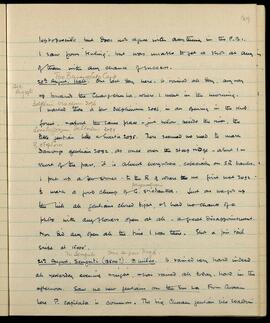
leptopuccile, but does not agree with anything in the F.B.I.

I saw four 'kuling', but was unable to get a shot at any of them with any chance of success.

20th August. Halt. Tso Blerang Lake Camp. Our last day here. It rained all day, anyhow up towards the Changchu La, where I went in the morning.

I marked there a few Delphinium 2096 (Delphinium viscosum), in an opening in the rhododendron forest, about the same place - just below, beside the river, the little gentian like a Swertia 2095 (Lomatogonium deltoideum). There seemed no need to mark G. otophora.

Dancing gentian 2092, as once over the steep ridge - about 1 mile short of the pass, it is almost everywhere, especially on SE banks. I put up a few stones - to the right of where we first met 2092 - to mark a good clump of G. stictantha (przewalskii). Just as we got up the hill all gentians closed tight, and I had no chance of a photo with any flowers open at all - a great disappointment. Nor did any open all the time I was there. Shot a pin tail snipe at 15000'.

21st August. Senguti (13500?). 8 miles. (To Senguti. Base Camp on May 16). It rained very hard indeed all yesterday evening and night, and has rained all today, hard in the afternoon. Saw no new gentians on the Sun La. From Churam here P. capitata is common. The big Churam gentian like Waltoni.

LSH/1/1/4/1/77 · Part · 1933-08-15
Part of The Ludlow & Sherriff Collection

SUMMARY:
At Tso Bunang Lake Camp, the writer questions K.W.’s purported new plant and notes a yellow rhododendron; Tenduk arrives unwell and is found to have gonorrhoea contracted in 1934 at Cyanbe. On 18 August they remain in camp developing photos and repairing gear amid mixed weather. On 19 August the writer explores west while Danzing collects notable gentians and a delphinium from the Changchu La toward Senguti, and Ludlow secures a second specimen of a new bird.

CONTENT:
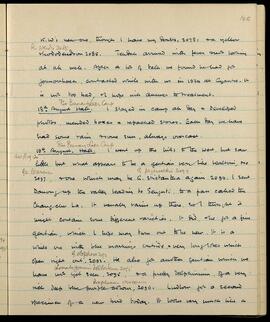
148

K.W.'s new one, though I have my doubts, 2078: a yellow Rhododendron 2085 (R. wardii 2085). Tenduk arrived with fever and not looking at all well. After a lot of talk we found he had got gonorrhoea, contracted while with us in 1934 at Cyanbe. It is not too bad, and hope will answer to treatment.

Tso Bunang Lake Camp
18th August. Halt. I stayed in camp all day and developed photos, mended boxes and repacked stores. Each day we have had some rain and some sun, always overcast.

Tso Bunang Lake Camp
19th August. Halt. I went up the hills to the west, but saw little but what appears to be a gentian very like Waltoni (See Aug. 20), No. 2097 (Gen. tianshanica), and one which may be G. stictantha again 2099 (G. przewalskii 2099). I sent Danzing up the valley leading to Senguti, to a pass called the Changchu La. It usually rains up there, so I thought it might contain some different varieties. It did, and he got a fine gentian, which I hope may turn out to be new. It is a white one with blue markings outside, and very long lobes which open right out, 2092 (G. otophora 2092). He also got another gentian which we have not yet seen, 2095 (Lomatogonium deltoideum 2095), and a pretty delphinium, of a very rich deep blue purple colour, 2096 (Delphinium viscosum). Ludlow got a second specimen of a new bird today. It looks very much like a