Showing 6 results

Archival description
6 results with digital objects Show results with digital objects
LSH/1/1/5/1/181 · Part · 1933-08-08 - 1933-08-10
Part of The Ludlow & Sherriff Collection

SUMMARY:
Diary records marches from Trashidinka to Ritang and on to Samtegang, with heavy rain, heat, and severe leech problems. The author collects primula roots and some iris seed, notes lilies seen but unreachable, and mentions a mule sent by Tobgye to meet at Wangdipotrang.

CONTENT:
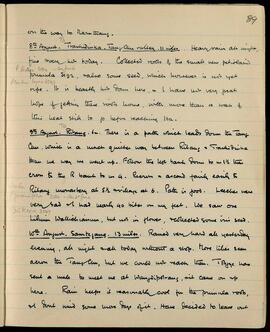
on the way to Samtegang.

8th August. To Trashidinka. Tang Chu valley. 11 miles. Heavy rain all night, fine and very hot today. Collected roots of the small new petiolaris primula 3192, and also some seed, which however is not yet ripe. It is beastly hot down here, and I have not very great hope of getting these roots home, with more than a week of this heat still to go before reaching Ha.

9th August. To Ritang. 6 m. There is a path which leads down the Tang Chu, which is a much quicker way between Ritang and Trashidinka than the way we went up. Follow the left bank down to m 1 1/2 then cross to the R bank to m 4. Recross and ascend fairly easily to Ritang monastery at 5 1/2 and village at 6. Path is good. Leeches were very bad and I had nearly 40 bites on my feet. We saw one Lilium wallichianum, but not in flower, and collected some iris seed.

10th August. Samtegang. 13 miles. Rained very hard all yesterday evening, all night and all today without a stop. More lilies seen across the Tang Chu, but we could not reach them. Tobgye has sent a mule to meet me at Wangdipotrang, and it came on up here. Rain keeps it reasonably cool for the primula roots, and I don't mind some more days of
LSH/1/1/10/1/129 · Part · 1949-04-16
Part of The Ludlow & Sherriff Collection

SUMMARY:
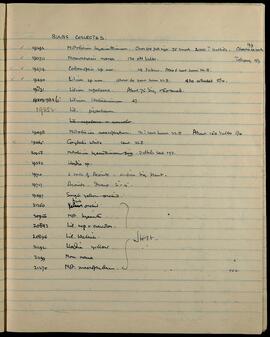
Page lists bulb and tuber collections by specimen number and species with counts, size notes, and shipments, including entries from Chachu La route and Tolegang. Several shipments are noted in late August and collections in September and October. The last six entries are bracketed with the initials J.H.H.

CONTENT:
BULBS COLLECTED.

19242 Notholirion hyacinthinum. Over 100 full size 75 small 2000? bulbils. Chachu La route 13/9
19070 Nomocharis nana 130 odd bulbs. Tolegang 10/9
19674 Codonopsis sp. nov. 14 tubers. Also 6 sent home 22.8.
19490 Lilium sp. nov. about 60 sent home 22.8. 430 collected 5/10.
19831 Lilium nepalense. About 75 big 50 small.
19846 Lilium wallichianum 47
19852 Lil. giganteum
[crossed out: Lil. nepalense v. concolor.]
19498 Notholirion macrophyllum. 12? sent home 22.8 About 150 bulbs 5/10.
19465 Corydalis white sent 22.8.
20956 Notholirion hyacinthinum pink. Bulbils sent 27/8.
19352 Lloydia sp.
19710 6 roots of Aconite. a fine big plant.
19727 Aconite. Dwarf 2"-4".
19497 Small yellow orchid.
21250 Pink orchid.
20956 Not. hyacinth.
20843 Lil. nep v concolor.
20846 Lil. Wallich.
21192 Lloydia yellow.
21199 Nom. nana
21270 Not. macrophyllum.

(The last six entries are bracketed with the initials J.H.H.)

LSH/1/1/9/1/123 · Part · 1937-08-12
Part of The Ludlow & Sherriff Collection

SUMMARY:
After an early start, Tasho and his man led the diarist to Codonopsis aff. vinciflora, and there are notes on discussing with HH the organization of medical work in Bhutan, including a hospital at Tongsa and rest houses. On 23 August at Isalunape heavy rains had altered the river and plants were later than in 1937, with the Zimpon improving the lodging. On 24 August at Tahudu the party reached camp early despite washed-out paths, noting large patches of Lilium wallichianum, finding Luculia pinceana, and collecting old seed of Streptocarpus simplex.

CONTENT:
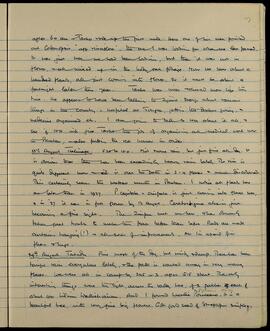
After 6:00 am Tasho rode up the first mile. Here one of his men pointed out Codonopsis 'aff. vinciflora', the one I was looking for when we last passed. It was just where we had been looking, but then it was not in flower, all mixed up in the holly oak foliage. Now we saw about a hundred plants, all just coming into flower, so it must be about a fortnight later this year. Tasho was nicer and showed more life this time. He appears to have been talking to Jigme Dorji about various things in the country - hospital at Tongsa, getting the doctors going, and medicine organised etc. I am going to talk to HH about it all, and see if HH will give Tasho the job of organising all medical work now in Bhutan, also putting the rest houses in order.

23rd August. Isalunape. 5:30 to 10:00. Mist and some rain, but just fine all day. It is obvious that there has been exceedingly heavy rain lately. The river is quite different now and it is over the path in 3-4 places and much discoloured. This certainly seems the wetter month in Bhutan. I notice all plants here are later than in 1937. P. capitata and crispata are just coming into flower now, and in '37 they were in full flower by 12 August. Ceratostigma also is just becoming a fine sight. The Zimpon met me here, and has obviously taken great trouble to make this place better than before. Beds are made, curtains hanging (!) and all sorts of improvements. All I'm afraid of are fleas and bugs.

24th August. Tahudu. Fine most of the day, but misty and damp. There has been terrific rain everywhere lately, and the path is washed away in very many places. We were all in camp by 2:45 or 3, after 5:15 start. The only interesting things were the sight, across the valley here, of 2 patches of each of about 100 Lilium wallichianum. And I found Luculia pinceana. It is a beautiful tree, with very fine big flowers. Got (old) seed of Streptocarpus simplex.

LSH/1/1/2/1/17 · Part · 1924-06-23
Part of The Ludlow & Sherriff Collection

SUMMARY:
Diary entries describe steep descents and ascents between Khomanaggri and Balfai, crossing the Tsalari, Temri Chu, and Jiri Chu, with camps at Yembo La and Balfai. Birds were shot and seen; Lilium wallichianum was abundant on recently jhumed slopes. The sister of the Trashigong Dzongpen visited the party; weather was hot with an evening thunder shower.

CONTENT:
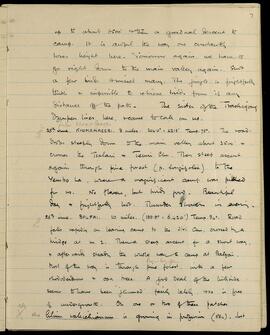
up to about 6500' then a gradual descent to camp. It is awful the way one constantly loses height here. Tomorrow again we have to go right down to the main valley again. Shot a few birds & missed many. The jungle is frightfully thick & impossible to retrieve birds from if any distance off the path. The sister of the Trashigong Dzongpen lives here, & came to call on us.

25th June. KHOMANAGGRI. 8 miles. 204.0° = 4215' Temp. 75°. The road drops steeply down to the main valley about 3500' & crosses the Tsalari & Temri Chu. Then steep ascent again through pine forest (P. longifolia) to the Yembo La, where a magnificent camp was pitched for us. No flowers, but birds good. Beautiful day & frightfully hot. Thunder shower in evening.

26th June. BALFAI. 10 miles. (199.9° = 6,420') Temp. 84°. Road falls rapidly on leaving camp to the Jiri Chu, crossed by a bridge at m 2. Then a steep ascent for a short way, & afterwards steady the whole way to camp at Balfai. Most of the way is through pine forest (Pinus longifolia), with a few rhododendrons & oak trees. A good deal of the hillside seems to have been 'jhumed' fairly lately, & so is free of undergrowth. On one or two of these patches Lilium wallichianum is growing in profusion (564). Just

LSH/1/1/9/1/111 · Part · 1933-08-03
Part of The Ludlow & Sherriff Collection

SUMMARY:
The writer recalls a 1933 arrival with Ludlow at Mangde Chu, aided by Tobgye with mules and beer, notes current finds including Lilium wallichianum and Codonopsis purpurea, and describes a clean bamboo house near Tongsa Dzong. On 4th August at Chendesi, in clear weather they collected many flowers, went via the Lamse La to find Primula hasecharis, and stayed in a bamboo house built two years earlier for H.H.’s visit to Ha.

CONTENT:
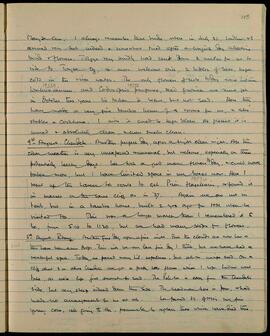
108

Mangde Chu. I always remember that bridge, where in July '33, Ludlow & I arrived very hot indeed & somewhat tired after a longish day collecting birds & flowers. Tobgye very kindly had sent down 2 mules for us to ride to Tongsa Dzong, & more welcome still, 2 bottles of beer, kept cold in the river water. The only flowers of note today were Lilium wallichianum (19559), and Codonopsis purpurea (19532), seed of which we must get in October this year. I've taken it before, but not seed. Here they have made a very fine bamboo house of 4 rooms for us, & also stables & cookhouse. I wish it could be kept clean. At present it is unused & absolutely clean, & even smells clean.

4th August. Chendesi. Another perfect day, after a bright clear night. All this clear weather is very unexpected & unusual, but welcome, especially on these potentially leechy days. We took a good many flowers today, & could have taken more, but I have limited space in our boxes now. Here I went up the Lamse La route to get Primula hasecharis (19574), & found it in masses on the same cliff as in '37. Again we are not in tents, but in a bamboo house, built 2 years ago for H.H. when he visited Ha. This was a longer march than I remembered it to be, from 5

LSH/1/1/5/1/183 · Part · 1933-08-10
Part of The Ludlow & Sherriff Collection

SUMMARY:
Notes on routes between Lomitsawa, Wangdipotrang, and Tsalimaphe, including Tobgye’s rapid ride from Wangdipotrang to Ha. Entries for 11–12 August describe continuous heavy rain after drought, severe mosquitoes, delayed rice sowing, finding scarce Lilium wallichianum near Wangdipotrang, and a 22-mile march to Tsalimaphe with swollen rivers, risky bridges, coolie changes, moving to a tent due to fleas, and arrival of mail.

CONTENT:
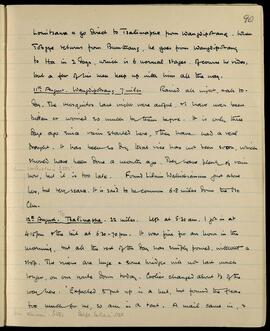
90

Lomitsawa and go direct to Tsalimaphe from Wangdipotrang. When Tobgye returns from Bumthang, he goes from Wangdipotrang to Ha in 2 days, which is 6 normal stages. Of course he rides, but a few of his men keep up with him all the way.

11th August. Wangdipotrang 7 miles. Rained all night, rain today. The mosquitoes last night were awful, I have never been bitten or worried so much by them before. It is only three days ago since rain started here, they have had a real drought. It has been so dry that rice has not been sown, which should have been done a month ago. They have plenty of rain now, but it is too late. Found Lilium Wallichianum just above here, but very scarce. It is said to be common 6-8 miles down the Mo Chu.

12th August. To Tsalimaphe. 22 miles. Left at 5:30 am. I got in at 4:15 pm and the kit at 6:30-7:00 pm. It was fine for an hour in the morning, but all the rest of the day has simply poured, without a stop. The rivers are huge and some bridges will not last much longer, on our route down today. Coolies changed about 1/3 of the way here. Expected to put up in a hut, but found the fleas too much for me, so am in a tent. A mail came in, and