Showing 5 results

Archival description
5 results with digital objects Show results with digital objects
LSH/1/1/6/1/91 · Part · 1938-07-08
Part of The Ludlow & Sherriff Collection

SUMMARY:
The diarist leaves the Tsangpo valley toward Nayü La, noting views of Gyala Tsutum and a local legend linking its summit to Samye via Yüsum. On 5th July at Nayü Chu, progress is delayed by lack of coolies despite assurances from Kusho and the gyimpon; on 6th July, after heavy rain, the party camps north of Nayü La and records notable plants including Lilium giganteum, a white water lily, and Smilacina.

CONTENT:
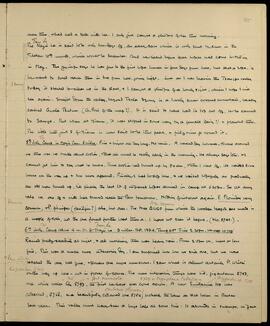
...were there, and had a talk with her. I only just caught a glimpse of her this morning.

The Nayü La is said to be only two days off, an easy pass which is only shut by snow in the Tibetan 10th month, which would be December. And we heard before that Lopas had come to Tsela in May. The gyimpon says he has gone to the first Lopa houses in four days from here, but that a Lopa, if he wants to could reach them in two from here, going light. Just as I was leaving the Tsangpo valley today it started to clear up in the East, and I caught a glimpse of a lovely scene, which I hope I will see again. Straight down the valley, beyond Tsela Dzong is a lovely snow covered mountain, locally called Gyala Tsutum (G. Peri of the map?). It is said to have had its top cut off, to be carried to Samye. But when at Yüsum, it was stopped in some way by a female deity (?) and planted there. The little hill just S of Yüsum is now said to be this peak, and pilgrims go round it.

5th July. Camp in Nayü Chu. 5 miles. Fine and bright all day long. No rain. A wasted day however. Kusho assured us there was no trouble about coolies, that all would be ready early in the morning. He always says this, and cannot get him to say what he knows. Three coolies had turned up by 8.0 am, then I went off. We waited some hours on the way up and two more appeared. Finally had to stop here, and we waited hopefully as gradually an odd man turned up, till finally the last lot of impressed Lopas arrived in camp at 6.30 pm. So at any rate we are off and with luck should reach the Pass tomorrow. Nothing of interest again. P. Florindae very common, and P. firmipes (flexilipes?) also, but over. The tree GIUGO from which the wooden teapots are made is a maple of sorts, not the one found further west though. I have not seen it before. (No. 5740.).

6th July. Camp about 4 m. N. of Nayü La. 9 miles. BP. 193.4. Temp 65° Time 2.30 pm. Ht app. 10700'
Rained pretty steadily at night, and all morning there was heavy rain. From 2.0 pm on, more or less fine. This was a much more interesting day. I am surprised how low we still are, but we have reached the very wet zone, and flowers are more numerous. I saw what is almost certainly P. Whitei on the way up here - not in flower of course. The most interesting things were Lil. giganteum 5743, and a white water lily 5759, the first we have ever come across. A new Smilacina too was collected, 5756, and a beautifully coloured one 5754, probably the same as that taken in Bhutan last year. This valley must have been a huge lake at some time. It abounds in swamps, in fact...
LSH/1/1/10/1/129 · Part · 1949-04-16
Part of The Ludlow & Sherriff Collection

SUMMARY:
Page lists bulb and tuber collections by specimen number and species with counts, size notes, and shipments, including entries from Chachu La route and Tolegang. Several shipments are noted in late August and collections in September and October. The last six entries are bracketed with the initials J.H.H.

CONTENT:
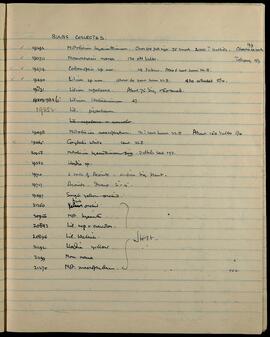
BULBS COLLECTED.

19242 Notholirion hyacinthinum. Over 100 full size 75 small 2000? bulbils. Chachu La route 13/9
19070 Nomocharis nana 130 odd bulbs. Tolegang 10/9
19674 Codonopsis sp. nov. 14 tubers. Also 6 sent home 22.8.
19490 Lilium sp. nov. about 60 sent home 22.8. 430 collected 5/10.
19831 Lilium nepalense. About 75 big 50 small.
19846 Lilium wallichianum 47
19852 Lil. giganteum
[crossed out: Lil. nepalense v. concolor.]
19498 Notholirion macrophyllum. 12? sent home 22.8 About 150 bulbs 5/10.
19465 Corydalis white sent 22.8.
20956 Notholirion hyacinthinum pink. Bulbils sent 27/8.
19352 Lloydia sp.
19710 6 roots of Aconite. a fine big plant.
19727 Aconite. Dwarf 2"-4".
19497 Small yellow orchid.
21250 Pink orchid.
20956 Not. hyacinth.
20843 Lil. nep v concolor.
20846 Lil. Wallich.
21192 Lloydia yellow.
21199 Nom. nana
21270 Not. macrophyllum.

(The last six entries are bracketed with the initials J.H.H.)

LSH/1/1/2/1/255 · Part · 1969-04-29
Part of The Ludlow & Sherriff Collection

SUMMARY:
At Diwangiri, mail and bulb specimens (Nos. 573, 1041, 717, 553, 564) were sent to Ramsbottom, and 19 loads of kit were sent via the Pradhan to the station at Rangiya; the area teemed with birds, with 23 shot and Ramzana handling the skins. After halting at Diwangiri with cool, rainy weather, the party set out early for Rangiya following night rain.

CONTENT:
night, and was fine and cool today.

Lil. giganteum 573
n. nanum 1041
Noth. bulbulifera 717
Lil. nepal. var concolor 553
Lil. wallichianum 564

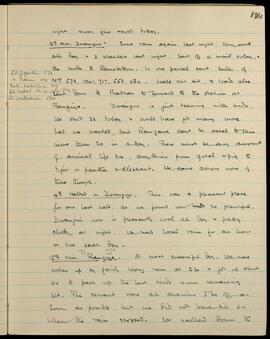
12th Nov. Diwangiri - Some rain again last night. Very cool all day and 3 blankets last night. Sent off a mail today, and the bulbs to Ramsbottom. In one parcel sent bulbs of Nos 573, 1041, 717, 553, 564. Half our kit, 19 loads also sent down to Pradhan to forward to the station at Rangiya. Diwangiri is just teeming with birds. We shot 23 today and could have got many more had we wanted, but Ramzana can't be asked to skin more than 20 in a day. There must be any amount of animal life too, anything from goral and pig to tiger or panther and elephant. We came across none of these though.

14th Halted in Diwangiri: This was a pleasant place for our last halt, as we found new birds so plentiful. Diwangiri now is pleasantly cool all day and pretty chilly at night. We had local rain for an hour or two each day.

15th Nov. To Rangiya. A most successful day. We were woken up by fairly heavy rain at 2.30 and got up about 4.0 to pack up the last birds and our remaining kit. The servants were all anxious to be off as soon as possible, but we did not leave till 6.0 when the rain stopped. We walked down to

LSH/1/1/5/1/93 · Part · 1933-05-30
Part of The Ludlow & Sherriff Collection

SUMMARY:
The party revisits the La, noting flowering Lilium giganteum, rhododendrons (possibly R. maddenii or R. calophyllum), and a primula akin to P. Boothii. A sepoy brings letters and gifts from Ashi Wangmoo and Tasho Haku, with reflections on Wangmoo’s situation as a nun; the Mara Chu is observed plunging in dramatic falls.

CONTENT:
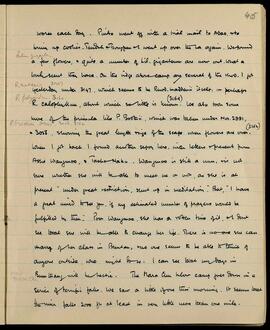
worse each day. Pintso went off with a trial mail to Adao, to bring up coolies. Tenduk & Tsoupen & I went up over the La again. We found a few flowers, & quite a number of Lil. giganteum are now out. What a lovely scent they have. On the ridge above camp are several of the Rhod. I got yesterday under 3147, which seems to be Rhod. maddenii itself, or perhaps R. calophyllum, about which so little is known. We also took some more of the primula like P. Boothii, which was taken under Nos. 2991, & 3056, showing the great length & size of the scape when flowers are over.

When I got back I found another sepoy here, with letters & presents from Ashi Wangmoo, & Tasho Haku. Wangmoo is still a nun, & is not sure whether she will be able to meet me or not, as she is at present "under great restriction, shut up in meditation". But, "I have a great mind to see you, if my estimated number of prayers would be fulfilled by then." Poor Wangmoo, she has a rotten time of it, & I don't see that she will be able to change her life. There is no one she can marry of her class in Bhutan, & no one seems to be able to think of anyone outside, who might do so. I can see that my days in Bumthang will be hectic. The Mara Chu below camp goes down in a series of terrific falls. We saw a little of one this morning. It seems that the river falls 2000 ft at least in very little more than one mile.

LSH/1/1/7/1/9 · Part · 1940-05-24
Part of The Ludlow & Sherriff Collection

SUMMARY:
The diarist describes abundant Primula species on swampy valley slopes and notes that by October seed and leaves were scarce due to yak grazing. On June 19th they returned to Lanyong, then departed for Molo via the Tse La, later traveling down the Tsangpo valley to Mayu and making difficult river crossings (including by skin coracles and a log raft) before proceeding up the Nagu Chu valley toward the Tam La over the Himalayas.

CONTENT:
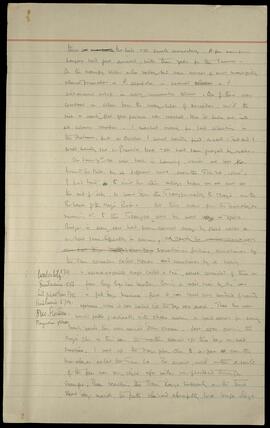
there are two huts & a small monastery. A few men
from Lanyong had just arrived, with their yaks for the summer -
On the swampy slopes in the valley bed were masses of most beautifully
coloured primulas - P. alpicola in several and a P.
sikkimensis subsp in every conceivable colour. One of these was
constant in colour down the rocky sides of cascades, until the
rich & marshy flat yak pasture was reached. Here it broke out into
all colours & shades. I marked many for seed collecting in
the Autumn, but in October I could hardly find a seed & indeed I
could hardly see a Primula leaf - all had been grazed by yaks.
On June 19th we were back in Lanyong, which we left then,
bound for Molo, by a different route, over the Tse La, 15000'.
I had time to visit two other valleys before we all met at
the end of July, so went down the Tsangpo valley to Mayu on the
R bank of the Nagu River - All these rivers from the Himalayas
running N. to the Tsangpo were by now in spate.
Bridges in every case had been carried away by flood water &
we had some difficulty in crossing, clear days sometimes fording, sometimes by
the skin coracles called Kowas and sometimes by a heavy

Waterlily 5749 unmanageable craft called a 'tru', which consisted of three or
Smilacina 5756 four long logs tied together. Crossing a rapid river by 'tru' was
Lil. giganteum 5743 a full day's business: first it was towed some hundreds of yards
Smilacina 5754 upstream, where it was loaded till the logs were awash. Then two men
Rhod. floribunda would paddle frantically with sticks making a yard across for every
Magnolia globosa twenty yards they were carried down stream. Just after crossing the
Nagu Chu in this way, the weather cleared after three days we had
sunshine. I went up the Nagu Chu valley to a pass at over the
Himalayas called the Tam La. The ascent, until within a mile
of the pass was very slight & for miles we plodded through
swamps. Then reaching the Main Range suddenly on the third
short day's march, the path climbed abruptly to a knife edge