Showing 7 results

Archival description
7 results with digital objects Show results with digital objects
LSH/1/1/4/1/38 · Part · 1936-04-28
Part of The Ludlow & Sherriff Collection

SUMMARY:
Notes of Heteroxenicus stellatus south of Changla at about 14,500 ft, described as tame and alone. Many Grandala were also seen in the same area.

CONTENT:
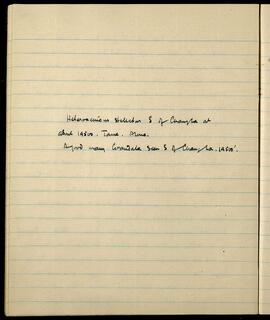
Heteroxenicus stellatus S of Changla at
about 14500. Tame. Alone.
A good many Grandala seen S of Changla. 14500'.

LSH/1/1/1/1/132 · Part · 1933-08-14
Part of The Ludlow & Sherriff Collection

SUMMARY:
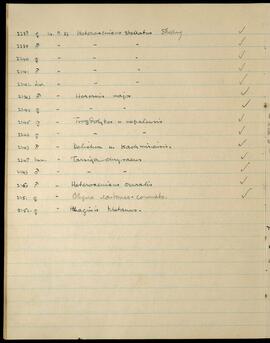
Log of bird specimens numbered 2238–2252, noting sex and species. Includes one dated entry on 14 August 1933 with locality Shokong; taxa listed include Heteroxenicus stellatus, Horornis major, Troglodytes u. nepalensis, Delichon u. kashmiriensis, Tarsiger chrysaeus, Heteroxenicus cruralis, Oligura castaneo-coronata, and Ithaginis tibetanus.

CONTENT:
2238 ♀ 14.8.33 Heteroxenicus stellatus Shokong ✓
2239 ♂ - - - ✓
2240 ♀ - - - ✓
2241 ♂ - - - ✓
2242 Juv. - - - ✓
2243 ♂ - Horornis major ✓
2244 ♀ - - - ✓
2245 ♀ - Troglodytes u. nepalensis ✓
2246 ♀ - - - ✓
2247 ♂ - Delichon u. kashmiriensis ✓
2248 Imm. - Tarsiger chrysaeus ✓
2249 ♂ - - - ✓
2250 ♂ - Heteroxenicus cruralis ✓
2251 ♀ - Oligura castaneo-coronata ✓
2252 ♀ - Ithaginis tibetanus

LSH/1/1/2/1/155 · Part · 1933-07-18
Part of The Ludlow & Sherriff Collection

SUMMARY:
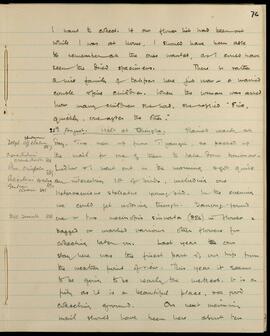
The party halted at Shingbe in heavy rain, arranged outgoing mail via two men from Tiyangpi, and spent the morning collecting birds and noting flowering plants. Ludlow and the diarist obtained several birds including a young Heteroxenicus stellatus, while Dancong located Meconopsis sinuata and marked other plants; a family of Tibetans was also present. A short list of target plants with collection numbers is noted.

CONTENT:
76

I want to collect. If our flower list had been out while I was at home, I should have been able to remember all the ones wanted, as I could have seen the dried specimens. There is rather a nice family of Tibetans here just now — a married couple & five children. When the woman was asked how many children she had, she replied "Five, quickly, one after the other."

25th August. Halt at Shingbe. Rained nearly all day. Two men up from Tiyangpi, so packed up the mail for one of them to take down tomorrow. Ludlow & I went out in the morning & got quite an interesting lot of birds, including one Heteroxenicus stellatus young bird. In the evening we could get nothing though. Dancong found one or two Meconopsis sinuata (886) in flower & bagged or marked various other flowers for collecting later on. Last year our stay here was the finest part of our trip from the weather point of view. This year it seems to be going to be nearly the wettest. It is a pity as it is a beautiful place, & a good collecting ground. Our next incoming mail should have been here about ten

Delph. bhutanicum afflatum 887.
Cremanthodium 888.
Prim. crispata 889.
Pedicularis excelsa 890.
Gentiana clivorum 891.
Mec. sinuata 886.

LSH/1/1/1/1/130 · Part · 1933-08-12 - 1933-08-18
Part of The Ludlow & Sherriff Collection

SUMMARY:
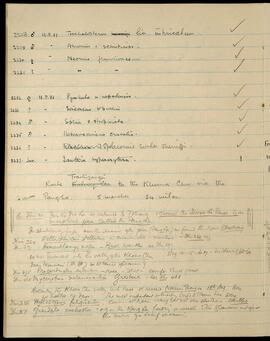
Page lists bird specimens 2228–2237 dated 12–13 Aug 1933 and describes the route from Kulong Chu to Khoma Chu via the Pang La after returning from Me La to Tobrang and crossing the Dong La Range. Notes record finding Heteroxenicus stellatus near the Pang La, additional species near Tosumani, and key birds at Narim Thang and on the Kang La, with arrival at Narim Thang on 18 Aug and a 10-day halt.

CONTENT:
2228 ♂ 12.8.33 Trochalopteron lin. imbricatum.
2229 ♂ 12.8.33 Abrornis schisticeps.
2230 ♀ 12.8.33 Neornis flavolivaceus.
2231 ? 12.8.33 Neornis flavolivaceus.

2232 ♀ 13.8.33 Pyrrhula n. nepalensis.
2233 ? 13.8.33 Seicercus burkii.
2234 ♂ 13.8.33 Siphia s. strophiata.
2235 ♂ 13.8.33 Heteroxenicus cruralis.
2236 ? 13.8.33 Spelaeornis souliei sherriffi.
2237 Juv. 13.8.33 Ianthia hypererythra.

Trashiyangsi
Route Kulong Chu to the Khoma Chu via the Pang La.
5 marches 34 miles.

& Itin 10. From the Me La we returned to Tobrang & crossed the Dong La Range by an unexplored pass called the Pang La.
In rhododendron jungle near the summit of the pass (Pang La) we found the rare Shortwing Heteroxenicus stellatus in considerable numbers - Itin 265 see.
Itin 271. Homochlamys major - Bush Warbler see Itin 271.
We now descended into the valley of the Khoma Chu - Aug 14-15-16-17 - see Itin 65-69
Near Tosumani (Itin 65) we obtained specimens of
Itin 475. Procarduelis nipalensis - rose-finch in conifer thick forest.
Itin 468 Mycerobas melanoxanthos Grosbeak - see Itin 468
Ascending the Khoma Chu valley, to its head we reached Narim Thang on 18th Aug. Here we halted 10 days. The most important birds obtained here were
Itin 286 Phylloscopus fuligiventer. Common at Narim Thang but not seen elsewhere. Warbler.
Itin 277 Grandala coelicolor - only on the Kang La feeding on insects & the glaucous indigo-blue berries of a dwarf vaccini.

LSH/1/1/6/1/111 · Part · 1933-07-25 - 1933-07-27
Part of The Ludlow & Sherriff Collection

SUMMARY:
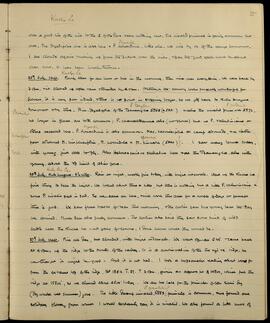
Notes from Kucha La and nearby valleys describe poor flowering despite promising terrain, with common Primula (including Dryadifolia/tsangensis and nivalid forms) and several Meconopsis. Weather shifts from clear to mist, rain, and thunder lead to a move back to Kulu Lungma; wildlife seen or reported include lerwa with young, Heteroxenicus stellatus, bear tracks and cubs, deer, and possible wild cattle. A hypsometer reading near the Go nyi re ridge suggests an elevation around 15,800 ft.

CONTENT:
Kucha La

over a good bit of the hill to the E of the Pass saw nothing new. The nivalid primula is fairly common but over. The Dryadifolia one is also here & P. jonardunii (Dryadifolia). Little else. We move by N of the range tomorrow. I see clouds again rushing up from the S west over the hills, that the good spell must be about over now. It has been lovely weather.

Kucha La
25th July. Halt. Fairly clear for an hour or two in the morning, then mist over everything. We were back by 3.0pm, it cleared up after rain & thunder by 4.0pm. Although the country looks perfectly wonderful for flowers, it is very poor indeed, there is no point in stopping longer, so we go back to Kulu Lungma tomorrow & try there. Prim. Dryadifolia (P. tsangensis) of the Tsanangha 5865 (= 5931) & also the nivalid primula 5872 (P. calliantha), no longer in flower, are both common; P. chamaethauma also (no flower) but no P. valentiniana or others expected here. P. jonardunii (Dryadifolia) is also common. Mec. betonicifolia at camp abounds, & a rather poor coloured M. simplicifolia, M. horridula & M. sinuata (speciosa) (5940). I saw many lerwa today, with young just able to fly. Also Heteroxenicus stellatus near the Tsanangha, also with young, about the top limit of abies zone.

Kulu Phu Chu
26th July. Kulu Lungma. 6 1/2 miles. Rain at night, mostly fine today, with bright intervals. Went up the Kucha La first thing to take the height. We looked about there a little, but there is nothing but a little P. valentiniana & some P. nivalis sect. in seed. So we came on here, will work this area for a couple of days as perhaps there is good. We saw fresh tracks of bear this morning, the coolies saw two young bear the day we arrived. Much deer also pretty common. The coolies also said they saw some kind of wild cattle near the Kucha La - not yaks of course. I don't know what they would be.

27th July. Halt. Fine all day, but clouded, with bright intervals. We went off at 5.45 & came back at 4.0pm, up the ridge to the North of the valley. It is a continuation of the Go nyi re ridge, so we thought it might be good. And it is not bad. I took a hypsometer reading about 400 ft from the extreme top of the ridge, BP 186.2 T. 57. at 2.0pm., giving an approx ht of 14800, which puts the ridge at 15800', so we climbed about 4500' today. We are too late for the primulas of the semi dry (dry winter wet summer) zone. The little dwarf nivalid (P. amabilis?), 5889, primula is common, we found one solitary flower, from which I would certainly say it is nivalid. We also found a little more of

LSH/1/1/4/1/143 · Part · 1933-10-19
Part of The Ludlow & Sherriff Collection

SUMMARY:
At Lung, the party halted for several days of fine weather while shooting birds and searching unsuccessfully for tragopan. The diarist notes rough valley paths, collects some rhododendron seeds, and remarks that other rhododendron seeds are not yet ripe.

CONTENT:
Lung
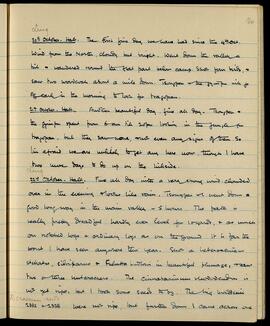
20th October. Halt. The first fine day we have had since the 4th Oct.
Wind from the North, cloudy but bright. Went down the valley a
bit - wandered round the flat part below camp. Shot four birds -
saw two woodcock about a mile down. Tsongpen & the gyimpon will go
off early in the morning to look for tragopan.

21st October. Halt. Another beautiful day, fine all day. Tsongpen &
the gyimpon spent from 6 am till 2.30 pm looking in the jungle for
tragopan, but they saw none, not even any signs of them. So
I'm afraid we are unlikely to get any here now, though I have
two more days to do up on the hillside.

Lung
22nd October. Halt. Fine all day, with a very strong wind: clouded
over in the evening & looks like rain. Tsongpen & I went down a
good long way in the main valley - 5 hours. The path is
really pretty dreadful, hardly ever level for 10 yards, & as much
on notched logs & ordinary logs as on the ground. It is far the
worst I have seen anywhere this year. Shot a Heteroxenicus
stellatus, Sylviparus & Fulvetta ludlowi in beautiful plumage, saw
two or three nutcrackers. The cinnabarinum rhododendron is
not yet ripe, but I took some seeds to try. The big maddenii
R. crassum seed
2332 & 2338 were not ripe, but further down I came across one

LSH/1/1/1/1/135 · Part · 1933-08-15
Part of The Ludlow & Sherriff Collection

SUMMARY:
After an exceptionally heavy night of rain, the party crossed Pang La and collected 15 bird skins, including four adult and one young Heteroxenicus stellatus and a female blood pheasant, while finding few flowers due to lack of permanent snow. They were misinformed about the distance to camp and then made a steep descent through jungle to a long-neglected bridge that was recently strengthened, of the usual cantilever type found in Bhutan, Turkestan, and Kashmir.

CONTENT:
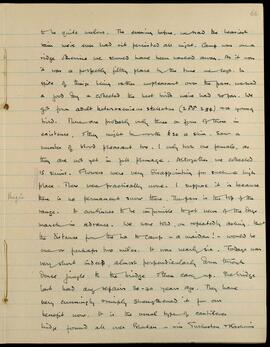
to be quite useless. The evening before, we had the heaviest rain we've ever had and it persisted all night. Camp was on a ridge otherwise we should have been washed away. As it was it was a perfectly filthy place by the time we left. In spite of things being rather unpleasant over the pass, we had a good day and collected the best birds we've had so far. We got four adult Heteroxenicus stellatus (2 males, 2 females) and a young bird. There are probably only three or four of these in existence, and they might be worth £20 a skin. Saw a number of blood pheasant too. I only took one female, as they are not yet in full plumage. Altogether we collected 15 skins. Flowers were very disappointing for such a high place. There were practically none. I suppose it is because

Pang La

there is no permanent snow there. The pass is the top of the range. It continues to be impossible to get news of the day's march in advance. We were told, on repeatedly asking, that the distance from the la to camp — a maidan! — would be one or perhaps two miles. It was nearly six. Today's was very short indeed, almost perpendicularly down through dense jungle to the bridge and then easy up. The bridge last had any repairs 30–40 years ago. They have very cunningly and simply strengthened it for our benefit now. It is the usual type of cantilever bridge found all over Bhutan — in Turkestan and Kashmir.