Affichage de 7 résultats

Description archivistique
7 résultats avec objets numériques Afficher les résultats avec des objets numériques
Note on 3310 and nest of Grandala
LSH/1/1/5/1/128 · Part · 1933-06-21
Fait partie de The Ludlow & Sherriff Collection

SUMMARY:
The writer disputes identifying Primula specimen no. 3310 as P. macrophylla, noting consistent differences in size, color, eye, and corolla tube, and its habitat on wetter, near-bare cliff faces. They also describe observing a Grandala nest at about 15,000 ft with three chicks, built under an overhanging cliff, and document frequent parental feeding visits.

CONTENT:
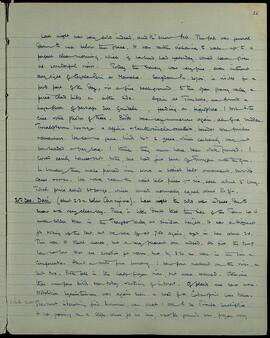
Note on 3310. I believe W. Smith put a similar primula which we got last year on the Bimbi La, as P. macrophylla forma. I cannot agree that this one is the same as P. macrophylla. The latter grows flowers in profusion all around. No 3310 is recognisable at once. It is always much bigger & always the same colour, & always has the deeper blue violet eye. The tube also is dark coloured, not nearly white as this is. The habitat is much the same, but 3310 grows on almost bare cliff faces in wetter places.

Note on nest of Grandala c.c. I have seen several Grandala carrying food for their young up here, or at about 15000 ft. Today we saw one nest. It was built under an overhanging cliff, or a rock ledge covered with grass & moss, & was quite unapproachable. But I watched both male & female come with food several times, & saw the chicks through binoculars take the food. There were three chicks. The nest appeared (15x) to be made of dry grass, a perfect round, well made, perched on a ledge, & lined with something soft looking. The nest was about 5"-6" diam outside, & about 3 1/2 or 3 inside. Parents came every 5-10 minutes.

see p. 75.
LSH/1/1/8/1/29 · Part · 1946-12-20
Fait partie de The Ludlow & Sherriff Collection

SUMMARY:
The diarist acquires a sheep and extra ponies to reach Temu La, aiming for views of snow mountains, and notes various birds including geese, a kite, Lophobasileus, a crossbill, a black woodpecker, a Sitta, and a large flock of Grandala. At Latsa Lunang above Tumbatse, poor visibility prevents mountain views; seeds of Notholirion hyacinthinum and two Berberis are collected, and weather and snow conditions are recorded before proceeding to Lunang.

CONTENT:
26

very obliging, ready to help. We are getting a sheep here, & taking on 2 extra ponies to the Temu La. About 2 miles from here there were many geese, some duck on the open plain & on some odd water. I also saw one kite - only the second to be seen since India. Our main idea in coming on is to try to get views of the snow mountains from the Temu La while the good weather lasts, but I wonder if it will last. Clouds came up fast today & we would not have had good views had we been there today. Yesterday B & I were out up the valley for birds & got 2 more Lophobasileus, a crossbill, a black woodpecker & a Sitta which seems different to any we have yet got, & different to anything in the Fauna of B.I.

19th Dec. Latsa Lunang (above Tumbatse). Left 7.30: in 3.30: transport 7.30 to 4.30 ponies. Clouded up during the day, & nothing visible from the La except hazy up the Tsangpo. An ice mass lay at 40° & another at approx 80°, but nothing could be identified - a great disappointment to us. We did not try to reach Tumbatse. This is a good camping ground, with about five houses. The Sancha can almost be seen from here, & seems to have more snow on it. Here the locals tell me, snow hardly falls at all. I got seed of Notholirion hyacinthinum within 500' of the La, SE side, & two Berberis, one blue fruit, one red N of the La. There was hardly a bird to be seen or heard in the forest on either side, particularly N side, till we got here - I heard a few calling only, but when we reached here, saw a large flock of Grandala, males & females, about 100 together. They were constantly on the move, between a tall Picea & some Hippophae which were covered with fruit. Shot one male or female. This evening it is heavily overcast, is snowing low down to the N beyond Tumbatse, perhaps even down to Lunang. Saw a jay, above Temo.

20th Dec. Lunang. Left at 8.0: in about 2.0. Road very easy & open.

LSH/1/1/8/1/31 · Part · 1946-12-23
Fait partie de The Ludlow & Sherriff Collection

SUMMARY:
After a very cold night with snowfall, the party enjoyed clear weather and fine scenery with Sengdam La visible, noted a large flock of Grandala at Tumbabe, and observed various birds including geese and mallard (two of which were shot and retrieved). They marched from Lunang to Daú below Chunjima, remarked on Lunang ironwork, and collected plants including Notholirion hyacinthinum, a Codonopsis (seed), and a probable Primula sonchifolia.

CONTENT:
Last night was very cold indeed, and 1/2" snow fell. The fall was general down to well below this place. It was rather sickening to wake up to a perfect clear morning, which if we had had yesterday would have given us wonderful views. Today the scenery was very fine, even without any sight of Gyala Peri or Namcha. Sengdam La, 20,700', is visible for a good part of the day, in a fine background to the open grassy valley & Picea-clad hills on either side. Again at Tumbabe, we found a huge flock of perhaps 300 Grandala, feeding on Hippophae. I took both cine & still photos of these. Birds were very numerous again, all of a sudden. Trochalopteron henrici & affinis & Ianthocincla ocellata, besides rose finches & accentors. We saw no game birds but 2 geese, which certainly were not bar-headed or grey lag. I think they must have been white fronted. I could easily have shot both, but had just sent off Tsongpen with the gun. In Lunang they make pierced iron work — waist belt ornaments, swords cases & so on. We have seen the waist belt pieces — six, each about 3" long. Total price asked 20 sangs, which would normally equal about Rs 3/-.

21st Dec. Daú. (about 2-3 m. below Chunjima). Last night the cold was intense, due to snow & a very clear sky. There is little doubt that this side of the Temu La is much colder than in the Tsangpo valley at similar heights. It was a difficult job rolling up the tent, but we were off at 7.50 again, arrived here about 2.0. This was a short march, but a very pleasant one indeed. At first the temp was so low that we couldn't get warm, but by 9.30 we were in the sun & comfortable. About a mile from Lunang, I saw four mallard on the river, & shot two. Both fell in the half frozen river, but were rescued. Otherwise there were few birds seen today anything of interest. Of plants we saw more. Notholirion hyacinthinum was again seen & seed of a Codonopsis was taken.
R. Hunter 12021 The most interesting find however, was what I took to be Primula sonchifolia. It was growing on a slope which got no sun, & so the ground was frozen very

LSH/1/1/8/1/83 · Part · 1947-03-20
Fait partie de The Ludlow & Sherriff Collection

SUMMARY:
The party halts for several days in a valley on the right bank of the river, noting delayed flowering compared to Tongkyuk and recalling the 1933 flood from a lake on the Munkhu Phu Chu. They describe routes toward Munkhu La and Yigong, observe various birds, and report activities including Akong collecting specimens, Tsongpen traveling to Sobhe La to repair a thermograph, and Bill ascending above camp but finding little in flower.

CONTENT:
the R. bank of the river.

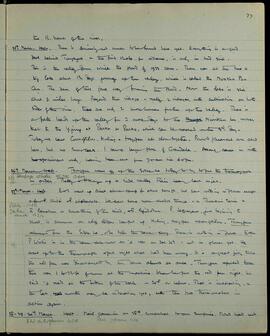
25th March. Halt. There is obviously not much to be found here yet. Everything is a good deal behind Tongkyuk — the pink rhodo, for instance, is only in bud still. This is the valley down which the flood of 1933 came. There was at the time a big lake about 1 1/2 days journey up this valley, which is called the Munkhu Phu Chu. The dam of this gave way forming the flood. Now the lake is still about 3 miles long. Beyond this village — really 2 villages, with cultivation on both sides of the river, there are only 2 more houses further up the valley. There is a path leads up the valley for 3 more days to the Munkhu la, over that to the Yigong at Parka or Parke, which can be reached on the 4th day. Today we saw Crossoptilon, kuling & tragopan all close together. Blood pheasant are also here, but no snowcock. I saw a large flock of Grandala. Akong came in with two specimens only, having been out from 7.0 am till 6.0 pm.

26th March Halt. Tsongpen went off up the Sobhe la today to try to put the thermograph in order. Betty & Akong up a side valley. Rain heavy last night.

27th March. Halt. Bill went up direct above camp for about 2000 ft, but saw nothing in flower except a few P. Winteri & rh. rhodentata. We saw some more rhodos though — a Thomsonii series & R. lanatum or something of the kind, rh. lepidotum. P. Jaffreyana, just beginning to shoot, is common on cliff ledges. We put up kuling, tragopan, crossoptilon. Tsongpen returned from the Sobhe la, she tells the same story. There is nothing in flower. Even P. Winteri is in the same state now as it was on Dec 31st — not in flower yet. He went up to the thermograph & put right what had been wrong. It is a great pity that the red pen was disarranged by the lama almost at once. Tsongpen reported that there was 1 to 1 1/2 ft of snow at the machine. When he put the red pen right, he said it read at the bottom of the scale — 20°F or below. That is interesting, & the last month may be interesting yet, with the two thermometers in action again.

28-29-30th March. Halt. Mail came in on 28th, somewhat to our surprise. Rhodo had not

LSH/1/1/9/1/77 · Part · 1933-06-16 - 1933-06-17
Fait partie de The Ludlow & Sherriff Collection

SUMMARY:
The diarist worked high above the Sokpon's huts near Haeth on 16 June, collecting several Primula species and observing many Grandala. On 17 June at Waitang, after a mishap with a shying pony that broke the diarist's glasses, Lundrup found a white variety of Primula caveana near the junction of two rivers.

CONTENT:
happen honestly. Whether it is Ngudup or Lhakpa who is doing it, I don't know. Either is capable, but Ngudup would think it quite usual.

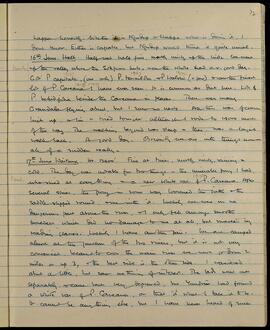
16th June. Haeth. Half wet half fine, mostly misty up the hills. We went up the valley above the Sokpon's huts, and on the whole had a good day. Got Primula capitata (one only), P. tenuifolia, P. walshii (very few) and saw the finest lot of P. caveana I have ever seen. It is common as dirt here. Lots of P. bellidifolia beside the caveana in places. There were many Grandala flying about, but I saw no nests. All this was of course high up, and I'm very tired tonight, although I rode to 14,000' most of the way. The walking beyond was steep and there was a longish walk back. A good day. Obviously we are into things now all of a sudden really.

17th June Waitang. Height 13,400'. Fine at times, mostly misty, raining and cold. The day was notable for two things - the miserable pony I had, who shied at everything and a new white variety of P. caveana. After several shies, the pony in some way loosened the girth and the saddle slipped round, and me with it. Luckily we were on no dangerous part above the river, and I only fell among smooth boulders which did no damage to me at all, but smashed my reading glasses. Luckily I have another pair. We are camped almost at the junction of the two rivers, but it is not very convenient because to cross the main river we must go down 2 miles or up 3, and the best side is the other side. I wandered about a little, but saw nothing of interest. The lads went out separately, and came back very depressed, but Lundrup had found a white variety of P. caveana, or that is what I take it to be. It cannot be anything else, but I have never heard of such

LSH/1/1/4/1/34 · Part · 1936-07-02
Fait partie de The Ludlow & Sherriff Collection

SUMMARY:
Notes bird sightings near a high pass and outlines a dated itinerary from Kense to Langong, Pa La, Paba, and Kyimdong Dzong. Summarizes a route from Pachakshiri via Langong and the Pa La along the Tsangpo valley to Nang Dzong, then up the Sipha Chu to Tso Bunang below the Sur La in the Tsari Valley, with a Tit-warbler noted and a return to Sanga, citing diary pages and Ibis references.

CONTENT:
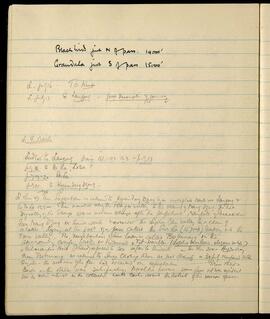
Blackbird just N of pass. 14,000'
Grandala just S of pass 15,000'

L. July 16 - To Kense.
L. July 17 To Langong - Good description of journey

L. H. Route

Ludlow to Langong diary 151-152-153 - July 17.
July 18. to Pa La, Loba
July 19-20 Paba.
July 21. to Kyimdong Dzong.

L. Ibis 47. From Pachakshiri we returned to Kyimdong Dzong by an unexplored route via Langong & the Pa La 15,500. Then marched along the Tsangpo valley to the vicinity of Nang Dzong. The hot dry valley of the Tsangpo was a welcome change after the perpetual rainfall of Pachakshiri. From Nang Dzong we turned south & ascended the Sipha Chu valley to a chain of lakes lying at the foot of a pass called the Sur La (15,700 ft) leading into the Tsari Valley. The neighborhood of these lakes is called Tso Bunang. In the surrounding conifer woods we discovered a Tit-warbler (Lophobasileus elegans subsp.), a Palaearctic point I had expected to see so far to the south. - In Ibis 204 - Aug 20 diary. From Tso Bunang we returned to Sanga

LSH/1/1/4/1/38 · Part · 1936-04-28
Fait partie de The Ludlow & Sherriff Collection

SUMMARY:
Notes of Heteroxenicus stellatus south of Changla at about 14,500 ft, described as tame and alone. Many Grandala were also seen in the same area.

CONTENT:
Heteroxenicus stellatus S of Changla at
about 14500. Tame. Alone.
A good many Grandala seen S of Changla. 14500'.