
Mostrando 3 resultados

Descripción archivística
3 resultados con objetos digitales Muestra los resultados con objetos digitales
LSH/1/1/3/3/158 · Part · 1983-05-05
Parte de The Ludlow & Sherriff Collection

SUMMARY:
Notes describe the Tsari river dropping rapidly like a cataract, with estimates of 500–600 ft per mile after leaving camp. A plant list is recorded at Podzo Sumdo (22 May), and observations at Migyitun note cultivation and a nearby holy lake Tso Kar, with black currants often epiphytic and biting insects common between there and Chick Kar.

CONTENT:
192.4
53

10033
1.0466
10033
40132
60198
1049451

L. p. 96. Killing of newly born calves?
(offspring of "Dzos")

Tsari river falling at a tremendous pace.
For over a mile it was nothing but a
cataract confined to a narrow boulder
strewn bed.

Podzo Sumdo
22 May
Diapensia himalaica 1640
P. atrodentata 1641
spru. "tsariensis 1650
dictyoneura 1654
praealta 1658
glabra 1642
Lloydia tibetica 1645
Pedicularis roylei 1646
Rhod. tsangpoense var.
pruniflorum 1647

  • Calostrotum 1649
  • lopsangianum 1631
    Anthopogon 1653
    Caloxanthum 1656
    Vaccinium sikkimense 1644
    " nummularia 1655
    Sax. granulata 1659

    9205.
    1.0599
    9205
    46025
    82845
    8284
    9757.379

L. p. 98 I think the Tsari river must be dropping
500-600 ft per mile for the first mile after leaving camp.

At Migyitun the valley opens out & there is quite a lot of cultivation including barley, potatoes,
turnips etc. Half the inhabitants here are either pure Lobas or have Loba blood in them.
A large stream comes in from the North & 2 marches distant is a holy lake "Tso Kar".
Black currants abound between here & Chick Kar. A curious feature about the bushes
is that they are frequently epiphytic.
Biting midges, ticks, fleas, & of course a louse or two.
LSH/1/1/3/3/201 · Part · 1996-06-18
Parte de The Ludlow & Sherriff Collection

SUMMARY:
Notes from Shagam La (next to Tame La) describe heavy snow and a difficult descent, with several primulas and gentians collected (nos. 2184–2189), including Meconopsis var. lutea noted as from Mipa rather than the Tawang district. Mentions a previous sighting of Pyrrhocorax at 16,000 ft and that a 'big bug' from Lhasa is expected tomorrow.

CONTENT:
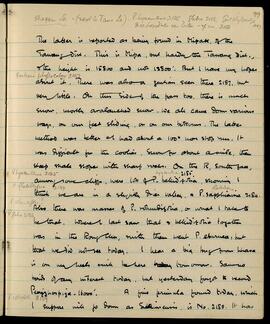
Shagam La - (next to Tame La). P. hyacinthina 2185, Glabra 2186, Gent. phyllocalyx 2187
Meconopsis var. lutea - of no. 2188

The latter is reported as being found in Mipak, of the Tawang dist. This is Mipa, but hardly the Tawang dist., the height is 15800 and not 13800'. But I have my hopes about it. There was also a gentian seen there 2187, but very little. On this side of the pass too, there is much snow, mostly avalanched snow. We all came down various ways, on our feet sliding, or on our bottoms. The latter method was better and had about a 100' non stop run. It was difficult for the coolies. Snow for about a mile, then steep shale slopes with sharp rocks. On the R, South face, among some cliffs, were lots of P. bellidifolia, showing I think we are in a slightly drier valley, a P. sapphirina 2184.

Also there were masses of P. rotundifolia, or what I take to be that. Where I last saw that & bellidifolia together was in the Rong Chu, with them went P. eburnea, but that we did not see today. I hear a big bug from Lhasa is on my heels and will be here tomorrow. Saw no birds of any interest today, but yesterday forgot to record Pyrrhocorax - 16000'. A fine primula found today, which I suppose will go down as sikkimensis, is No. 2189. It has...

LSH/1/1/9/1/61 · Part · 1949-06-01
Parte de The Ludlow & Sherriff Collection

SUMMARY:
After an early start the party reached Weitang, noting Primula bellidifolia in bud, P. crispata, and particularly P. calderiana in white, yellow, and hybrid forms, while other expected species were absent, possibly due to heavy yak grazing. News arrived that the Druk Locha (Bumthang Representative) from Lhasa is en route to Bumthang and expected shortly; the diarist recalls meeting him previously in Lhasa with Betty.

CONTENT:
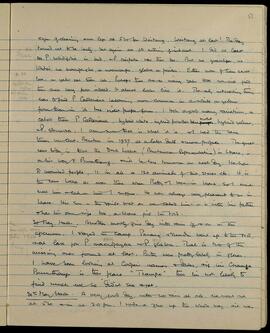
Signs of clearing and we left at 5:30 for Weitang. Weitang at last! The day turned out to be lovely, but again we saw nothing of interest. I did at last see P. bellidifolia in bud, and P. crispata was there too. But no gracilipes, no whitei, no macrophylla, or macrocarpa, glabra or puella. Either none of them exist here, or yaks eat them all. Perhaps there are so many yaks that we will find this area very poor indeed. It almost looks like it. The only interesting thing was to find P. Calderiana becoming more common in a white or yellow form than in its true violet purple form. I took a good many variations, and called them P. Calderiana, hybrid white, hybrid powder blue violet, hybrid yellow, and P. strumosa. I am sure that is what it is, and had the same times in central Bhutan in 1937 at a later date and more profuse. The great news today is that the Druk Locha (Bumthang Representative) in Lhasa, is on his way to Bumthang, will be here tomorrow or next day. He has 8 mounted people, 11 in all and 120 animals of kit, stores etc. It is the same Locha as was there when Betty and I were in Lhasa, so I must meet him and talk to him I suppose. He was always very pleasant to us in Lhasa. His son—the spoilt brat as we called