Showing 4 results

Archival description
4 results with digital objects Show results with digital objects
LSH/1/1/1/1/157 · Part · 1933-08-30 - 1933-08-31
Part of The Ludlow & Sherriff Collection

SUMMARY:
Diary notes the ascent of Bod La (properly Pö La), a rocky pass with an old Tibetan block house, followed by a descent past a lake to the Hamo Chu and the Hamo camping ground. Weather clears after snow over the pass; plant collections are listed. The next day is a halt at Hamo.

CONTENT:
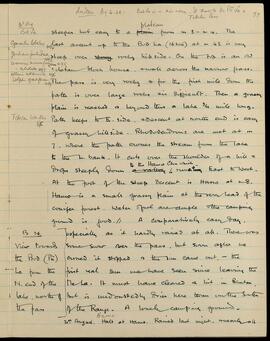
Ludlow Aug 30-28 - Bod La is a misnomer. It should be the Pö La // Tibetan Pass 77

30th Aug. plateau
Bod La steeper but easy to a plain from m 3 - m 4. The
Cyananthus lobatus 494 last ascent up to the Bod La (16300) at m 4 1/2 is very
Gentiana paludosa 493 steep over rocky hillside. On the top is an old
Arenaria musciformis 495
" ciliolata 497 Tibetan block house, built across the narrow pass.
Phlomis sikkimensis 496
Delphinium grandiflorum 499 The pass is very rocky & for the first mile down the
path is over large rocks and difficult. Then a grassy
plain is reached & beyond this a lake 3/4 mile long.
Tibetan warbler Path keeps to E. side, & descent at north end is easy
off grassy hillside. Rhododendrons are met at m
7, where the path crosses the stream from the lake
to the L. bank. It cuts over the shoulder of a hill &
drops steeply down to the Hamo Chu which runs East to West.
At the foot of the steep descent is HAMO at m 8.
Hamo is a small grassy plain at the very head of the
conifer forest. Water & fuel are ample & the camping
ground is good. // A comparatively easy day,
B 26. especially as it hardly rained at all. There was
View toward some snow over the pass, but soon after we
the Bod (Pö) crossed it stopped & the sun came out, - the
La from the first real sun we have seen since leaving the
N. end of the Me La. It must have cleared a bit in Bhutan,
lake, north of but is undoubtedly drier here than on the South
the pass of the Range. A lovely camping ground.
Hamo.
31st August. Halt at Hamo. Rained last night, nearly all
LSH/1/1/2/1/129 · Part · 1933-07-18
Part of The Ludlow & Sherriff Collection

SUMMARY:
Notes abundant Delphinium grandiflorum and a large Aconite, with Plumbago absent here but expected lower down. Describes travel from the Dzong across the Nyamjang Chu, along the right bank to the Tsuk Chu and up to the customs village of Tsuk, then ascending toward the Cha La. Mentions reports on the road to Shingbe and contrasts the friendliness of Dongkar people with the rudeness in Tsuna.

CONTENT:
63

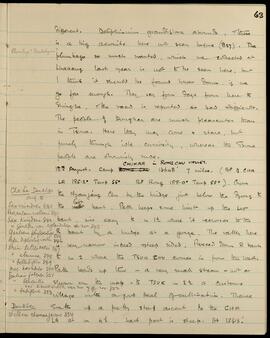
Different. Delphinium grandiflorum abounds, there is a big Aconite here not seen before (827). The Plumbago so much wanted, which we collected at Lhakang last year is not to be seen here, but I think it should be found lower down, if we go far enough. They say four days from here to Shingbe, the road is reported as bad & difficult. The people of Dongkar are much pleasanter than in Tsuna. Here they may come & stare, but purely through idle curiosity, whereas the Tsuna people are boorishly rude.

CHUKAR in RONG CHU VALLEY.
18th August. Camp 13648' 7 miles. (BP of CHA LA 185.2° Temp 55° BP Rong 188.0° Temp 55°). Cross the Nyamjang Chu by the bridge just below the Dzong to the left bank. Path keeps some height up the left bank, is easy to m 1 1/2 where it recrosses to the R bank by a bridge at a gorge. The valley here is very narrow indeed steep sided. Proceed down R bank to m 2 where the TSUK CHU comes in from the west. Path leads up this — a very small stream — not as shown on the map — to TSUK m 2 1/2 a customs village with a good deal of cultivation. Thence south up a pretty steep ascent to the CHA LA at

LSH/1/1/1/1/171 · Part · 1933-09-05
Part of The Ludlow & Sherriff Collection

SUMMARY:
Describes the daily casting of lots for distributing loads among villagers and observations of women using black plasters and face paste recommended by lamas. Notes foraging mushrooms and wild gooseberries for tarts, local beliefs about tomatoes, and carrying Delphinium grandiflorum plants to obtain seed.

CONTENT:
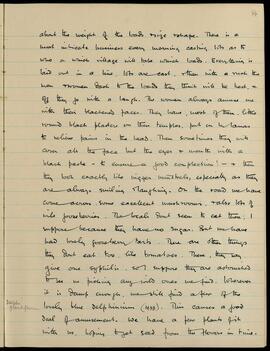
about the weight of the loads, size & shape. There is a most intricate business every morning casting lots as to who or which village will take which loads. Everything is laid out in a line, lots are cast, then with a rush the men & women dash to the loads they think will be best, & off they go with a laugh. The women always amuse me with their blackened faces. They have, most of them, little round black plasters on their temples, put on by lamas to relieve pains in the head. Then sometimes they will cover all the face but the eyes & mouth with a black paste - to ensure a good complexion! - & then they look exactly like nigger minstrels, especially as they are always smiling & laughing. On the road we have come across some excellent mushrooms, & also lots of wild gooseberries. The locals don't seem to eat them; I suppose because they have no sugar. But we have had lovely gooseberry tarts. There are other things they don't eat too, like tomatoes. These, they say, give one syphilis, so I suppose they are astonished to see us picking any wild ones we find. Wherever it is damp enough, we still find a few of the Delphin. grandiflorum lovely blue delphinium (499). This causes a good deal of amusement. We have a few plants of it with us, hoping to get seed from the flowers in time.

LSH/1/1/1/1/161 · Part · 1933-09-24
Part of The Ludlow & Sherriff Collection

SUMMARY:
Describes sheer cliffs and numerous waterfalls en route to Lhahang from Homa, including a measured 13.5-second drop, and a sudden shift from wet conifer jungle to a dry shrub zone near Homa Chu. Notes disagreement with White’s elevation, local threshing and fruit (peaches and gooseberries; no apricots), discreet collecting of birds and butterflies, and a request to the Jongpen to collect Delphinium seeds (499).

CONTENT:
79

B. 26.
Waterfalls on the way to Lhahang from Homa.

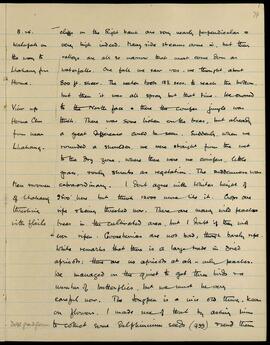
Cliffs on the right bank are very nearly perpendicular and very high indeed. Many side streams come in, but their valleys are all so narrow that most come down as waterfalls. One fall we saw was, we thought, about 800 ft. sheer. The water took 13 1/2 secs. to reach the bottom, but then it was all spray by that time. We crossed

View up Homa Chu from near Lhahang.

to the North face and there the conifer jungle was thick. There was some lichen on the trees, but already a great difference could be seen. Suddenly, when we rounded a shoulder, we were straight from the wet to the dry zone, where there were no conifers, little grass, and only shrubs as vegetation. The suddenness was extraordinary. I don't agree with White's height of

Men and women of Lhahang threshing with flails

9,500' here but think 12,000 more like it. Crops are ripe and being threshed now. There are many wild peach trees in the cultivated area, but I doubt if they will ever ripen. Gooseberries are not bad, though barely ripe. White remarks that there is a large trade in dried apricots: there are no apricots at all - only peaches. We managed on the quiet to get three birds and a number of butterflies, but we must be very careful now. The Jongpen is a nice old thing, keen on flowers. I made use of that by asking him

Delph. grandiflorum

to collect some Delphinium seeds (499) and send them