Showing 3 results

Archival description
3 results with digital objects Show results with digital objects
LSH/1/1/6/1/70 · Part · 1938-06-09
Part of The Ludlow & Sherriff Collection

SUMMARY:
Records a clutch of seven Crossoptilon harmani eggs near Langong at about 12,000', with the nest described as in moss and fir leaves. Notes abundant blackbirds and T. albocinctus near Langong, limited range of T. m. merula, and that Bill flushed a Monal on the south side of Chubumbu La; specimen 5522 Primula alpicola is noted.

CONTENT:
350

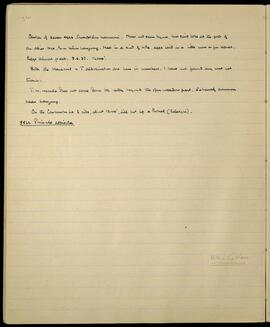
Clutch of seven eggs, Crossoptilon harmani. Nest not seen by me, but said to be at the foot of an abies tree, 1/2 m below Langong. Nest in a kind of hole, eggs laid in a little moss & fir leaves. Eggs almost fresh, 9.6.38. 12000'.

Both the blackbird & T. albocinctus are here in numbers. I have not found any nest yet though.

T. m. merula does not come down the valley beyond the open meadow part. Extremely common near Langong.

On the Chubumbu La S side, about 13000', Bill put up a Monal (Sclateri).

5522 Primula alpicola

Hitchin S's plans

LSH/1/1/6/1/60 · Part · 1938-05-28 - 1938-05-29
Part of The Ludlow & Sherriff Collection

SUMMARY:
Field notes from Langong list multiple Primula specimens with observations on flowering, variation, and a possible hybrid, and note nearby passes (Lo La/Shethang La and Chubumbu La) used in July–August. Bird nesting records for Crossoptilon harmani and Blood Pheasant at about 12,000 ft are dated 28–29 May 1938.

CONTENT:
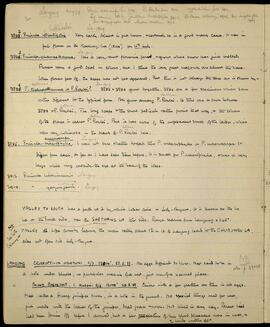
Langong - May 38. Primula macrocephala 3889, R. laudandum 3900, agglutinatum form 3902, Lil. nanum 3903, Gaultheria trichophylla 3905, Androsace delavayi 3906, Mec. integrifolia 3909, Trichophragma 3910, Lloydia serotina 3915.

30a Littledalei Langong

  1. Primula rotundifolia. Very early. Almost in full bloom, certainly so in a good many cases. It was in full flower on the Kashong La (15000') on 15th July.

  2. Primula chamaethauma. Has a very short flowering period, and grows where snow has just melted.
    Flowers vary a good deal in colour, but I think the very great majority are almost the same.
    When flowers fall off, the scape has not yet appeared. But this is not always the case as is shown by —

3894 P. chamaethauma x P. Roylei? 3893 and 3894 grow together. 3894 are a few specimens which seem rather different to the typical form. Both grow among P. Roylei. Is this one a cross between 3893 and P. Roylei? The long scape and the short pedicels rather point that way, and the colour of the flower is nearer P. Roylei. But it has none of the unpleasant smell of the latter, which was very noticeable in the plants of P. Roylei here.

  1. Primula macrophylla. I was not sure whether to call this P. macrophylla or P. macrocarpa. It differs from each, as far as I have seen them before. It is small for P. macrophylla, and has a very large white ring outside the eye at the base of the lobes.

  2. Primula sikkimensis. Langong.

  3. Primula yargonjensis. Langong.

VALLEY TO SOUTH has a path up it by which Lopas come in July - August. It is known as the Lo La on the South side, and the SHETHANG LA this side. Rough bearing from Langong = 145°.

VALLEY to Lopa country leaving the main valley about 1 1/2 m W. of Langong leads to the CHUBUMBU LA, also not open till July - August.

LANGONG CROSSOPTILON HARMANI. c/7. 12000'. 28.5.38. All eggs difficult to blow. Nest said to be in a hole under shrubs, no particular making of a nest, just use of a natural place.

BLOOD PHEASANT. I. kuseri. c/6 12000' 29.5.38. Chicks with a few feathers on them in all eggs. Nest under a dwarf juniper bush, in a hole in the ground. No special things used for nest, just made with the leaves of the juniper, dead grass and moss. Not lined in any way. Parent bird had been driven off before I arrived, but a few feathers of her blood pheasant were in nest, and 2 birds within 40 yds.

LSH/1/1/6/1/63 · Part · 1938-05-29
Part of The Ludlow & Sherriff Collection

SUMMARY:
At Langong, the diarist collected eggs of Crossoptilon harmani and Blood pheasant and described a demanding routine of writing up flowers and blowing eggs. On 31st May, halted at Langong due to continuous rain and, with Tsongpen, attempted to reach Shethang La toward the Sur La side but turned back in severe weather and deep snow, noting bearings, distance, and elevation, and shooting a target bird.

CONTENT:
Langong

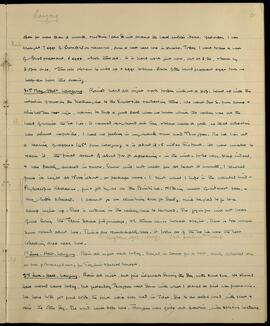
open for more than a month, and think I can do little to change the local people's ideas. Yesterday I was brought 7 eggs of Crossoptilon harmani, from a nest near here in shrubs. Today I went to see a nest of Blood pheasant, 6 eggs, took them all. It is hard work just now, out at 5.30, & back by 3.0pm or so, then all flowers to write up & eggs to blow. Each of the blood pheasant eggs took me half an hour this evening.

31st May Halt Langong. Rained hard all night & all today without a stop. Went up with the intention of crossing the Shethang La to the Sur La side & collecting there. We went due S. from camp & climbed far too high, having to drop a good deal when we knew which the valley was at the head of which the La lies. It rained very hard all day & blew half a gale, so that collecting was almost impossible. I had no feeling in my hands nor had Tsongpen. The La lies at a bearing of approx 145° from Langong & is about 4-5 miles distant. We were unable to reach it, the final ascent of about 700 ft appearing - in the mist - to be very steep indeed, & was deeply covered in snow. Snow will not melt for at least a month. I should guess its height at 15000' about, or perhaps more. I shot what I hope is the wanted bird - Phyll