
Showing 2 results

Archival description
2 results with digital objects Show results with digital objects
LSH/1/1/5/1/56 · Part · 1933-05-09
Part of The Ludlow & Sherriff Collection

SUMMARY:
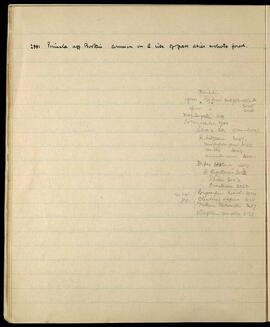
Page lists plant taxa with collection numbers, including Primula aff. boothii, Berberis subpteroclada sp. nov., and several Rhododendron species. Locations noted include Chandubi and Lamu La at 9500-12500 ft.

CONTENT:
R. hodgsonii 3047
campylocarpum 3048
smithii 3049
cinnabarinum 3050
Daphne bholua 3051
P. flagellaris 3052
whitei 3053
bracteosa 3054
See next page Bryocarpum himalaicum 3055
Clintonia alpina 3056
Trillium tschonoskii 3057
Streptopus simplex 3138

I will format it cleanly.

2991 Primula aff. boothii common on E side of open Abies-rhodo forest.

Chandubi
sp. nov. Berberis subpteroclada
sp. nov. " " 3045
" " " 3046
Mag. campbellii 3139
Cornus capitata 3140
Lamu La 9500-12500 ft
R. hodgsonii 3047
campylocarpum 3048
smithii 304

LSH/1/1/9/1/141 · Part · 1933-09-01
Part of The Ludlow & Sherriff Collection

SUMMARY:
Notes on Primulas from Karponang grown at 4500', highlighting unusual rose coloration, leaf variation, and difficulty matching key characters; possible identification as elongata is questioned. Field observations report local abundance up to about 8500' near Sergong La, and above 12500' white forms of P. calderiana and natural hybrids become more common than the deep violet true P. calderiana.

CONTENT:
133

Primulas from Karponang in our garden at 4500' have grown leaves like bracteosa. Due to low altitude?
Never seen the rich rose colour before.

Locally quite common.

Eventually found very common, highest altitude about 8500' near Sergong La.

This does not answer the key 'tube 3 times as long as calyx'. It is nothing like it.

Might be elongata, but leaves are pretty rotund.

Not common.
This seemed to be the same as 18946, but leaf varies. Probably both are the same thing.

A gathering with very few old capsules even some old seed.
These three are all natural hybrids. As one gets above 12500', so white forms of P. Calderiana become more & more common until at 13000 & a little above - just at the top edge of the abies zone - these hybrids become much more common than the true P. Calderiana, which here is deep violet. What are the parents?
P.T.O.