Showing 12 results

Archival description
12 results with digital objects Show results with digital objects
LSH/1/1/3/3/135 · Part · 1933-03-08
Part of The Ludlow & Sherriff Collection

SUMMARY:
After a sleepless night the party set off before dawn and crossed the Le La in mist with fresh snow. They observed numerous Primula species, dense rhododendrons, Abies, and a Corydalis, noting the area would be spectacular later in the season.

CONTENT:
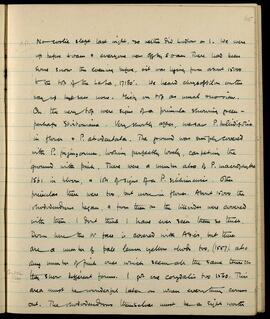
No coolie slept last night, so neither did Ludlow or I. We were up before 4.0 am & everyone was off by 5.0 am. There had been some snow the evening before, and it was lying from about 15000 to the top of the Le La, 17180'. We heard chrysochlora on the way up but saw none. Misty on top as usual no view.

On the very top were signs of a Primula showing green - perhaps Stirtoniana. Very shortly after, we saw P. bellidifolia in flower & P. atrodentata. The ground was simply covered with P. pryingorum, looking perfectly lovely, carpeting the ground with pink. There were a number also of P. macrophylla 1561 in bloom, & lots of signs of a P. sikkimensis. Other primulas there were too, but none in flower. About 15000 the rhododendrons began, & from then on the hillsides were covered with them. I don't think I have ever seen them so thick.

Down here the W face is covered with Abies, but there are a number of pale lemon yellow rhodos too, (1557). Also any number of pink ones which seem all the same though they show different forms. I got one Corydalis too 1560. This area must be wonderful later on when everything comes out. The rhododendrons themselves must be a sight worth
LSH/1/1/3/3/41 · Part · 1934-03-10
Part of The Ludlow & Sherriff Collection

SUMMARY:
The diarist slowly ascends to Choking La around midday, noting magnolias and rhododendrons, but fewer flowers than expected. Tenduh finds Primula specimens (1166 and 1167), likely including P. boothii, with both forms later seen growing together near snow patches; compass bearings include one toward Mera.

CONTENT:
18

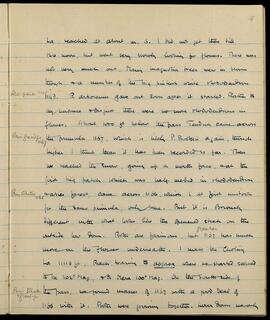
La reached at about m. 6. I did not get there till 12.0 noon, but went very slowly looking for flowers. There was not very much out. Many magnolia trees were in bloom though, and a number of the big pinkish white rhododendron [Rho. grande 1148?] 1148. Rhododendron arboreum gave out soon after it started. Rather to my surprise and disgust there were no more rhododendrons in flower. About 1000 ft below the pass Tenduh came across [Primula gracilipes 1167] the primula 1167, which is likely P. boothii again, though higher I think than it has been recorded so far. Then we reached the snow, going up a north face, and at the first big patch which was half melted in rhododendron [Primula white 1166] and Abies forest, came across 1166, which I at first mistook for the same primula, only blue. But it is obviously different, with what looks like the opened sheath on the outside low down. Both are farinose, but 1167 has much more on the flower underneath. I make the Choking La 11116 ft. Back bearing to approximately where we started seemed to be 302° Mag, and to Mera 100° Mag. On the south side of [Primula white of gracilipes] the pass, we found masses of 1167 with a good deal of 1166 with it. Both were growing together. Lower down we only

LSH/1/1/7/1/3 · Part · 1940-05-24
Part of The Ludlow & Sherriff Collection

SUMMARY:
The diarist describes a difficult crossing of the Chubumbu La in mist, rain, and snow, followed by notable finds of Primula species and hybrids on the southern slopes. They also note a later visit to the Chimi La, where melting snow revealed several bodies of Lhopas from the previous autumn.

CONTENT:
In profusion had just been uncovered by melting snow, and seed capsules were still full of good seed. On the edge of the Abies forest, Omphalogramma minus was seen, while on very damp swampy slopes, O. brachysiphon was again found. As before, the flowers of this were mostly 5-partite, though a small percentage had six segments. On June 7th, I crossed the Chubumbu La (13,900'), the last 1,000 ft of which was deep in snow on the North side. The South face, however, was clear except for piles of avalanche snow 1,000' down the very steep slopes. It was a beastly day of driving mist and rain, over cold conditions which we had on every single Himalayan Pass this year, with the solitary exception of one fine morning on the Ka La in April. However, I was soon compensated for this. We took a last breather behind a rock on the summit before plunging down the southern slopes, and a compass bearing to keep us right as there was no path visible. Almost at once, we saw a mass of golden yellow Primulas. This proved to be the same as found south of the Do La in Ap at 11,500'; but here it was with proper habitat. This has now been named P. chionogenes. With it was also another Petiolarid Primula - P. tsariensis, and occasionally these two had hybridized and produced a queer but pretty Primula, the colour of which was about halfway between golden yellow and blue-violet. These covered the steep, slippery slopes for 500 ft, where their place was taken by equally large numbers of P. elizabethae, one of the most magnificent of Primulas. Among other Primulas found here were P. pudibunda, P. firma, P. normandiana, P. aff. clutterbuckii (3937), P. dickieana var. pantlingii, and P. barbatula.

The next Pass visited was only a few miles further East - the Chimi La, of 15,000'. Here again, snow lay deep on the North face, the last 1,000' of the N face, but it was melting fast, and we came across several bodies of Lhopas who had been overcome by bad weather the previous Autumn. I was surprised to find that

LSH/1/1/7/1/21 · Part · 1940-04-22
Part of The Ludlow & Sherriff Collection

SUMMARY:
After a snowfall delay, the party crossed the Lo La on April 24 and descended the steep south side into the Rhododendron–Abies forest. Along the Chudi Chu they observed numerous Rhododendron and Primula species, including the new Primula P. chionogenes and another unnamed Primula on an inaccessible cliff.

CONTENT:
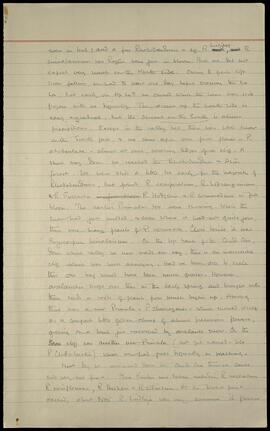
were in bud, and a few Rhododendrons - e.g. R. hirtipes, and R. cinnabarinum var. roylei were just in bloom. But we did not expect very much on the North side. Owing to fresh soft snow falling, we had to wait one day before crossing the Lo La, but early on April 24th we crossed while the snow was still frozen with no difficulty. The ascent up the North side is easy and gradual, but the descent on the South is almost precipitous. Except in the valley bed, there was little snow on the South face, and we came upon our first flower - P. atrodentata - almost at once, covering ledges of a cliff. A short way down we reached the Rhododendron - Abies forest. We were still a little too early for the majority of Rhododendrons, but found R. exasperatum, R. lopsangianum, R. forrestii, R. hodgsonii, and R. commodum in full bloom. The earlier Primulas too were showing. Where the snow had just melted, and even where it had not quite gone, there were many plants of P. vernicosa. Close beside it was Bryocarpum himalaicum. On the left bank of the Chudi Chu, down which valley we now made our way, there is an inaccessible cliff which was most annoying. Had we been able to scale this our bag would have been much greater. However, avalanches swept over this in the early spring and brought with them seeds or roots of plants from much higher up. Among these was a new Primula - P. chionogenes - which showed itself as a compact little golden clump of almost precocious flowers, growing on a bank just uncovered by avalanche snow. On the cliff was another new Primula (not yet named - like P. clutterbuckii) which we had great difficulty in reaching.

Next day we continued down the Chudi Chu through dense and very wet forest. More Rhodos were taken, including R. uvariifolium, R. neriiflorum, R. hookeri and R. ciliatum. At the lowest point reached, about 8500', R. lindleyi was very common in flower.

LSH/1/1/5/1/73 · Part · 1937-05-22
Part of The Ludlow & Sherriff Collection

SUMMARY:
The diarist descends through an Abies forest after passing a small flat, noting masses of Primula roylei in clearings and Primula whitei in damp forest, with several rhododendrons including a pale mauve form. After brief rain the weather clears, and plans are made to attempt reaching the holy lakes the next day, though climbing peaks is deemed impossible.

CONTENT:
A small open flat is passed at 1 1/2. Then the forest of Abies is entered and the path wanders down this by an easy descent to m 3, where a valley enters from the south. A little beyond this is a clearing where a small camp can be made.

Several rhododendrons were seen on the way down, but most were not in full bloom yet. Primula roylei is in masses wherever there is a clearing, while damp spots in the forest have Primula whitei growing to perfection, dotted about all over the place, on mossy slopes. Rain started at 1:00 pm. There are no built-up shelters beyond yesterday's camp. The coolies hoped I might stay there for a day. They can reach the holy lakes in one day from there, and back, with difficulty, starting about 3:00 or 4:00 am. We will go up tomorrow if the weather is good and see how far we can get, but any hope of climbing the peaks is out of the question.

The prettiest rhododendrons today were Rhododendron fulgens (?) 3090 and a pale mauve one 3087 which looks very pretty indeed when fully out, as I saw it in a side valley below us. The rain did not last for long and now it is again clear at 4:30 pm. I do hope we have a good day tomorrow to see the lakes, though I hardly expect to find many flowers.

LSH/1/1/5/1/97 · Part · 1928-06-02
Part of The Ludlow & Sherriff Collection

SUMMARY:
The diarist ascends from Gonghe Gompa to the Lao La, crosses the pass, and collects a new Primula (P. geraniifolia, No. 3173) and notes Androsace geraniifolia (3175) in abies mixed forest. On 3rd June they halt at Lao La amid rain and mist, visit a cliff-top monastery, proceed to Jigche La, descend to Longtegang, join the main east–west road to the Pele La, and continue along a rough contouring path.

CONTENT:
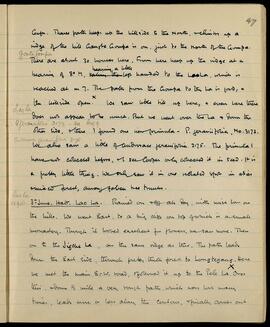
Gompa. Thence path keeps up the hillside to the North, climbs up a ridge of the hill Gonghe Gompa is on, just to the north of the Gompa.

There are about 30 houses here. From here keep up the ridge at a bearing of 8° M, bearing a little to the Lao La, which is reached at m 7. The path from the Gompa to the La is good, and the hillside open. We saw little till up here, and even here there does not appear to be much. But we went over the La and down the other side, where I found one new Primula - P. geraniifolia, No. 3173.

We also saw a little of Androsace geraniifolia 3175. The primula I have not collected before, and I see Cooper only collected it in seed. It is a pretty little thing. We only saw it in one isolated spot in abies mixed forest, among fallen tree trunks.

3rd June. Halt. Lao La. Rained on and off all day, with mist low on the hills. We went East, to a big cliff on top of which is a small monastery. Though it looked excellent for flowers, we saw none. Then on to the Jigche La, on the same ridge as this. The path leads down the East side, through pretty thick forest to Longtegang. Here we met the main E.-W. road, and followed it up to the Pele La. Over this, and down 1/2 mile a very rough path, which was lost many times, leads more or less along the contours, and finally comes out.

LSH/1/1/5/1/59 · Part · 1933-05-09
Part of The Ludlow & Sherriff Collection

SUMMARY:
The diarist describes local opposition to ascending Dungshigon due to fears of hail damaging crops, noting that Pintso mentioned the Tsari pilgrimage to reassure them. On 15 May at Phobshikha, after variable weather, the party explored a cliff and mountain, recording Primula strumosa (3060), Rhododendron triflorum (3061), masses of Primula winteri (3053), and several rhododendron species.

CONTENT:
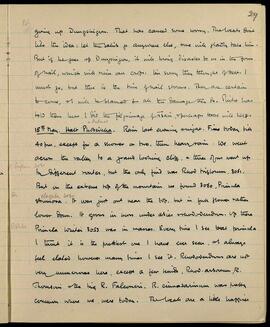
going up Dungshigon. That has caused some worry. The locals don't like the idea: let the Sahib go anywhere else, some will gladly take him. But if he goes up Dungshigon, it will bring disaster to us in the form of hail, which will ruin our crops. I'm sorry they thought of that. I must go, but this is the time of hail storms. They are certain to come, and I will be blamed for all the damage they do. Pintso has told them how I did the pilgrimage of Tsari, perhaps that will help.

15th May. Halt Phobshikha. Rain last evening and night. Fine today till 4:00 pm, except for a shower or two, then heavy rain. We went across the valley to a grand looking cliff, and three of us went up by different routes, but the only find was Rhododendron triflorum, 3061.

But on the extreme top of the mountain we found 3060, Primula strumosa. It was just out near the top, but in full flower rather lower down. It grows in moss under Abies and Rhododendron. Up there Primula winteri 3053 was in masses. Every time I see that Primula I think it is the prettiest one I have ever seen, and I always feel elated however many times I see it. Rhododendrons are not very numerous here, except a few kinds, Rhododendron arboreum, R. thomsonii and the big R. falconeri.

LSH/1/1/6/1/149 · Part · 1938-10-16
Part of The Ludlow & Sherriff Collection

SUMMARY:
The diarist records persistent wet and snowy weather, local accounts of seasonal precipitation, and difficulties drying seeds, which are laid out on blotting paper. On a halt at Lanjong, they pack numerous seed lots, note additional collections by Taylor, confirm transport with the gyampon, and mention snow on nearby hills and the expected arrival of the Kyimdong Dzongpen, suggesting the Pa La route remains passable.

CONTENT:
76

Weather NB
One man who has been, says we do not go to Tso Kar, although a possible path does lead that way. It seems too much to hope for fine weather, as I have seldom seen the weather so set wet looking. It snowed all day where we were, but wet snow, which did not lie much during the day. I have always thought the monsoon ended quite suddenly up here on 18th Oct. But that cannot be so in this longitude. This is the 24th of the 8th month, locals say quite definitely that during the 8th & 9th months they expect a lot of rain here, & snow up the mountains. In the 10th month, they say, it does not snow much, but they have their really heavy falls in the 11th & 12th, when everything is shut up. They retire to their huts then, remain in them for four months, seldom even going out to visit their next door neighbors 50-100 yds away. All the animals too are shut up in the huts, & fed on the dried grass the locals are now busy storing. It is a great problem how to dry our seeds this weather. I have most laid out on blotting paper, which is changed & dried as often as possible, & the seeds moved about on it. If out of the capsule they dry then pretty quickly, but rhododendrons take a very long time.

19th October. Halt. Lanjong. Fine & bright till 2.0pm: then heavy cold showers & snow chiefly up the Mipitun Pa La way. Stayed in camp. Lovely & warm all morning, & the sun allowed me to get nearly all my seeds packed up. Altogether I have this year 316 seed lots, which must mean about 360 or 370 packets, while Taylor must have an extra 150-200, so we are doing well. I hope for another 50 or so on the way home. I have asked the gyampon over & over again about tomorrow's transport, & he assures me still that all is ready, & we should take but three days. This evening it is again overcast, & a good deal of rain about, but much colder, so we hope for fine weather again. We have not collected in the valley due N. of Lanjong village, but there was nothing to be expected there, except some more P. rotundifolia seed. And it seems more important for me to get out of this valley as soon as possible. Snow this morning was well down into the abies forest, & appeared very thick high up the hills. The Kyimdong Dzongpen is expected shortly, so presumably the Pa La route is kept open, or being a good path, is passable in deep snow.

Seeds NB

LSH/1/1/3/3/47 · Part · 1934-03-10
Part of The Ludlow & Sherriff Collection

SUMMARY:
The diarist describes finding an enormous Abies at Munde La, notes scarce birds with several sightings and a couple shot, and enjoys a cloudless view of the northern snows. Due to unreliable maps, he plans to ascend a high point on the ridge north of Mera, and mentions local information about the Mera chu.

CONTENT:
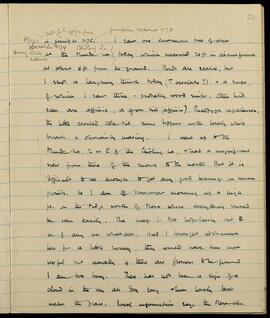
Abies and juniper 1175. I saw one enormous tree of Abies today at the Munde La, which measured 20 ft in circumference at about 5 ft from the ground. Birds are scarce, but I shot a laughing thrush today (T. ocellata?) - a snipe, of which I saw three - probably wood snipe. Other birds seen are affinis, a grosbeak (affinis), Pnoepyga nepalensis, the little crested coal tit, some dippers with lovely white breasts, and obviously mating.

I went up to the Munde La, 2 miles east of the Chöling La, and had a magnificent view from there of the snows to the north. But it is difficult to see enough to get any good bearings on known points. So I am off tomorrow morning up a high point on the ridge north of Mera where everything should be seen easily. The map is too hopelessly out to be of any use whatever. Had I brought instruments here for a little survey, they would have been most useful, but usually if there are flowers to be found I am too busy. There has not been a sign of a cloud in the sky all day long. How lovely that makes the place. Local information says the Mera chu

LSH/1/1/5/1/106 · Part · 1937-06-07
Part of The Ludlow & Sherriff Collection

SUMMARY:
Notes compare Primula specimens: No. 2305, likely a variety of P. griffithii from 14,000–15,000 ft, resembling No. 21621 from Chikchar, Tsari (May 1936), with early, low, non-whorled flowering on open grassy slopes. No. 3227 is identified as P. hopeana, noted as unusually early; Cooper collected it on 20th June and 1st July, with later flowering previously observed in Tsari and in Tibet.

CONTENT:
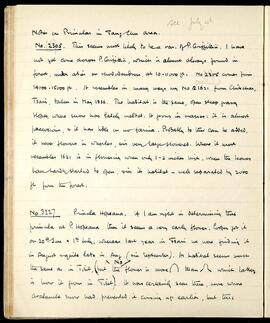
Notes on Primulas in Tang Chu area.

No. 2305. This seems most likely to be a var. of P. Griffithii. I have not yet come across P. Griffithii, which is almost always found in forest, under Abies or Rhododendron, at 10-11,000 ft. No. 2305 comes from 14,000-15,000 ft. It resembles in many ways my No. 21621 from Chikchar, Tsari, taken in May 1936. The habitat is the same, open steep grassy slopes, where snow has lately melted. It grows in masses: it is almost precocious, and it has little or no farina. Probably to this can be added, it never flowers in whorls, or very large flowered. Where it most resembles 1621 is in flowering when only 1-2 inches high, when the leaves have hardly started to open, and in its habitat - well separated by 2,000 ft from the forest.

No. 3227 Primula Hopeana. If I am right in determining this primula as P. Hopeana, then it seems a very early flower. Cooper got it on 20th June and 1st July, whereas last year in Tsari we were finding it in August and quite late in Aug (or September). Its habitat seems much the same as in Tibet, (but the flower is more [narrowly bell-shaped] than [widely bell-shaped] which latter is how it grows in Tibet). It was certainly seen there, here where avalanche snow had prevented it coming up earlier, but this