
Showing 3 results

Archival description
3 results with digital objects Show results with digital objects
LSH/1/1/6/1/11 · Part · 1933-03-02
Part of The Ludlow & Sherriff Collection

SUMMARY:
The diarist records a cable from Taylor about plans to arrive in Calcutta on April 2, then details travel from Kala to Gyantse with strong winds and dust storms, wildlife sightings and shooting, and use of the wireless. Mail reports from Wright Smith on the 1937 primulas, and upon reaching Gyantse they call on Richardson, Dr Morgan, Colbourne, Hudson, and receive a friendly visit from Tendong.

CONTENT:
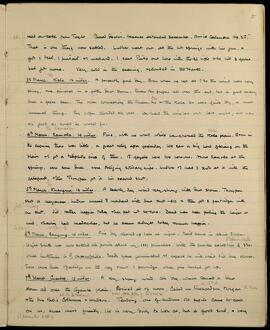
NB read a cable from Taylor "Passed Doctor. Absence extended December. Arrive Calcutta April 2nd."
That is one thing now settled. Ludlow went out at the hot springs with his gun, and got 1 teal, 1 pintail and 1 mallard. I sent Punso out here with the .22 rifle and he hit 3 geese but got none. Very cold in the evening, clouded in the North.

3rd March. To Kala. 12 miles. A perfectly fine day. Even when we left at 7:30 the wind was very strong, and we finished in a filthy dust storm. Rham tso frozen all over this end, but a good many duck and geese seen. The river connecting the Rham tso and the Kala tso was quite dry, a most unusual thing. By 1:00 pm clouded all over. We had the wireless out last night, and it was as good as could be wished for.

4th March. To Samoda. 14 miles. Fine, with no wind while we crossed the Kala plain. Even in the evening there was little, a great relief after yesterday. We saw a big herd of kiang on the plain and got a telephoto cine of them. 18 gazelle were too nervous. Above Samoda at the springs were some duck, and one obliging solitary snipe. Ludlow and I had 3 shots at it with the catapult, then Tsompen got it on his second shot.

5th March. To Khangma. 14 miles. A beastly day, wind very strong, with dust storm. Tsompen shot a merganser, Ludlow missed 8 mallard with dust shot .410 and then got 3 partridges with one shot. Jill (dog) rather happier today and her feet not so sore. David has been feeling the height and wind, and having bad headaches, but he seems alright today and much happier.

6th March. Saugong. 14 miles. Fine day, cleared up late at night. Mail came in about 8:00 pm. Wright Smith has now settled all points about my 1937 primulas, with the possible exception of 3301 which he thinks is P. chasmophila. Seeds have germinated, and I expect he will wait till they flower. Saw more duck and partridge on the way and shot 1 partridge, when five burhel got up.

7th March. Gyantse. 15 miles. A very strong wind all day, which caused a dust storm all over the Gyantse plain. Arrived at 12 noon. Called on Richardson, Morgan the doctor (16 B.T.A.) and the two B.O.'s (O.C. 16th Detachment) Colbourne and Hudson. Tendong, now Jongpen of Gyantse, one of Ludlow's old pupils came to call on us, and was most friendly. He is very dirty to look at, but a good soul, and very...
LSH/1/1/6/1/55 · Part · 1936-05-13 - 1936-05-16
Part of The Ludlow & Sherriff Collection

SUMMARY:
Entries from camps east of Lo La describe rough roads, changing weather, and botanical collecting focused on rhododendrons and primulas. Ludlow shot two male monal while coolies snared a female, and the diarist explored with Tsongpen and Tsering before moving to Singo Samba.

CONTENT:
Lo La
27

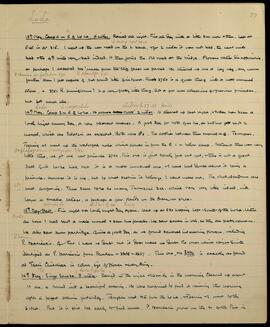
13th May. Camp 4 m E of Lo La. 6 miles. Rained all night. Fine all day with a little sun now and then. Left at 5.45, in at 3.15. I went up the new road on the L bank (L bank = right bank), and for 2 miles it was not bad, the next mile bad and the 4th mile very bad indeed. It then joins the old road at the bridge. Flowers rather disappointing, or perhaps I expected too much from the cliff faces we passed. We climbed up one a long way, very much further than I felt capable of, but found little of interest. Rhododendron 3750 is a queer thing with a most unusual colour, and 3751 R. primuliflorum? is a very pretty little thing. Got a few more collections of previous primulas, but not much else.

14th May. Camp 2 m E of Lo La. At approx 12000' 2 miles. It cleared up last night, and today has been a lovely bright sunny day, a very pleasant change. A good day for both of us too, as Ludlow shot 2 monal, which are Sclateri as expected. Both were males. The coolies between them snared a female. Tsongpen, Tsering and I went up the waterfall nullah which comes in from the E 1 m below camp. Although there was very little there, we got one new primula 3762. This one is just barely fully out yet, and there is not a great deal of it to be had, but it is a most unusual one, and I have had doubts about it being a primula. However it is one, but to what section it belongs, I can't make out. The rhododendrons are most confusing. There seem to be so many Thomsonii Ser. which vary very little indeed, with larger or smaller calyces, or perhaps a few glands on the ovary or style.

15th May Halt. Fine night and a lovely bright day again. Went up at 5.30 keeping high - South - of the Lo La. Within an hour I had shot a male monal and seen two females. We saw seven in all, so they are pretty common. We also saw snow partridge. Quite a good day, as we found several interesting flowers, including P. tsariensis. Of this I have no doubt but it does make me doubt the ones which Wright Smith identified as P. bariensis from Bhutan - 3366 - 3367. This one, No 3779, is exactly as found at Tsari Chikchar in colour, size of flower and everything.

16th May. Singo Samba. 8 miles. Rained in the night and early in the morning. Cleared up about 10 am, and turned into a beautiful evening. We were surprised to find it raining this morning after a perfect evening yesterday. Tsongpen went NE from the Lo La, and Tsering and I went to the S West. But it is still too early to find much. P. tsariensis grows on the N of the Pass in...

LSH/1/1/5/1/161 · Part · 1937-07-14
Part of The Ludlow & Sherriff Collection

SUMMARY:
Notes describe abundant white Primula (P. tsariensis alba) on south- and east-facing screes, a steep shortcut descent by gully, and the winding down of high-altitude collecting. The writer lists misses (P. dryadifolia, P. Griffithii) and counts about 40 Primula species, including many not seen before, expressing satisfaction with work on the Black Mt.

CONTENT:
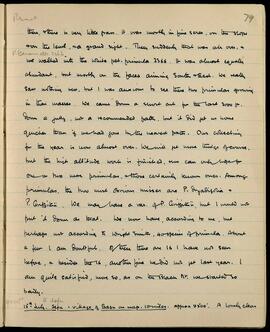
Primula 79

there, there is very little fern. It was mostly in fine screes, on the slope
above the level, a grand sight. Then suddenly that was all over, and
P. tsariensis alba 3366
we walked into the white pet. primula 3366. It was almost equally
abundant, but mostly on the faces aiming South and East. We really
saw nothing new, but I was anxious to see these two primulas growing
in their masses. We came down a short cut for the last 3000 ft.
down a gully, not a recommended path, but it did get us home
quicker than if we had gone by the nearest path. Our collecting
for the year is now almost over. We will get more things of course,
but the high altitude work is finished, one can only hope for
one or two more primulas, and those certainly known ones. Among
primulas, the two most obvious misses are P. dryadifolia and
P. Griffithii. We may have a var. of P. Griffithii, but I would not
put it down as that. We now have, according to me, but
perhaps not according to Wright Smith, 40 species of primula. About
a few I am doubtful. Of these there are 16 I have not seen
before, and besides the 16, another five we did not get last year. I
am quite satisfied, more so, as on the Black Mt.