Showing 52 results

Archival description
52 results with digital objects Show results with digital objects
LSH/1/1/9/1/49 · Part · 1933-05-07
Part of The Ludlow & Sherriff Collection

SUMMARY:
After a 10-mile march to Menjisi in windy weather, the writer receives letters from Betty via Trinley and notes serious delays to H.H.'s stores sent from Lhuntse, affecting travel plans to Bumthang. Kapo is treating many syphilis patients with limited drugs, while reports mention Tshering doing well, Hicks being tired, the finding of P. Normaniana, a planned route via Ungar and Pimi, concerns from Tobgye about the Treaty and the Maharaj Kumar, and news from Norman regarding a problematic sale to Mintri.

CONTENT:
15th May Menjisi. 10 miles. Wet in the night, but fine today locally and with a very strong wind. I had a long talk with Kapo yesterday, who came in the morning and again for dinner. He gave me a letter from Betty, brought by Wangmo's Trinley. Incidentally H.H.'s large box of stores, sent off from Lhuntse on 4th to Betty, had only got 1 day's march from Lhuntse by May 11th. I don't know what had happened. That has held up other things too, as H.H.'s man cannot return to Bumthang till he has an answer from Betty. Kapo seems to be busy with his syphilis patients, who are a great many. But he finds difficulty in keeping them in Lhuntse. Also he cannot get other drugs for H.H. for other diseases. I gave him what I could spare. It was grand to hear again from Betty, though her letter was written some time ago. They seem to have done fairly well, and have also found P. Normaniana. Tshering doing well, and Hicks seemingly tired. I hope he can stand it all. We left at 5:15 this morning and got in about 10:30. This is a much better division of the marches - Lhuntse, Menjisi - Ungar - Pimi, and I must tell Betty to do the same. We passed another dak today and took ours out on Betty's unopened. This was a bigger one and was sent from K'pong on 29th April. I had several letters from Tobgye, worried about the Treaty and also the Maharaj Kumar's behaviour to him. He has not been at all kind, and his behaviour towards Tobgye is disgusting and disgraceful. I hope now that he will not get Kaysang, who is far too good for him. Norman's letter says that he is off, and he also thinks there may be difficulty about selling Crocket to Mintri, who is a slimy individual. Among other things sent to me is a will which I witnessed many years ago. It is sent in original, and I have to
LSH/1/1/6/1/163 · Part · 1933-11-13
Part of The Ludlow & Sherriff Collection

SUMMARY:
The diarist travels from Changphu to Chumkarah and on to Pinshogong and Hach, crossing the Bhutan–Tibet boundary near Jangphu, aided by mules from the Trashigang Dzongpon. They collect more Albizzia sherriffii seeds, note fruit sent by the Dzongpon, observe otters, visit a new Dzong, and receive a warm welcome from Dzongpon Dopola while mail arrangements via Basu Pradhan remain unresolved. Weather is noted as improving after rain, with hot conditions in the valley.

CONTENT:
To Changphu
16th November, JAMGPHU. Rain yesterday evening and last night. Fine and bright today. Changed transport twice, but everything ready for us. It is a long climb up from the bridge to Jangphu, the last 2 miles being more or less level. Three mules were sent to meet us, but only for the level stretch, so we all had a good sweat. Hills much drier here, being barer and more cultivated. The boundary of Bhutan with Tibet is crossed 300 yards W of Jangphu — a small very insignificant little valley. Oranges I'm glad to say are ripe, or near enough so to be eaten, and are very good after a climb like today's.

To Chumkarah
17th November, Chumkarah. Clouded and a little rain at night: fine all day. We are getting almost too civilized now. People turn out to meet us, tea is produced by the roadside, and camping grounds are prepared. I would rather just be allowed to wander along. However it is nice to have the Trashigang Dzongpon's mules here to help us on our way. I have hardly ridden at all since we left Kalimpong in Feb. — only on 3 or 4 days for a short while. But here it is hot, and a mule will be very nice to have. Changed transport once again today.

I could not find the original tree of Albizzia Sherriffii, although I recognized the place, but took more seeds again today, so surely should have it by now. The Dzongpon sent some pears, bananas and oranges, which are just what the doctor ordered for this hot valley. I hear that there is still no mail in Trashigang, so again our arrangements have gone wrong, though why I cannot think. I wrote to PM Kumarikata Basu Pradhan in August, and Tobgye has forwarded our letters to the latter.

To Trashigong Dzong
18th November, Pinshogong. Fine and very hot. On the way, I spotted three otters having a great time in the river, always keeping together, and hunting for a few minutes, then joining up on to the hot sandy beach and rolling and playing about. Owing to a cliff I could not get very close, but took a tele-cine picture of them. Went and saw the new Dzong, which is a fine building and seems well designed. Then came on here about 3.0 pm, for a very warm welcome from the Dzongpon Dopola. Rained pretty hard at night.

19th November, Hach. Fine all day. Stayed in camp, and talked to the Dzongpon. He says the same

LSH/1/1/6/1/3 · Part · 1938-02-08 - 1938-02-24
Part of The Ludlow & Sherriff Collection

SUMMARY:
Notes 1938 expedition plans for the Yilung Chu–Gyala area and records February travel from Mansehra via Rawalpindi to Calcutta and Kalimpong, dealing with delayed kit and shipping. Mentions visits with the Potters and Bakewells, calling Taylor and Mary, staying with Tobgye, a trip to Gangtok to see Gould, and preparations to proceed to Pedong.

CONTENT:
In 1936 L.D. collected in the upper reaches of the Subansiri. In 1938 they decided to collect in the drainage basin for the north of Molo on the Yilung Chu down to Gyala at the entrance to the gorge. (journey to last for 10 months). East of the area covered in 1936 — between Long. 94° and the bend of the Tsangpo — is contained in the Tsela District of Kongbo Takpo.

1938.

Feb. 8th. Mansehra The last two days have been cold with a good deal of snow at Uri. So we decided to leave today about 11:30, and go as far as possible. Actually the road was not really bad, and there was no snow beyond Uri. Primula inayatii was in flower at the cliff beyond Uri. At Domel we heard the road between Domel and Kohala was shut, so we went by the Abbottabad road and reached Mansehra very easily by 5:45 pm. Bungalow very clean and nice.

Feb. 9th. Rawalpindi. Left at 8:30, and got in in good style just after 11:00. The kit servants reached Pindi by mail lorry at 3:20 pm. Spent most of the day with the Potters and Bakewells.

Feb. 12th. Calcutta Left Pindi by the Frontier Mail on 10th at 2:10 pm and reached here at 8:00 am today. The first blow was to find that our kit had not arrived on our train. We then went to Cox and Kings and heard that the B.M. boxes had not been taken off the 'Domala' and that all the seven cases of whisky and rum had not been sent on from Bombay. Then we found the Bank all shut, and a good many shops too. In the evening we went to Mrs. Graham's house and telephoned to Taylor and Mary — six minutes to each, which meant a bill of Rs 160/-.

Feb. 13th. Kalimpong. Arrived here this morning by 10:30. It was nice, as always, to see Tobgye again, and we are staying in their house with them.

Feb. 24th. to Pedong. 10 miles We can now be said to have started. While with Tobgye we went to Gangtok, spent two nights with Gould. It was in a way rather a waste of time, as Gould is not a bit fit, and could not see us for very long. After that all our time was spent in packing and checking kit, leaving stuff for Taylor and making arrangements for his following us on. Tobgye had sent on some of our kit, on two different

LSH/1/1/1/1/77 · Part · 1933-07-01
Part of The Ludlow & Sherriff Collection

SUMMARY:
The party splits as W and Mrs W go to Punakha while the diarist and Ludlow, on Tobgye's advice, take a dense leech-infested jungle path from below Lomitsawa towards Wangdupotrang. They avoid shooting due to sensitivities in the late Shabdrung’s area near Thimbu, collect some birds, butterflies, and plants, and after a tiring nine-hour trek reach the Punakha Chu/Mo Chu; camp conditions are filthy with flies, mud, and fleas.

CONTENT:
36

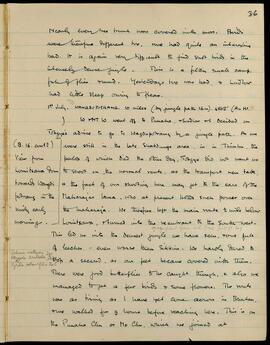
Nearly every tree trunk was covered with moss. Birds were therefore different too, and we had quite an interesting bag. It is again very difficult to find shot birds in the intensely dense jungle. This is a filthy small camp, full of flies and mud. Yesterday too was bad, and Ludlow had little sleep owing to fleas.

70
1st July. TO WANGDUPOTRANG. 10 miles (by jungle path 16 miles). 4508' (An Ht. ). W and Mrs W went off to Punakha, and Ludlow and I decided on Tobgye's advice to go to Wangdupotrang by a jungle path. As we

(B. 16. contd) View from Lomitsawa down towards Wangdi Potrang in the misty early morning.

were still in the late Shabdrung's area, in Thimbu, the Penlop of which died the other day, Tobgye did not want us to shoot on the normal route, as the transport men talk, and the fact of our shooting here may get to the ears of the Maharaja's lama, who at present holds such power over the Maharaja. We therefore left the main route ½ mile below Lomitsawa, and turned into the re-entrant to the South West.

magnificent fern with fronds 3-5 ft long
This led us into the densest jungle we have seen, and full of leeches - even worse than Sikkim. We hardly dared to stop a second, as our feet became covered with them.

Schima wallichii 201
Polygala arillata 202
Pyrola rotundifolia 203

There were good butterflies to be caught though, and also we managed to get a few birds and some flowers. The route was as tiring as I have yet come across in Bhutan, and we walked for 9 hours before reaching here. This is on the Punakha Chu or Mo Chu, which we joined at

LSH/1/1/1/1/153 · Part · 1933-08-29
Part of The Ludlow & Sherriff Collection

SUMMARY:
Notes on collecting a different Primula near a pass and on labelling flowers and preparing bird skeletons. On 28 August they packed, received final mail including a letter from Tobgye, and could not send replies until reaching Gyantse. On 29 August they traveled from Menchu Mu over Kang La to a shelter at Mencheman, describing the route, elevations, scarce fuel, and an 8-hour march for the coolies.

CONTENT:
75

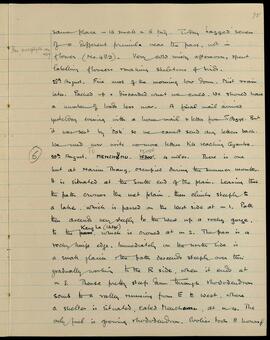
same place - 16 small & 6 big. Today bagged seven of a different primula near the pass, not in flower (No. 489). Very cold misty afternoon, spent labelling flowers & making skeletons of birds.

28th August. Fine most of the morning low down. Mist & rain later. Packed up & discarded what we could. We should have a number of loads less now. A final mail arrived yesterday evening with a home mail & letter from Tobgye. But it was sent by 'dak' so we cannot send any letters back. We need now write no more letters till reaching Gyantse.

29th August. MENCHU MU. 15300'. 4 miles. There is one hut at Narim Thang, occupied during the summer months. It is situated at the South end of the plain. Leaving this the path crosses the wet plain, then climbs steeply to a lake, which is passed on the West side at m 1. Path then ascends very steeply to the West up a rocky gorge to the pass (Kang La (16300')), which is crossed at m 2. The pass is a rocky knife edge. Immediately on the north side is a small glacier & the path descends steeply over this gradually working to the R side, when it ends at m 3. Thence pretty steep down through rhododendron scrub to a valley running from E to West, where a shelter is situated, called Mencheman, at m 4. The only fuel is growing rhododendron. Coolies took 8 hours

LSH/1/1/8/1/125 · Part · 1933-06-02
Part of The Ludlow & Sherriff Collection

SUMMARY:
In heavy rain at Yonpu La, the party travels and, at Yusu’s request, writes to Neoli Basu to arrange bullock carts if vehicles cannot reach Darang Mela; they are lent mules to Darang and find lodging near a new lhakang built by Dopala. Local requests for medical aid are noted, and Betty falls ill with stomach trouble, likely food-related.

CONTENT:
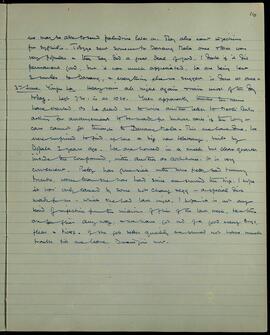
we may be able to send paludrine later on. They also want injections for syphilis. Tobgye sent someone to Darang Mela once that was very popular & they say did a great deal of good. I doubt if it did permanent good, but it was much appreciated. We are being lent 3 mules to Darang, & everything else we suggest is done at once.

3rd June Yonpu La Heavy rain all night again & rain most of the day today. Left 7.30: in at 10.30. Yusu apparently thinks the rains have started, as he asked us to write another letter to Neoli Basu asking for arrangements to be made for bullock carts if the lorry or cars cannot get through to Darang Mela. This we have done. We were surprised to find up here a big new Hlakang, built by Dopala 3 years ago. We are housed in a small but clean quarter inside the compound, with another as cookhouse. It is very convenient. Betty has fallen sick with some pretty bad tummy trouble, worse than she has had since we started the trip. I hope it was only caused by some hot chang regg - a special dish made for us - which she had last night. I hope it is not any kind of infection from the millions of flies of the last week. Here there are few flies anyway, & we have got rid of good many bugs, fleas & ticks. If she gets better quickly we should not have much trouble till we leave Dmanjin now.

LSH/1/1/1/1/75 · Part · 1933-06-30
Part of The Ludlow & Sherriff Collection

SUMMARY:
Notes on the death of the Thimbu penlop and Tobgye’s sending of English medicine, causing concern with the Maharaja. On 30th June Ludlow and the author travelled to Lomi-Tsa-wa via Do Kyong La in clearing weather, collecting flowers including Magnolia globosa and observing that vegetation in the Trashi-cho-dzong valley and at the pass resembled Sikkim.

CONTENT:
35

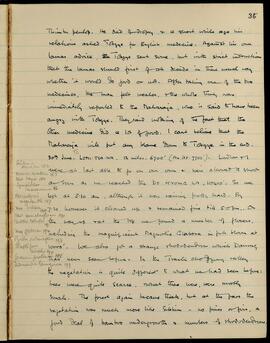
Thimbu penlop. He died of dropsy & a short while ago his
relations asked Tobgye for English medicine. Against his own
lamas advice, Tobgye sent some, but with strict instructions
that the lamas should first of all decide in their usual way
whether it would do good or not. After taking one of the two
medicines, the man felt weaker, & the whole thing was
immediately reported to the Maharaja, who is said to have been
angry with Tobgye. They said nothing of the fact that the
other medicine did a lot of good. I can't believe that the
Maharaja will put any blame down to Tobgye in the end.

30th June. TO LOMI-TSA-WA. 12 miles - 6700' (An. Ht. 7700'). Ludlow & I
Embelia oleracea 182
Anemone rivularis 183 were at last able to go on our own & were allowed to shoot
Rhod. Keysii 184
Symplocos ramosissima 186 as soon as we reached the DO KYONG LA, 10410'. So we
Pedicularis megalantha 187
left at 5.30 am, although it was raining pretty hard. By
Meconopsis villosa 189
Rhod. camelliaeflorum 190 7.30 however it cleared up & remained fine till 5.0 pm. On
Berberis celestina 191
the way up & at the top we found a number of flowers,
Mag. globosa 192
Pyrola rotundifolia 193 including the magnificent Magnolia Globosa in full bloom at
Streptopus simplex 194
10000'. We also got a strange rhododendron which Dawang
Geranium pratense 198
Didissandra lanuginosa 199 has never seen before. In the Trashi-cho-dzong valley
the vegetation is quite different to what we had seen before:
trees were quite scarce, & what there were, were mostly
small. The forest again became thick, but at the pass the
vegetation was much more like Sikkim - no pines or firs, a
good deal of bamboo undergrowth & numbers of rhododendrons.

LSH/1/1/5/1/181 · Part · 1933-08-08 - 1933-08-10
Part of The Ludlow & Sherriff Collection

SUMMARY:
Diary records marches from Trashidinka to Ritang and on to Samtegang, with heavy rain, heat, and severe leech problems. The author collects primula roots and some iris seed, notes lilies seen but unreachable, and mentions a mule sent by Tobgye to meet at Wangdipotrang.

CONTENT:
on the way to Samtegang.

8th August. To Trashidinka. Tang Chu valley. 11 miles. Heavy rain all night, fine and very hot today. Collected roots of the small new petiolaris primula 3192, and also some seed, which however is not yet ripe. It is beastly hot down here, and I have not very great hope of getting these roots home, with more than a week of this heat still to go before reaching Ha.

9th August. To Ritang. 6 m. There is a path which leads down the Tang Chu, which is a much quicker way between Ritang and Trashidinka than the way we went up. Follow the left bank down to m 1 1/2 then cross to the R bank to m 4. Recross and ascend fairly easily to Ritang monastery at 5 1/2 and village at 6. Path is good. Leeches were very bad and I had nearly 40 bites on my feet. We saw one Lilium wallichianum, but not in flower, and collected some iris seed.

10th August. Samtegang. 13 miles. Rained very hard all yesterday evening, all night and all today without a stop. More lilies seen across the Tang Chu, but we could not reach them. Tobgye has sent a mule to meet me at Wangdipotrang, and it came on up here. Rain keeps it reasonably cool for the primula roots, and I don't mind some more days of

LSH/1/1/1/1/61 · Part · 1933-06-08
Part of The Ludlow & Sherriff Collection

SUMMARY:
A rainy day at HA included archery practice with Tobgye, during which an eagle owl was seen but not taken. The party used a local fish-catching method with a V-shaped stone barricade and bamboo cone, followed by wrestling, races, other games, and a Tibetan dinner with Tobgye and his lama at the Dzong.

CONTENT:
28
Reportage Excellent

being within a couple of yards of the mark. It rained all the time we were out, and became so heavy we had to stop. Tobgye tea'd with us here and stayed the evening.

13th June. HA. Rain most of the morning. Went down the valley at 9.30, back at 12.0. No birds, but I saw and tried to shoot an eagle owl - the only owl we have seen in Bhutan so far.
B. 9. finished.

Archery at HA. (Poor light, raining slightly).
After lunch Tobgye arrived and took us off for more archery practice, which we went on with for more than an hour. There were only a dozen or so out shooting, but we are promised a day when women folk will turn out. Apparently the women, who don't shoot, enjoy the tamasha a lot. And woe betide the man who holds his bow upside down: he will be turned upside down too, and dipped in the river.

B. 10. Local method of catching fish by driving them up or down stream, and into a cone placed at the point of a V barricade of stones and men.
Later the schoolboys all turned up, and we did some fishing. A stretch of about 60 yds of a side stream was chosen: then a close line of men walked up stream beating the water and hissing. At the other end of the stretch 8-10 men made a V shaped barrier of stones, and at the point, put a submerged bamboo cone. When the beaters got close to this, they ran in, and the fish were forced into the cone. We collected 20-30 like this in one bout. After this, we watched wrestling matches, and I took on one man myself: relay races followed, and all sorts of other games. Tobgye finished up after we left with some "cricket" practice. We finished the day with dinner - Tibetan - with Tobgye and his lama at the Dzong.

LSH/1/1/1/1/87 · Part · 1933-07-14 - 1933-07-11
Part of The Ludlow & Sherriff Collection

SUMMARY:
Notes on film sent from Bumthang and exposure issues; shooting was limited due to Tobgye’s concern about H.H.’s views on filming in E. Bhutan. Describes arrival at Bumthang with a pompous musical welcome by H.H.’s trained band, mentions groups on the Kykji Pass, and the march to Bumthang (9 miles, alt. 9900').

CONTENT:
41

14.7.33
Sent from Bumthang on Report 2 to 17 satisfactory, slightly underexposed.
18A colour filter on wrong column complimentary.

Quite a lot of sun. We had hoped to spend the whole day shooting, but Tobgye is anxious as to what H.H. will say about our shooting in E. Bhutan, and does not want us to spoil our chances by shooting too much now.

16 B. finished. 11th July. To BUMTHANG. 9850. 9 miles. (Alt. 9900').
Arrival at Bumthang. Arrived in a blaze of trumpets, bagpipes, drums and other instruments at Bumthang. A pleasant camp on a fine day. Everyone now knows
Groups on the Kykji Pass. that the way to please W. is to give him a pompous kind of welcome, and he was as pleased as Punch to
the cavalcade. see all this turn out in his honour. H.H. has
No. 17. B. the nucleus of an army in 25 young Bhutanese
In Bumthang. trained by a man who did some years with the
Archery and 8th Gurkhas. They possess three bagpipes, two bugles,
other scenes. a cornet and 2 fifes. Add them to the kettle drums,
No. 18. big drum, and surnais of the bodyguard, and you get