Showing 34 results

Archival description
34 results with digital objects Show results with digital objects
LSH/1/1/4/1/69 · Part · 1933-08-12 - 1933-08-13
Part of The Ludlow & Sherriff Collection

SUMMARY:
Diary describes a fine-weather traverse from below Karpo over Sokpo Pass with steep shale and scree, turning near Chioling and reaching a yak encampment at the foot of Mihrang La; the route recalls Tulung La. Botanical notes include several gentians and Swertia; one young Cremophilum was shot and bharal were seen, with identifications discussed with Sherriff. The following day begins with a steep ascent to Mihrang La from camp between Cha La and Chorten Namo.

CONTENT:
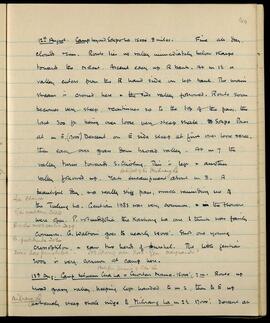
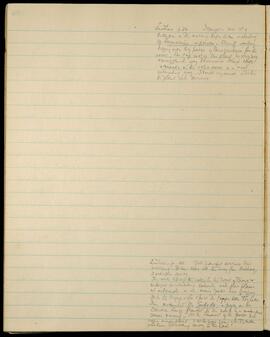
12th August. Camp beyond Sokpo La, 15,000 feet, 8 miles. Fine all day,
clouds and sun. Route lies up the valley immediately below Karpo
towards the North East. Ascent easy up the right bank. At mile 1 1/2, a
valley enters from the right-hand side on the left bank. The main
stream is crossed here and the side valley followed. The route soon
becomes very steep and continues so to the top of the pass, the
last 300 feet being over loose, very steep shale. Sokpo Pass
at mile 5 (17,000 feet). Descent on the east side is steep at first over loose scree,
then easy over grass down a broad valley. At mile 7, the
valley turns towards S. Chioling. This is left and another
valley followed up. At the foot of the Mihrang La, a yak encampment at about mile 8. A
beautiful day and a really stiff pass, much reminding me of
the Tulung La (Gen. kherica). Gentian 1983 was very common and the flowers
were open (Gen. waltonii 2028). P. rotundifolia, the Kashong La one I think, was fairly
common (Swertia multicaulis 2029). G. waltonii goes to nearly 14,000 feet. Shot one young
Cremophilum (Ph. pectinibunda 2030) and saw two herds of bharal. The little gentian
2034 (Gent. punctulata - Sherriff says 2035 = Gen. marquandii?) is very common at camp here.

(Mile from summit of Cha La)
13th August. Camp between Cha La and Chorten Namo, 15,000 feet, 7 miles. Route up
a broad grassy valley, keeping left-handed to mile 2, then to the east up
an extremely steep shale ridge to Mihrang La at mile 2 1/2 (17,000 feet). Descent at...
LSH/1/1/6/1/83 · Part · 1938-06-22
Part of The Ludlow & Sherriff Collection

SUMMARY:
Travel notes record heavy rain, difficult marching, and a camp on the Gyara Phu Chu, followed by a fine day reaching Gyara (Nepar). Common Primula species were noted, Lerwa with young were observed, and there is disappointment at few notable finds, with hopes to visit passes east of Lilung; transport delays prevent moving on to Pamse.

CONTENT:
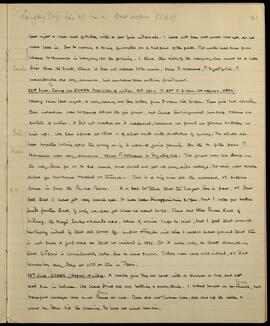
Langong Trip has not been a great success (S. 647)

Last night and rain most of today with a few fine intervals. I have not been out much here yet, as we were late in, due to meeting a string of mules on a bad part of the path. The mules had come from Lhasa to summer in Langong for the grazing. I think this side of the Langong Chu must be a little drier than the south, though it does not appear to be much. Here P. hopeana, P. dryadifolia, P. macrophylla are very common, but we have seen nothing of interest.

To
22nd June. Camp on GYARA PHU CHU. 6 miles. BP. 191.1 T. 55° T. 3.0pm. Ht approx. 11832'.
Heavy rain last night, and very heavy all day today from 8.0am till 2.0pm. Then fine but cloudy. Our intention was to camp above the fir forest, but Chulla distinguished himself and came on another 4 miles. It did not matter as it happened, because we found no flowers to delay us high up. We saw Lerwa at 15,000 - 4 adult birds with a clutch of young. The adults all kept together looking after the young as if it were a joint family. On the N. of the pass P. kansuensis was very common, and some P. hopeana and dryadifolia. The forest was too dense on the way down for us to see much, and we could not see up any side valleys. The rain was really awful for two hours and soaked us through. This is a big river at the moment, and I suppose comes in from the Pacha Peaks. It is sad to think that the longest day is past, and I don't feel that I have got very much yet. It has been disappointing so far, but I hope for better finds further East, if only we can get where we want to go. There are three Passes East of Lilung, the Magu, Shoka and Namdo Las, each of which I hope to visit, but I feel that we will be lucky indeed if that all comes off. Ludlow and Sherriff will also I expect have found that this is not such a good area as that we visited in 1936. Or it may only be that everything in East Tsari is considerably later, due to more snow. Today was very cold indeed, and I don't remember any days as cold as this in Tsari.

To
23rd June. GYARA (Nepar). 4 miles. A really fine day at last, with a shower or two, but hot real sun in between. We have dried all our bedding and everything. I hoped to get on to Pamse, but transport changes here and at Pamse as well. There are no horses here, all are up the valley and won't be down till the evening. So here we must remain.

LSH/1/1/2/1/116 · Part · 1933-07-18
Part of The Ludlow & Sherriff Collection

SUMMARY:
The diarist collected many butterflies before 11 a.m., while Sherriff dug Paraquilegia from rocky cliffs, though its survival seemed doubtful. Yak transport arrived from Meishang via a route west of Tsona, crossing the Nyap-La, passing Poppa Chu Tso lake, and ascending the Forke-La in the Donka Range with wide views over the Tibetan plateau.

CONTENT:
Ludlow p. 84. I caught a nice lot of butterflies in the morning before 11 a.m. including 16 Parnassius imperator. Sherriff was busy digging out a big batch of Paraquilegia from the rocks. The tap root of this plant is very long, worming its way downward through cliffs and cracks in the solid rock in a most astonishing way. I doubt very much whether the plant will survive.

Ludlow p. 85. Yak transport arrived this morning. It has come all the way from Meishang, 2 marches away. The route led up the valley to the west of Tsona and entered undulating country with flat plains at intervals on which many yaks were grazing. Over the Nyap-La and past the Poppa Chu Tso lake then ascended the Forke-La, a pass in the Donka Range flanked to the north by a magnificent snow massif. At the summit of the pass we had a magnificent and extensive view of the Tibetan plateau stretching away to the East.

LSH/1/1/2/1/221 · Part · 1934-10-14
Part of The Ludlow & Sherriff Collection

SUMMARY:
The diarist reports a night disturbed by insects, rainy weather clearing after an east wind, and ongoing concern for a Tibetan companion with an abscess. They note mixed attitudes from locals, observations on extensive rice cultivation compared to Rungzyung and the Trashiyangsi valley, and remarks on rhododendron flowering and regional snow/frost levels. They remain in the same camp as before.

CONTENT:
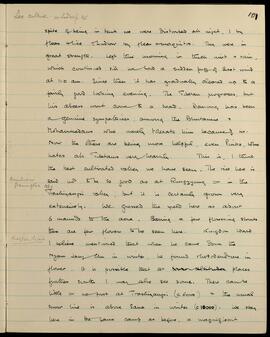
In spite of being in tents we were disturbed all night, I by fleas and lice, Sherriff by fleas and mosquitoes. They were in great strength. Left this morning in thick mist and rain, which continued till we had a sudden puff of East wind at 11:00 am. Since then it has gradually cleared up to a fairly good looking evening. The Tibetan progresses, but his abscess won't come to a head. Dorong has been a genuine sympathiser, among the Bhutanese and Mohammedans who merely tolerate him because of us. Now the others are being more helpful, even Pinbo, who hates all Tibetans very heartily. This is, I think, the best cultivated valley we have seen. The rice here is said not to be so good as at Rungzyung or in the Trashiyangsi valley, but it is certainly grown very extensively. We guessed the yield here as about 6 maunds to the acre. Barring a few flowering shrubs there are few flowers to be seen here. Kingdon Ward, I believe, mentioned that when he came down the Nyam Jang Chu in winter, he found rhododendrons in flower. It is possible that at lower altitude places further south I may also see some. There is little or no frost at Trashiyangsi (c. 6,000') and the usual snow line is above Sana in winter (c. 10,000'). We stay here in the same camp as before, a magnificent

LSH/1/1/6/1/47 · Part · 1933-05-01 - 1933-05-02
Part of The Ludlow & Sherriff Collection

SUMMARY:
Entries for 1–2 May describe moving a short distance up the spur/ridge north of Lhalung through extremely dense forest, requiring continuous path-cutting and resulting in a foul camp with little water. Coolies were unreliable or refused to proceed, two men promised by Pintso did not arrive, and birds were scarce though tragopan and serow were heard; Ludlow and David suffered swollen hands from biting flies while Sherriff was away.

CONTENT:
seven or eight on my feet. But damdim (Simulium damnosum) flies are the worst nuisance here. They seem to be more poisonous than the Bantan ones. Both Ludlow & David have very swollen hands & wrists.
Sherriff away for 6 days.

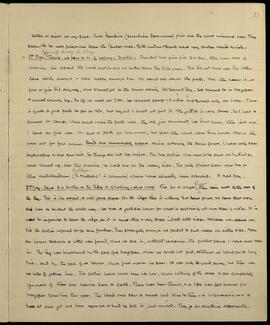
1st May. Camp up spur to N. of Lhalung. 3 miles. Clouded but fine till 3.0 pm, then rain rest of evening. I'm afraid the local coolies are no better than the Moio ones. Two did not turn up. The others came early enough & were happy enough too. We asked all about the path. Yes, they knew it, or four or five did anyway, & we should get to the snow easily the second day. We should be in tragopan & monal country too. So off we went at 7.30. We reached camp - 3 miles and 2000 ft only at 1.0 pm. There is quite a good path as far as this, but beyond I could not find it, the jungle is very dense. So I had to consent to camp. When asked where the path was, then all just answered, 'We don't know, there isn't one'. I sent on five men, to cut a path for tomorrow, but fear they won't have done much, though they were out for four hours. Birds are remarkably scarce, since entering the dense forest, I have only seen phylloscopus & one sunbird. So things are not too bright. The two coolies who were to be sent on by Pintso, never turned up, even this evening, so loads are on the heavy side. The only flowers seen were two or three rhododendrons (R. nuttallii? lindleyi is common) which have already been collected. A bad day.

2nd May. Camp 2 m further up the Ridge N. of Lhalung. about 11000' Fine for a couple of hours, then rain most of the rest of the day. This is, I'm afraid, a wild goose chase. On the ridge there is nothing but dense forest, so dense that every step has to be cut the whole way. We took a good six hours for what is certainly not more than 2 miles. It is next to impossible to leave the ridge, as it is knife edge & very steep indeed both sides. However we came on, till the coolies refused to go any further. Then strangely enough we failed to find water on either side. After an hour's search a little was found, there we are in, without exception, the foulest camp I have ever been in. The day was brightened by the call of a tragopan, which we could not find, although we looked for a long time: and by the call of a serow, whose fresh marks we saw. He was only 50 yards away, but there was no hope of getting him. The coolies have never been up here, know nothing of the area & are completely ignorant of there ever having been a path. There has been though, & a Lopa has set snares for tragopan sometime this year. The Lpah once saw a small bird close to them - a Heteroxenicus - & two at once got out bow & arrows & tried to pot it, but missed. They go for anything apparently.

LSH/1/1/4/1/49 · Part · 1933-07-23
Part of The Ludlow & Sherriff Collection

SUMMARY:
The party proceeds via Chagal, while the Dzongpen departs to Drokpa La with the Trim jigmpu and a coolie, leaving Tenduk, Ahmad Sheikh, and the diarist with 14 coolies. At Chagal Dzong they record weather and notable plants, and exchange calls with the Dzongpen who arranges matters for the next day.

CONTENT:
134

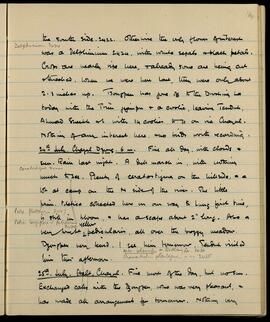
the south side. 2422. Otherwise the only flower of interest was a Delphinium 2424, with white sepals & black petals. Crops are nearly ripe here, & already some are being cut & threshed. When we were here last, they were only about 2-3 inches up. Dzongpen has gone off to the Drokpa La today with the Trim jigmpu & a coolie, leaving Tenduk, Ahmad Sheikh & I with 14 coolies to go on via Chagal. Nothing of any interest here, no birds worth recording.

24th July. Chagal Dzong. 6 m. Fine all day, with clouds & sun. Rain last night. A dull march in, with nothing much to see. Plenty of Ceratostigma on the hillside, & a lot at camp on the N side of the river. The little Primula tibetica collected here on our way to Lung first time, is still in bloom, & has a scape about 2" long. Also a very bright yellow Pedicularis, all over the boggy meadow. Dzongpen very kind. I see him tomorrow. Tenduk visited him this afternoon.

25th July. Halt. Chagal. Fine most of the day, but no sun. Exchanged calls with the Dzongpen, who was very pleasant, & has made all arrangements for tomorrow. Nothing very

[Marginalia:]
Delphinium 2424
Ceratostigma minus
Pedicularis fletcheri 2427
Pedicularis longiflora v. tubiformis 2429
rec. Sherriff on Dricheng La. 2436
Cremanthodium plantagineum 2435

LSH/1/1/4/1/118 · Part · 1933-09-24
Part of The Ludlow & Sherriff Collection

SUMMARY:
Sherriff went up to the Chayul Valley, working around the Kashong La and Lung area, while the diarist collected Himalayan Crossbill specimens feeding on larch cones. Notes indicate a return to Tsona and travel to Sakden via Tawang, then to Dewangiri.

CONTENT:
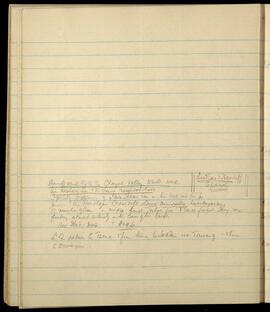
Sherriff went up to the Chayul Valley to work round Ludlow Sherriff
the Kashong La, the Lung neighbourhood. Separate
I got lovely specimens of a bird I have been on the look out for
years - the Himalayan Crossbill, Loxia curvirostra himalayensis.
A number of them in mixed birch, silver fir & larch forest. They were
feeding almost entirely on the cones of the larch.
See Ibis. 348. T Aug. 6.

L. D. return to Tsona & from there to Sakden via Tawang - then
to Dewangiri.

LSH/1/1/3/3/183 · Part · 1983-05-05
Part of The Ludlow & Sherriff Collection

SUMMARY:
At Chichechar, the party searched in the evening for new game birds; Ludlow heard them and later saw one, while Pintso also saw one, yielding two skins for identification. Danong returned from Thijijitum with flowering magnolia, a rhododendron, and Meconopsis but no primula. The group then split, with Ludlow and Sherriff joining M. over the Bimbi La while the writer proceeded to do the Kingkor.

CONTENT:
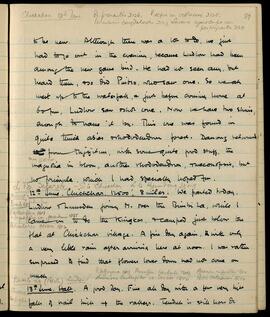
Chichechar 12th June
Pr. prenanthoides 2126. P. alpina violacea 2128, Pedicularis corydaloides 2127, Lonicera cyanocarpa var. porphyrantha 2129. 89

to be new. Although there was a lot to do, we just had to go out in the evening, because Ludlow had been among the new game birds. He had not seen any, but heard them, as did Pintso, who saw one. So we all went up to the waterfall, and just before coming home at 6 p.m., Ludlow saw another one. Now we have two skins, enough to name it by. This one was found in quite thick Abies rhododendron forest. Danong returned from Thijijitum, with some quite good stuff, the magnolia in bloom, another rhododendron, Meconopsis, but no primula, which I had specially hoped for.

L. & S. Separate - S. to Chichechar - L. to Kyimdong Dzong.
Sieru
Bimbi La
P. bellidifolia 1801
P. bryophila var. jerdoniana 1895
Pedicularis oederi 1802

12th June. Chichechar. 12500', 8 miles. We parted today, Ludlow and Sherriff joining M. over the Bimbi La, while I came on to do the Kingkor,

LSH/1/1/7/1/1 · Part · 1940-05-24
Part of The Ludlow & Sherriff Collection

SUMMARY:
The expedition splits, with Ludlow and Taylor heading to passes east of Tsela Dzong while Sherriff works the Lanyong area and passes between Roro and Bela Dzong, departing Roro on 24 May. The page describes the Lanyong Chu valley, its isolated inhabitants and seasonal conditions, and notes early-season floral observations on high slopes, including Rhododendron repens and Primula species.

CONTENT:
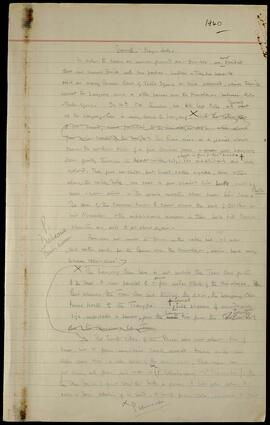
1940.

Sherriff - May - July -

In order to cover as much ground as possible, we now decided that we should divide into two parties. Ludlow and Taylor were to visit as many passes East of Tsela Dzong as time allowed, while Sherriff worked the Lanyong area and other passes over the Himalayas between Roro and Bela Dzong. On 24th May therefore we all left Roro, and Sherriff went up the Lanyong Chu in easy stages to Lanyong.

The Lanyong Chu here is not unlike the Tsari Chu further to the West. It runs parallel to and about four miles North of the Himalayas. But whereas the Tsari Chu cuts through the axis, the Lanyong Chu turns North to the Tsangpo. Several side streams of considerable size, unfordable in summer, join the Lanyong from the South.

The valley, which is from 300-600 yards wide, flows gently through the valley bed. The inhabitants are very isolated. They grow no crops, but breed cattle and yaks. Here and there along the valley bed, one sees a few chalet-like huts, used by men and yaks alone in the winter months when snow lies deep. The rain of the summer turns to snow about the end of October or mid-November, and the inhabitants remain in their huts till March when they are able to get about again.

There was not much in flower in the valley bed, as it was still rather early for the passes over the Himalayas, which here vary between 13,500 - 15,000'.

The South sides of the passes were now almost free of snow, but North faces were still deeply covered. However on the open slopes about 14,000' a little North of the main axis, Rhododendron repens was just coming into flower, and with it (P. valentinianum and P. franchetii). On the same day as I first saw the latter in flower, I was also able to make a large collection of its seed. A north facing slope on which it grew P. vernicosa.

LSH/1/1/6/1/117 · Part · 1933-07-27
Part of The Ludlow & Sherriff Collection

SUMMARY:
The party halted at Tse, planned routes with Ludlow going north toward the plateau and then to Trongsa, while Taylor and the diarist would work NW of Tsela and cross the Nyang Chu to reach Trongsa by a new route. They found delayed mail at Tsela Dz, traveled by coracle to Tsela Dzong, and then on to Puchu (Nyang Chu); there was a dispute with Tendong in Gyantse over dak payments, cordial visits with the Dzongpon and his wife, and Sherriff visited to hear the wireless, after which Ludlow went on ahead while transport was arranged.

CONTENT:
58

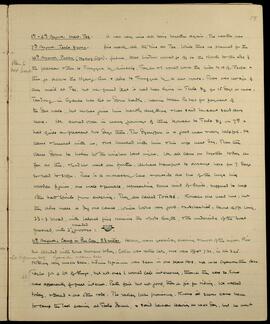
1st - 6th August. Halt. Tse.
It was very nice all being together again. The weather was fine nearly all the time at Tse. While there we planned for the future, that Ludlow would go off to the North to the edge of the plateau then to Trongsa by himself. Taylor and I would work the hills NW of Tsela and then go across the Nyang Chu and also to Trongsa by a new route. There was no sign of any mail at Tse, but we found that it had been lying in Tsela Dz for 15 days or more.

7th August. Tsela Dzong.

10th August. Puchu (Nyang Chu).
Plans for next month.
Tendong in Gyantse has let us down badly, having taken Rs 240 for payment of the dak wala, but he has given him hardly anything and has said he cannot send any more. We came over in many journeys of three coracles to Tsela Dz on 7th and had quite a pleasant two days there. The Dzongpon is a good man and very helpful. He came and lunched with us, and we lunched with him and his wife next day. Then Sherriff came down to listen to the wireless last night. We all came on together today as far as this, then Ludlow went on further. We have transport to arrange here for 7 days so had to stop. There is a monastery here and outside are two of the huge big wooden figures, one male and female, representing