Showing 29 results

Archival description
29 results with digital objects Show results with digital objects
10th May, CHANGU TSOMGO
LSH/1/1/1/1/23 · Part · 1933-05-10
Part of The Ludlow & Sherriff Collection

SUMMARY:
Notes describe a caravan of lamas stopping at a minimal shelter, continued snowfall around the bungalow, and attempts to find and identify very large snipe, with few flowers due to lack of sun. On 10th May at CHANGU TSOMGO there was a fine morning after fresh snow, a further search for the snipe yielded little, and bird activity seemed to have moved lower.

CONTENT:
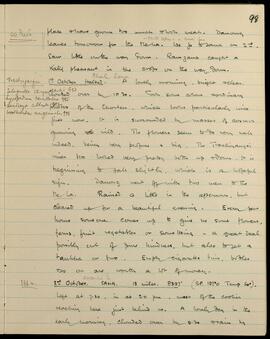
wonderful traveller in the mountains. The whole caravan is stopping tonight at a shelter 2 miles beyond here. They will have a miserable time, as the place is nothing but a shelter. It is ten years since the Tashi Lama left Tibet, since then he has been in Mongolia & Nanking. It seems generally to be thought that it will be a very good thing if he does return. The two lamas were dressed in new yellow clothes & looked very fine on their decorated mules. I went out again this afternoon up the hill behind the bungalow, & there was very surprised to see two of the biggest snipe I have ever seen. I shot both but only picked up one. We are not certain if it is a wood snipe or solitary. They must have a nest, but the snow was so heavy over that I had to return without finding it. It continues to snow this evening. Had we only had a few days sun, I believe there would have been many more flowers coming out: as it is we have only one specimen.

10th May. CHANGU TSOMGO. A fine morning for a change. Breakfast 5.30. Climbed the hill behind the bungalow to look for yesterday's snipe, but found neither it nor its nest. There had been about 6" fresh snow last night covering most tracks. Back at 11.30, only one bird between us. The fresh snow must have driven them down a bit. Hear there

B. 3 contd.
Ramzana
climbing through
fresh snow
behind bungalow
LSH/1/1/4/1/67 · Part · 1933-07-23
Part of The Ludlow & Sherriff Collection

SUMMARY:
Route from Karpo over the Trakan La is described, with an easy ascent and gradual descent into valleys and grassy hills. Few flowers noted, but some Saxifraga and Cyananthus are mentioned; Lumsden shot a young musk deer which Ramzana halal-slaughtered. The party suffered slight headaches and celebrated with a large birthday dinner.

CONTENT:
Saxifraga tangutica 2003, punctulata 2004, signatella 2007.
not yet ripe, but we are taking some on with us. All of us again had slight headaches. We had a huge birthday dinner of hare soup, roast partridge, pate de foie gras, apricot cream, and mushrooms on toast. Perhaps it was no wonder we slept badly.

11th August. Karpo via Trakan La. 12100'. 11 m. An easy ascent up a broad valley over grassy slopes to the Trakan La (16900'?) at m 3. The pass is a broad one & very stony both sides. The road over the pass first leads down left handed to avoid a mass of boulders, then crosses a small valley to another broad open valley in the same line as the final ascent to the Trakan La. Thence descent easy & gradual over grassy hills, to m 10, when it becomes steeper, with a final steep fall to the valley bed at Karpo, where there are three little clusters of houses, some cultivation. Nothing very much today in the flower line, but G. stictantha? (unopened) on the pass, Cyananthus incanus (var leiocalyx?) on the way down. Lumsden missed a fluke from musk deer, then at the same point shot a young male, which Ramzana managed to halal, or said he did. Yak meat very good.

LSH/1/1/1/1/107 · Part · 1933-07-26
Part of The Ludlow & Sherriff Collection

SUMMARY:
Notes on fleas and lice among the party, with Ludlow inspected daily and Ramzana attributing lice to sweat; temporary huts built and a comfortable halt at Donga Pini with fine weather, bird shooting, and photo developing. On 27th July the party proceeds to SANA, climbing from about 8000' to 9600' along the ridge via the DONGA LA, with plants such as Primula xanthopa, P. sikkimensis, and Oxalis acetosella recorded.

CONTENT:
a good many fleas & lice about. Ludlow has his clothes searched every morning for lice. Ramzana, when asked where they came from, could only offer the explanation that they came from sweat. Three temporary huts have been built for the coolies & our Cookhouse, so we are all quite comfortable here, & will stay tomorrow. A very good day for birds, but no flowers.

B. 22. 26th July. Halt at Donga Pini. Fine almost all the day, with some
Coolies at Pini mist at times. The clouds away down in the valley were
amusing them- particularly beautiful in the evening. Spent the day
selves during the shooting birds in the morning & drying & packing up, &
day's halt. also developed some flower photographs. Coolies remained
Clouds in here all day, ready for tomorrow. There are no houses or
valley below shepherds here, but they amused themselves at their various
Pini in games.
Kurn Chu.

8 27th July To SANA 12 1/2 miles. 8000' 9600'. Path climbs steeply up
B. 22 finished. grassy ridge for 1 1/2 miles, then zig zags over rocky
Looking down to ground among trees, always keeping to the ridge, till
the cloud filled Primula xanthopa 329. P. sikkimensis 331, Oxalis acetosella 332
valley of the the DONGA LA

LSH/1/1/6/1/39 · Part · 1933-05-17
Part of The Ludlow & Sherriff Collection

SUMMARY:
The party moved up the valley with coolies burdened by heavy loads and delays at Molo, noted weather changes, and observed several rhododendrons and primulas. On 22 April at a camp above Singo Samba, a hazardous bridge crossing led Ramzana to cross while Ludlow forded downstream with Tseringpen. On 23 April, despite fresh snow and the coolies’ refusal to move, Ludlow, Tseringpen, and the diarist scouted and broke a path to the Lo La pass, checking known plant sites now under snow.

CONTENT:
have weighed at least 130 lbs. In most cases the coolies also carried a lot of stuff to trade in Pachakshiri, so they have very heavy loads. We left at 7:15 and were in at 12:15, but transport did not arrive until about 4:00 pm, chiefly because they all went to Molo to drink chang and get extra loads to take for themselves. A small shower of rain at 4:00 pm, but evening clear. Rhododendrons are more in flower up this valley than at Molo, R. 3624 (3631) is common. R. cinnabarinum is just coming into flower and R. vellereum is in flower in a good many places. P. Roylei just in flower common.

22nd April. Camp 4 m. above Singo Samba. 7 miles. Rained and snowed a good deal during the night. Fine but clouded all morning. Fine rain and mist by 12:00 noon and for rest of the day. No flowers today, and really rather few signs of them. Nearly up here, Primula prenantha is common, but only leaves visible yet. P. glabra is just in flower beside camp. P. atrodentata also shown here. The bridge at Singo Samba is not nice - it consists of only one usable plank, with another a foot lower and very wavy. The length is about 30 yards and the height above water 15 ft. Ramzana crossed first in good style, but Ludlow preferred to ford the river 200 yards further down. Poor Ramzana ran, or did his best to, twice more across the bridge when he saw Ludlow about to ford. I'm afraid I was angry with Ludlow for telling no-one but Tseringpen, whom he took with him, what he was going to do. The valley up here looks lovely and should hold good flowers when they come on. Isopyrum is just showing new leaves on the cliffs on the R. bank. A few seed were found.

23rd April, Halted Camp. Clouded early, fine and bright till 2:00 pm, then cloudy and some rain. We were all ready to cross the Lo La and expected an early start, but woke up to find 2" of fresh snow in camp. That really made no difference, but the coolies refused to move, so here we still are after a perfect clear sunny day. As there was nothing else to be done Ludlow, Tseringpen and I went up to the Pass to make a path, ordering a dozen men to follow and stamp it down. Deep snow lay just beyond camp and continued to the pass, but it was not very often that one went through. It only took us 3 hours to reach the top, and we are convinced the coolies could have gone up. I was shown the places P. Elizabethae, Omphalogramma minus and brachysiphon and some rhododendrons were - all under snow now. On our way back we dug down near the P. Elizabethae

LSH/1/1/9/1/17 · Part · 1949-04-08
Part of The Ludlow & Sherriff Collection

SUMMARY:
After heavy overnight rain, the party went from Chamkhar (Bumthang) over the Kyikyi La to camp behind Byakar Dz, receiving food gifts from Pintso Wangdi and Ashi Choden Mother while H.H. added atta; rhododendrons were noted and a film pack was successfully developed. The following day was a rainy halt with more presents, preparations for Lhuntse, and a short excursion with Bette to collect a Prunus and a beautiful crab apple, with supplies sent as far as the Rudo La.

CONTENT:
in July also (perhaps 1st week Aug), they must breed here.

11th April. Chamkhar (Bumthang) 8 miles. c. 9500'. It rained very hard last night for a good many hours, but stopped as we got out at 5.30. We went the quicker way, over the Kyikyi La, 11,600', & down right at Byakar Dz, just behind which we are camped. Here I had expected that we would be left alone, but no sooner were we in than large presents started to arrive from Pintso Wangdi & Ashi Choden Mother. These were of foodstuffs, but still meant something in return. We saw little on the way. Rhod. ciliatum (18683) was a new one for us, we also got a good Barbatum Series Rhododendron (18682). Beside the Dzong (Byakar) another rhodo is in flower, (R. virgatum) 18687 which we last saw in Tongkyuk, but this was a much finer plant. Here everything has been made easy for us. We have ample food: H.H. has produced two mds. of atta to add to our supply, with all the butter & rice we've been given, we need for little. I developed the first film pack, with good results. It will be nice again to have a halt tomorrow. With new people with us, there is much more to do than with old. When we had Pintso & Tendup, Ramzana & Linka, the camp bundobast ran itself. H.H. has given me a very good man in Ngudup Namgyal who has authority to do anything, which makes a very great deal of difference.

12th April. Halt. Rained part of the night, & off & on all day today. We spent most of the day in camp getting things ready for the next jump to Lhuntse. More presents came in, & Pintso Wangdi sent food for us all as far as the Rudo La. Bette & I went up a side valley & found a Prunus 18691, like the Kongbo Nga La one, & a very beautiful Crab apple (18690) which we must try to get seed of.

LSH/1/1/1/1/81 · Part · 1933-07-05 - 1933-07-06
Part of The Ludlow & Sherriff Collection

SUMMARY:
Field notes record plant specimens and a wet, muddy march from Chendebi over the Pele La and down the Longte Chu, with difficulties taking flower photographs and observations on loads carried by local porters. A report was sent from Trongsa on 8 July 1933 noted as slightly underexposed, and the next camp was at Tsang Ka.

CONTENT:
38

5.0 pm, so Ramzana could not skin many that night.

Notholirion macrophyllum 228
Lilium nanum 225 - 1 plant.
Calanthe alpina 226
Meconopsis villosa 230
Oreocharis foliosa 234

5th July. CHENDEBI. 7500. 13 miles. (An. Ht. 7500' set) Another foul day with mist & heavy rain all day. Saw none of the country, birds were all lying clump. Flowers quite interesting. I find it almost impossible to get any colour photos of flowers. There is hardly a fine moment when we reach camp, or else it is only fine before my tail comes in. A hard day over awful mud paths; first a very steep ascent to the Pele La (11055') then steady down slippery paths along the Longte Chu to camp. The coolies are not particularly quick, but it seems to make little difference whether they go up hill or along the level. Tobgye tells me that normally, when carrying their own loads, women even carry 2 maunds (160 lbs), & then always carry the whole stage.

No 16 sent from Trongsa on 8.7.33.
Report slightly underexposed

6th July. TSANG KA. 7500'. 12 miles. (An. Ht. ) Another filthy wet day, raining hard all

LSH/1/1/2/1/199 · Part · 1933-10-01 - 1933-10-02
Part of The Ludlow & Sherriff Collection

SUMMARY:
The party halted at Chorten Kora in Trashiyangsi, noting abundant cosmos flowers and a falling river; Damong departed with two men for the Me La, and Ramzana caught a Kalij pheasant. On 2 October they ascended to Sana (c. 8397 ft), with most coolies arriving shortly after, amid changing weather.

CONTENT:
98

(see Me La)
Place above grown too much dhobi wash. Damong leaves tomorrow for the Me La - shall return in a week's time. We go to Sana on 2nd. Saw little on the way down. Ramzana caught a Kalij pheasant in the crops on the way down.

(Trashiyangsi)
(Selaginella chrysocaulos 993)
(Lycopodium cancellatum 995)
(Lindsaya cultrata 997)
(Woodwardia unigemmata 998)

1st October. Halted. Chorten Kora. A lovely morning, bright and clear. Clouded over by 10.30. Took some photos, ordinary photos of the Chorten, which was particularly nice just now. It is surrounded by masses of cosmos growing wild. The flowers seem to do very well indeed, being very profuse and big. The Trashiyangsi river too looked very pretty both up and down. It is beginning to fall slightly, which is a hopeful sign. Damong went off with two men to the Me La. Rained a little in the afternoon, but cleared up for a beautiful evening. Every few hours someone comes up to give us some flowers, ferns, fruit, vegetables or something - a great deal possibly out of pure kindness, but also to get a tankha or two. Empty cigarette tins, bottles and so on are worth a lot of money.

(386 n.)
2nd October. SANA. ascended to 13 miles. 8397' (BP. 197.0 Temp 60°). Left at 7.30, in at 2.0 pm, most of the coolies reaching here just behind us. A lovely day in the early morning, clouded over by 9.30 and rain by...

LSH/1/1/2/1/131 · Part · 1933-07-18
Part of The Ludlow & Sherriff Collection

SUMMARY:
The party descends from the Cha La on the south side to the village of Chukar, observing weather shifts and cloud over the pass. Notes include Dongkar as part of the Tibetan dry zone, a transition near the Trak Chu with dwarf and small rhododendrons, and many pink Meconopsis horridula; Kuntip is ill while Ramzana is recovering.

CONTENT:
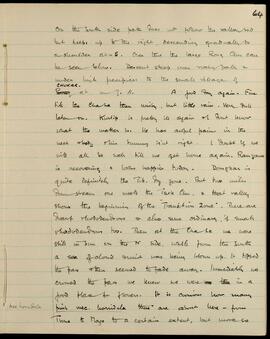
On the south side path does not follow the valley bed but keeps up to the right, descending gradually to a shoulder at m. 5. Over this the large Rong Chu can be seen below. Descent steep over rocky path and under high precipices to the small village of CHUKAR at m. 7.11.

A good day again. Fine till the Cha La then misty, but little rain. Very dull later on. Kuntip is pretty ill again and don't know what the matter is. He has awful pains in the neck and body and his tummy isn't right. I doubt if we will all be well till we get home again. Ramzana is recovering and looks happier today. Dongkar is quite definitely the Tib. dry zone. But two miles downstream one meets the Trak Chu, and that valley shows the beginning of the "Transition Zone". There are dwarf rhododendrons and also some ordinary, if small, rhododendrons too. Then at the Cha La we were still in sun on the N side, while from the south a sea of cloud mist was being blown up. It topped the pass and then seemed to fade away. Immediately we crossed the pass we knew we were in a good place for flowers. It is curious how many pink mec. horridula there are about here - from Tsona to Mago to a certain extent, but more so.

LSH/1/1/2/1/255 · Part · 1969-04-29
Part of The Ludlow & Sherriff Collection

SUMMARY:
At Diwangiri, mail and bulb specimens (Nos. 573, 1041, 717, 553, 564) were sent to Ramsbottom, and 19 loads of kit were sent via the Pradhan to the station at Rangiya; the area teemed with birds, with 23 shot and Ramzana handling the skins. After halting at Diwangiri with cool, rainy weather, the party set out early for Rangiya following night rain.

CONTENT:
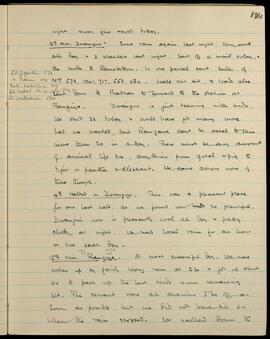
night, and was fine and cool today.

Lil. giganteum 573
n. nanum 1041
Noth. bulbulifera 717
Lil. nepal. var concolor 553
Lil. wallichianum 564

12th Nov. Diwangiri - Some rain again last night. Very cool all day and 3 blankets last night. Sent off a mail today, and the bulbs to Ramsbottom. In one parcel sent bulbs of Nos 573, 1041, 717, 553, 564. Half our kit, 19 loads also sent down to Pradhan to forward to the station at Rangiya. Diwangiri is just teeming with birds. We shot 23 today and could have got many more had we wanted, but Ramzana can't be asked to skin more than 20 in a day. There must be any amount of animal life too, anything from goral and pig to tiger or panther and elephant. We came across none of these though.

14th Halted in Diwangiri: This was a pleasant place for our last halt, as we found new birds so plentiful. Diwangiri now is pleasantly cool all day and pretty chilly at night. We had local rain for an hour or two each day.

15th Nov. To Rangiya. A most successful day. We were woken up by fairly heavy rain at 2.30 and got up about 4.0 to pack up the last birds and our remaining kit. The servants were all anxious to be off as soon as possible, but we did not leave till 6.0 when the rain stopped. We walked down to

LSH/1/1/2/1/125 · Part · 1933-07-18
Part of The Ludlow & Sherriff Collection

SUMMARY:
After descending about 1000 ft and collecting butterflies, the party reached Dongkar where a load fell off a bridge; Purbo later recovered the tent two miles downstream after nearly drowning. They enjoyed fine views and a garden-like camp, noted abundant Delphinium grandiflora and borage, observed Ramzana’s meagre condition after fever at Tsuna, and outlined transport changes from Bhutan via Mago toward the Cho La and Shingbe.

CONTENT:
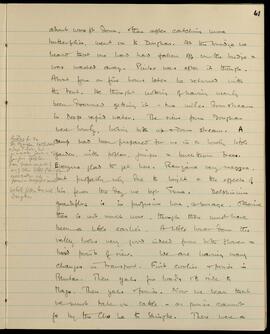
about 1000 ft down, then after catching more butterflies, went on to Dongkar. At the bridge we heard that one load had fallen off on the bridge and was washed away. Purbo was after it though. About four or five hours later he returned with the tent. He thought nothing of having nearly been drowned getting it - two miles downstream in deep rapid water. The views from Dongkar were lovely, looking both up and down stream. A camp had been prepared for us in a lovely little "garden", with poplar, juniper and buckthorn trees. Everyone glad to get here. Ramzana very meagre, but probably only due to height and the effects of his fever the day we left Tsuna. Delphinium grandiflora is in profusion here, and borage. Otherwise there is not much now, though there must have been a little earlier. A little lower down the valley looks very good indeed from both flower and bird points of view. We are having many changes in transport. First coolies and ponies in Bhutan. Then yaks for loads and to ride to Mago. Then yaks and ponies. Now we hear that we must take on cattle - as ponies cannot go by the Cho La to Shingbe. There were a

[Marginal notes:]
Ludlow p. 92
D. grandiflorum has produced a large and blue flower in a water garden in a garden from Bhutan.
From grass carpets with blue Delphinium flowers, wild aster etc. form a delightful sward.
We both fell in love with Dongkar.