Showing 4 results

Archival description
4 results with digital objects Show results with digital objects
LSH/1/1/6/1/19 · Part · 1938-03-21
Part of The Ludlow & Sherriff Collection

SUMMARY:
Accounts of a sandy riverbank camp below Chora with severe winds and a night-long dust storm, alongside observations of large numbers of geese and cranes. The following day they travelled by kowa to Tsetang amid gale conditions, waited at a ferry while Puibo sought transport, saw many geese near the ferry, and found poor lodgings in town with loads from Tamalung still missing.

CONTENT:
2:00 pm, putting up tents for a change. It is a good camp, but very sandy.

22nd March. Camp on R. bank. 9 hours in kowa below Chora. Yesterday evening was most interesting. We sat outside our tents and watched geese, duck, crane and Brahminy flighting in low over our tents. After dark there must have been hundreds of geese, in the morning we counted over 170 crane. During the flight, crane came in by 30-40 at a time: we have never seen so many together before. Altogether this was a very nice camp and we were comfortable in tents again but a bit cold. Today was fine again, but more windy. By the evening there was a terrific dust storm blowing. We landed at the only place where there were no sand dunes and pitched tents. By 6:00 pm the wind died down and we thought all was well. Up till then the wind had been very strong down the valley. By 10:00 pm the wind got up and blew very strongly indeed dead up the valley, and it continued to do so for the whole night, with the result that we had not a wink of sleep and were covered thick in sand by the morning.

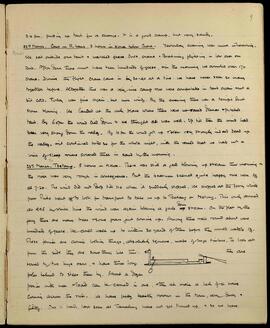
23rd March. To Tsetang. 5 hours in kowa. There was still a gale blowing up stream this morning and the river was very rough in consequence. But the boatmen seemed quite happy and we were off at 7:20. The wind did not drop till 11:00 when it suddenly stopped. We stopped at the ferry while poor Puibo went off to look for transport to take us up to Tsetang or Netong. This only arrived at 4:45 by which time the wind was again blowing a gale down stream. On the flat by the ferry there are many trees and some grass just coming up. Among these all round about were hundreds of geese. We could walk up to within 30 yards of them before they would waddle off. These ferries are comic looking things, absolutely square, made of huge timbers. To look at from the side they are something like this: they are steered by two huge oars, and have three long poles behind to steer them by. About a dozen ponies with men and loads can be carried in one, and they all make a hell of a noise coming across the river. We have pretty beastly rooms in the town, very dusty and filthy. Our 11 loads, last seen at Tamalung have not yet turned up, and so we have
LSH/1/1/2/1/191 · Part · 1933-09-22
Part of The Ludlow & Sherriff Collection

SUMMARY:
Halted in rain; the Jongpen asked to go to Trashigang for dancing during a Bhutan festival called Tü, and with few flowers or ferns left they began collecting fungi. The next day, still halted at Rocha Chu in heavy rain, the party split up to hunt “binain dum” birds, with Puibo, Ludlow, and Danang taking different guns and achieving mixed results, including a shot that struck both the bird and the narrator.

CONTENT:
94

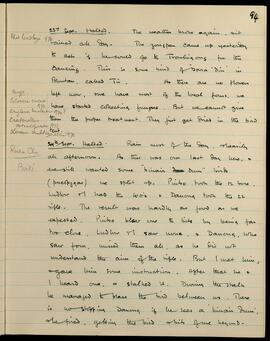
23rd Sept. Halted. The weather broke again, and it
Rhod. lindleyi 976 rained all day. The Jongpen came up yesterday
to ask if he could go to Trashigang for the
dancing. This is some kind of 'Bara Din' in
Bhutan, called Tü. As there are no flowers
Fungi. left now, and we have most of the local ferns, we
Calocera viscosa 973 have started collecting fungus. But we cannot give
Amylaria himalaica 974? them the proper treatment. They just get dried in the bird
Craterellus cornucopioides 977 tent.
Stereum multizonatum 978

24th Sept. Halted. Rain most of the day, and heavily
Rocha Chu all afternoon. As this was our last day here, and
Birds we still wanted some "binain dum" birds
(puepygas) we split up. Puibo took the 12 bore,
Ludlow and I had the 410's and Danang took the 22
rifle. The result was hardly as good as we
expected. Puibo blew one to bits by being far
too close, Ludlow and I saw none, and Danang, who
saw four, missed them all, as he did not
understand the aim of the rifle. But I met him,
and gave him some instruction. After that he and
I heard one, and stalked it. During the stalk
he managed to place the bird between us. There
is no stopping Danang if he sees a 'binain dum',
and he fired, getting the bird and bits of me beyond.

LSH/1/1/2/1/205 · Part · 1933-10-05
Part of The Ludlow & Sherriff Collection

SUMMARY:
The diarist reports a serious epidemic to the south in Shinga Dzong, thought by Puibo to be influenza though possibly typhoid. While halted at Sana, Ludlow treated a Tibetan man's abscess and ongoing dressings improved his condition amid rainy weather and delays awaiting mail.

CONTENT:
101

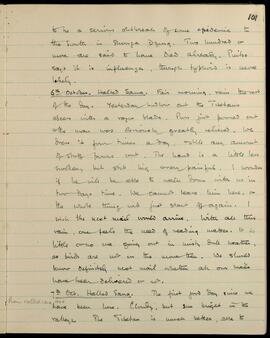
to be a serious outbreak of some epidemic to
the south in Shinga Dzong. Two hundred or
more are said to have died already. Puibo
says it is influenza, though typhoid is more
likely.

6th October. Halted Sana. Fair morning, rain the rest
of the day. Yesterday Ludlow cut the Tibetan's
abscess with a razor blade. Pus just poured out
and the man was obviously greatly relieved. We
dress it four times a day, and still any amount
of stuff pours out. The hand is a little less
swollen, but still big and very painful. I wonder
if he will be able to walk down with us in
two days' time. We cannot leave him here, or
the whole thing will just start off again. I
wish the next mail would arrive. With all this
rain, one feels the need of reading matter. It is
little or no use going out in misty dull weather,
as birds are not on the move then. We should
know definitely next mail whether all our mails
have been delivered or not.

7th Oct. Halted Sana. The first good day since we
have been here. Cloudy, but sun bright in the
valleys. The Tibetan is much better, able to

Phylloscopus affinis wallichiana 10000

LSH/1/1/5/1/11 · Part · 1935-11-27
Part of The Ludlow & Sherriff Collection

SUMMARY:
The writer describes a steep forested path to the clearing at Surelakha, notes the absence of rhododendrons, and seeks directions to the Black Mt. Locals suggest Shamgong Dzong and mention the name Dungshigon; Puibo explains that 'gon' means a range. The headman proposes reaching Nabsigaon or Nabsikorbhu in two days and then the Black Mt. in another two, though transport may be difficult, with only shepherds operating in the area.

CONTENT:
Surelakha Albizzia Sherriff 27 Nov 1935

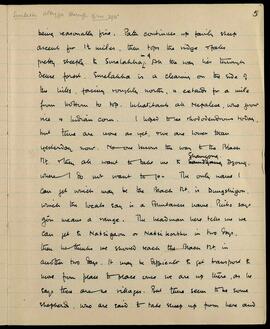
being reasonably fine. Path continues up fairly steep ascent for 1 1/2 miles, then tops the ridge and falls pretty steeply to Surelakha. All the way lies through dense forest. Surelakha is a clearing on the side of the hills, facing roughly north, and extends for a mile from bottom to top. Inhabitants all Nepalese, who grow rice and Indian corn. I hoped to see rhododendrons today, but there are none as yet, we are lower than yesterday now. No one knows the way to the Black Mt. They all want to take me to Shamgong Dzong, where I do not want to go. The only name I can get which may be the Black Mt. is Dungshigon, which the locals say is a Bhutanese name. Puibo says gon means a range. The headman here tells me we can get to Nabsigaon or Nabsikorbhu in two days, then he thinks we should reach the Black Mt. in another two days. It may be difficult to get transport to move from place to place once we are up there, as he says there are no villages. But there seem to be some shepherds, who are said to take sheep up from here and