Showing 13 results

Archival description
13 results with digital objects Show results with digital objects
LSH/1/1/2/1/159 · Part · 1933-07-18
Part of The Ludlow & Sherriff Collection

SUMMARY:
The author discusses hopes that the monsoon is ending, tests a walking stick gun for use in dense jungle, and worries about overdue mail and poor arrangements by the Trashigang Dzongpen. On 28th August they march 9 miles to Lao, experiencing fine weather until late morning followed by heavy rain and returning to the leech zone.

CONTENT:
78

eggs & beans & potatoes, all very welcome, as we had none left. I now tell Ludlow that this is the end of the monsoon. As a rule it is he who is so optimistic about the weather. After such a heavy monsoon to start with, it might quite likely finish off early, though I hardly believe it myself. Ludlow tried the walking stick gun yesterday & found it distinctly dangerous. But after peeling all the outer covering away, I found it very good this morning. Perhaps after all it will come in useful. Something of the sort is needed in the very thick low jungle in which many of the most interesting birds live. It is time Pimbo came back; he must have found the road in worse condition than he expected. There are several bridges down we know. The non-arrival of any mail is very worrying. We should have had two since reaching here, but have had none, nor any news of them. The Trashigang Dzongpen was so optimistic about everything, but his arrangements seem to have been pretty bad.

28th August. LAO. 9 miles. 9203' (B.P. 195.6° Temp 60°).

Fine till 11.0 am then heavy rain most of the day. Back into the leech zone with a vengeance. As soon as we
LSH/1/1/2/1/107 · Part · 1933-07-18
Part of The Ludlow & Sherriff Collection

SUMMARY:
After bathing at the hot springs, the party received gifts from the Maharaja via eight men from Bumthang, including rice, butter, cloth, a dagger, silver lime boxes, and potatoes, with plans to return the cloth to Trashigang. Flower collecting has been modest, and they expect to write multiple letters of thanks. Pimbo probed why locals discouraged their movements, learning it may be due to fears of them digging for valuables and disturbing earth spirits.

CONTENT:
a bath at the hot springs. There are several places banked up to make it possible to sit in water 2 ft deep, just as hot, or hotter, than one likes. I felt much better after a good bath. When we came back we found that a party of 8 men had arrived with presents from the Maharaja & Co in Bumthang. They brought 2 maunds of rice, 2 maunds of butter(!), about 3 maunds of cloth of various kinds, a dagger, silver lime boxes and a maund of potatoes. We kept all but will return the cloth to Trashigang by the same people. We have not done much in the way of flower collecting between us. I think we have perhaps 6 or 8 good things collected in these six days. However we have found out a good deal about the country and something of the people. The worst about the presents is that they mean that tomorrow we must write to Bumthang no less than seven letters of thanks each! Pimbo has been trying to get to the bottom of why these people have been doing their utmost to put us off wandering about the countryside. The only likely true answer he can get, is that they were afraid we would try to dig up 'pearls' or gold or other valuable stones, and so, of course disturb the earth spirits. Beyond that I think

LSH/1/1/1/1/165 · Part · 1933-09-24
Part of The Ludlow & Sherriff Collection

SUMMARY:
Notes damp weather, farewell to Pimbo, Kuntip, and Danong while taking on Tenduk, with praise for the Bhutanese workers; Tenduk will help with Kusho until the party returns to Sikkim. Describes dry, treeless country, the Kuru Chu gorge near Lhakang and its several local names, steady progress by coolies including many women wearing the Lhassa head dress, and few notable flowers or birds. A margin note mentions reunion at Yatung on Oct 3.

CONTENT:
81

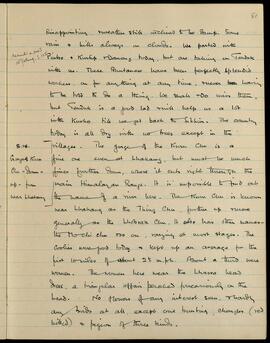
Disappointing, weather still inclined to be damp. Some rain & hills always in clouds. We parted with Pimbo & Kuntip & Danong today, but are taking on Tenduk with us. These Bhutanese have been perfectly splendid workers, on for anything at any time, never having to be told to do a thing. We shall miss them, but Tenduk is a good lad will help us a lot with Kusho till we get back to Sikkim. The country today is all dry with no trees except in the villages. The gorge of the Kuru Chu is a fine one even at Lhakang, but must be much finer further down, where it cuts right through the main Himalayan Range. It is impossible to find out the name of a river here. The Kuru Chu is known near Lhakang as the Thing Chu, further up more generally as the Lhobrak Chu. It also has other names - the Mo chi chu & so on, varying at most stages. The coolies were good today & kept up an average for the first 10 miles of about 2 1/2 m.p.h. About a third were women. The women here wear the Lhassa head dress, a triangular affair perched precariously on the head. No flowers of any interest seen, & hardly any birds at all, except one bunting, choughs (red billed) & pigeon of three kinds.

reunited on Oct 3 at Yatung. S. 105
B. 26. Gorge of Kuru Chu - down

LSH/1/1/2/1/163 · Part · 1933-08-30
Part of The Ludlow & Sherriff Collection

SUMMARY:
Camped at Tobrang in the Bashiyang Valley, the party plans a seven-day stay, dismisses the coolies, and notes leech problems and severely disorganized mail. Pimbo goes to T'gong to investigate the missing mail, while the diarist spends the day birding near camp and reports Ahmed Sheikh’s quick recovery. Heavy Bhutan–Tibet barter traffic is observed, and plant collections are listed.

CONTENT:
business in the morning, when he put it on.
This place is by no means free of leeches. It was last year, but we had a dry spell here then. We have decided to put in seven days here & have dismissed the coolies, paying them 2 tankhas a day. Pimbo has gone off to T'gong to find out what has happened to our mail if he can. It is completely disorganised, & we are getting no mail up at all. It seems very doubtful whether any mail is reaching Kumarikhata either, which is a serious matter.

Bashiyang Valley.
Tobrang
Aug. 30
Osbeckia capitata 913
Crotalaria capitata 914
Selaginella chrysocaulos 915
Erythrina arborescens 916
Impatiens 918
Adenophora khasiana 920
Shuteria ferruginea 919
Apios carnea 921
Didymocarpus pulchra 923
Inula nervosa 924
Phytolacca acinosa 926

30th August. Halt Tobrang. Fine most of the day.
Spent the day looking for birds in the jungle close to camp. There are any number of good birds about, but they are extraordinarily difficult to get, owing to the thick undergrowth. Ahmed Sheikh made a very quick recovery, being perfectly all right again in the morning. At the moment all seem to be pretty fit. This is the time that all the barter is done between Tibet & Bhutan, & we have seen hundreds of Bhutanese going up to Tibet with cloth etc, & returning with Tibetan cloth & salt. Men & women both carry great loads which must be

LSH/1/1/5/1/115 · Part · 1933-06-14 - 1933-06-16
Part of The Ludlow & Sherriff Collection

SUMMARY:
Heavy rain flooded the camp at Phobsikha, mail was sent via Adao and Chirang, and plans were made to proceed to Dungshinggang. Pimbo fell ill and was left behind with quinine and aspirin to rejoin later. On 16 June they reached Camp Tsophup near Dungshinggang amid hail and rain, noting Primula pusilla near camp.

CONTENT:
valley, certainly has nothing of interest in the open part of it. Even
P. erythrocarpa, so big elsewhere, is dwarfed here on the red soil.

14th June. Halt. Phobsikha District

15th June Halt. Phobsikha District. Yesterday was an awful day. It rained all
night & swamped the whole camp, soaking all the servants' bedding.
It poured equally hard all day & all last night. Today has been
really very nice, & has been fine & sunny all afternoon. I spent all
the time writing a mail, & have just sent it off via Adao & Chirang.
We go on tomorrow to Dungshinggang. Pimbo has fever, & I am
leaving him behind tomorrow, to come on with the coolies on 21st if
he is fit. He is not very bad, but has pains, some fever, &
'chukkas'. I hope he recovers. He will remain with a bottle of quinine &
of aspirin. onto Black Mt - Dungshinggang

16th June. Camp Tsophup. Dungshinggang 10 miles. Ht. approx. 14,000'. Very much
to our surprise, it was fine in the morning, & was really lovely
till about 9:30, when there was a sudden very heavy hailstorm.
After that rain & bright intervals alternated. We did not see
much coming up, & a little primula I had marked down
before, hardly seemed to have moved. But I found a few of it
near camp, it is P. pusilla. Then in the little gully where the

LSH/1/1/4/1/119 · Part · 1933-09-24
Part of The Ludlow & Sherriff Collection

SUMMARY:
Diary entries record fine weather, observations of flowering Gentiana and seed collecting of Primula species around Kyimpu Halt and Le La. On 4 October the author moves to a camp north of Drichung La, parts from Ludlow and Lumsden, and continues with Ahmad Sheikh, Tsongpen, and Pimbo toward Trim while continuing seed collections.

CONTENT:
Scrophularia & Codonopsis vinciflora. Androsace not yet ripe, & G. waltonii is in full flower.

2nd October. Kyimpu Halt. A fine day with sun all day. The Drichung La has a lot of snow, but it should soon go with this sun. Went up to the Le La, & saw G. amoena in full flower. Got a fine haul of seeds of P. nivalis (macrophylla?) & a similar higher altitude one. Most are barely ripe yet, as P. cawdoriana, P. rotundifolia. A little Mec. bella found.

3rd October. Kyimpu Halt. A perfect day, even the hills being clear of cloud almost all day. Stayed in camp & dried & packed seeds.

4th October. Camp N of Drichung La. 15000'(?) 7 miles. Fine, but cloudy except from 8.0 am till 1.30 pm. Quite a good day for seeds again, but P. cawdoriana is not yet ripe. Left Ludlow & Lumsden behind, will next see them in India, at Dirang Dzong about the end of November. Ahmad Sheikh & Tsongpen accompany me, & Pimbo as far as Trim to make the bandobast. Seeds of P. nivalis sp very common & ripe 2719. They are the same as the Le La seeds 1561(2). Also a Primula like P. atrodentata, but I think perhaps different 2722. Snow lies about 500 ft above camp, & thence to the top. I handed over my gun

LSH/1/1/3/3/115 · Part · 1933-04-09
Part of The Ludlow & Sherriff Collection

SUMMARY:
Notes from Lung describe a rough track above the right bank, forested slopes, and village/camp spots, with few flowering Primula and nearly finished Rhododendron, comparing the area unfavourably to Natrampa. The next day at Lung, the party halts and splits up, sending Pimbo and Danong to inspect the route up the Char Chu.

CONTENT:
Lung April 28th
Paeonia lutea var. ludlowii 1376
Prim. whitei 1379
Rhod. arizelum 1380

The path is no more than a track, not made in any way. It leads down stream, usually keeping about 300 ft above the right bank. In places it goes over rock slides, in others through forest of fir & pine. On the whole it is not difficult, & is in pretty good order. At m. 5 the Char Chu comes in from the north, through a very narrow steep gorge. M 6 Lung, consisting of four stone houses, with wood roofs is passed. The valley opens out a little & there is some cultivation at m 7 where camping is good & water excellent. The right bank is wooded throughout with pine & fir; a lot of burning has been carried out, though why it is difficult to say, as there appears to be plenty of ground suitable for cultivation down here - more level & more suitable in every way. So far Lung has not come up to expectations. We have found one primula, over, some rhododendron also very nearly finished. I don't think it can be so good as Natrampa, but will have a better look tomorrow.

29th April. Halt Lung. We split up into three parties today. Pimbo & Danong to inspect the route up the Char Chu: Ludlow

LSH/1/1/5/1/23 · Part · 1935-11-27
Part of The Ludlow & Sherriff Collection

SUMMARY:
At Nabzi (4600 ft) on April 30th, after fine weather turning to rain by noon, Pimbo fetched the local Kazi, who agreed to arrange a trip to a pass towards the Black Mountain. A brief search along the Trongsa path yielded few plants, while notes describe how the Jirgang Chu joins the Mangde Chu near Byiti Sam and outline routes via Nabzi Kortha and the Trashi La.

CONTENT:
Jirgang Chu Valley R. Arboreum 2800. 11

April 30th Nabzi 4600ft. Fine all yesterday and last night, but rain by 12 noon today. The local Kazi did not come up yesterday, so Pimbo went down for him today and brought him back.

I went out along the Trongsa path, but although the country looks wonderful - or would be 1500' higher - we found little but some ferns. A man said there were primulas along the bunds of the fields, but not yet out - red, yellow and white. But we can see no sign. When I asked the colour of some irises at the same place, he said they were red, white, yellow and blue, all from the same plant, so I can't put much weight in what he says.

The Kazi has just been down, and he says he will arrange for us to go up to a pass, towards the Black Mountain. Beyond that he knows nothing of the country. This is good, and I hope we will get into some good country.

The Jirgang Chu flows to the Mangde Chu, joining it about 3 miles above BYITI SAM (Bitana Sang). Shamgong Dzong is about 3 miles above BYITI SAM. The road to Byiti Sam goes via Nabzi Kortha over the Trashi La, 3 m beyond and then down a valley to the Mangde Chu. The Trongsa road goes along

LSH/1/1/3/3/123 · Part · 1933-04-09
Part of The Ludlow & Sherriff Collection

SUMMARY:
Notes on flowering rhododendrons, a yellow peony, tsuga, and firs; Danong and Tenduk scout south towards the Karhongla, sending back rhododendron and Primula roylei specimens. The diarist struggles with photography, and Pimbo injures his leg and needs a stitch.

CONTENT:
on the way back here, except that rhododendrons have come on a good deal. And the fine yellow peony (Paeonia lutea var. ludlowii) 1376, is more in bloom too, shows very handsome. I took a number of seeds from it today. I also noticed some fine Tsuga brunoniana trees. Mostly the higher slopes seem to be covered with two firs (Picea spinulosa), which I have collected under Nos. 1395 and

Danong & Tenduk go up the hills to the South for the next two nights. The country looks good & should contain something worth while. There is a path leading from Dotrang to the Karhongla, on the South side of which they say there are many Lopas.

Natrampa. 2nd May. Halt. Last night Danong sent back the first fruits of his excursion - a rhododendron, which I think we had seen before, and a primula (Primula calderiana 1396). The latter is P. Roylei, one of the finest there is to my mind. I have photographed it today, & made a most awful hash of my photographs, doing everything possible wrong that I could. However after ruining five precious films, I got a good one, & also of that queer little rhododendron, No. 1355 (Rhododendron glaucophyllum). Pimbo cut his leg rather badly the other day, & had to have a stitch in it, is pretty lame now. There are

LSH/1/1/4/1/183 · Part · 1933-11-09
Part of The Ludlow & Sherriff Collection

SUMMARY:
At Nyingsang La the party gathered several rhododendrons between the north and south passes, noted Primula boothii in bud, and faced difficulties with a pony while traveling from Tsona via Tawang. Sanders felt cold compared to October 1934, and Pimbo ensured rapid travel; on the 14th November halt they dried rhododendron seed and briefly collected a small epiphytic rhododendron.

CONTENT:
Nyingsang La. 2850, 2849. Rh. camelliiflorum 2845, fulgens 2846, Thomsonii 2847, Rh. 2848, campanulatum 2851 (203)

Nyingsang La. 2850g.
La. we got another 3 or 4 rhododendrons & several more between the N pass & the S one, none epiphytic shrubs from this side. No flowers seen. I started to ride, but gave up after one hour as the pony could not carry me & barely go on itself. Sanders feels pretty cold, but not nearly so cold as in Oct. 1934. On the way up the north side, we saw a lot of Prim. Boothii, but just small buds very densely covered with thick yellowish farina. Pimbo has done well to get us here in 5 days from Tsona, and with no later arrival than 4.30 at Tawang & here. These are both long marches, with a lot of climbing in them.

14th November. Halt. A beautiful morning, clouds coming up by midday, mist low in the evening. Spent the day drying yesterday's rhododendron seed, and only out a short time, getting one small epiphytic rhod (2853) [R. camelliiflorum 2853, 2852], the flower of which we collected in March, & a