Showing 35 results

Archival description
35 results with digital objects Show results with digital objects
LSH/1/1/9/1/74 · Part · 1949-06-15
Part of The Ludlow & Sherriff Collection

SUMMARY:
Relentless monsoon rain at Haeth leads to a day of packing flowers and preparing to return to Pangotang, with a brief outing to collect mulch and attempt monal photography/hunting in poor conditions. The party then marches back to Pangotang in continuous rain, finds dwarf rhododendrons in bloom, and notes frustration that Pasang hesitates to press specimens.

CONTENT:
12th June - Haeth. This is undoubtedly monsoon. It still has not stopped raining, the rain has been very hard indeed. At any rate it must bring out the flowers, that is the best way of looking at it. I'm not going out today, but packing up all my flowers there are, & getting ready to leave tomorrow, back to Pangotang by the same way as we came. I fear we will have about the same view as when we came too - in the mist the whole way. I wonder how Betty will manage this weather, though Lloyd said she has a big comfortable tent.

Later. Still no let up even by tonight, it looks like going on for a month. I did go out eventually, & picked up some mixed mulch. Then after that I took out Tundra - P. & took my gun camera with telephoto lens in. We were after monal, & I should have got 2 quite nice pictures of cock monal provided the light was good enough, & my focus correct; both were difficult to judge & the rain very hard. I have never been near monal so long before. I had a shot but missed unfortunately, as P particularly wanted some meat. I think I eat less than anyone in that line here, though I have had a couple of tins of bully beef.

13th June. Pangotang. Back again to our old camp, but on a soaking wet day; rain without pause again all the day. And although the dwarf rhodos were out now, still the march never seemed interesting, & we got nothing. I sometimes wonder how what I have missed, just because Pasang has no idea of what he sees, & is afraid of putting something in the press which may not be wanted. I've told him many times not to think of that, but put in the press anyway. The worst that can...
LSH/1/1/9/1/102 · Part · 1949-07-12
Part of The Ludlow & Sherriff Collection

SUMMARY:
The writer treats a yakherd's child who broke his arm after falling from a sheep, applying a splint and dressing blisters. On 15 July they halt in thick mist and rain; Pasang and Gyundon also stay, men arrive from Pangstang with mules, there is no letter from Betty, and Ngudup cannot obtain information on the route. On 16 July they march to Namdating in persistent mist and rain via the Kyikyi Tsom La, descending between lakes at the head of the Chachuka valley towards the Tsangpo valley.

CONTENT:
to the Drolma Shöki La. It is much colder now than a month ago, and they will be pretty chilly when they come in. A woman came down from the yakherds upstream, with her child aged about 6. The poor kid had been riding a sheep (!) and had fallen off and broken his arm - about 3 days ago. It had been tied up with some moss, very tightly, which made things worse by strangling the arm and causing large blisters. I don't know what they had put on. I doubt if I did much good, but I put a splint on and dressed the blisters.

15th July. Halt. Thick mist and rain. Stayed in camp again, so did Pasang and Gyundon. We are all tired of this place, and will be glad to move tomorrow morning over the pass leading to the Tsangpo valley. Several men have come up from Pangstang, with I think the Druk Locha's mules, to graze above here. I hoped anyone coming up now might have brought a letter from Betty, but there is none. All coolies have turned up this evening. I still can't get any information about where we are going to. Someone must know, but Ngudup either won't or can't extract any useful information - the same difficulty as one always has on first going to a place.

16th July. Namdating. From 5:45 to 1:30 pm. Mist all day, rain on top. This was a queer march, and I'm not quite sure yet where we are. First we went up the valley opposite camp; over the side to the south to the next valley, down into that and steep up again to the Kyikyi Tsom La. The first pass would be about 15,000' and the Kyikyi Tsom La about 15,500. Then down rock scree and grass hillside to between two fine lakes at the head of what I had previously seen was the Chachuka valley. This is the one I went up on 1st July; the lower lake was the one I just

LSH/1/1/9/1/80 · Part · 1933-06-19
Part of The Ludlow & Sherriff Collection

SUMMARY:
A halt day with damp conditions; the diarist photographed and tended drying flowers, and noted Tibetans trading salt, wool, and cloth at Pangstang with rice sent to Towa Dzong. On 20th June they crossed the river to inspect west-side cliffs, where few plants were in flower; Pasang collected P. muscoides, and P. strumosa was confirmed with notes on its hybridization with P. calderiana.

CONTENT:
about 5 feet across, stopped 50 yards above camp. So back we went to bed. The boys were out across the river down below, but had a poor day, got nothing. I did some photographs in the morning, changed flowers and that is about all today. Flowers take much longer now to dry. The atmosphere is always damp, and our fire is not so good in the tent as in the huts we've been used to. I'm told now that many Tibetans will be coming down in the next few days, with salt, wool and woollen cloth. They exchange at Pangstang for madder mostly, and some rice. But more of the rice is H.H.'s and Her H.'s and other officials, all is sent to Tibet for sale in Towa Dzong and other places.

20th June Halt. It was misty and doubtful when we got up at 5:30 this morning, but there was a clear patch of blue sky to the south, which I was sure would mean a good day. But we didn't go straight for the pass. I wanted to investigate the cliffs on the West side as soon as we could cross the river which we did about 9:00 a.m. But there was very little indeed in flower. Mec. horridula had not opened its buds at all. P. bellidifolia was common, and Pasang got P. muscoides (19303) to add to the list. I had seen a yellow mass through binoculars and went to find out what that was. It turned out to be P. strumosa (19304), and I now know that all the colour varieties we found before were hybrids of Calderiana and strumosa as I supposed. What is interesting is that P. strumosa has the exact same unpleasant smell as Calderiana has, which would seem to put it nearer P. Calderiana than ever. There is no doubt they are the parents of all the mixed colours around here... It was a fine day after the first

LSH/1/1/10/1/9 · Part · 1949-09-14
Part of The Ludlow & Sherriff Collection

SUMMARY:
The diarist notes many migratory birds from Tibet and poor seed results except likely from Marlung or passes to the west. On 21 Sept., they remain in camp while Yundon and Pasang collect Primula caveana and a fine woolly Phandra from Tamagorra Nala, returning late and exhausted, with Yundon suffering a bad headache. On 22 Sept., amid cold wind and intermittent rain and sun, letters arrive from H.H. and mail from Hicks and Ludlow, but none from Betty.

CONTENT:
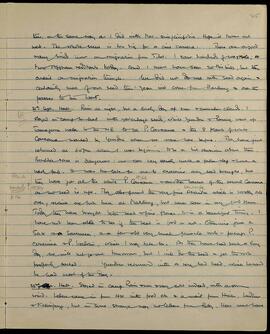
This, in the same way as I did with Mec. simplicifolia. Hope it turns out well. The whole scene is too big for a cine-camera. There are a good many birds now on migration from Tibet. I saw hundreds of wagtails and two Afghan redstarts today. And I must have seen 20 Ibisbills, but they aren't on migration though. We did not do well with seed again, and certainly most of our seed this year will come from Marlung or over the passes to the West.

21st Sept. Halt. Rain at night, but a lovely day of sun and cumulus clouds. I stayed in camp to deal with yesterday's seeds, while Yundon and Pasang went up Tamagorra Nala to the NE to get P. caveana and the 8 plants of white caveana marked by Yundon when we were here before. They have just returned at 6:00 pm when I was beginning to be a bit anxious about them. Boulder scree is dangerous: one can very easily make a false step and have a nasty fall. It was too late for me to examine any seed brought, but they have got all the white P. caveana, and another basket of the usual caveana as no seed is ripe. They also found the very fine Phandra which is woolly all over, and which we took twice at Marlung, but never saw in very good flower. Today they have brought both seed and fine flower. It is a beautiful thing. I have not been able to see if the seed is good or not. Otherwise just a Sax or a Saussurea, and a few odd very small primula roots - perhaps P. cervicina or P. walshii, which I may take too. As they have had such a long day, we will not go out tomorrow, but I will do the seed and get the roots properly packed. Yundon returned with a very bad head, which he said he had most of the day.

22nd Sept. Halt. Stayed in camp. Rain and sun very cold indeed, with a strong wind. Letters came in from H.H. with food etc and a mail from Hicks, Ludlow and Kalimpong, but in some strange way no letters from Betty. Hers must have

LSH/1/1/9/1/33 · Part · 1949-05-06
Part of The Ludlow & Sherriff Collection

SUMMARY:
A local messenger is sent over the Sebri La to Charkakora to arrange a meeting at Pangkar. After heavy rain, the Kuomo Chu bridge is washed away; two Tibetans visit from Tsari Chikchar, Pasang departs for Julu to collect mice, and Ngudup recounts a recent landslip that killed 11 people. The following day brings more rain, little of botanical interest, and hopes for a letter from Betty.

CONTENT:
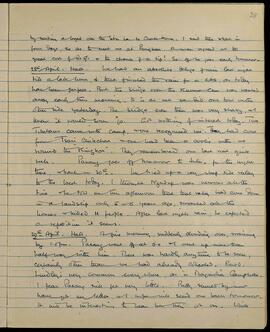
by sending a local over the Sebri La to Charkakora. I said then back in four days, so as to meet me at Pangkar. A man agreed at the great cost of Rs 7/- + the chance of a tip! So off he goes early tomorrow.

28th April. Halt. We had an absolute deluge of rain last night till a late hour, & that finished the rain for a little, as today has been perfect. But the bridge over the Kuomo Chu was washed away early this morning. It is as well we did our tour on the other side yesterday. The bridge even then was very shaky, & I knew it would soon go. Got nothing of interest today. Two Tibetans came into camp, & one recognized me. They had come from Tsari Chikchar, & one had been a coolie with me round the "Kingkor". They remembered our last visit quite well. Pasang goes off tomorrow to Julu, for the mice there, & back on 30th. We tried up a very steep side valley to the west today. I thought Ngudup was nervous all the time, & he told me this afternoon that that valley had come down in a landslip only 5 or 6 years ago, smashed all the houses & killed 11 people. After last night's rain he expected a repetition it seems.

29th April. Halt. A fine morning, suddenly clouding over, & raining by 1.0 pm. Pasang went off at 6.0 & I went up more than half way with him. There was hardly anything to be seen, certainly other than we had already collected. Rhod. Lindleyi very common everywhere, as is Magnolia Campbellii. I fear Pasang will get very little. Betty should by now have got my letter, & I hope will send one back tomorrow. It will be interesting to hear how they got on. While

LSH/1/1/9/1/88 · Part · 1933-06-11
Part of The Ludlow & Sherriff Collection

SUMMARY:
The author reports rapid wear of shoes, sends mail, and has Pasang and Mundra go to Shasjebang, expecting their return on 1 July; letters from Betty include Chuni’s quip about B.J.’s impending child. On 29 June a halt is kept with some rain; photos are developed, stores rearranged ahead of moving toward Bumthang, Lhakpa washes clothes, fleas are dealt with using DDT, and observations are made on late flowering and snow conditions near Me La.

CONTENT:
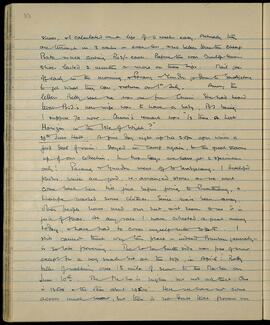
shoes, I calculated on a life of 6 weeks easy. Actually they are through in 3 weeks or even less, and better than the cheap Bata muck costing Rs 2/- each. Before the war Dunlop tennis shoes lasted 2 months or more on these trips. Mail went off early in the morning, Pasang & Mundra go down to Shasjebang to get what they can, return on 1st July. Among the letters Betty sent me was one from Chuni. She had heard that B.J.'s new wife was to have a baby, B.J. being I suppose 70 now. Chuni's remark was "Is there a Lost Horizon in the Isle of Wight?"

29th June Halt. A fine day right up till 2.0pm, after which a good deal of rain. Stayed in camp again, to the great showing up of our collection. In two days we have got 2 specimens only! Pasang & Mundra went off to Shasjebang. I developed photos, which are good, re-arranged stores, as we won't come back here till just before going to Bumthang, & Lhakpa washed some clothes. Since we've been away, other people have used our hut, so it seems to me it is full of fleas. At any rate I have collected a great many today, & have had to cover myself with DDT. I still cannot think why this place - indeed Bhutan generally - is so late flowering. The Lola Smith side was free of snow except for a very small bit at the top, in April. Betty talks of walking over 1 1/2 miles of snow to the Me La on June 10th. The Me La is higher, but not all that. One is 13500 & the other about 14500'. Here we have not come across much snow, but there is no doubt that flowers on

LSH/1/1/10/1/19 · Part · 1933-10-01
Part of The Ludlow & Sherriff Collection

SUMMARY:
Clear, frosty day at Amelungnang with notes on Hicks needing to cross the Rudo La in Bhutan. The writer reflects that the Dhur Chu area would have yielded better flowers than Waitang, noting climatic differences after crossing the Tolegang La; Pasang and Yundru arrived later with a good haul of seed despite a foot of snow on boulder scree, and there was disappointment regarding Mec. bella near the Sin La.

CONTENT:
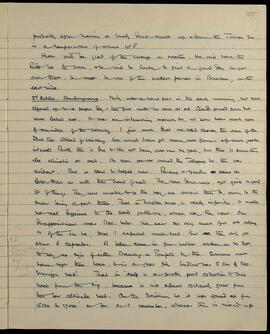
probably, after having a lonely duck swoosh up and down the Tumen Su in a temperature of about 10° F.

Hicks will be glad of the change in weather. He will have the Rudo La to cross, and he will be lucky to find a good day to get over that. It must be one of the wetter passes in Bhutan, on the east side.

3rd October. Amelungnang. Misty, with a hard frost in the early morning, but soon cleared up to a perfect day - the first with no rain at all. Clouds formed soon but never looked wet. It was an interesting march, too, and I now have much more of an idea of the country. I just wish that we had chosen the area of the Dhur Chu instead of Waitang. We would have got many more flowers and of much greater interest. Partly this is due to the area not being overrun by yaks, but there is something else climatic as well. As soon as we crossed the Tolegang La, this was evident. But it can't be helped now. Pasang and Yundru came on later than us with their haul of seed. They have done well, and got quite a good lot of things. They were unable to go the way we meant them to, owing to the snow being a foot thick. That on boulder scree, is really impossible. It made no real difference to the seed gathering, which way they went. One disappointment was Mec. bella. We saw so very much of it all along N of the Sin La, that I expected

LSH/1/1/9/1/35 · Part · 1949-05-06
Part of The Ludlow & Sherriff Collection

SUMMARY:
The diarist walks alone while Ngundup asks about Delhi, London, and the King; the writer reflects on the Maharaja’s authority in Bhutan and warns of leeches on routes toward Tobrang and between Denchume and Jula. During halts on 30 April and 1 May near Sulu, Pasang returns with few specimens (no primulas) and a possible Rhododendron magnificum, and the diarist notes the scarcity of dogs and consults 1937 field notes.

CONTENT:
Walking alone, Ngundup keeps on asking me questions. We discussed Delhi today, and got a bit mixed as he was under the impression that Delhi was in England. Delhi and 'Wilayat' are the same to him I think. I have told him I will teach him Hindi when we reach Nashima. He also asked if when I went to 'London' I had to pay my respects to the King, and if when in Calcutta I had to obey the King's orders. In Bhutan the Maharaja is everything. One can see this by the way it is impossible to stop the making of camps. H.H. ordered it: it must be done. It does not matter whether I want it or not. Today we found a good many leeches on the path, not near here curiously enough, but very much further up. Betty will have to look out on these marches, like up to Tobrang, and from Denchume to Jula. Luckily there are not very many where leeches are bad.

30th April Halt. Rain at night, but fine all day today. Pasang got back at 4.0 pm, with very little stuff. He seems to have tried hard, but there can't have been many flowers out. Particularly he looked for primulas, and I am very surprised that he did not find any at all. Probably Sulu is not high enough. I don't know how high it is, but perhaps not more than 9500'. He may have got Rhod. magnificum (18801). I only went a short way today, and found nothing. It is most noticeable how few dogs there are in Bhutan. This village has one only. The reason is there are no thieves. In Tibet every house has dogs to keep away the professional beggars and thieves.

1st May. Halt. Thunder and rain last night, a lovely morning today. This is our last day here. I have been looking up my 1937 record of field notes,

LSH/1/1/9/1/54 · Part · 1933-05-22
Part of The Ludlow & Sherriff Collection

SUMMARY:
The party crossed Peipe La early but found little of interest due to dense bamboo, then moved into a more promising valley around 10,000 feet. H.H. sent multiple loads of provisions, and Yundun returned after depositing boxes; a local note explains that 'Smasietang' refers to Guru Rimpoche’s footprint kept in the Lhakhang. Weather was wet at night but mostly fine during the halt day.

CONTENT:
Rhod. xanthocodon 18521.
Campylotropis 18522.

89
Perpida

over the Peipe La, at 6.30. We started at 5.0 and in about 10.0 am going very slow. The pass was a disappointment, and we saw nothing of interest at all. There is a great deal of dense small bamboo, and nothing else much could grow in that. But there were some nice looking cliffs, which I scanned carefully through binoculars, hoping for P. Hazeharii or some other primula. But I could see nothing at all. Now we've got to our second choice of valley, and it is much nicer and more promising looking. Here the valley floor is almost 10,000', and I should think we rise about 1000 ft per day. I'm sorry we must stay tomorrow, but that is as arranged. H.H. has not forgotten us. He has sent in all 3 loads of rice, a load of meat and a load of other foodstuffs. That should see us through a month or two. Yundun also returned, having left our box of dried flowers with our other boxes.

22nd May Halt. Wet at night, fine nearly all day. "Smasietang" refers to Guru Rimpoche's foot, (honorific) which he put on a stone here, and the mark is in the local Lhakhang. Pasang and Yundun went out at

LSH/1/1/9/1/40 · Part · 1933-05-05 - 1933-05-07
Part of The Ludlow & Sherriff Collection

SUMMARY:
Rain and an injured companion (Nyudup) force halts, while a man from H.H. delivers a large box of tinned supplies. Letters mention fishing in Ha and Richardson’s note that Ludlow should have little difficulty making a final visit to Tibet; little botanical progress is made despite searches with Pasang. Mail is sent to Kpong, Betty, H.H., and Wangmoo, and the party marches 7 miles to Dunkhar hoping for fine weather to reach Thu.

CONTENT:
there is another village close to. Rain again this evening.
5th May. Halt. A fine day, lovely morning, till 5.0 pm when the
rain came on again. No flowers, although we went high up
the hillside - open oak forest. But I must stay yet another
day as Nyudup has got a poisoned foot & can't walk. This
afternoon a man from H.H. arrived with a huge box (70 lbs)
of tinned things! I don't know how to stop him. We have all
we need here with us, & now he has sent nearly half as
much again. It is very very kind. Tobgye sent on a letter
from Ludlow to him, in which he describes the fishing in
Ha as quite wonderful. He also sends Richardson's latest
letter in which it seems there will be little difficulty in
Ludlow getting in his last visit to Tibet. That is a good thing
for Ludlow. With H.H.'s present came a mail from Kpong
13th April, but little news in my part of it. I hear H.H. has
sent on even more to Betty than to me. We must stop this
somehow.

6th May. Halt. Fine again up till 2.0 pm then clouded & some rain.
Pasang & I tried another direction this morning, but we failed
to find anything. The last week hasn't produced more than
15 specimens I believe. We must get on up. Mail to Kpong
& to Betty & H.H. & Wangmoo all go off tomorrow morning.

7th May. Dunkhar 7 miles. Another fine day. I just hope that we
will have three more fine days. It would make a lot of
difference could we but get into Thu or wherever it is we
are to stay on a fine day, when we can see where we
are going. From here we get some idea, but not much.