Showing 281 results

Archival description
281 results with digital objects Show results with digital objects
LSH/1/1/1/1/166 · Part · 1933-09-05
Part of The Ludlow & Sherriff Collection

SUMMARY:
Records a male Leptopoecile s. obscura at Singhi Dzong. Ludlow notes that the hillsides on both banks of the Ruru Chu are very stony, with artemisias the only plants thriving.

CONTENT:

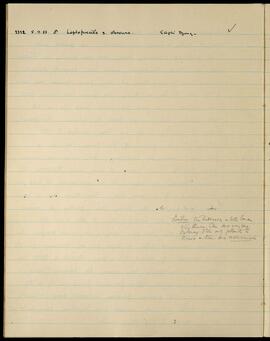
  1. 5.9.33. ♂ Leptopoecile s. obscura. Singhi Dzong.

    Ludlow the hillsides on both banks
    of the Ruru Chu are very
    stony & the only plants to
    thrive on them are artemisias

LSH/1/1/9/1/138 · Part · 1933-09-01
Part of The Ludlow & Sherriff Collection

SUMMARY:
Notes a fine Aconite in flower but seeds largely unripe; mail arrived quickly from Kalimpong. On 13 September, after heavy rain and new snow down to 14,500 ft, the party halted and went up the Chachhu La route toward Nanda La to seek Notholirion bulbs and possible seed, planning to take roots on return from Waitang.

CONTENT:
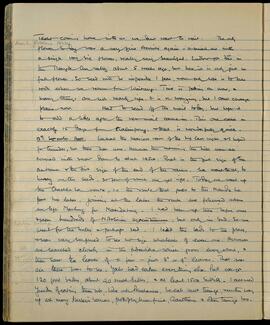
Tashi coming home with us, we don't want to wait. The only flower today was a very fine Aconite again - a small one with a single very big flower, really very beautiful. Ludlow got this in the Rongde Chu valley about 5 weeks ago, but here it is only just in full flower. So seed will be impossible I fear, and our only hope is to take roots when we return from Waitang. Time is getting on now, and many things are not nearly ripe. It is very worrying, but I can't change plans now. Had to send off the mail today, but kept it to add a little after the new mail came in. This one came in exactly 15 days from Kalimpong, that is wonderfully quick.

13th September. Halt. We had the heaviest rain of the trip last night, and hoped for thunder, but there was none. However this morning the hills were all covered with snow down to about 14500. That is the first sign of the autumn and the first sign of the end of the rains. We want that, to hurry on the seeds, so few of which are yet ripe. Today we went up the Chachhu La route, i.e. the route that goes to the Nanda La past two lakes, joining at the lakes the route we followed when we left Marlung for Mandating. I had been up there before once and seen hundreds of Notholirion hyacinthinum, but only in bud. So we went for the bulbs and perhaps seed. I

LSH/1/1/8/1/47 · Part · 1947-01-13
Part of The Ludlow & Sherriff Collection

SUMMARY:
The diarist describes very tall pines and junipers, birches and oaks, and notes the striking jade-green colour of the Po Tsangpo river. On 14th Jan. near Sangyü, Ludlow and Henry took the pony path while the diarist and B. followed the riverside through dense wet forest with massive junipers, passing Rhododendron trees near Chahzam and old cultivated flats with ruins said to have been destroyed by the Chinese in '12.

CONTENT:
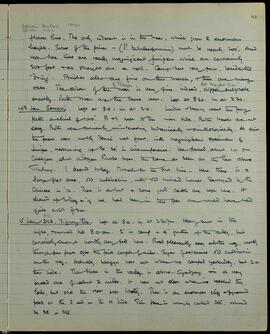
Cupressus torulosa 12141
Cedrela 12142

43

flower line. The only interest is in the trees, which grow to enormous heights. Some of the pines - (P. tabulaeformis) must be nearly 200 feet. And near here there are really magnificent junipers which are certainly 200 feet and straight as a rod. Camp here very poor, beside the 'spring'. Birches also are fine on this march, and there are many oaks. The colour of the Po Tsangpo river is very fine indeed, copper sulphate (pale 'deep jade green') exactly. Both rivers are the same now. Left at 8.30. In at 2.30.

14th Jan. SANGYÜ. Left at 9.0 : in at 2.0. Ludlow and Henry went the pony path, a climb of 1000 feet. B. and I kept to the river side. Both tracks are not easy. Both were curiously uninteresting botanically and ornithologically. At first the forest was mostly dense wet forest, with magnificent specimens of Juniper, measuring up to 20 feet in circumference. We passed, about 1 mile from Chahzam, about a dozen Rhododendron trees, the same as seen on the Pan above Trulung. I heard today Monal for the first time. Here there is a large flat area, old cultivation, with old ruined houses, destroyed by the Chinese in '12. There is a hut and

LSH/1/1/1/1/143 · Part · 1933-08-18
Part of The Ludlow & Sherriff Collection

SUMMARY:
The diarist reset a damaged aneroid using the known height of Singhi Dzong, endured rain, and recounts leech bites involving both the writer and Ludlow. On 18th August they went 2 miles to Narim Thang (13,900 ft), the path passing the Dzong through fir forest before a steep climb to the plateau with rhododendron but no fir.

CONTENT:
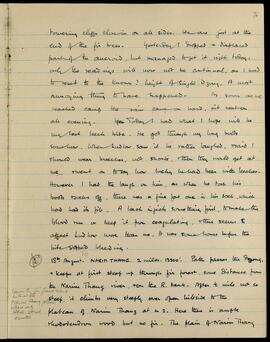
towering cliffs close in on all sides. We are just at the
end of the fir trees. Yesterday I dropped and displaced
part of the aneroid, but managed to get it right today:
only the readings will now not be continual, as I had
to reset to the known height of Singhi Dzong. A most
annoying thing to have happened. As soon as we
reached camp the rain came on hard, and it went on
all evening. Today I had what I hope will be
my last leech bite. He got through my long boots
somehow. When Ludlow saw it he rather laughed, and said I
should wear breeches, not shorts, then they wouldn't get at
me, and went on to say how lucky he had been with leeches.
However I had the laugh on him, as when he took his
boots and socks off, there was a fine fat one in his sock, which
had had its fill. A leech injects something first, to make the
blood run or keep it from coagulating, and this seems to
affect Ludlow more than me. It was some hours before the
bite stopped bleeding.

18th August. NARIM THANG. 2 miles. 13900'. Path passes the Dzong,
and keeps at first steep up through fir forest, some distance from
the Narim Thang river, on the R. bank. After 1/2 mile not so
steep, it climbs very steeply over open hillside to the
plateau of Narim Thang at m 2. Here there is ample
rhododendron wood but no fir. The plain of Narim Thang

LSH/1/1/2/1/4 · Part · 1934-06-13 - 1934-06-29
Part of The Ludlow & Sherriff Collection

SUMMARY:
Notes quote Ludlow’s plan to work the Tawang Chu and Nyam Jang Chu basins in Tibet and revisit the Trashi Yangsi Valley. Permission was granted by the Maharaja and late-May sanction came from the Tibetan Government, prompting a rapid approach via the Dewangiri–Tawang Trade Route through the eastern Duars. The itinerary records travel from Srinagar to Dewangiri and onward to Trashigong in late June 1934.

CONTENT:
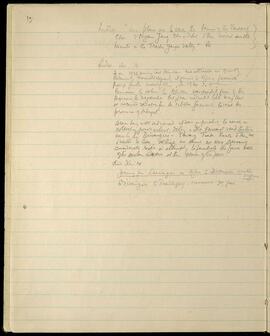
10

Ludlow: "our plans are to work the basins of the Tawang Chu & Nyam Jang Chu in Tibet & then revisit our old haunts in the Trashi Yangsi Valley." P. 8

Ludlow. Ser. 13
In our 1933 journey East Bhutan had attracted us greatly. Botanically & ornithologically it seemed to offer a favourable field for further investigation. In 1934 ...
Permission to return to Bhutan was readily given by His Highness the Maharaja but it was not until late May that we received sanction from the Tibetan Government to cross the province of Mönyul.

Season being well advanced it was imperative to reach our collecting grounds without delay. The quickest road thither was by the Dewangiri - Tawang Trade Route & this we decided to take although we knew we were running considerable risks in attempting to penetrate the fever belt of the eastern Duars at this season of the year.

Lud. Ser. 14
Journey from Srinagar on 13 June to Dewangiri reached 22 June.
Dewangiri to Trashigong - reached 29 June.

LSH/1/1/1/1/77 · Part · 1933-07-01
Part of The Ludlow & Sherriff Collection

SUMMARY:
The party splits as W and Mrs W go to Punakha while the diarist and Ludlow, on Tobgye's advice, take a dense leech-infested jungle path from below Lomitsawa towards Wangdupotrang. They avoid shooting due to sensitivities in the late Shabdrung’s area near Thimbu, collect some birds, butterflies, and plants, and after a tiring nine-hour trek reach the Punakha Chu/Mo Chu; camp conditions are filthy with flies, mud, and fleas.

CONTENT:
36

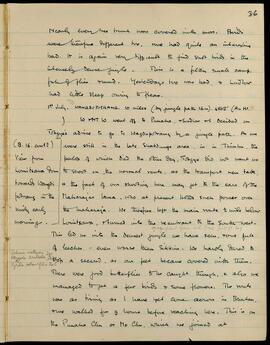
Nearly every tree trunk was covered with moss. Birds were therefore different too, and we had quite an interesting bag. It is again very difficult to find shot birds in the intensely dense jungle. This is a filthy small camp, full of flies and mud. Yesterday too was bad, and Ludlow had little sleep owing to fleas.

70
1st July. TO WANGDUPOTRANG. 10 miles (by jungle path 16 miles). 4508' (An Ht. ). W and Mrs W went off to Punakha, and Ludlow and I decided on Tobgye's advice to go to Wangdupotrang by a jungle path. As we

(B. 16. contd) View from Lomitsawa down towards Wangdi Potrang in the misty early morning.

were still in the late Shabdrung's area, in Thimbu, the Penlop of which died the other day, Tobgye did not want us to shoot on the normal route, as the transport men talk, and the fact of our shooting here may get to the ears of the Maharaja's lama, who at present holds such power over the Maharaja. We therefore left the main route ½ mile below Lomitsawa, and turned into the re-entrant to the South West.

magnificent fern with fronds 3-5 ft long
This led us into the densest jungle we have seen, and full of leeches - even worse than Sikkim. We hardly dared to stop a second, as our feet became covered with them.

Schima wallichii 201
Polygala arillata 202
Pyrola rotundifolia 203

There were good butterflies to be caught though, and also we managed to get a few birds and some flowers. The route was as tiring as I have yet come across in Bhutan, and we walked for 9 hours before reaching here. This is on the Punakha Chu or Mo Chu, which we joined at

LSH/1/1/10/1/9 · Part · 1949-09-14
Part of The Ludlow & Sherriff Collection

SUMMARY:
The diarist notes many migratory birds from Tibet and poor seed results except likely from Marlung or passes to the west. On 21 Sept., they remain in camp while Yundon and Pasang collect Primula caveana and a fine woolly Phandra from Tamagorra Nala, returning late and exhausted, with Yundon suffering a bad headache. On 22 Sept., amid cold wind and intermittent rain and sun, letters arrive from H.H. and mail from Hicks and Ludlow, but none from Betty.

CONTENT:
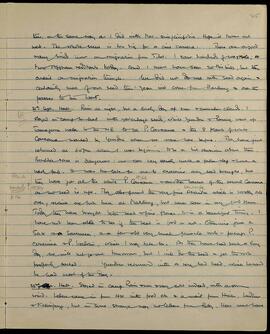
This, in the same way as I did with Mec. simplicifolia. Hope it turns out well. The whole scene is too big for a cine-camera. There are a good many birds now on migration from Tibet. I saw hundreds of wagtails and two Afghan redstarts today. And I must have seen 20 Ibisbills, but they aren't on migration though. We did not do well with seed again, and certainly most of our seed this year will come from Marlung or over the passes to the West.

21st Sept. Halt. Rain at night, but a lovely day of sun and cumulus clouds. I stayed in camp to deal with yesterday's seeds, while Yundon and Pasang went up Tamagorra Nala to the NE to get P. caveana and the 8 plants of white caveana marked by Yundon when we were here before. They have just returned at 6:00 pm when I was beginning to be a bit anxious about them. Boulder scree is dangerous: one can very easily make a false step and have a nasty fall. It was too late for me to examine any seed brought, but they have got all the white P. caveana, and another basket of the usual caveana as no seed is ripe. They also found the very fine Phandra which is woolly all over, and which we took twice at Marlung, but never saw in very good flower. Today they have brought both seed and fine flower. It is a beautiful thing. I have not been able to see if the seed is good or not. Otherwise just a Sax or a Saussurea, and a few odd very small primula roots - perhaps P. cervicina or P. walshii, which I may take too. As they have had such a long day, we will not go out tomorrow, but I will do the seed and get the roots properly packed. Yundon returned with a very bad head, which he said he had most of the day.

22nd Sept. Halt. Stayed in camp. Rain and sun very cold indeed, with a strong wind. Letters came in from H.H. with food etc and a mail from Hicks, Ludlow and Kalimpong, but in some strange way no letters from Betty. Hers must have

LSH/1/1/6/1/83 · Part · 1938-06-22
Part of The Ludlow & Sherriff Collection

SUMMARY:
Travel notes record heavy rain, difficult marching, and a camp on the Gyara Phu Chu, followed by a fine day reaching Gyara (Nepar). Common Primula species were noted, Lerwa with young were observed, and there is disappointment at few notable finds, with hopes to visit passes east of Lilung; transport delays prevent moving on to Pamse.

CONTENT:
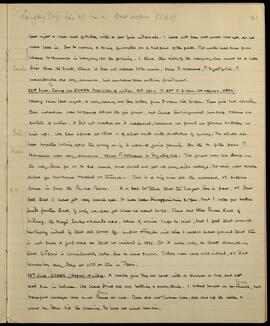
Langong Trip has not been a great success (S. 647)

Last night and rain most of today with a few fine intervals. I have not been out much here yet, as we were late in, due to meeting a string of mules on a bad part of the path. The mules had come from Lhasa to summer in Langong for the grazing. I think this side of the Langong Chu must be a little drier than the south, though it does not appear to be much. Here P. hopeana, P. dryadifolia, P. macrophylla are very common, but we have seen nothing of interest.

To
22nd June. Camp on GYARA PHU CHU. 6 miles. BP. 191.1 T. 55° T. 3.0pm. Ht approx. 11832'.
Heavy rain last night, and very heavy all day today from 8.0am till 2.0pm. Then fine but cloudy. Our intention was to camp above the fir forest, but Chulla distinguished himself and came on another 4 miles. It did not matter as it happened, because we found no flowers to delay us high up. We saw Lerwa at 15,000 - 4 adult birds with a clutch of young. The adults all kept together looking after the young as if it were a joint family. On the N. of the pass P. kansuensis was very common, and some P. hopeana and dryadifolia. The forest was too dense on the way down for us to see much, and we could not see up any side valleys. The rain was really awful for two hours and soaked us through. This is a big river at the moment, and I suppose comes in from the Pacha Peaks. It is sad to think that the longest day is past, and I don't feel that I have got very much yet. It has been disappointing so far, but I hope for better finds further East, if only we can get where we want to go. There are three Passes East of Lilung, the Magu, Shoka and Namdo Las, each of which I hope to visit, but I feel that we will be lucky indeed if that all comes off. Ludlow and Sherriff will also I expect have found that this is not such a good area as that we visited in 1936. Or it may only be that everything in East Tsari is considerably later, due to more snow. Today was very cold indeed, and I don't remember any days as cold as this in Tsari.

To
23rd June. GYARA (Nepar). 4 miles. A really fine day at last, with a shower or two, but hot real sun in between. We have dried all our bedding and everything. I hoped to get on to Pamse, but transport changes here and at Pamse as well. There are no horses here, all are up the valley and won't be down till the evening. So here we must remain.

LSH/1/1/1/1/107 · Part · 1933-07-26
Part of The Ludlow & Sherriff Collection

SUMMARY:
Notes on fleas and lice among the party, with Ludlow inspected daily and Ramzana attributing lice to sweat; temporary huts built and a comfortable halt at Donga Pini with fine weather, bird shooting, and photo developing. On 27th July the party proceeds to SANA, climbing from about 8000' to 9600' along the ridge via the DONGA LA, with plants such as Primula xanthopa, P. sikkimensis, and Oxalis acetosella recorded.

CONTENT:
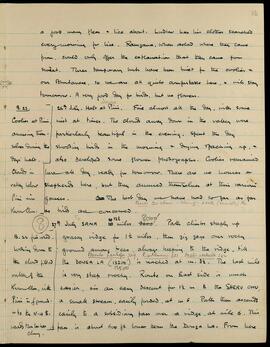
a good many fleas & lice about. Ludlow has his clothes searched every morning for lice. Ramzana, when asked where they came from, could only offer the explanation that they came from sweat. Three temporary huts have been built for the coolies & our Cookhouse, so we are all quite comfortable here, & will stay tomorrow. A very good day for birds, but no flowers.

B. 22. 26th July. Halt at Donga Pini. Fine almost all the day, with some
Coolies at Pini mist at times. The clouds away down in the valley were
amusing them- particularly beautiful in the evening. Spent the day
selves during the shooting birds in the morning & drying & packing up, &
day's halt. also developed some flower photographs. Coolies remained
Clouds in here all day, ready for tomorrow. There are no houses or
valley below shepherds here, but they amused themselves at their various
Pini in games.
Kurn Chu.

8 27th July To SANA 12 1/2 miles. 8000' 9600'. Path climbs steeply up
B. 22 finished. grassy ridge for 1 1/2 miles, then zig zags over rocky
Looking down to ground among trees, always keeping to the ridge, till
the cloud filled Primula xanthopa 329. P. sikkimensis 331, Oxalis acetosella 332
valley of the the DONGA LA

LSH/1/1/1/1/152 · Part · 1933-08-29
Part of The Ludlow & Sherriff Collection

SUMMARY:
Specimen entries 2303–2304 record male Grandala coelicolor from Kangha at 14,500 feet on 29/08/1933. Includes a note quoting Ludlow about the strenuous ascent to the Kang La and feeling the effects of high altitude.

CONTENT:

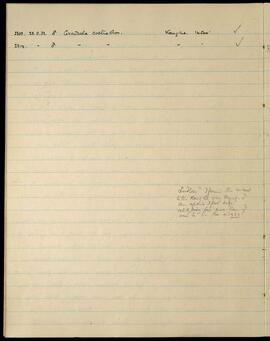
  1. 29.8.33. ♂ Grandala coelicolor. Kangha. 14500' ✓
  2. " ♂ - - - ✓

    Ludlow "I found the ascent
    to the Kang La very trying. I
    am afraid I feel high
    altitude far more than I
    used to" - this in 1933!