Showing 5 results

Archival description
5 results with digital objects Show results with digital objects
LSH/1/1/2/1/221 · Part · 1934-10-14
Part of The Ludlow & Sherriff Collection

SUMMARY:
The diarist reports a night disturbed by insects, rainy weather clearing after an east wind, and ongoing concern for a Tibetan companion with an abscess. They note mixed attitudes from locals, observations on extensive rice cultivation compared to Rungzyung and the Trashiyangsi valley, and remarks on rhododendron flowering and regional snow/frost levels. They remain in the same camp as before.

CONTENT:
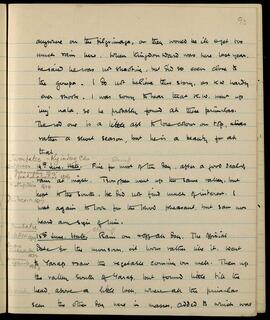
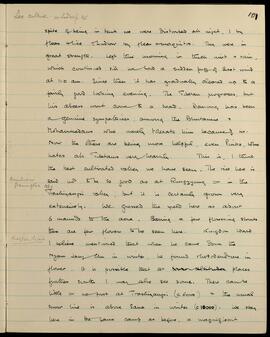
In spite of being in tents we were disturbed all night, I by fleas and lice, Sherriff by fleas and mosquitoes. They were in great strength. Left this morning in thick mist and rain, which continued till we had a sudden puff of East wind at 11:00 am. Since then it has gradually cleared up to a fairly good looking evening. The Tibetan progresses, but his abscess won't come to a head. Dorong has been a genuine sympathiser, among the Bhutanese and Mohammedans who merely tolerate him because of us. Now the others are being more helpful, even Pinbo, who hates all Tibetans very heartily. This is, I think, the best cultivated valley we have seen. The rice here is said not to be so good as at Rungzyung or in the Trashiyangsi valley, but it is certainly grown very extensively. We guessed the yield here as about 6 maunds to the acre. Barring a few flowering shrubs there are few flowers to be seen here. Kingdon Ward, I believe, mentioned that when he came down the Nyam Jang Chu in winter, he found rhododendrons in flower. It is possible that at lower altitude places further south I may also see some. There is little or no frost at Trashiyangsi (c. 6,000') and the usual snow line is above Sana in winter (c. 10,000'). We stay here in the same camp as before, a magnificent
LSH/1/1/3/3/103 · Part · 1933-04-09
Part of The Ludlow & Sherriff Collection

SUMMARY:
The party halts, receives a visit from the local Dzongpen and returns the call, deciding to go down to Lung for several days. Locals mention Kingdon Ward’s visit the previous year, and the diarist notes peach blossom fading, irises emerging, and abundant willow, poplar, and buckthorn; the following halt day includes weather readings and packing flowers.

CONTENT:
signs of wetter zone are apparent. Owing to coming on so far we were rather late in arriving, but found a good camp, whose dust is the only drawback.

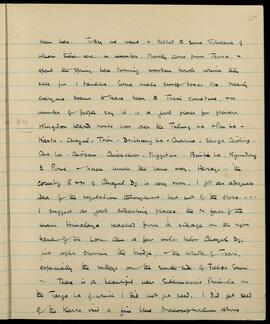
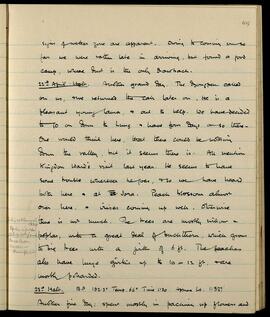
22nd April Halt. Another grand day. The Dzongpen called on us, and we returned the call later on. He is a pleasant young lama, and out to help. We have decided to go on down to Lung and have four days or so there. One would think here, that there could be nothing down the valley, but it seems there is. All mention Kingdon Ward's visit last year. He seems to have some trouble wherever he goes, and so we have heard both here and at E. Jora. Peach blossom almost over here, and irises coming up well. Otherwise there is not much. The trees are mostly willow and poplar, with a great deal of buckthorn, which grows to big trees with a girth of 6 ft. The peaches also have huge girths up to 10 or 12 ft, were mostly pollarded.

23rd Halt. B.P. 192.3° Temp. 66° Time 1130. Approx alt. 11387'
Another fine day: spent mostly in packing up flowers and

LSH/1/1/3/3/71 · Part · 1936-03-10
Part of The Ludlow & Sherriff Collection

SUMMARY:
Notes describe a valley with magnolia and pine, a Jasminum dispermum at a bamboo bridge, and Primula gracilipes at a waterfall by the Chorten, thought to be where Kingdon Ward previously collected it. On 28th March at Pangchen, a few orchids and Mahonia sidneyi sp. nov. were found; ticks were troublesome, and the party decided the locality was poor but stayed due to illness.

CONTENT:
up where an old landslide has made a block in the
valley. At mile 9, the valley opens out and there is a
plain about 2 miles long and at most 500 acres. Got
a Jasminum dispermum at the first bamboo bridge 1238, and a few
other shrubs of not much interest. Primula gracilipes was still
just in flower at the waterfall beside the Chorten, but
nearly over. This must be the place that Kingdon Ward
took it from. I saw it at no other waterfalls today.
This place is lower than I had hoped. Most flowers are
probably above 10,000 or below 6,000 just now. Magnolia
campbellii trees make a white line along the hillsides,
they are abundant and beautiful, between about 7,500 - 8,500 or a little higher. There are
a fine lot of pines here. The East face is more or
less covered with them right down to camp.

28th March. Halt Pangchen. Nothing found today but a
Cymbidium hookerianum 1245, Mahonia sidneyi sp. nov. 1247,
Dendrobium and Primula gracilipes again, above Pangchen to the East.
Ticks are now becoming a curse; I found myself
covered with them several times this morning when in
bamboo forest among ferns. We have decided this place
is no good, will go on as soon as possible, but had to stay on account of illness.

LSH/1/1/3/3/189 · Part · 1936-06-13
Part of The Ludlow & Sherriff Collection

SUMMARY:
Notes skepticism about a report of Kingdon Ward shooting near the gompa and mention that he went up the diarist’s nala likely finding primulas. Records two halts at Sumbatse with weather details, Tsongpen’s excursion with little of interest, searches for blood pheasant, a visit to Yarap with vegetables growing well, and abundant primulas above a small loch, with plant species listed.

CONTENT:
anywhere on the pilgrimage, or they would be ill after too much rain here. When Kingdon Ward was here last year, he said he was not shooting, but did so even close to the gompa. I do not believe this story, as K.W. hardly ever shoots. I was sorry to hear that K.W. went up 'my' nala, so he probably found all these primulas. The red one is a little apt to lose colour on top, and has rather a short season, but he is a beauty for all that.

Sumbatse - Kyimdong Chu Sherriff
14th June. Halt. Fine for most of the day, after a good deal of rain at night. Tsongpen went up the same valley, but kept to the south. He did not find much of interest. I went again to look for the blood pheasant, but saw nor heard any sign of him.
(Androsace graminifolia 1815, brahma-putrae 1816, strigillosa 1814, Iris decora 1817)

Sumbatse Sherriff
15th June. Halt. Rain on and off all day. The official date for the monsoon, and it looks rather like it. Went to Yarap and saw the vegetables coming on well. Then up the valley south of Yarap, but found little till the head, above a little loch, where all the primulas seen the other day were in masses, added to which was
(L. tibetica 1819, Primula trichosanthes 1832, Primula officinalis 1823)

LSH/1/1/3/3/75 · Part · 1936-03-10
Part of The Ludlow & Sherriff Collection

SUMMARY:
The diarist spoke with Tibetans, mostly from Tsona, who make wooden bowls and snuff boxes and report that Tsari is good for flowers. The page records Kingdon Ward’s route through numerous passes and places and his recommendations for rich collecting areas near Chayul Dz, the Lore Chu, Tsari, and Takpa Shiri, noting a Primula on Targa La and seeds of Karta iris and Dracocephalum.

CONTENT:
been here. Today we went & talked to some Tibetans, of
whom there are a number. Mostly come from Tsona, &
spent the spring here turning wooden bowls which they
sell for 1 tankha. Some make snuff boxes too. Nearly
everyone seems to have been to Tsari sometime, & a
number of people say it is a good place for flowers.

Kingdon Ward's route was over the Tulung La & Pen La -
Karta - Chayul - Trön - Drichung La - Charme - Sanga Chöling -
Cha La - Chösam - Chikchar - Migyitun - Bimba La, Kyimdong
to Pome & back much the same way. He says - 'the
country E & N of Chayul Dz is very rich. I got an adequate
idea of the vegetation throughout, but not of the flora. ---
I suggest as good collecting places, the N face of the
main Himalaya reached from a village on the right
bank of the Lore Chu a few miles below Chayul Dz,
just after crossing the bridge; & the whole of Tsari,
especially the valleys on the south side of Takpa Shiri.
--- There is a beautiful new Sikkimensis Primula on
the Targa La of which I did not get seed. I did get seed
of the Karta iris, a fine blue Dracocephalum above