Showing 6 results

Archival description
6 results with digital objects Show results with digital objects
LSH/1/1/6/1/91 · Part · 1938-07-08
Part of The Ludlow & Sherriff Collection

SUMMARY:
The diarist leaves the Tsangpo valley toward Nayü La, noting views of Gyala Tsutum and a local legend linking its summit to Samye via Yüsum. On 5th July at Nayü Chu, progress is delayed by lack of coolies despite assurances from Kusho and the gyimpon; on 6th July, after heavy rain, the party camps north of Nayü La and records notable plants including Lilium giganteum, a white water lily, and Smilacina.

CONTENT:
...were there, and had a talk with her. I only just caught a glimpse of her this morning.

The Nayü La is said to be only two days off, an easy pass which is only shut by snow in the Tibetan 10th month, which would be December. And we heard before that Lopas had come to Tsela in May. The gyimpon says he has gone to the first Lopa houses in four days from here, but that a Lopa, if he wants to could reach them in two from here, going light. Just as I was leaving the Tsangpo valley today it started to clear up in the East, and I caught a glimpse of a lovely scene, which I hope I will see again. Straight down the valley, beyond Tsela Dzong is a lovely snow covered mountain, locally called Gyala Tsutum (G. Peri of the map?). It is said to have had its top cut off, to be carried to Samye. But when at Yüsum, it was stopped in some way by a female deity (?) and planted there. The little hill just S of Yüsum is now said to be this peak, and pilgrims go round it.

5th July. Camp in Nayü Chu. 5 miles. Fine and bright all day long. No rain. A wasted day however. Kusho assured us there was no trouble about coolies, that all would be ready early in the morning. He always says this, and cannot get him to say what he knows. Three coolies had turned up by 8.0 am, then I went off. We waited some hours on the way up and two more appeared. Finally had to stop here, and we waited hopefully as gradually an odd man turned up, till finally the last lot of impressed Lopas arrived in camp at 6.30 pm. So at any rate we are off and with luck should reach the Pass tomorrow. Nothing of interest again. P. Florindae very common, and P. firmipes (flexilipes?) also, but over. The tree GIUGO from which the wooden teapots are made is a maple of sorts, not the one found further west though. I have not seen it before. (No. 5740.).

6th July. Camp about 4 m. N. of Nayü La. 9 miles. BP. 193.4. Temp 65° Time 2.30 pm. Ht app. 10700'
Rained pretty steadily at night, and all morning there was heavy rain. From 2.0 pm on, more or less fine. This was a much more interesting day. I am surprised how low we still are, but we have reached the very wet zone, and flowers are more numerous. I saw what is almost certainly P. Whitei on the way up here - not in flower of course. The most interesting things were Lil. giganteum 5743, and a white water lily 5759, the first we have ever come across. A new Smilacina too was collected, 5756, and a beautifully coloured one 5754, probably the same as that taken in Bhutan last year. This valley must have been a huge lake at some time. It abounds in swamps, in fact...
LSH/1/1/8/1/113 · Part · 1933-05-18 - 1933-05-19
Part of The Ludlow & Sherriff Collection

SUMMARY:
The diarist travels from Go-Cyae in perfect weather, noting tame gazelle, kyang, high passes, and sightings of parnassius butterflies, with observations on elevation, vegetation, and local attire. On 19 May they make a long march to Dongkar Dzong with mules and donkeys, encounter unhelpful local officials (Chanzo and Gyimpon) but find tipping effective, and plan to continue toward Trimo via Lior, noting Primula in flower and changing peoples along the route.

CONTENT:
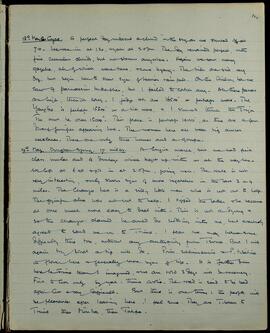
18th May. Go-Cyae. A perfect day without a cloud in the sky as we started off at 7.0. We were in at 1.30, again at 2.0pm. The day remained perfect, with fine cumulus clouds, but no storms anywhere. Again we saw many gazelle, all of which were tame, and some kyang. The hills are still very dry, but begin here to show signs of heavier rainfall. On the Chidney La we saw 4 parnassius butterflies, but I failed to catch any. All these passes are high, though easy. I judge all are 16500' or perhaps more. The Yangtse is perhaps 15500' or a bit more, and I should think the Triju Tso must be over 15000'. This place is perhaps 14000', as there are a few dwarf juniper appearing here. The women here all wear big amber necklaces. There are only three houses and a Gompa.

19th May. Dongkar Dzong. 17 miles. A longish march, but we had first class mules and 4 donkeys which kept up with us all the way here. We left at 6.40 and got in at 2.0pm, going well. The route is not very interesting, only shows signs of more vegetation in the last 3 or 4 miles. The Chanzo here is a silly little man who is not one to help. The Gyimpon also was not one to help. I tipped the latter, who became at once much more easy to deal with. This is not a Dzong so the Chanzo claimed he could do nothing with me, but eventually agreed to send me on to Trimo. I fear we may have some difficulty there too, without any authority from Tsona. But I will again try what a tip will do. Prim. sikkimensis and P. tibetica in flower here and generally more signs of life. It is further from here to Trimo than I imagined, we are told 3 days will be necessary. First to Lior only by yak: thence coolies. The road is said to be bad after Lior and very difficult. But there is one thing: the people will be pleasanter after leaving here, I feel sure. They are Tibetan to Trimo then Monba, then Tahpa.

LSH/1/1/6/1/61 · Part · 1938-05-29
Part of The Ludlow & Sherriff Collection

SUMMARY:
At Langong, the diarist records collecting several Primula and other alpine plants, observing a new warbler (P. tibetanus), and noting marmots and lingering snow. A clutch of Crossoptilon eggs and a blood pheasant egg are obtained; the gyimpon arrives and promises coolies, and plans are made to explore valleys between Pa La and Lo La before visiting the Pachakshiri Loba.

CONTENT:
Langong

depressed, but then we saw P. bariensis, and knew that there would be other things as well. For a change, the second time only, I did not take a gun, and of course saw the new warbler P. tibetanus. There were two of them, in juniper scrub, just as on the Bimbi La. Of interesting things, we saw Mec. simplicifolia - and I particularly examined the filaments, which were white. Then Tsonypon brought in a primula, which I think must be P. chamaethauma 3893 (P. chionantha 3893). Then P. macrophylla 3894, 3895 (P. macrophylla var. macrocarpa 3895) was seen. Then over a ridge we found in almost full flower that delightfully pretty - and fragrant - P. rotundifolia. On the whole a good day. There are many marmots running about, now the snow is off the ground. The actual pass is probably still covered with snow, as there were huge drifts a good deal lower than the highest we went, on the North faces. I heard on return that one man had already found a nest of Crossoptilon, but he has not brought the eggs yet.

29th May. Halt. Langong. Fine most of the day, but clouded and showery. Started in the morning about at 11.00 a.m. Saw nothing much. In fact there is remarkably little in the valley. Collected Primula yargongensis 3914. Our offer for eggs is doing well. Today got a clutch of seven eggs of Crossoptilon, nest on the ground in a bush. Later on a man came in with one blood pheasant's egg, and will see the nest tomorrow. The eggs were very difficult to blow, having chicks inside. (P. dryadifolia 3917, Rhododendron v. microstoma 3918, Ranunculus 3919, 3923, Primula 3925, Gal. nambanensis 3920, Corydalis 3921, 3922, Lonicera litangensis 3926).

30th May. Halt. Langong. Mostly fine in Langong, but rain mist on the hills all day. I went up the valley immediately North of Langong village, running parallel to the Tscha valley. There is nothing in any of these valleys till one gets to 13,500 feet or so. Then primulas appear. This is a fine valley, with a good sized lake at about 13,500 feet above which there is a fine waterfall. But flowers are few and far between, and I think we are really too early yet. The gyimpon has arrived, seems very helpful and friendly. He wants to go off for 8 days, but has promised coolies all I want in the meantime. My plans are to stay here two more days, and then go West, up a valley which lies between the Pa La and Lo La routes. Stay there four days and return here for two before going off to the Pachakshiri Loba on the 9th, for a week. That will take up all the time I can spare in this area. Everything here seems to be late. Snow lies pretty thick on the hills yet, and nearly all passes are shut. Tsari Sama - known generally as Tsari Sarpa, "the new Tsari" is not

LSH/1/1/6/1/71 · Part · 1938-06-09
Part of The Ludlow & Sherriff Collection

SUMMARY:
Rainy halt days in Langong with a meeting with the gyimpon, who arranges coolies and discusses routes via Lo La, Trashigong, and the Tsari Sama pilgrimage, with notes on the difficult Migyitun road over the Potsang La. The party moves to a camp by the upper bridge over the Langong Chu, collects plants (including Meconopsis), struggles with midges and slow coolies, and then reaches above Singo Samba where a bridge’s planks appear to have been removed.

CONTENT:
35

9th June. Halt. Langong. Rain most of the night, rain today. This is the first day there has been no wind in Langong. The gyimpon came to call, we had a long talk. He is ordering coolies for all I want, which now is to go to the Lo La, stay there 5 or 6 days, come back to the lowest bridge and then do the Tsari Sama pilgrimage. This is not as I had thought, a longish circle, coming back by the Chumbumbu La, but only a small one from Trashigong back to Trashigong, which can, with difficulty, be made in a day. We should take four days from bridge to bridge. It sounds quite promising. Rations for coolies may be a little difficult. The gyimpon tells me the Migyitun road is possible, but very difficult, over the Potsang La, would take three days. This is what I heard in Migyitun. I hope we may go there in Oct.-Nov. Langong is covered with snow from the Tibetan 10th to 3rd months, even the rivers being covered over. In Langong village, on the south side of the valley, he says they don't have much more than one foot of snow in a fall.

10th June. Halt. Langong. Heavy rain last night. Clouded, with showers all day. We went down the left bank under the cliffs, found flowers there had come on a lot, got quite a good haul, but nothing of outstanding interest. Coolies all promised for tomorrow morning.

11th June. To Camp at upper bridge over Langong Chu. 10 miles. Wet night, but mostly fine today till 3.0 p.m. A disappointing day. I had hoped to find much more out, but really there is little change down here since we came up. Meconopsis betonicifolia is very common, and I still think is a poor flower, beaten easily by Meconopsis simplicifolia, and most of the others. Midges very bad all day, making walking no rest at all. Coolies very slow, but quite a cheery, pleasant crowd, much more so than the Molo people.

12th June. Camp 3 miles above Singo Samba. Wet night and a very wet day. A bad day in all ways. Although most of the Langong people seem nice, especially the gyimpon, there are some nasty bits of work. And we seem to have struck them. I went on ahead today and reached Singo Samba by 9.0 a.m. There was no bridge there. Someone has lifted the two big planks and let them go down the river. There can be no other explanation; I am quite positive it was done by...

LSH/1/1/4/1/143 · Part · 1933-10-19
Part of The Ludlow & Sherriff Collection

SUMMARY:
At Lung, the party halted for several days of fine weather while shooting birds and searching unsuccessfully for tragopan. The diarist notes rough valley paths, collects some rhododendron seeds, and remarks that other rhododendron seeds are not yet ripe.

CONTENT:
Lung
20th October. Halt. The first fine day we have had since the 4th Oct.
Wind from the North, cloudy but bright. Went down the valley a
bit - wandered round the flat part below camp. Shot four birds -
saw two woodcock about a mile down. Tsongpen & the gyimpon will go
off early in the morning to look for tragopan.

21st October. Halt. Another beautiful day, fine all day. Tsongpen &
the gyimpon spent from 6 am till 2.30 pm looking in the jungle for
tragopan, but they saw none, not even any signs of them. So
I'm afraid we are unlikely to get any here now, though I have
two more days to do up on the hillside.

Lung
22nd October. Halt. Fine all day, with a very strong wind: clouded
over in the evening & looks like rain. Tsongpen & I went down a
good long way in the main valley - 5 hours. The path is
really pretty dreadful, hardly ever level for 10 yards, & as much
on notched logs & ordinary logs as on the ground. It is far the
worst I have seen anywhere this year. Shot a Heteroxenicus
stellatus, Sylviparus & Fulvetta ludlowi in beautiful plumage, saw
two or three nutcrackers. The cinnabarinum rhododendron is
not yet ripe, but I took some seeds to try. The big maddenii
R. crassum seed
2332 & 2338 were not ripe, but further down I came across one

Trip to Chiniung La
LSH/1/1/6/1/81 · Part · 1938-06-20
Part of The Ludlow & Sherriff Collection

SUMMARY:
During a halt at Langong, two local men reconnoitred the Chiniung La, encountering deep snow, a half-frozen lake to the south, remains of Lopas on the pass, and few flowers, while the diarist records plant notes and a long circuit over the main range. That evening the gyimpon described local customs regarding Lopas and claimed that “Highburn Pk” near Tso Kar is the real Takpa Shiri; the writer wished to hear the account through Pintso but struggled to understand Kusho, who had been drinking chang. The party then moved to a camp south of the Tse La in heavy rain.

CONTENT:
Chiniung La
Trip to Chiniung La

20th June. Halt Langong. Rain nearly all day, finer in the evening. Trompen or rather two locals went up the valley to the South of Langong to try the South of the main range. It took 3 hours to reach the pass, going without a halt. The pass is called the CHINIUNG LA, (BP. 185.0, Temp 51°. 9.0 am, Ht. approx 15318.) There is a good deal of deep snow on this side still, but sufficient has melted to show the remains of some Lopas who died on the pass last year. Five died there, but we only saw one. They don't just leave their dead where they lie, but put a few stones round them, cover them with their hats & their fibre rain coat affair, then leave them little bundles of tsampa or food, & stick their bow up at one end. The arrows however, seem to have been taken away. Two Lopas crossed this pass last week & returned. On the South side, about 500 ft. down is a large lake, still half frozen, which shows how late things are here. There were hardly any flowers out as far as we went - P. Valentiniana near others of P. tsariensis. We got nothing on the South side. Then we did a big circle round to the left, over the main range again, but there was little new. P. chamaethamna was really more beautiful in masses, occasionally mixed with P. tsariensis. P. Hobsonii common & also P. macrophylla 5608. P. rotundifolia 5606 was common near the Chiniung La. Out at 5.30, back at 3.30 pm. pretty tired. The gyimpon this evening said they had not much trouble with the Lopas. When they come, a yak is killed on a stone & both the Lopas & the Langong people drink the blood. After this there is no trouble between the men, but he said that perhaps a woman or two or a child might get hit up, he did not know much about them. Tomorrow they have some kind of tamasha. As far as I can make out, they all go out with guns & let them off in Pachakshiri direction. It seems some idea of frightening the Lopas, who however know nothing about it all. I should like to have heard the whole story through Pintso. Kushos Urdu or Hindi is about as good as my Tibetan, & he is almost impossible to understand, especially as he had been drinking chang this evening. The gyimpon insists that the "Highburn Pk" - near Tso Kar - is the real Takpa Shiri, & that it is universally so called. I wonder if he can be right?

21st June. Camp S. of the Tse La. 6 miles. BP. 186.4° Temp. 50° Time 3.30 pm. Ap. ht. 14457'. Heavy rain