
Showing 2 results

Archival description
2 results with digital objects Show results with digital objects
LSH/1/1/1/1/213 · Part · 1933-10-04
Part of The Ludlow & Sherriff Collection

SUMMARY:
Diary notes describe travel from Kipup to Sedonchen and Rhenock with misty weather, high passes, and tiring stone paths. The party reunites with Pinto and Danong; notes mention bird collecting, scarce Bhutan lily bulbs, and bird boxes dispatched from Yatung with one possibly near Salimapo. A glimpse of Kanchenjunga and return to a leech-prone zone are recorded.

CONTENT:
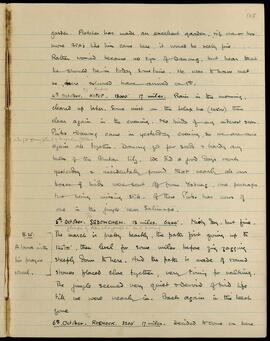
105

garden. Fletcher has made an excellent garden, if one or two more BIA's like him came here, it would be really fine. Rather worried because no sign of Danong, but hear that he should be in today sometime. He was to have met us, should have arrived on 1st.

4th October. TO KIPUP. 13000' 17 miles. Rain in the morning, cleared up later. Some mist on the Jelap La (14500) then clear again in the evening. No birds of any interest seen. Pinto & Danong came in yesterday evening, so we are once again all together. (also for young plants of Magnolia Globosa) Danong got few seeds & hardly any bulbs of the Bhutan lily. We did a good day's work yesterday & incidentally found that nearly all our boxes of birds were sent off from Yatung, one perhaps two being missing still. Of these Pinto has news of one in the jungle near Salimapo.

5th October. TO SEDONCHEN. 13 miles. 6400'. Misty day, but fine. (glimpse of Kanchenjunga in early morning) The march is pretty beastly, the path first going up to 13500', then level for some miles before zig zagging steeply down to here. And the path is made of round stones placed close together, very tiring for walking. The jungle seemed very quiet & devoid of bird life till we were nearly in. Back again in the leech zone. (B.35. A lama with his prayer wheel.)

6th October. TO RHENOCK. 3200' 17 miles. Decided to come on here
LSH/1/1/9/1/143 · Part · 1933-09-01
Part of The Ludlow & Sherriff Collection

SUMMARY:
Notes reconsidering identifications of Primula specimens, suggesting 1937 L+S mixtures (3433–3437) are P. strumosa × P. calderiana hybrids rather than tsariensis, and discussing affinities among P. Barnardoana, elongata, involucrata, and alpicola. Mentions observations at Lussing La and references comments by Fletcher and a possible need to await Prof. Brown.

CONTENT:
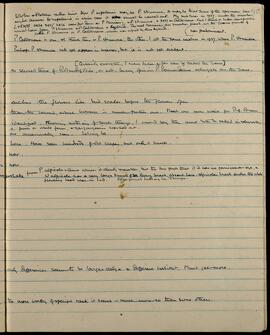
Words of Fletcher rather hint that P. nepalensis may be P. strumosa. It may be that some of the specimens here which answer to nepalensis, in which case it should be washed out. My mixtures in 1937, under the numbers L+S 3433, 3434, 3435, 3436 were put down as P. tsariensis, & P. strumosa, & 3437 as Calderiana. But I think a better identification would have been P. strumosa & P. Calderiana hybrids. The real tsariensis are smaller plants, and the coarse growth of either P. strumosa or P. Calderiana, which was copied in these hybrids, was predominant. P. Calderiana is one, I think this is P. strumosa, the other. I got the same mixture in 1937, where P. strumosa
Perhaps P. strumosa will yet appear in masses, but it is not yet evident.

[Certainly everything I have taken so far can be called the same]
as showed those of Rotundifoliae, or not. In my opinion P. Barnardoana & elongata are the same.

enclose the flowers like bud scales before the flowers open.
than the second, which however is much further on. Must one now wait for Prof. Brown
identified. Knowing nothing of such things, I would say they must both be called involucrata,
a pink or white form, or any orangeing washed out.
are occasionally seen. Lussing La.

here. Have seen hundreds of old scapes, but only 1 bunch.
now.
now.

unshakable from P. alpicola v. luna which it closely resembles, but the two facts that i) it has no farinaceous eye, &
ii) alpicola has a very large bunch of leafy bracts, absent here. alpicola bracts enclose the whole
flowering head when in bud. Also found Lussing La. Tsampa.

only differences seem to be larger calyx & different habitat. Must get more.

the more worthy of specific rank it seems - much more so than some others.