Showing 11 results

Archival description
11 results with digital objects Show results with digital objects
LSH/1/1/9/1/12 · Part · 1949-07-30
Part of The Ludlow & Sherriff Collection

SUMMARY:
Notes discussions with H.H. on a new treaty affecting Bhutan, mention of Tasho Jigme’s freedom to travel, and soldiers sent up the Bumthang road to collect flowers including Prim. bracteosa, a Magnolia, and a Daphne. On 8th April they watched Bhutanese dancers and later hosted H.H. for a long session reminiscing about Calcutta and P.O.'s Gould, Williamson, Bailey, and Bell; letters from Kalimpong reported Ludlow’s departure and Norman’s sale of Glenulli.

CONTENT:
almost 300." I hope something may be done, because certainly already many lakhs of rupees worth of damage has been done in the last 30 years or so. H.H. was undoubtedly interested, & doubly so as the new Treaty, although it promises 5 lakhs of cash annually to Bhutan, also says this may be stopped at any time if the Treaty is not kept. This sounds like a convenient loophole. We also talked about Tasho Jigme, & H.H. said that he could travel where he liked in Bhutan. I still hope to have further talks, as H.H. seems to like it. H.H. sent three soldiers up the Bumthang road to see what flowers they could get, & they brought back Prim. bracteosa, a Magnolia & a Daphne that were interesting.

8th April. Our time here has not all been lazy. H.H. has entertained us fully & we have entertained him too. We were down on 6th to watch Bhutanese dancers, male & female, & the next day we had H.H. up for a good long session, 1.0pm till 5.30. He was then in great form reminiscing, mostly about his Calcutta visit & various doings of P.O.'s Gould, Williamson, Bailey or Bell. Mostly he talks of Bailey, of whom he certainly has the highest opinion. He would very much like to see Bailey again, & thinks he may come here sometime yet. I know Bailey is anxious to come, & if he does, he will get a welcome. We have not bothered much about flowers, but took a few more yesterday from round about, including Albizzia Sherriffii (18657), which is a fine tree. Tobgye sent a few letters on from Kalimpong, which arrived yesterday. No special news, except that Ludlow got off alright, & that Norman had sold Glenulli.
LSH/1/1/1/1/91 · Part · 1933-11-02
Part of The Ludlow & Sherriff Collection
  • SUMMARY:
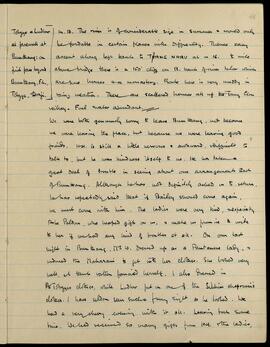
    The diarist records a warm farewell from friends in Bumthang, including H.H. and the ladies (notably Ashe Paldon), with gifts and a light‑hearted evening dressing in various outfits. Route notes describe an easy ascent along the left bank to THANG NARU, a river difficult to ford in summer, muddy sections, a 150-foot cliff with houses and a monastery, and scattered houses along the Tang Chu valley.

CONTENT:
43

Tobgye & Ludlow

  • m. 13. The river is of considerable size in summer & would only
    at farewell at

  • be fordable in certain places with difficulty. Thence easy
    Bumthang: on

  • ascent along left bank to THANG NARU at m 15. 1/2 mile
    first pass beyond

  • above bridge there is a 150' cliff on R. bank of river below which
    Bumthang. F.L.,

  • are some houses & a monastery. Route here is very muddy in
    Tobgye, Dorji.

  • rainy weather. There are scattered houses all up the Tang Chu

  • valley. Fuel water abundant.

We were both genuinely sorry to leave Bumthang, not because we were leaving the place, but because we were leaving good friends. H.H. is still a little nervous & awkward, & difficult to talk to, but he was kindness itself to us. He has taken a great deal of trouble in seeing about our arrangements East of Bumthang. Although he has not definitely asked us to return, he has repeatedly said that if Bailey should come again, we must come with him. The ladies were very kind, especially Ashe Paldon, who heaped gifts on us, & made us promise to write to her if we had any kind of trouble at all. On our last night in Bumthang Mrs W. dressed up as a Bhutanese lady, & induced the Maharani to get into her clothes. She looked very well, & I think rather fancied herself. I also dressed in Tobgye's clothes, while Ludlow put on one of the Sikkim chaprassis' clothes. I have seldom seen such a funny sight as he looked. We had a very cheery evening with it all. Leaving took some time. We had received so many gifts from H.H. & the ladies,

LSH/1/1/6/1/20 · Part · 1938-03-21
Part of The Ludlow & Sherriff Collection

SUMMARY:
Travel account from Tsetang through Lhagyari over the Putrang La to the Tsangpo at Dzam, along to Nang Dzong, and via the Kongbo Nga La to Molo, noting wetter forests, pheasants, and a large black woodpecker, with arrival at Molo on April 14. Notes include Abba Lulla showing Bailey-related letters and observations of bar-headed geese and the valley's daily wind patterns.

CONTENT:
10a

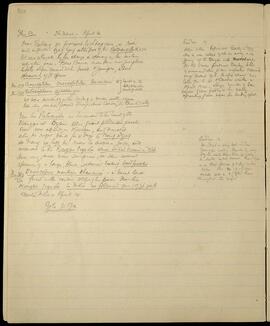
Ibis 53 . 26 March - April 14.

From Tsetang we proceeded to Lhagyari, a rich and important Dzong lying at the foot of the Putrang La 16,470. We were struck by the change in scenery on the eastern side of the pass. Bare barren mountains now gave place to whole slopes covered with birch & juniper, where pheasants of 2 species

Ibis 377 Crossoptilon crossoptilon harmani } lurked in the Rhododendron undergrowth
Ibis 382 Tetraophasis szechenyii

We were entering on the borders of a much wetter region than any we had passed through since leaving the Chumbi Valley.

From the Putrang La we descended to the level of the Tsangpo at Dzam where giant pollarded peach trees were already in blossom, and marched along the right bank for 4 days to Nang Dzong. At Nang we left the river to avoid a gorge, and ascended to the Kongbo Nga La which we had crossed in 1936. Here, very much to our surprise, we saw several specimens of a large, black, satanic-looking woodpecker

Ibis 369-372 Dryocopus martius khamensis - in burnt larch forest on the western slopes of the pass. From the Kongbo Nga La to Molo we followed our 1936 route reached Molo on April 14.

Go to p. 17a


Ludlow 19
Abba Lulla befriended Bailey in 1913 when he was robbed of all his money on his journey up the Tsangpo with Morshead. The old trader produced Bailey's letter of recommendation for our inspection & seemed very proud of it. He also showed us a letter from K. W. & Cawdor written in April 1924. Large number of bar-headed geese feeding on the newly sprouting grass near the landing ghat.

Ludlow 20.
The dust is very bad in this Tsangpo valley. Regularly every day the wind blows down the valley from 10 am until sunset. Then there is a short period of calm until 10 pm. Then the up-stream wind sets in & (often) blows throughout the night.

LSH/1/1/8/1/43 · Part · 1947-01-13
Part of The Ludlow & Sherriff Collection

SUMMARY:
Entries for January 6–9 describe a snowy halt, peak angle measurements from a Dzong, and marches to Layoting and Camp Namdi. The writer disputes Ward and Bailey on the visibility of Gyala Peri, notes friendly villages, a nearby peak Gelung Jokpo, forests transitioning from pine to dense broadleaf, and observations of birds, clematis, and abundant Lilium giganteum.

CONTENT:
letters. He says he will arrive in about 22 days. Our own next mail will not leave here for 7 or 8 weeks or so until we reach India in 3 months from now, so this is worth while.

Jan 6th & 7th Halt. Snowed night of 6-7th then cleared up to a beautiful day. On 7th I took the angles to peaks from the Dzong. They are: - to left-hand peak 114° : to two peaks in centre 132° to big right-hand nearest peak 150°. I disagree with Ward's identification of Gyala Peri. Everyone in Tongkyuk says it cannot be seen from Tongkyuk.

Jan 8th LAYOTING. 9 miles. A good fine day. Left at 10.0 got in at 3.30. Road good mostly fit for loaded animals. At mile 2 from the bridge pass village of DABLA, about 4 houses. Layoting has about 12 houses. People here very friendly. From here a fine snow peak with cut top lies to the South up a bleak looking valley in which are said to be many 'takin', locally called CHIMNYA. There is a sling or cane bridge over to this valley. The peak at the head of the valley is called GELUNG JOKPO. From down near the river, Gyala Peri can be seen in the distance. Forest is first almost entirely pine, then changes to pretty dense mixture of pine, holly oak & shrubs.

Jan 9th Camp NAMDI. On the whole the road was uninteresting. It keeps beside the river all the way till about 1 mile from camp. As soon as it left the river & went up a bit to the forest, we found many things of interest, both birds & flowers. The change was most marked. At camp the forest is dense, evergreen broadleaf & shrubs. Bailey mentions that Gyala Peri is visible at the head of the Netrang Chu, but in this I think he is wrong. The peak seen there is very close indeed. I took a photo of it. It lies almost due S of the Netrang Chu junction with the Tongkyuk Chu. At camp we found three clematis in seed, the flowers of two were seen later on. There is a great deal of Lilium giganteum in this forest from here on.

LSH/1/1/3/3/127 · Part · 1933-04-09
Part of The Ludlow & Sherriff Collection

SUMMARY:
A plant noted on the 26th was photographed and pressed. Pintso visited with a notebook to describe the Lopas, and observations were made about their recognition of upside-down camera images compared to Kashmiris and servants. Dawang reported an old Gompa on the route from Dotrang to Kashongha, now a pilgrimage site with oil lamps in early June, and a marking on Bailey’s map is noted as mistaken.

CONTENT:
on 26th has nearly come to full bloom, so I photographed it &
had it pressed. May it turn out to be a new one. Fine.
Pintso was asking more about the Lopas & came in with
his little notebook to tell us all about it. He described
the various tribes & finished with the lowest of the low. "These
he said "have tails about 4 to 5 inches long." It was said
in all seriousness, & he & all the Kashmiris of course,
believe it. It was curious how all the Lopas, when I
let them look through the back end of the camera, at
once recognized whoever was sitting in front. And he saw
too that the image was upside down. A jungly Kashmiri
would never see that, I doubt even if our own servants
would. The 'temple' which Dawang reported seeing on the
way to the Kashongha from Dotrang is an old Gompa of
considerable size. It used to be an important & holy place,
till looted by the Lopas. Even now though it has no
occupants, it is a place of pilgrimage. All the people in
the district go there on the 15th of the 4th month (about the
beginning of June) & make a circle of oil light lamps round.
The marking of this on Bailey's map is the only mistake we

LSH/1/1/3/3/109 · Part · 1933-04-09
Part of The Ludlow & Sherriff Collection

SUMMARY:
Describes a riverside march with bridges and a near-vertical ladder en route to Trum, comparing the terrain to Baltistan and noting local trees and flowering plants. Records a subsequent march to Natrampa with fine conditions, noted as interesting for Ludlow and the writer.

CONTENT:
narrow cantilever bridge to the left bank. The bridge is a little higher up than it was in Bailey's time, and avoids the 400' ascent and descent he mentions. Cross the bridge at mile 4 and down left bank for 1/2 mile where a gorge comes in. Here there is a 30 ft ladder, almost vertical, perched on a column of stones, well built and strong. The path winds up a little above this, and gradually down to the river side. Cross to right bank by a bridge, often washed away, at mile 6. Proceed close to the river through shrubbery and cultivation to Trum, a small village at mile 7. An interesting march, which reminds one very much of Baltistan with the path on jaharies and with ladders. Gorges of the river are pretty narrow, and the side valleys come through absolute slits, only a few feet wide. Above us the hillside is covered with pine 1344 (Pinus tabulaeformis) and fir 1345 (Picea spinulosa), with a good deal of juniper. Nothing much yet in the way of flowers, but a rhododendron 1342 (Rhododendron vellereum) and some interesting ferns, especially 1340 (Pteris dactylina). Gooseberries are here in plenty, just over the flowering stage. Trees are mostly peach, willow and poplar, with buckthorn and other scrub.

26th April. To Natrampa. 7 miles. BP 19.47 Temp. 52 Time 4.30 Approx height 10247'.
Fine. A most interesting day for both Ludlow and myself.

LSH/1/1/6/1/21 · Part · 1938-03-21
Part of The Ludlow & Sherriff Collection

SUMMARY:
While halted at Tsetang, the party sent Pimbo back to Gonkar to recover 11 boxes of kit, which he found near Chora. They met the Ladakhi trader Ata Ulla, who spoke about Bailey, showed bird eggs from near Lhagyari, and helped procure a sheep. On 26 March they marched to Rong (Rongchaka) Dzong with poor bullock transport, and the writer suffered a minor fall from a pony.

CONTENT:
Atta Ulla Khan, a Ladakhi merchant trading in Tsetang

Kongka reluctantly to send Pimbo back to Gonkar to find out what has happened. That may mean a four or more days stay in this filthy place. This has made us vow not to stay in any more houses now. They really are too dirty for words. On arrival here we saw Ata Ulla, an old Ladakhi trader who has been here for 30 years or more. He lives here with a few other Mohammedans—all of whom dress as Tibetans, and all of whom are despised by our own servants. However I am sending Culla and Daud to see them today. Tsetang is quite a picturesque place from a distance, with two red and brown gompas and all the rest of the houses whitewashed. The village lies under a hillside, faces north. There are more trees than we have seen elsewhere—all willows and poplars, the poplars being in many cases very old and fine trees. The river narrows a great deal here. We are told kowas can go down another day's march, but are not advised to use them further.

24th March. Halt Tsetang. We had to halt here to allow the 11 boxes of kit left behind to be found.

25th March. Halt Tsetang. Pimbo went back yesterday 24th to look for it, and luckily found it before reaching Chora. He returned at 6:00 pm with the kit. These two days have been beastly. The wind and dust are perfectly awful and everything gets full of sandy dust. We have seen a good deal of Ata Ulla who begs us to come and talk each day. It is really a question of listening to him talk about Bailey. He showed us two eggs, properly blown, of what he said were crossoptilon from near Lhagyari, 5 others of which he gave to Bailey. And he told us all about Bailey giving him a gun for which he had a few cartridges. With great difficulty we have got a sheep for Rs 2/12. They don't like killing them this month they say, but seem to do it themselves all the same. Ata Ulla has been a great help in this way.

26th March. Rong (Rongchaka) Dzong. 14 miles. A lovely day, but spoilt by the awful transport. With some difficulty we got the transport to turn up early and were off by 7:45. But it was nearly all bullocks, and our boxes suffered very badly. Although a good path and only 14 miles, the last dozen loads only got in at 7:45 pm—12 hours for 14 miles. I only rode a short way, but when I did mount, the pony went off splitarse, fell on its head and threw me over its neck. I was lucky in being on a good bit of path and only skinned my finger badly, and dislocated the...

LSH/1/1/8/1/13 · Part · 1946-11-14
Part of The Ludlow & Sherriff Collection

SUMMARY:
Diary entries record travel from Tsetang through Rong Dzong, Lhagyari, Lasor and Lhapso to Lenda, with delays due to slow transport and negotiations over animal hire rates. Notes include hospitality from local officials and the Jetsung Kusho’s sister, and botanical observations of Gentiana waltonii and Androsace with seed collected.

CONTENT:
15th Nov. Rong Dzong. Left Tsetang camp at 9.20 & Tsetang at 10.0. In at 4.0 pm. Last kit, on bullocks, in at 6.0 pm. A fine still day. We had long arguments about passports with the Tsetang Dzongpon's scribe - a nasty man. At last he let us go when we paid sangs 3 per donkey & 7 per pony. This was at any rate very much better than our passport rate of 6 & 12.

16th Nov. Lhagyari Dz. Left at 9.0 am: in at 5.0 pm. Only half the kit got in last night. Remainder is not even all in at 10.0 this morning. The distance, given by Bailey at 16 miles, seems much nearer 20 miles. We all agree on this. I suggested we pay 2 sangs per donkey & 4 per pony at Rong. This was cheerfully agreed to by the headmen & Dzongpon's "trap". As a result of the slow transport, we cannot leave here on 17th. Coming up the valley there was a good deal of G. Waltoni & two sp. of Androsace, seed of one of which I took. The Jetsung Kusho here has gone to Lhasa, but her sister is very good to us, & has produced all we need for dinner, including food, plates etc., as our kitchen stuff had not come in.

17th & 18th Nov. HALT. We were unable to get transport in time to leave even on 18th, but most of the kit went then to a village 3 miles short of the Potrang La.

19th Nov. Lasor. Left at 7.30: in at 5.0 pm. Kit which left with us got in at 9.0 pm.

20th Nov. Lhapso Dz. An easy day of only 7 miles. Cloud came up by midday & it was dull the rest of the day. The Lhapso Dzongpon was very good to us. He had been personally to Lasor the day before & produced everything we wanted.

21st Nov. Lenda. Left at 7.50: in at 2.45: transport 3.30 to 4.0 pm. Coolies & transport were very good though hardly halted anywhere. The Lhapso Dzongpon arrangements were very good indeed.

LSH/1/1/6/1/23 · Part · 1938-03-21
Part of The Ludlow & Sherriff Collection

SUMMARY:
Notes a ruined iron chain bridge below Tsetang and a night spent in a newly renewed but empty Dzong. The party travels to Lagyari/Lhagyari, halts for transport arranged by a helpful ruling nun, then crosses the Potrang La to Lasor, recording birds and early-season botanical observations.

CONTENT:
27 March Ludlow 22. "No European seems to have travelled this stage. Bailey avoided it - p. 313 F.K.W. u. 1924."

top joint & hurt my wrist. It might have been much worse. There are still the remains of an old iron chain suspension bridge.

Chain bridge 1 1/2 m below Tsetang - two huge piles of rocks & two chains still hanging down from one.

No one was in the Dzong which had just been renewed, so we spent the night in it, & were very comfortable. The Tsangpo here takes a very sharp 100° turn to the North. (70 13100' see Ludlow p. 22-23.)

27th March. Lagyari. 15 miles. Perfect weather & v. hot. Started at 7.0 am, in at 4.0 pm. Transport mostly bullock, & again many boxes badly damaged. Half way up we came across geese & shot three. Also saw a Sheldrake & some pintail, mallard & teal. Lagyari is a lovely place: Dzong & monastery on the edge of a cliff on the river bank, & beautiful wooded flats below, in which we are camped. They threaten to keep us here a day, but we still hope for the best. Ludlow has gone to the Dzong to call for both of us. There are no flowers out here yet, though Iris (ensata?) is 1" above ground & there is a very small gentian showing flowers here & there. P. tibetica not yet in flower. This place seems independent of Lhasa & is ruled, & ruled well by a nun.

28th March. Halted Lhagyari. Fine. As ponies could not be produced in time, we had to halt. However the nun gave orders for donkeys & bullocks to come today & take on as much kit as we could spare - about 28 loads. The remainder will be carried by mules & ponies tomorrow. We lunched today in the gompa, a beautifully clean place. The nun is a fine looking woman, related to many people of importance - of some importance herself. She was very friendly & helpful. From here to Tsona is only 4 days march, so this might be a good way home. There is little snow of course up here in winter.

29th March. Lasor (12,200' ap). 16 miles. Beautiful day. Left at 7.15 am, in at 4.0 pm. The ascent to the Potrang La (16500 ft) is steeper than we expected. Gradually the hills become more vegetated, & there are many dwarf junipers & a small Rhododendron near the top. But the East side shows a more marked contrast, & the rainfall on the E must be very considerably more than on the West. From the very top, it is apparent. Rhododendron covers the hillside (R. lepidotum). Among these we saw many old stalks of Primula - P. macrophylla(?) & P. sikkimensis. There are also gentians, these seen being much too early for flowers on the north side of the main range & at this altitude.

LSH/1/1/1/1/17 · Part · 1933-05-06
Part of The Ludlow & Sherriff Collection

SUMMARY:
Notes describe hiring a Lepcha collector named Danon, severe snow and hail at Tsomgo Tso, attempts at fishing and bird collecting, and excellent bungalow provisions. Mentions cine film of the Karponang–Tsomgo road, pressing a primula, caravans struggling in deep snow with losses, and arrangements involving Bombay and a return to Gangtok.

CONTENT:
Ludlow 6. We have a Lepcha-collector called Danon to help us with flowers. He has worked for the Botanical Survey of India and should be very helpful as he knows his flowers thoroughly and even tells us the scientific names of many.

B.1 & 2 good

inches deep. The Tsomgo Tso is free of snow except at the upper end. Ten tufted pochard on the lake. Too wet to try for trout, which were put in by Bailey. The chowkidar (watchman) says he has seen them in summer at the lower end, not at the top. These bungalows are the best I have ever seen. They are equipped with cutlery and crockery, so that one need not open up one's own.

Cine film B.2. 0-45'. Views on the Karponang-Tsomgo road as far as Lagyap La.

There are no stores, except wood. The wood used for burning is chiefly rhododendron, which gives out great heat. Hail and snow here all afternoon, looking bad for tomorrow. Pressed the first flower today - a small primula (P. gracilipes (L & S)). We are using for shooting birds, .22 rifles with dust shot and .410 bores with 2 1/2" cases of dust shot. The former will usually kill up to five yards, the latter to 25".

B.1 & 2 sent Bombay 10th May. Return to Gangtok.

7th May. TSOMGO. Still clouded this morning and fine snow falling. A caravan of mules came down this morning: they had crossed yesterday, and reported having lost two mules and a man. So we decided to stay here. Snow is about 10" deep. It has been thawing all day, but the sun can't get out for any length of time. Tried fishing this morning with fly and frogs. The water was too cold for the frog, and we saw no signs of fish. Shot a few birds. 3.0 pm. A caravan has just come in from 2 miles up the hill. They took nine hours to do the two miles, and yesterday lost two mules, and had to have 40 coolies from Chupitang to help. They report up to seven

B.2. Tsomgo dak bungalow. Tsomgo Tso. A caravan from Tibet arriving at Tsomgo having taken 9 hrs for 2 miles.