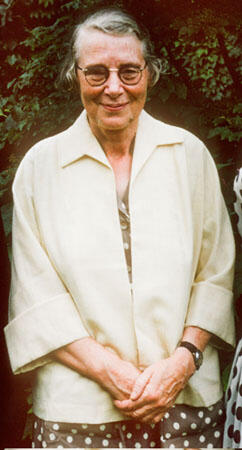

Went to the University of Exeter to take an Honours Degree in Botany. In 1961, she moved to the botany department at the University of Leeds to become a research student of Professor Irene Manton. Anne's area of research was in two genera: Asplenium and Polystichum. She investigated the relationship between diploid taxa and the evolution of polyploids.
Many aspects of her work can be found in her 1966 dissertation, "Some cyto-taxonomic problems in the fern genera Asplenium and Polystichum," which, unfortunately, was never published and therefore only exists in a few copies. She was then awarded a research fellowship to spend two years in Japan from 1967 to 1969 to continue her work on ferns. She recalled this as a formative experience in her life. It allowed her to travel extensively in the East and establish a broad circle of professional and personal friendships.
Anne had barely returned from Japan when she developed systemic sclerosis, a rare and debilitating disease that proved difficult to diagnose and treat. This illness increasingly restricted her and made it less and less possible for her to pursue scientific work. Despite the great difficulties arising from her illness, she continued to expand her research, though the practical fern work proved increasingly difficult. Eventually, her illness began to affect her heart, and she eventually succumbed to the disease.
The Anne Sleep Award (The Linnean Society), Established by Mrs. Ivy Sleep in fulfilment of the wishes of her daughter, Dr Anne Sleep FLS. Awards of up to £3,000 are made at (odd-numbered) two year intervals, to assist one or more scholars to carry out biological research in the Middle or Far East, or similarly for scholars from the Middle or Far East to pursue their own biological research in the UK.
Mrs. Ivy Sleep, died in 1996 and left the sum of £120000 to the Linnean Society of London in fulfilment of her daughter’s wishes.