Mostrar 4565 resultados

Registro de autoridade
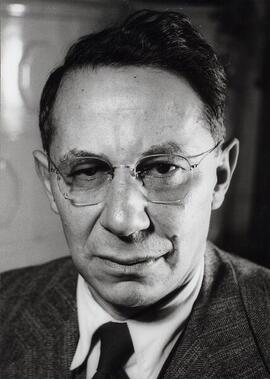
Reichstein, Tadeusz
Pessoa · 20 July 1897 – 1 August 1996

A Polish-Swiss chemist.

Won a Nobel Prize in Physiology or Medicine (1950) along with Edward C. Kendall & Philip S. Hench, “for their discoveries relating to the hormones of the adrenal cortex, their structure and biological effects.”

Sung Chu
Pessoa

A solider who accompanied Dr. JH Hicks and Betty Sherriff during the 1949 (final) Ludlow and Sherriff Expedition.


Also acted as an interpreter.

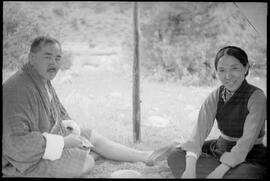
Tsongpen
Pessoa

A Lepcha plant collector for George Sherriff.

Described by Dr. JH Hicks as a 'sharp, little man.' His father and grandfather were also plant collectors for other Europeans.


During the 1949, the final, Ludlow and Sherriff expedition, he was the chief collector for Betty Sherriff & Dr. JH Hicks. He also assisted, alongside Betty Sherriff, Dr. Hicks when he was doctoring.

Also acted as an interpreter

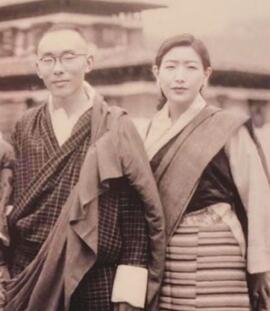
Dorji. Mayeum Choying Wangmo
Pessoa · 1897-1994

Princess of Sikkim, daughter Chogyal Thutob Namgyal, the 9th consecrated ruler of Sikkim. (Bhutia 1994: 57) Mother of Queen Grandmother Ashi Kesang Choden of Bhutan. Wife of 2nd Prime Minister Sir Raja Sonam Tobgye Dorji.

In her early years she was given an monastic education.

She is best known for designing the flag of Bhutan.

5 April 1918, marries Sonam Tobgye Dorji of Bhutan. They had five children: his eldest son Jigme Palden (1919-1964) who became Prime Minister of Bhutan; the second eldest, a daughter Tashi (b.1923), who helped in the affairs of the Bhutan House; Kesang Choden (b.1930), who married the third King of Bhutan; Ugyen (1933-2006), a reincarnation of a high priest in Tibet; and Lhendup (1935-2007). The children were all born and brought up in Bhutan House and educated in the elite schools set up by the British within Darjeeling and Kalimpong. (Khandu-Om Dorji 2008:10)

Was deeply religious and a scholar with an interest in the history and culture of Bhutan. Was also knowledgeable about the history and cultures of Tibet and Sikkim. She was a founding member and took an active role in the Sikkim Research Institute of Tibetology (SRIT), Gangtok, Sikkim. From 1964-65 she was co-opted in the General Council of SRIT. (Bhutia 1994: 59)

In memory of her husband, Mayum was commissioned by Jigme Dorji Wangchuck (third king of Bhutan & Mayum's son-in-law) to write the Kanjur and Tenjur, comprising of over 300 volumes of sacred teachings and expositions of Bhuddha in gold lettering (Bhutia 1994: 57)

She funded the construction of many Lhakhangs (temples) and the renovations of monasteries. (Bhutia 1994: 57)

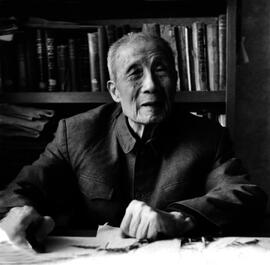
Ching, Ren-Chang
Pessoa · 1898-1986

Chinese botanist, known as the father of Chinese pteridology. Wrote the first complete monograph of Chinese Ferns. He published over 160 articles and monographs, as well as 15 translations.

Developed the Ren-Chang Ching System for ferns. In 1940, Ren-Chang Ching published the Natural Classification System of Polypodiaceae, in which he divided plants of Polypodiaceae into 33 families and 249 genera, and proposed 5 evolutionary clues (Xing, 1994). His system ended the conservative classification system of Joseph Dalton Hooker and solved the biggest problem of fern botany at that time, which made great contributions to the worldwide fern taxonomy.


Became interested in botany when studying at the First Agricultural School in Jiangsu Province. After graduation, he attended the University of Nanking and got a bachelor degree in forestry.

Ren-Chang, went on to work as an assistant at Southeast University and later got a job with the Natural History Museum of Academia Sinica.

In 1929, he began researching ferns at the Botany Museum at the University of Copenhagen (Denmark). After returning to China, he worked as a researcher at the Institute of Hydrobiology in Peiping. In 1934, he was sent to Jiangxi to establish the Lushan Botanical Garden and became its director.

During the War of Resistance against Japan, he established a fern research center in Kunming. From 1945, he became an associate professor at the Department of Forestry and Biology of Yunnan University.

In 1949, he also became the Deputy Director of the Forestry Bureau of Yunnan Province.


In order to study ferns he learned English, French, Latin, and other languages.

He took over 18,300 photographs of fern patterns.

Dorji, Jigme Palden
Pessoa · 14 December 1919 - 6 April 1964

Son of Sonham Tobgye Dorji. Became 1st offical Prime Minister of Bhutan (and first to hold the title, Lyonchen). Brother-in-law of Jigme Dorji Wangchuck. Was assassinated in April 1964


1928, at the age of nine, was appointed the Trungpa (Administrator) of Haa Dzongkhag

1953, he succeeded his father Raja Tobgay, after his death, as Bhutan Agent to Kalimpong.[6] He became the first man to hold the title Prime Minister of Bhutan (Lyonchen).

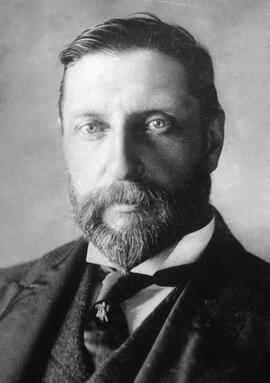
Henry Rider Haggard, Henry Rider
Pessoa · 22 June 1856 14 May 1925

an English novelist best known for his romantic adventure King Solomon’s Mines (1885).

He published two unsuccessful novels but captured the public with his African adventure story King Solomon’s Mines. He followed this with She (1887) and further stories of Africa, notably Allan Quatermain (1887), Nada the Lily (1892), Queen Sheba’s Ring (1910), Marie (1912), and The Ivory Child (1916). He used other settings for such striking romances as Cleopatra (1889), Montezuma’s Daughter (1893), and Heart of the World (1896).


  • Haggard was also a practical farmer; he served on several government commissions concerning agriculture and was knighted in 1912 for these services.
  • With Robert Louis Stevenson, George MacDonald, and William Morris, Haggard was part of the literary reaction against domestic realism that has been called a romance revival.
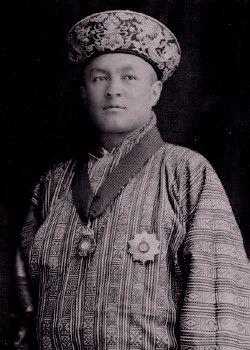
Wangchuck, Jigme
Pessoa · 1905-1952

Was the second Druk Gyalpo (King) of Bhutan from 26 August 1926 until his death on 30 March 1952.


Kesang Choden Wangchuck
Pessoa · 21 May 1930-

Married to the third King of Bhutan, Jigme Dorji Wangchuck (marries 5 Oct 1951). Daughter of Sonam Topgay Dorji & Mayum Choying Wangmo.


  • 1972 the Third King's health had seriously deteriorated. On 22 April 1972 Kesang Choden was formally appointed regent to act on his behalf during his illness — one of the very few women in Bhutanese history to hold such a position.

  • From 1972 her title shifted from Queen Consort to Queen Mother, in Dzongkha Gyalyum (རྒྱལ་ཡུམ). She did not remarry. During the Fourth King's long reign (1972–2006) she remained a senior figure at court but kept a deliberately low public profile compared with her four daughters-in-law — four sisters from the Yangtse-based Ngalop family who married her son in a single ceremony in 1988. Observers describe her role in this period as that of a private matriarch rather than a public figurehead, focused on religious practice, family, and the education of her grandchildren.

  • When her son Jigme Singye Wangchuck abdicated in December 2006 in favour of his eldest son, Kesang Choden's formal title became Gyalyum Chenmo — "Great Royal Grandmother" — though in common Bhutanese usage she is simply the Royal Grandmother.

Ludlow, Frank
GB/NNAF/P133407 · Pessoa · 1885-1972

Frank Ludlow graduated from Cambridge in 1908 with a BA in natural sciences and on leaving university was appointed vice principal at Sind College, Karachi. During the First World War he served in Mesopotamia after which he went to Poona as Inspector of European Schools. In 1923 he opened a new school at Gyantse, Tibet. Although this closed in 1926 he remained on good terms with the Tibetan government and was almost uniquely allowed access to that country for a number of years. In 1927 he retired to Srinigar in Kashmir and from this date started travelling extensively, collecting birds and plants for the British Museum of Natural History. In 1928 he met George Sherriff in Kashgar in Chinese Turkestan and with their shared interests in ornithology, travel and plants they began a lifelong friendship which led to a series of major expeditions to the Eastern Himalayas and South East Tibet. During the 1930s they trekked through the Tian Shan mountains, Sikkim, Bhutan and Tibet, collecting thousands of plant specimens, though on these journeys Ludlow was more concerned with the collection of birds on which he wrote extensively. During the Second World War Ludlow was in charge of British Mission in Lhasa from 1942 to 1943 and was Joint Commissioner in Ladakh from 1940-42 and again from 1943-46. He continued collecting in 1946 setting off for South East Tibet again with Sherriff. Their sixth and final great expedition together was collecting alpine and temperate flora in Bhutan in 1949. They both returned to Britain in 1950 where Ludlow spent his remaining years working on their collections in the British Museum.
Sources: R. Desmond ‘Dictionary of British and Irish Botanists and Horticulturalists; obituary folder; H.R. Fletcher ‘A Quest for Flowers’.
D.W.