
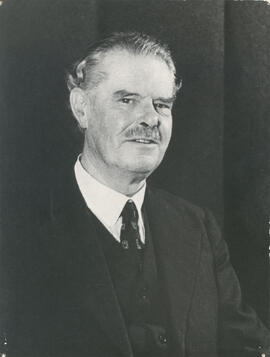
Born Kincardineshire 1892; died Edinburgh 1960
Educated at Gordons College Aberdeen and Edinburgh University graduating MA with honours botany, John Macqueen Cowan completed his training in forestry at Oxford before being appointed to the Indian Forest Service in 1914. During ten years with the Indian Service he studied and classified vegetation and made considerable plant collections in Sikkim, Bengal and Burma, travelling with his wife, also a botanist. He was attached to the Indian Army during the First World War and served in Egypt and Palestine. On his return to India he officiated as Director of the Botanical Survey then as Superintendent of Royal Botanic Garden Calcutta from 1926, retiring in 1928. In that year he gained a temporary appointment as a botanist in the herbarium at Kew and in 1929 undertook botanical expeditions to Iraq and Persia principally to collect tulip bulbs but returning with 2,500 plant and herbarium specimens. In 1930 Cowan became assistant to the Regius Keeper of the Royal Botanic Garden Edinburgh, a post he was to hold for 24 years. Using the Garden’s extensive collections he became an authority on Rhododendron, publishing widely on this and other genera. During the Second World War he was seconded to the Ministry of Supply build up timber production in west of Scotland. Cowan was President Botanical Society of Edinburgh from 1951 to 1953. On retirement in 1954 he took charge of the National Trust for Scotland (NTS) Garden at Inverewe in Wester Ross developing it into a major visitor attraction, and also inaugurated the prestigious NTS garden cruises.
Sources: R. Desmond ‘Dictionary of British and Irish Botanists and Horticulturalists); HR Fletcher and WH Brown ‘The Royal Botanic Garden Edinburgh 1670-1970’; obituary folder.
D.W.
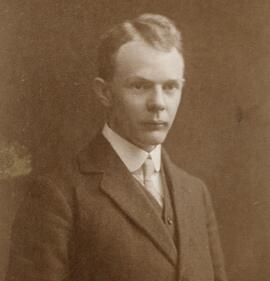
Born Cyprus 1907; died 2003
Hagop "David" Davidian graduated in botany from Edinburgh University in 1946 and in 1947 was offered a post at Royal Botanic Garden Edinburgh by Sir William Wright Smith, Regius Keeper, to work on the taxonomy of rhododendrons. Rhododendrons became his life long specialism and enthusiasm. He contributed regularly to the RHS Rhododendron and Camellia Yearbook and at one stage identified 2,000 rhododendrons from the Arnold Arboretum in the USA. Honoured twice by the RHS and in Sweden, after his retirement in 1972 he set to work writing, in four volumes, books on the genus based on the Balfourian system.
Source; cuttings and obituary files
D.W.
Robert Chapman Davie was born in Lisbon in October 1886, but moved to Glasgow and was schooled there at the Glasgow High School, before going to the University of Glasgow in 1904, where he graduated with a first class honours M.A. in English. This degree included some scientific courses, including one on Elementary Botany taken in 1905, and Davie found himself drawn more to that subject than English, so went on to pursue this by enrolling for another degree, a BSc. in Botany, Chemistry, Zoology and Geology, graduating in 1909 after winning the Dobbie-Smith gold medal for Botany along the way. He stayed at the University of Glasgow, becoming an assistant in the Botany Department before moving to the University of Edinburgh in 1912 to become a Botany lecturer under RBGE Regius Keeper and Professor of Botany, Isaac Bayley Balfour. Davie was given special charge of the large Teachers in Training classes and lectured on hepatics (liverworts) and mosses to Edinburgh University Botany students at the Garden. He carried on with his own studies throughout his teaching career, and soon had enough material to research a doctoral thesis on the subject of pinna-trace in ferns, and he completed this at the University of Glasgow, graduating with a DSc in April 1915 whilst still teaching and working at Edinburgh.
Davie’s research was interrupted in 1914, not by the war at first, but when he obtained a grant from the Royal Society to travel to Brazil to research comparisons between flowering plants. He was still working on the material he collected there when the call to join the military service finally came in 1917.
Due to effects of ill health when he was younger, it was known that Davie would not have been fit for a role in a combative branch in the army, and this may be why he wasn’t called upon to enter service until 1917, despite him apparently offering his services when war broke out. Another reason may be that his specialism in mosses meant that he was heavily involved in the work RBGE was doing in offering specialist advice to those engaged in collecting sphagnum moss to aid the war effort – the moss was used as an alternative to cotton in making would dressings, it being highly absorbent and antiseptic too. Finally though, in 1917 he was enlisted to the Royal Army Medical Corps, to a role which took full advantage of his scientific training – a Lieutenant, later promoted to Captain, and Senior Chemist in the 4th Water Tank Company, providing clean and sterile water to the troops on the Front Line, a vital and often forgotten service. He was in France with his unit during the German’s Spring Offensive, and the subsequent Allied advance in the last months of the war.
After the Armistice, in January 1919, Davie was granted some leave to return home to Largs to visit his wife and infant daughter who was born in 1917, and it was whilst he was there he succumbed to influenza, (possibly the Spanish Flu?) which turned to pneumonia with fatal effect; he died at home on the 4th February 1919 at the age of 32. https://stories.rbge.org.uk/archives/30481